The Crypto Trading Starter Kit
A plain-English PDF: what to check before you trade, how orders and risk really work, and the mistakes to skip. Get it free.
CBDC development is a rapidly evolving area of financial technology. While CBDCs aim for stability, their implementation involves significant policy, security, and privacy debates. Central bank backed money is conceptually risk-free, but its digital delivery may introduce new systemic risks. Past performance is not indicative of future results. Capital at risk.
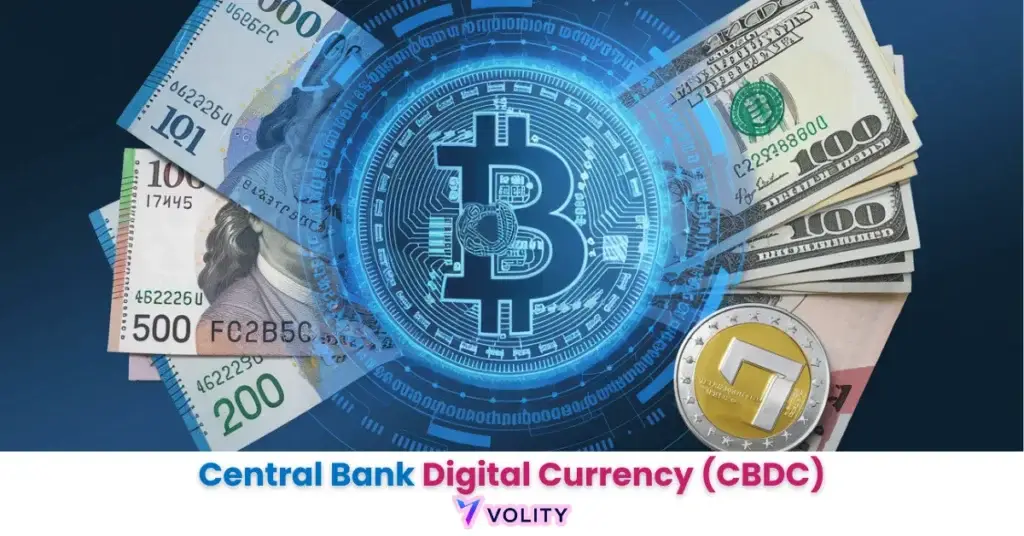
A Central Bank Digital Currency (CBDC) identifies a digital form of state-backed fiat money issued directly by a nation’s central bank. These instruments reveal a shift toward real-time settlement and financial inclusion across 91% of the world’s economies. Identifying 2026 milestones like the Digital Euro regulation reveals the maturing role of CBDCs in global monetary systems.
Central Bank Digital Currency (CBDC) identifies the official digital representation of a nation’s sovereign currency, issued and backed by the central bank as a direct liability. This financial innovation reveals a global movement where over 91% of central banks are now actively building or testing digital fiat solutions. In 2026, the transition from theoretical research to large-scale pilot programs identifies the future of real-time interbank and retail settlement.
The interaction between emerging CBDCs and private digital assets, such as stablecoins, has accelerated the push for state-backed digital money. While proponents highlight gains in efficiency and financial inclusion, critics warn of unprecedented surveillance and systemic risks to commercial banking. This guide examines the fundamental mechanics of CBDC models and identifies the current global leaders in the digital currency race for 2026.
While understanding Central Bank Digital Currency (CBDC) is important, applying that knowledge is where the real growth happens. Create Your Free Forex Trading Account to practice with a free demo account and put your strategy to the test.
What is a Central Bank Digital Currency (CBDC)?
A Central Bank Digital Currency (CBDC) is a digital form of a country’s fiat money that identifies as a direct claim on the central bank rather than a commercial financial institution. This distinction is fundamental, a CBDC represents money issued by the government itself, not by a private bank holding deposits.
The relationship between CBDC and cash reveals why this distinction matters. Physical banknotes in your pocket identify a direct claim on the central bank; the bank guarantees their value and acceptability. A CBDC extends this same principle to the digital realm. When you hold a digital dollar or euro in a central bank wallet, you own the public money directly, without intermediation by a commercial bank.
Digital cash versus digital bank money represents a critical dividing line. Bank deposits, the money in your checking account, identify as private money, a liability of the commercial bank, not the central bank. If your bank fails, the FDIC insures deposits up to $250,000. A CBDC eliminates this counterparty risk entirely. You hold a direct claim on the Federal Reserve or ECB, making it the safest digital asset in the financial system. The distinction explains why CBDCs maintain the same unit of account (dollars, euros, yen) as existing national currencies, ensuring perfect parity.
This foundational concept explains why 91% of surveyed central banks are exploring CBDCs as of late 2025, according to the BIS “Advancing in Tandem” report. Understanding Blockchain Explained: How Decentralized Technology Reshapes Industries helps clarify the technical underpinnings that enable these systems, though CBDCs themselves are not cryptocurrencies.
Ready to Elevate Your Trading?
You have the information. Now, get the platform. Join thousands of successful traders who use Volity for its powerful tools, fast execution, and dedicated support.
Create Your Account in Under 3 MinutesHow Does a CBDC Differ from Bitcoin and Stablecoins?
The primary difference between a CBDC and a cryptocurrency identifies the centralized authority and official state backing that underpins the government-issued asset. This difference shapes every technical and regulatory aspect of the two systems.
Centralization versus decentralization represents the fundamental divergence. Bitcoin operates on a permissionless network where no single entity controls the ledger; instead, distributed miners and nodes validate transactions. A CBDC places the entire ledger under the control of a single central bank. This centralization enables instant settlement, government policy controls, and regulatory compliance, but eliminates Bitcoin’s resistance to censorship and state control.
Value stability demonstrates the second critical difference. Bitcoin’s value fluctuates based on supply (fixed at 21 million coins) and demand from market participants. A CBDC’s value remains fixed to the nation’s fiat currency, one digital dollar always equals one physical dollar, by definition. This stability makes CBDCs suitable for everyday payments, while Bitcoin remains volatile and speculative.
Stablecoins complicate the comparison. Assets like USDC (USD Coin) create digital representations of the US dollar but are issued by private companies (Circle, Coinbase), not the Federal Reserve. Stablecoins promise stability through reserve backing, Circle maintains $1 in assets for every USDC token issued. Yet stablecoins introduce counterparty risk: if Circle faces regulatory action or bankruptcy, USDC holders could lose capital. A CBDC eliminates this risk entirely, replacing private reserve backing with the “Full Faith and Credit” of the United States government.
Privacy and anonymity further distinguish these assets. CBDCs are likely to be fully traceable, creating a permanent ledger of all transactions. Bitcoin offers pseudonymity, addresses are not linked to identities, though all transactions remain visible on the blockchain. This privacy difference reveals why some critics oppose retail CBDCs. Understanding What is a Stablecoin? | The Bridge Between Crypto & Fiat clarifies how these alternatives compare.
What is the Global Status of CBDC Projects in 2026?
Global CBDC projects identify a massive shift toward live implementation in 2026, with major economies like the Eurozone, Brazil, and Russia entering critical launch phases. The landscape has matured from research projects to operational systems.
The Digital Euro project targets adoption of its regulatory framework by co-legislators in 2026, with a full launch expected by 2029. The European Central Bank released a detailed two-phase development plan. Phase one (2023-2025) completed the design and legal framework; Phase two (2026-2029) will build the system, conduct pilot testing, and transition to live operations. This timeline reveals the ECB’s cautious but committed approach to digital money.
Brazil’s Drex (Real Digital) represents the most aggressive retail timeline. The Central Bank of Brazil launched a wholesale pilot in 2023 and plans to expand to a two-phase rollout throughout 2026. Phase one focuses on financial institutions and large-value settlements; Phase two targets retail deployment, enabling Brazilian citizens to hold digital reals directly.
Russia’s Digital Ruble entered a test phase in 2023 and is scheduled for major bank integration by September 2026. This timeline accelerated due to international sanctions, which motivated Russia to develop payment systems independent of SWIFT. The Digital Ruble will identify a key tool for managing cross-border payments and financial sovereignty.
China’s e-CNY (Digital Yuan) represents the world’s largest retail pilot program. The People’s Bank of China has tested digital yuan extensively across multiple cities, and 2026 scaling represents the next phase toward broader integration. Understanding these global KYC & AML in Crypto: Why Compliance Matters standards helps contextualize how CBDCs will enforce regulatory compliance.
Additional context: ECB: Progress on the Digital Euro Preparation Phase
2026 CBDC Project Metrics and Adoption Benchmarks
CBDC development benchmarks reveal the rapid transition of the global financial system toward a tokenized and central-bank-backed digital infrastructure. The following table shows the quantitative progress across major initiatives:
| CBDC Project | Specification | Timeline/Value |
| Global Banks | Exploration Rate | 91% (BIS, 2025) |
| Digital Euro | Regulation Date | Estimated 2026 (ECB, 2026) |
| Brazil (Drex) | Launch Window | 2026 Phases (IMF, 2026) |
| Project Agorá | Focus | Unified Ledger (wCBDC) (BIS, 2026) |
| Digital Ruble | Bank Integration | September 2026 (IMF, 2026) |
Sources: BIS: Advancing in Tandem – 2024 CBDC Survey
Turn Knowledge into Profit
You have done the reading, now it is time to act. The best way to learn is by doing. Open a free, no-risk demo account and practice your strategy with virtual funds today.
Open a Free Demo AccountHow Do Retail and Wholesale CBDC Models Work?
CBDC technical models identify two distinct architectures designed for either general public usage or specialized interbank financial settlement. Understanding both reveals how the digital financial system will evolve.
Retail CBDCs target everyday consumers. A “Digital Wallet for Everyone” allows citizens to receive salaries, buy groceries, and transfer funds using CBDC wallets on their phones. These wallets interface with the central bank’s ledger, enabling instant peer-to-peer transfers and real-time payment settlement. The retail model prioritizes accessibility and user-friendly design, mirroring how payment apps (Venmo, PayPal) already function.
Wholesale CBDCs (wCBDC) operate differently. These are designed exclusively for banks and financial institutions to conduct large-value interbank settlements. The “Backend plumbing” of the financial system uses wCBDC to eliminate intermediaries and settlement delays. Instead of waiting 2-3 days for payments to clear through SWIFT (Society for Worldwide Interbank Financial Telecommunication), wholesale CBDCs enable instant, final settlement at any hour.
Project Nexus represents the next evolution, connecting domestic instant payment systems globally by 2026. This initiative aims to create pathways for multiple wCBDC systems to interoperate, enabling a Chinese bank to instantly settle with a European bank using their respective wholesale CBDCs.
Hybrid models represent a practical compromise. Instead of deploying full retail CBDCs, some central banks may use commercial banks as intermediaries. Citizens would hold accounts with commercial banks (offering better customer service), but those banks settle their balances through wholesale CBDC on the central bank’s ledger. This hybrid approach addresses systemic risk by preventing bank disintermediation, the risk that everyone moves deposits from commercial banks to CBDC wallets, draining liquidity from traditional banking.
Real project example: Project Agorá. Seven central banks, including the Federal Reserve, ECB, and Bank of England, tested cross-border wholesale settlement on a unified ledger in 2026. Settlement times reduced from days to seconds with 100% mathematical finality using wCBDC. Past performance is not indicative of future results.
Deploying these models requires understanding What Is a DEX (Decentralized Exchange) in Crypto? to recognize how CBDCs differ from decentralized alternatives.
💡 KEY INSIGHT: Project Agorá is the 2026 project to watch. It identifies a unified ledger system where wholesale CBDCs and tokenized deposits can interact on a single, highly efficient platform.
What are the Risks and Benefits of a Digital Dollar or Euro?
The debate over CBDC implementation identifies a conflict between the efficiency gains of real-time payments and the potential for unprecedented government surveillance. Neither side of this debate offers simple answers.
Benefits include real-time 24/7 payments, dramatically reduced transaction costs, and instant government aid distribution. When disaster strikes, governments could immediately transfer relief payments to affected citizens through CBDC systems, versus waiting days for traditional banking. Cross-border payments would settle instantly, benefiting international trade. Financial inclusion improves for underbanked populations who gain access to the financial system without needing a traditional bank account.
Privacy risks represent the critical counterpoint. Unlike physical cash, where transactions are anonymous, a CBDC ledger records every transaction the central bank conducts. This identifies a level of surveillance unprecedented in modern finance. Governments could theoretically monitor all spending, preventing certain transactions deemed “unacceptable,” or seizing funds through unilateral account freezing. Western democracies debate how to implement CBDCs while preserving personal privacy through privacy-preserving cryptography techniques.
Financial stability concerns center on “Bank Disintermediation.” If citizens can hold unlimited CBDC balances at near-zero risk (backed by the central bank), during financial stress they might rapidly withdraw all commercial bank deposits and move them to CBDC wallets. This creates a “bank run” where deposits drain from the financial system instantly. Policymakers are considering holding limits (perhaps $50,000-$100,000) to prevent sudden liquidity shocks that could freeze credit markets.
Cybersecurity identifies another critical risk. A central government ledger becomes the ultimate target for state-sponsored hackers. A successful breach could compromise the integrity of an entire nation’s monetary system. Defending against this requires quantum-resistant cryptography and resilient network architecture. Understanding What is Bitcoin (BTC) Crypto? highlights why some see decentralized alternatives as more resilient against single-point-of-failure risks.
Additional perspective: IMF: CBDC Global Status and Country Reviews
WARNING: Privacy remains the primary concern with retail CBDCs. Unlike physical cash, a digital ledger identifies every transaction, potentially granting governments unprecedented surveillance over personal spending habits.
Key Takeaways
- Central Bank Digital Currencies (CBDCs) are official digital versions of a nation’s fiat currency, issued directly by the central bank.
- The BIS reports that 91% of global central banks are now actively exploring or piloting CBDC solutions as of late 2025.
- Wholesale CBDCs (wCBDC) are leading development in 2026, focusing on cross-border settlement through initiatives like Project Agorá.
- The European Central Bank expects to adopt the Digital Euro regulatory framework in 2026, targeting a live launch by 2029.
- Brazil’s Drex and Russia’s Digital Ruble are both scheduled for significant live expansion phases throughout the 2026 calendar year.
- CBDCs differ from Bitcoin by being centralized and government-backed, prioritizing state monetary control over decentralization.
Frequently Asked Questions
This article contains references to Central Bank Digital Currencies, blockchain technology, and stablecoins, and mentions Volity, a regulated CFD trading platform. This content is produced for educational purposes only and does not constitute financial advice or a recommendation to use any digital currency or trading service. Always verify current regulatory status and technological specifications before using any CBDC or financial innovation. Some links in this article may be affiliate links.
By Alexander Bennett, Volity research desk.
What our analysts watch: Three policy variables decide whether a CBDC actually moves money in real life. Holding limits cap how much retail balance can sit in central-bank money before it competes with deposits. Programmability scope sets whether the unit is plain cash-equivalent or carries conditional rules. And the wholesale rail design, especially DLT settlement bridges, dictates how quickly tokenised securities and tokenised deposits can interlock with the CBDC. The economies that get all three right become real-time settlement hubs.
Volity operates a trading platform and also publishes educational and analytical content about trading. The content on this page is for educational purposes only and should not be considered financial advice. Volity may benefit commercially when readers open trading accounts through links on this site.
Our content is produced and reviewed under documented editorial standards; see our comparison and review methodology.