Quick answer
Silver trading is buying and selling silver, usually as the XAG/USD pair, silver CFDs or ETFs, with leverage and the ability to go long or short, rather than holding physical metal. Silver is both a precious metal and an industrial one, so it moves on investment demand, the dollar and industry. It is more volatile than gold, offering opportunity and risk.
Silver trading speculates on the price of XAG/USD (the silver-to-dollar ratio) through CFDs, futures, ETFs, or physical purchase. Volity offers silver as a CFD on Volity MT with leverage up to 1:100, tight spreads, and CySEC-regulated execution. This page covers silver’s dual role as monetary and industrial metal, the gold trading guide-silver ratio, and practical trading mechanics.
Silver trading: silver’s dual nature
Silver is unique among tradable commodity trading platform because it serves two markets simultaneously:
1. Monetary metal. Silver has been a store of value for millennia. It trades alongside gold during monetary regime stress, currency debasement concerns, and safe-haven demand. The monetary thesis drives buying during US dollar weakness, geopolitical risk events, and inflation regime changes.
2. Industrial metal. Roughly 50-60% of annual silver demand comes from industrial uses: photovoltaics (solar panels), electronics, medical applications, photography. Industrial demand correlates with global economic growth, not safe-haven flows.
The two demand streams sometimes align (broad commodity bull markets) and sometimes diverge (industrial recession + monetary stress = ambiguous). Trading silver requires acknowledging both.
Silver trading vs gold trading
Silver and gold both function as precious metals, but silver moves differently:
| Feature | Gold (XAU) | Silver (XAG) |
|---|---|---|
| Annual volatility (typical) | 12-15% | 20-30% |
| Industrial demand share | ~10% | ~50-60% |
| Monetary demand share | ~50% | ~25% |
| Investment demand share | ~40% | ~20% |
| Daily volume relative | Higher | Lower |
| Margin requirements | Lower per ounce | Similar percentage |
Silver moves more sharply than gold. In bull markets for precious metals, silver typically outperforms; in bear markets, silver typically underperforms. The amplification cuts both ways.
The gold-silver ratio
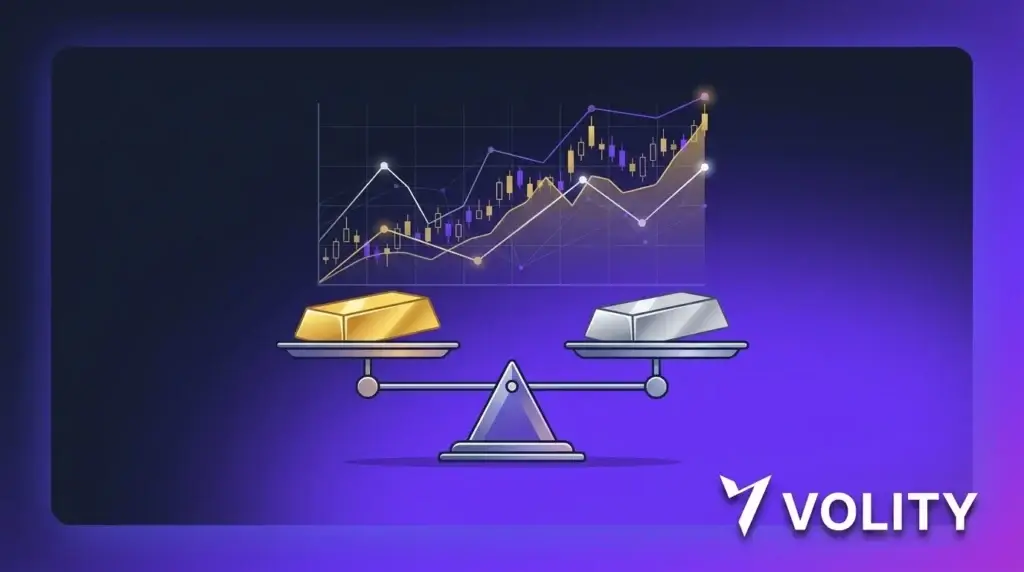
The gold-silver ratio is the number of silver ounces required to buy one ounce of gold. A higher ratio means silver is relatively cheap; a lower ratio means silver is relatively expensive.
Historical context:
- Long-term historical average: roughly 50-70:1
- Bull market lows (silver overshoots gold): 30-40:1
- Bear market highs (silver lags gold): 80-120:1
- March 2020 stress peak: briefly above 120:1
Traders use the ratio to time silver entries: when the ratio reaches historically high levels (silver cheap vs gold), some traders rotate from gold to silver expecting mean reversion. The ratio is a tendency, not a rule; ratios can stay extended for years.
Silver as a CFD on Volity
Volity offers XAG/USD as a CFD with:
- Leverage: up to 1:100 on selected products
- Contract: flexible position size starting at 0.01 lot
- Spreads: competitive on the spot XAG/USD pair
- Trading hours: Sunday 23:00 GMT to Friday 22:00 GMT with brief daily settlement break
- No expiry: open-ended position
- Swap fee: applied at 22:00 GMT on leveraged overnight positions
Why CFDs vs other silver trading methods
| Method | Capital required | Leverage | Storage cost | Short selling |
|---|---|---|---|---|
| Physical silver (bullion) | Full purchase | None | Vault fees, insurance | Hard, requires lending |
| Silver ETF (SLV, SIVR) | Full purchase | Limited (~1:2 retail in EU) | Expense ratio (~0.5%/year) | Possible but harder |
| Silver futures (SI) | Margin requirements | ~1:10-1:20 retail | Expiry roll required | Yes (sell to open) |
| Silver CFD (Volity) | Margin requirements | Up to 1:100 | None | Yes (sell to open) |
For active traders, CFDs offer the lowest friction. For long-term holders, physical or ETF positions avoid the swap fee on overnight CFD positions.
Common trade setups
1. Gold-silver ratio reversion. When the ratio reaches historical extremes (above 100 or below 40), traders look for mean-reversion trades. This is a multi-week to multi-month thesis, not intraday.
2. Risk-on/risk-off macro trades. Silver tends to rally with broader commodity bull markets and sell off in risk-off episodes. Cross-asset views can be expressed through silver.
3. Inflation-driven demand. Silver historically benefits from inflation regime changes alongside gold. Long-dated positions before expected CPI surprises.
4. Industrial demand cycles. Solar panel demand growth, electronics cycle, broader manufacturing PMI data can drive silver. Industrial demand thesis trades are longer-horizon than retail CFD trades typically support, but tactical positions around major data releases work.
Risk in silver trading
- Higher volatility than gold. Silver moves more in both directions. Position sizing should account for ~2x gold volatility
- Industrial demand recession risk. A global recession can crush silver while gold holds up, breaking the precious-metals correlation
- ETF redemption dynamics. Heavy redemptions from SLV can push physical silver supply onto the market and depress prices
- Currency manipulation cases. Silver has historical episodes of price manipulation (Hunt brothers 1980, more recent JPMorgan settlements). Modern surveillance reduces but does not eliminate this
Cost summary
- Spread on XAG/USD: competitive
- Swap on overnight: applied at 22:00 GMT
- Commission: $0 on Standard
- FX conversion: 1% on non-USD funding
A note on physical silver vs silver CFD
A common reader question: which is better, physical silver or silver CFD? Different tools for different jobs:
- Physical silver: for long-term wealth preservation, no counterparty risk, no recurring cost beyond storage. Bad for active trading
- Silver CFD: for active trading, short-selling, leverage, integration with multi-asset accounts. Bad for long-term wealth preservation due to swap fees
Many traders hold a core physical position for monetary insurance and trade silver CFDs around it for short-term opportunities.
Sources
Related Volity platforms
- Oil Trading on Volity: WTI & Brent CFDs
- Crude Oil Trading: WTI CFDs on Volity
- Natural Gas Trading: Henry Hub CFDs on Volity
- Commodity Trading Platform on Volity: 150+ Markets
Frequently asked questions
What is silver trading?
Silver trading speculates on the price of XAG/USD through CFDs, futures, ETFs, or physical purchase. Silver is a dual-role metal: monetary store of value plus industrial input (solar, electronics, medical). Volity offers XAG/USD CFDs with up to 1:100 leverage.
Can I trade silver on Volity?
Yes. Silver (XAG/USD) is available as a CFD on Volity MT with leverage up to 1:100, flexible position sizing, no expiry, and CySEC-regulated execution. Markets follow underlying spot silver schedule (Sunday-Friday).
How is silver trading different from gold trading?
Silver is more volatile than gold (annual volatility 20-30% vs 12-15% for gold). Silver has heavier industrial demand exposure (~50% vs 10% for gold), so industrial recession risk is greater. In bull markets silver typically outperforms gold; in bear markets it typically underperforms.
What is the gold-silver ratio?
The gold-silver ratio is the number of silver ounces required to buy one ounce of gold. Historical average is roughly 50-70:1. Above 100:1 indicates silver is historically cheap relative to gold; below 40:1 indicates silver is historically expensive. The ratio is used for mean-reversion trade timing.
What moves silver prices?
Five drivers: monetary regime shifts (USD weakness, inflation), industrial demand cycles (solar panels, electronics, manufacturing), gold prices (correlation, often >0.8 short-term), ETF flows, and central bank policy. The mix shifts over time.
Is physical silver better than silver CFDs?
Different tools. Physical silver suits long-term wealth preservation with no counterparty risk. Silver CFDs suit active trading, short-selling, leverage, and multi-asset integration. Many investors hold both: physical core + CFD tactical layer.
What leverage is safe for silver?
Volity supports up to 1:100 on silver. Given silver’s higher volatility relative to gold, most retail strategies work better at 1:10 to 1:20. At 1:100, a 1% adverse move wipes margin, and silver routinely moves 1-2% intraday.