Quick answer
100x in crypto has two meanings. As a return, a 100x means an investment grows 100 times, turning 1,000 into 100,000. As leverage, 100x means controlling a position 100 times your margin, which liquidates on a 1% move against you. The first is the dream traders chase; the second is the fastest way to lose an account.
The Crypto Trading Starter Kit
A plain-English PDF: what to check before you trade, how orders and risk really work, and the mistakes to skip. Get it free.
Investing in financial products involves risk. Losses may exceed the value of your original investment.
Ever dream of turning a small crypto investment into a life-changing sum? You’ve likely heard the legendary tales, investors who bought Bitcoin for pennies or stumbled upon a new altcoin that skyrocketed, turning a modest $1,000 stake into $100,000. This is the allure of the 100x crypto, a term that represents the pinnacle of high-risk, high-reward investing. These long-shot bets are also known as moonshot crypto, low-cap coins chased for an outsized run.
But finding these gems isn’t about luck; it’s about a disciplined process. While the crypto landscape is filled with noise and scams, a structured approach can help you separate promising projects from worthless tokens. This guide will break down what a 100x crypto truly is, what characteristics these projects share, and provide a step-by-step framework you can use to identify and vet the next potential breakout star. We’ll move beyond the hype and give you the tools to make informed, strategic decisions.
While understanding 100x Crypto is important, applying that knowledge is where the real growth happens. Create Your Free Forex Trading Account to practice with a free demo account and put your strategy to the test.
What Is 100x?
100x means a 100-fold price increase or a 100-times return on a position. In crypto, a 100x usually describes a token whose price multiplied by 100, turning a 1,000 USD entry into 100,000 USD. The term also describes leveraged contract size: a 100x leverage position lets a trader open exposure 100 times their margin. Both meanings dominate crypto trader conversations, although they carry very different risk profiles. A 100x spot move is rare and patient. A 100x leverage trade can liquidate in seconds on a small adverse price move.
100x Crypto Meaning: Spot vs Leverage
A 100x crypto move can refer to a 100-fold spot price appreciation or to a leveraged trading position. Spot 100x is what memecoin hunters chase: holding a token from launch until the market cap multiplies by 100. Leverage 100x is what derivatives traders chase: using 100x leverage on a futures contract to amplify a small price move. Spot 100x rewards conviction over months or years. Leverage 100x rewards speed and tight risk management within minutes or hours. Confusing the two leads to fast liquidations and unrealistic expectations.
What Does “100x” Actually Mean in Crypto?
Before diving into the strategy, it’s crucial to understand the fundamental concept. A “100x” return is a powerful but often misunderstood term that drives much of the speculative frenzy in the crypto market.
A Simple Definition: From $1,000 to $100,000
At its core, a 100x return means your investment has multiplied by 100. The math is straightforward:
- If you invest $100, a 100x return would turn it into $10,000.
- If you invest $1,000, a 100x return would turn it into $100,000.
- If you invest $10,000, a 100x return would turn it into $1,000,000.
This happens when the price of a token increases by 100 times its original value. For example, if you buy a token at $0.01, it would need to reach a price of $1.00 for you to realize a 100x gain.
Why Chasing 100x Returns is the Ultimate High-Risk, High-Reward Game
This is core degen trading territory, extreme risk, extreme upside, 95% failure rate.
The potential for massive gains is what draws investors to hunt for 100x opportunities. However, the potential for reward is directly proportional to the risk involved. For every project that achieves a 100x return, thousands of others fail, resulting in a 90-100% loss for investors, a risk profile very different from typical forex leverage gains (crypto vs forex).
These projects are almost always new, unproven, and highly speculative, with the hype around 100x returns often driving increased retail crypto adoption.. You are betting on an idea, a team, and a community before they have a proven track record or widespread adoption. This is the crypto equivalent of venture capital investing, where the vast majority of bets fail, but a single winner can cover all the losses and deliver extraordinary returns. Understanding this risk-reward balance is the first step to responsible investing in this niche.
Is Finding a 100x Crypto Still Possible? (Setting Realistic Expectations)
Yes, finding a crypto that delivers a 100x return is still possible, but it’s significantly harder and riskier than it was in the early days of the market. The space is more saturated, sophisticated scams are more common, and regulatory scrutiny is increasing.
However, new narratives, technologies, and problems emerge in every market cycle, creating fresh opportunities. Projects in sectors like AI, DePIN (Decentralized Physical Infrastructure Networks), and Real-World Asset (RWA) tokenization are examples of new frontiers where innovation is happening.
The key is to set realistic expectations. You are not looking for a guaranteed winner. You are looking for projects with the potential for exponential growth, and you must accept that most will not reach it. The goal of a structured research process isn’t to eliminate risk, that’s impossible, but to mitigate it by filtering out obvious scams and fundamentally weak projects.
The Anatomy of a 100x Coin: 7 Key Characteristics to Look For
The earliest entry point, and the riskiest, is via buying new crypto before listing.
Successful high-growth projects often share a common set of characteristics. By learning to identify these traits, you can dramatically improve your ability to spot potential winners early.
1. Extremely Low Market Cap
This is the single most important mathematical factor. Market Capitalization (Market Cap) is the total value of a cryptocurrency, calculated by multiplying the circulating supply by the current price. For a coin to 100x, its market cap must have room to grow by 100 times.
- A coin with a $1 billion market cap would need to reach $100 billion to 100x. This is extremely unlikely, as it would need to become one of the top 3-5 projects in the entire industry.
- A coin with a $2 million market cap only needs to reach $200 million to 100x. While still a significant achievement, this is far more attainable, as it would simply need to become a top-200 project.
Therefore, the hunt for 100x gems almost exclusively takes place in the “micro-cap” or “nano-cap” space (typically sub-$10 million market cap).
2. A Novel Use Case or Narrative
The project must solve a real problem or tap into a powerful, emerging narrative. Does it offer a 10x improvement over an existing solution?
Does it create an entirely new market? A strong use case provides a fundamental reason for the project to exist and grow beyond pure speculation.
Examples include projects that drastically lower transaction fees, enable new forms of gaming, or secure data in a novel way.
3. Strong and Transparent Tokenomics
Tokenomics refers to the economics of a token. It dictates how tokens are created, distributed, and managed. This is where many projects fail. Strong tokenomics include:
- A reasonable total supply: A capped supply can create scarcity.
- Fair token distribution: A large portion should be allocated to the community, not
reserved for the community, not concentrated in the hands of the team and private investors.
- Clear Vesting Schedules: Tokens allocated to the team and early investors should be locked and released gradually over time (vesting). This prevents them from “dumping” their tokens on the market as soon as the price rises.
- Real Token Utility: The token must have a purpose within the ecosystem. Is it used for governance, paying fees, staking, or accessing services? A token without utility is purely speculative.
4. An Engaged and Growing Community
A project’s community is its lifeblood. A passionate, organic community can be a powerful marketing engine and a leading indicator of future success.
- Look for quality, not just quantity: A Discord server with 50,000 members is useless if it’s full of bots and “wen moon” messages. Look for genuine discussion, technical questions, and helpful community members.
- Check social channels: Monitor their Twitter (X), Telegram, Discord, and Reddit. Is the engagement real? Are people genuinely excited about the project’s development, or are they just speculating on price?
- Developer activity: For open-source projects, check their GitHub. Are developers actively committing code? This shows the project is being built, not just marketed.
5. A Credible and Public Team
While some successful projects have been launched by anonymous founders (like Bitcoin), it’s a massive red flag in today’s environment. A public, or “doxxed,” team provides accountability.
- Verify their identities: Look for team members on LinkedIn. Do they have real profiles with relevant experience in blockchain, software development, or business?
- Track record: Has the team built successful projects in the past? While not a requirement, a proven track record is a huge plus.
- Communication: Does the team communicate openly and regularly with the community through AMAs (Ask Me Anything), blog posts, and development updates?
6. A Clear and Achievable Roadmap
A roadmap outlines the project’s future development milestones. It shows that the team has a long-term vision.
- Good Roadmap: Contains specific, measurable goals with realistic timelines. For example, “Q3: Mainnet Launch,” “Q4: Integration with Protocol X.”
- Bad Roadmap: Full of vague, buzzword-filled promises without concrete deadlines. For example, “Next: Revolutionize DeFi,” “Soon: Global Adoption.”
- Execution is key: Check if the team has met its past roadmap goals. A team that consistently delivers on its promises is a team you can trust.
7. Early-Stage Availability (IDO/Presale)
To capture the full 100x potential, you often need to invest before the token is widely available on major centralized exchanges like Coinbase or Binance.
- Initial Dex Offering (IDO): This is when a token first launches on a Decentralized Exchange (DEX). This is often the first opportunity for the public to buy.
- Presale/Private Sale: These rounds happen even earlier and are sometimes open to the public, offering tokens at a lower price before the official launch.
Getting in at these early stages carries the highest risk but also offers the highest potential reward, as the initial market cap is at its absolute lowest.
Ready to Elevate Your Trading?
You have the information. Now, get the platform. Join thousands of successful traders who use Volity for its powerful tools, fast execution, and dedicated support.
Create Your Account in Under 3 MinutesHow to Find Potential 100x Crypto: A 5-Step Research Framework?
Finding gems requires a systematic process. Here is a step-by-step framework you can follow to move from discovery to deep analysis.
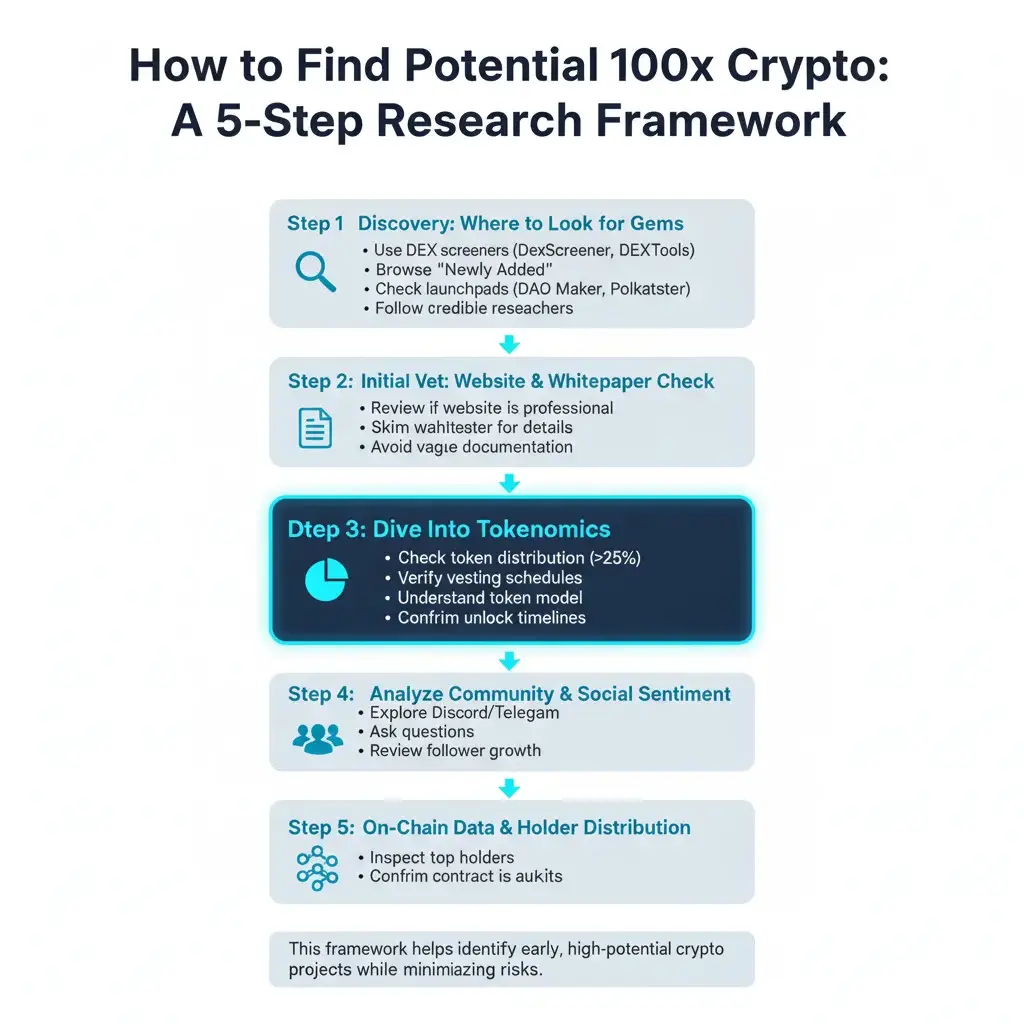
Step 1: Discovery (Where to Look for Gems)
Your first task is to create a “watch list” of interesting new projects. Here are the best places to hunt:
- DEX Screeners: Tools like DexScreener or DEXTools are essential. You can filter for new pairs, low liquidity, and low market cap tokens on various blockchains.
- Crypto Data Aggregators: Websites like CoinGecko and CoinMarketCap have “Newly Added” sections that list the latest tokens.
- Launchpads: Platforms like DAO Maker, Polkastarter, or chain-specific launchpads are where many projects conduct their IDOs.
- Crypto Twitter (X): Follow reputable analysts and researchers who specialize in uncovering low-cap projects. Be wary of “shillers” who promote projects for a fee.
Step 2: The Initial Vet (Reading the Whitepaper & Website)
Once you have a list of potential candidates, perform a quick 15-minute vet.
- Website: Is it professional and well-designed? Does it clearly explain what the project does? A sloppy, generic website is a red flag.
- Whitepaper: Skim the whitepaper. You don’t need to understand every technical detail, but you should be able to identify:
- The problem it solves.
- The proposed solution.
- The token’s utility.
- The team behind it. If the whitepaper is full of marketing fluff and lacks substance, move on.
Step 3: Deep Dive into Tokenomics (The Most Important Step)
If a project passes the initial vet, it’s time to analyze its tokenomics. This is non-negotiable.
- Find the Token Distribution: Look for a chart that shows how the total supply is allocated (e.g., Team, Community, Treasury, Private Sale). High allocations to the team/insiders (>25%) can be a red flag.
- Check Vesting Schedules: The project should publicly state the lock-up and vesting periods for team and investor tokens. If this information is missing, assume the worst.
- Assess Inflation/Deflation: Is the token inflationary (new tokens are constantly created) or deflationary (tokens are burned)? Understand how the supply will change over time.
Step 4: Analyze the Community and Social Sentiment
Dive deep into their social channels. Spend time in their Discord or Telegram.
- Gauge the Vibe: Is the community genuinely excited about the technology and its use case, or is everyone just focused on the price?
- Ask Hard Questions: Ask a thoughtful question in their Discord. Does the team or a knowledgeable community member provide a helpful answer, or are you ignored or banned?
- Look for Organic Growth: Check their social media follower counts over time. Did they gain 50,000 followers overnight (likely bots), or has it been a steady, organic climb?
Step 5: Check On-Chain Data and Holder Distribution
Use a block explorer like Etherscan (for Ethereum) or Solscan (for Solana) to verify claims and analyze the token holders.
- Holder Distribution: Look at the list of top holders. Do a few wallets hold a huge percentage of the supply? If the top 10 wallets (excluding exchange and contract addresses) hold 20-30% or more of the supply, it poses a significant centralization risk.
- Liquidity: Has the project locked its liquidity in a smart contract? This is a crucial step to prevent a “rug pull.” Platforms like Team.Finance or Unicrypt can verify this.
- Contract Security: Has the smart contract been audited by a reputable security firm like CertiK or Hacken? An audit doesn’t guarantee safety, but it’s a critical sign of a professional team.
Your 100x Crypto Vetting Checklist
Use this checklist to systematically evaluate any potential project. A project doesn’t need a perfect score, but it should be strong in most areas. Major red flags in any single category, especially Tokenomics or Team, should be grounds for disqualification.
Here’s your data organized neatly into a simple table format:
| Category | Checkpoint | Green Flag (Good) | Red Flag (Bad) |
| Project Fundamentals | Problem & Solution | Solves a clear, specific problem with a unique solution. | Vague, buzzword-filled mission (“We are revolutionizing Web3”). |
| Whitepaper | Detailed, technical, and well-written. | Full of marketing jargon, typos, and plagiarized content. | |
| Roadmap | Specific, dated milestones that the team is hitting. | Vague goals with no timeline (“Q4: Moon”). | |
| Tokenomics | Market Cap | Sub-$10 million (ideally sub-$5 million). | Over $50 million (less room for 100x growth). |
| Token Distribution | <20% for Team/Insiders. Large allocation for community. | >30% for Team/Insiders. Concentrated ownership. | |
| Vesting Schedule | Clear, long-term vesting for team/investors (e.g., 2-4 years). | No vesting or very short vesting periods (<6 months). | |
| Token Utility | Clear use case (governance, staking, fees, etc.). | Purely speculative; no reason to hold the token. | |
| Team & Backers | Team | Public, doxxed team with a public track record and relevant experience. | Anonymous or pseudo-anonymous team with no verifiable history. |
| Backers/Investors | Backed by reputable VCs or crypto funds. | No notable backers; funded entirely by anonymous presales. | |
| Community & Socials | Community Engagement | Active, organic discussion about the technology and use cases. | Dominated by “wen moon,” “wen lambo,” price-only talk. |
| Social Growth | Steady, organic follower growth over months. | Sudden spikes in followers (likely bots). | |
| Team Communication | Regular, transparent updates from the team (AMAs, dev blogs). | Team is silent for long periods; questions are ignored or deleted. | |
| Technical & Security | Smart Contract Audit | Audited by a well-known security firm (CertiK, Hacken, etc.). | No audit, or an audit from an unknown, low-reputation firm. |
| Liquidity | Liquidity is locked for a significant period (e.g., 1 year+). | Unlocked liquidity, meaning the team can remove it at any time. | |
| GitHub Activity | Active and consistent code commits from developers. | Empty or inactive GitHub repository. |
7 Red Flags: How to Spot a Scam or a “Rug Pull”
While the checklist helps you find promising projects, it’s equally important to know how to spot the dangerous ones. A “rug pull” is a malicious maneuver where a crypto development team abandons a project and runs away with investors’ funds. Here are the most common warning signs.
Anonymous Team
If you cannot verify the identities of the core team members through LinkedIn or other professional networks, this is a massive red flag. Legitimate founders are accountable and stand behind their work. An anonymous team has nothing to lose by disappearing with your money.
Vague Whitepaper
A whitepaper should be a detailed technical document, not a glossy marketing brochure. If it’s filled with buzzwords like “decentralized paradigm shift” and “Web3 revolution” but lacks concrete details on the technology, tokenomics, and architecture, it was likely created to generate hype, not to build a real product.
Unfair Token Distribution
Use a block explorer to check the token holder list. If a huge percentage of the total supply (e.g., 50% or more) is concentrated in just a handful of wallets outside of the main smart contracts, it’s a major risk. These wallets can dump their tokens on the market at any time, crashing the price instantly.
No Locked Liquidity
This is a critical technical red flag. When a project launches on a DEX, the team provides a pool of their tokens and a major crypto (like ETH or SOL) to create a market.
This is called liquidity. If this liquidity is not locked in a smart contract for a set period, the team can withdraw it all at once, leaving holders with worthless tokens they cannot sell.
Always verify locked liquidity using services like Team.Finance.
Aggressive Hype and Unrealistic Promises
Be wary of projects that focus exclusively on marketing and price speculation. If their social media is filled with promises of “guaranteed 100x returns,” constant celebrity endorsements, or paid “shills,” they are likely selling hype instead of substance. Real projects focus on building their product and let the results speak for themselves.
Disabled Social Media Comments
A confident team welcomes discussion and criticism. If a project’s Twitter (X) account has comments disabled or their Telegram/Discord channels aggressively delete or ban anyone who asks a difficult question, they are likely hiding something. This is a common tactic used by scams to control the narrative and silence dissent.
No Reputable Smart Contract Audit
A smart contract audit is a third-party review of the token’s code to check for security vulnerabilities. While not a guarantee of safety, the absence of an audit from a reputable firm like CertiK, Hacken, or ConsenSys is a major red flag. It suggests the team has either cut corners or is intentionally leaving backdoors in the code.
The Unspoken Truth: Managing Risk When Hunting for Gems
Chasing 100x returns is an exciting but dangerous game, the opposite of the disciplined patience of HODL investors. Without a disciplined risk management strategy, you are more likely to lose your entire investment than to find a gem. The goal is not to avoid risk, but to manage it intelligently so you can stay in the game long enough to find a winner.
Here are three non-negotiable rules:
- The 1-5% Rule: Only allocate a very small portion of your total crypto portfolio to these high-risk “moonshots.” Most experienced investors cap this at 1-5%. This means if your total crypto portfolio is $10,000, you should not invest more than $100-$500 in these speculative plays. This ensures that even if the project goes to zero, it won’t significantly impact your overall financial health.
- Invest What You Can Afford to Lose: This is the golden rule of all investing, but it is especially true here. Before you invest a single dollar, look at the amount and honestly ask yourself, “If this money vanished tomorrow, would it negatively affect my life?” If the answer is yes, you are investing too much.
- Take Profits Strategically: The hardest part of a 100x journey is knowing when to sell. Greed can cause you to hold on too long, only to watch your gains evaporate. A common strategy is to “take your principal back.” Once the investment doubles (a 2x return), sell half of your position. This returns your initial investment, meaning everything left in the project is pure profit. From that point on, you are playing with “house money,” which removes the emotional stress and allows you to let the rest ride for a potential 100x.
Turn Knowledge into Profit
You have done the reading, now it is time to act. The best way to learn is by doing. Open a free, no-risk demo account and practice your strategy with virtual funds today.
Open a Free Demo AccountFrequently Asked Questions (FAQ)
What our analysts watch: We track three signals when reading the crypto tape. Spot ETF net flows reveal institutional demand. Stablecoin issuance shows sidelined buying power. Miner reserves indicate supply pressure.
What our analysts watch: The Volity desk does not endorse moonshot hunting, but where traders insist on it, the discipline that separates lottery tickets from informed bets has three parts. Position sizing capped at 1% of total portfolio per moonshot (so a zero in the position is annoying but not portfolio-altering).
Pre-defined exit ladder (sell 25% at 5x, 25% at 10x, hold the runner). And a hard rule against averaging down on positions that drop more than 50% from entry; that rule alone preserves more capital than any selection criterion.
The expected value math only works when the survivors fund the losers, and only sizing makes that real.
Volity operates a trading platform and also publishes educational and analytical content about trading. The content on this page is for educational purposes only and should not be considered financial advice. Volity may benefit commercially when readers open trading accounts through links on this site.
Our content is produced and reviewed under documented editorial standards; see our comparison and review methodology.