Investing in financial products involves risk. Losses may exceed the value of your original investment.
Bitcoin holds support is a core topic for traders in 2026. The complete guide follows.
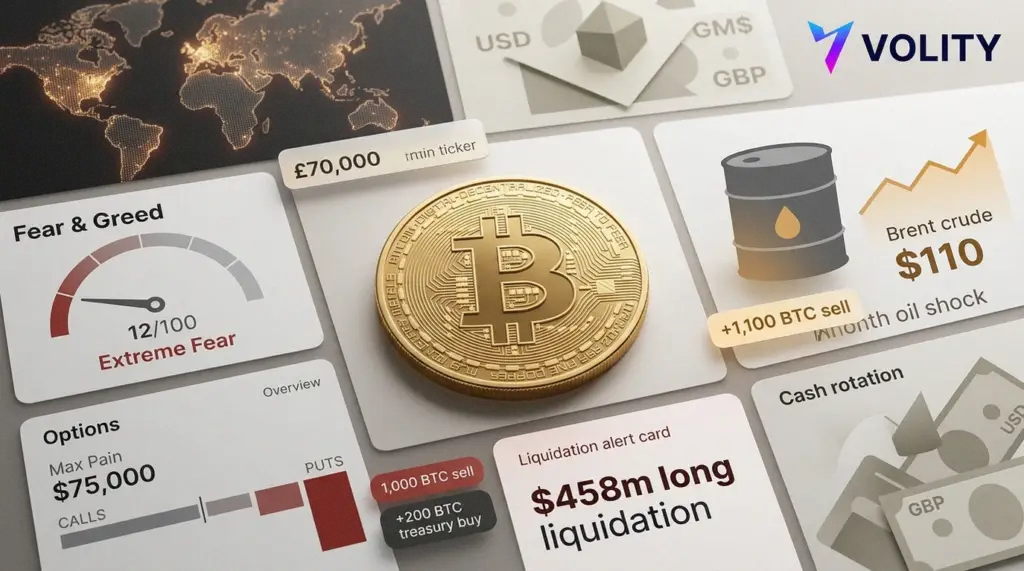
Bitcoin spent the session circling $70,000, like a boxer clinching after a heavy round. However, the bigger punch landed in energy. Iranian strikes on Gulf networks pushed Brent crude above $110 a barrel, and the knock-on effect swept through equities, rates and then crypto.
As oil rallied, risk appetite thinned. Bitcoin briefly slid under $71,000 before grinding back towards $70,000.
Meanwhile, the Crypto Fear and Greed Index sank to 12 out of 100, from 22 only days earlier. That sort of reading does not predict direction, but it does describe positioning.
Traders stop reaching, and they start surviving.
Oil shock, macro nerves, thinner bids
Crude’s jump revived a familiar playbook. Traders sold growth, clung to cash and stared at inflation again. The rates backdrop tightened just as geopolitics heated up. Hot producer price data and Jay Powell’s insistence on restraint kept rate-cut hopes on a short leash.
Then liquidity did what it always does in crypto. It disappeared at the edges first. A large Hyperliquid long reportedly blew up in a liquidation event tied to a $458m position. Separately, an early Bitcoin holder sold 1,000 BTC, adding to the sense that rallies may meet supply sooner than expected.
Not everyone blinked. DDC Enterprise added 200 BTC, taking its treasury to 2,383 coins. Still, the options tape looked jumpy. Traders flagged “max pain” around $75,000, while heavy put positioning hinted at demand for crash protection rather than hero trades.
Altcoins try to trade their own book
Some charts tempted dip buyers, although the tape stayed twitchy. Zcash pulled back into a well-watched support band after testing $200. Bulls argued for a rebound through $250, although sellers will likely defend that zone on the first attempt.
Elsewhere, XRP’s loyalists pointed to bullish formations and floated targets up to $2. That trade, however, tends to work best when Bitcoin behaves. Meanwhile, Pi Network traded above $0.19 ahead of a v21 launch, resisting the broader sogginess. Ethereum watchers returned to breakout talk, with $3,000 framed as the line that changes sentiment.
- Bitcoin: churned around $70,000 after dipping below $71,000
- Oil: Brent pushed above $110 a barrel after Gulf infrastructure strikes
- Fear gauge: Crypto Fear and Greed Index at 12 out of 100, from 22 days earlier
- Flow watch: 1,000 BTC sold by an early holder, while DDC added 200 BTC
Regulation and security add their own drag
Policy noise did not help. South Korea’s tax authority outsourced custody for seized crypto after a security lapse, while domestic politicians pushed to scrap a 22% crypto tax. In Britain, authorities shut Zedxion over Iranian sanctions links. Across the US, lawmakers kept tossing out proposals that unsettle wallet privacy and compliance expectations.
Security fears also stayed loud. The FBI warned about Tron-based scam tokens mimicking law enforcement. Meanwhile, users fretted over seed-phrase messaging tied to Coinbase Commerce ahead of a 31 March shutdown. Even when these incidents sit at the edges, they erode confidence on days when traders already feel hunted.
Institutions keep building, even as screens flash red
While retail traders flinched, institutions kept laying track. Tokenisation momentum continued, with standards work in tokenised gold, exchange trials for tokenised equities and renewed ETF paperwork. The longer-term plumbing improved even as short-term price action worsened.
That split matters. Crypto often sells off on macro stress, then rallies on structural progress once the panic exhausts itself. However, the timing can be cruel, and leverage rarely survives the wait.
Key takeaways
- Watch oil first: sustained trade above $110 keeps crypto in risk-off mode.
- Respect thin liquidity: liquidation cascades can appear without warning near round numbers.
- Bitcoin’s $70,000 area is a sentiment pivot, not a guarantee of support.
- Altcoins may bounce, although they tend to fail if Bitcoin cannot stabilise.
- Options positioning suggests demand for protection, so rallies may meet hedged sellers.
For now, the market looks less like a bold bet and more like a stress test. If oil cools, crypto can breathe again. If it does not, traders will keep hands near the risk switch.
For more on this topic see our deep-dives on Bitcoin, Trade Fears and the Fed Chair Race: Reading Policy Risk, Bitcoin Price Dips as ETF Outflows Surge and Pi Network Eyes Rally, and Japan Tightens Crypto Investment Rules: What Bitcoin Investors Must Know.
What our analysts watch: Three correlations frame the trade. The 30-day rolling correlation between BTC and the Nasdaq, BTC and gold, and BTC and the dollar (DXY). When BTC-Nasdaq correlation falls below 0.3 while BTC-gold rises above 0.4, the macro regime has flipped: BTC is trading as a store of value, not risk-on. We also watch oil-equity correlation; spikes in WTI paired with VIX above 22 historically pre-date 5 to 8 percent BTC drawdowns within two weeks unless that hedge regime is firmly in place.
Frequently asked questions
Why does Bitcoin sometimes hold support during equity selloffs?
BTC behaves as a hybrid asset: high-beta tech proxy in low-volatility regimes, sovereign-risk hedge in high-volatility regimes. When fear-gauge readings climb and currencies weaken, capital occasionally flows toward BTC as digital gold rather than away from it. The BIS has published extensive work on the shifting correlation properties of crypto assets.
How does an oil spike affect Bitcoin?
Oil shocks raise headline inflation and pressure central banks to delay rate cuts. That tightens dollar liquidity, which is usually negative for BTC. The exception is when oil shocks are tied to geopolitical risk; then BTC sometimes catches a hedge bid alongside gold. Investopedia explains oil price shocks and their second-order market effects.
What does the VIX tell me about Bitcoin?
The VIX is a 30-day implied-volatility forecast for the S&P 500. BTC tends to take cues from the VIX in two regimes: when VIX is low and rising, BTC often retraces; when VIX is high and stable, BTC volatility decouples and can rally on its own catalyst. The Federal Reserve publishes financial-conditions indices that complement VIX readings.
Can I hedge BTC and oil exposure on the same Volity account?
Yes. Volity supports spot BTC and major altcoins alongside oil CFDs, FX pairs and equity indices through UBK Markets (CySEC licence 186/12) and our Saint Lucia and Cyprus entities. You can pair a long BTC position with an oil hedge or volatility expression in one place, with negative-balance protection on retail accounts.
Related guides
Volity operates a trading platform and also publishes educational and analytical content about trading. The content on this page is for educational purposes only and should not be considered financial advice. Volity may benefit commercially when readers open trading accounts through links on this site.
Our content is produced and reviewed under documented editorial standards; see our comparison and review methodology.