Investing in financial products involves risk. Losses may exceed the value of your original investment.
Bitcoin etfs stablecoins is a core topic for traders in 2026. The complete guide follows.
Crypto news digest: Bitcoin tests $77k amid Hormuz rebound and Trump’s wild week
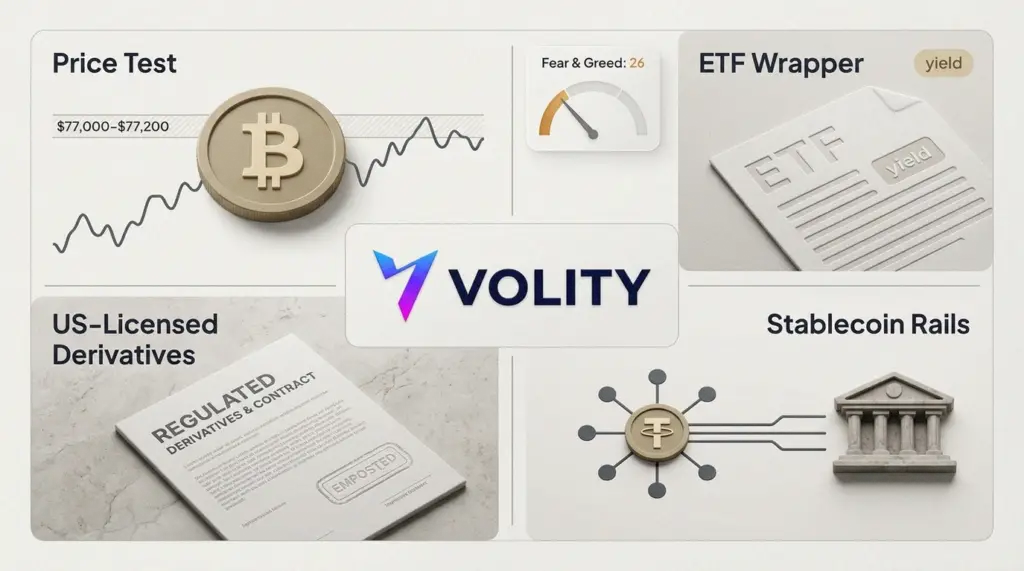
Bitcoin edged back towards $77,000 on Monday, as the Hormuz Strait risk premium faded and traders put last week’s panic back on the shelf. However, the mood stayed brittle, with the Fear and Greed Index stuck at 26 and altcoins failing to follow the bounce. Meanwhile, institutions kept building the pipes, from ETF filings to stablecoin settlement rails, even as Washington produced another day of noisy headlines.
Bitcoin’s defensive bounce: $77k is the test
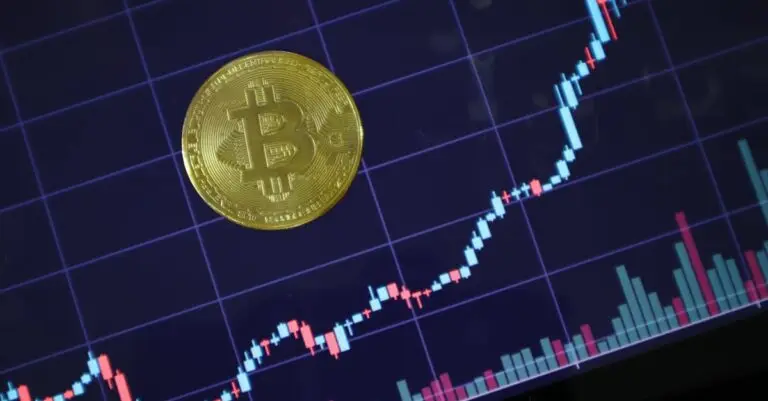
Bitcoin traded around $76,755, up 1.34%, and held above $76,000 for a third session. Total crypto market value sat near $2.68tn, with roughly $155bn in 24 hour trading volume and Bitcoin dominance at 57.3%. Yet the tape looked more like a relief rally than a reboot, because volume never really punched through and risk appetite stayed narrow.
- Key levels: Resistance sits at $77,000 to $77,200, while support rests near $73,600.
- What would change the tone: Bulls wanted a clear break with a meaningful volume lift, rather than another thin push.
- How traders framed it: Some pointed to negative funding as support for an upside squeeze, while others watched for a third rejection at $76,000 to $77,000.
Ethereum lagged again. ETH traded near $2,381, up about 1.1%, and the ETH/BTC ratio slipped to around 0.031, a three week low. That underperformance mattered because it often signals caution, particularly when Bitcoin strength comes without broader participation. Even so, ETF flows were reported as positive across several sessions, which kept dip buyers interested near $2,400.
Institutions keep laying track: ETFs, exchanges and a derivatives land grab
On the regulated side, the story stayed busy. Goldman Sachs filed for a Bitcoin Premium Income ETF, adding another product wrapper aimed at the same audience that wants Bitcoin exposure with a yield-like overlay. Meanwhile, Payward, Kraken’s parent, agreed to buy the US licensed crypto derivatives firm Bitnomial for $550m, a sign that the next fight sits in futures and options rather than spot.
Elsewhere, AndX launched a US crypto exchange using BitGo’s regulated infrastructure. At the same time, Circle opened parts of its payments network to banks, pushing stablecoin settlement closer to mainstream plumbing. The market’s institutional build-out continued even as price action remained rangebound.
Stablecoins and regulation: Europe inches, Washington talks
In Europe, the push for euro stablecoins stayed on the agenda, with talk of a 2026 launch plan from France-linked initiatives. In the US, lawmakers continued debating how yield, custody and disclosure should work for stablecoins, yet no quick legislative finish looked imminent. Meanwhile, the SEC’s messaging signalled a softer tone under the current leadership mix, even if enforcement risk has not disappeared.
Poland’s Prime Minister Donald Tusk accused a Russia-linked crypto firm of financing political opponents, which kept the geopolitics-regulation link in view. In Hong Kong, Flow Capital moved a $150m credit fund onto blockchain rails via DigiFT, another example of tokenisation moving from pilot projects to real allocations.
Altcoins: a few winners, but rotation stayed defensive
With Bitcoin dominating flows, altcoin leadership looked patchy. Hedera (HBAR) and Stellar (XLM) outperformed within major-coin baskets, while Morpho jumped about 12% on the day. Pi Network drew attention after a chart break and developer updates, while Flare highlighted plans tied to MEV capture and a reduction in FLR inflation.
However, several headline names weakened. Solana fell about 1.6% and Dogecoin slid about 1.4%, which reinforced the sense of selective risk-taking. An NFT platform, Foundation, said it would shut down after a failed rescue effort, a reminder that the weaker end of the market still has little margin for error.
Geopolitics, the dollar and the new macro loop
With Hormuz traffic normalising, the dollar slipped and crude’s war premium eased, which helped Bitcoin look steadier by comparison. Still, traders treated the calm as provisional. Many desks stayed focused on whether macro relief translates into sustained crypto inflows, or simply creates better levels for sellers to reload.
Trump’s week stays loud, markets stay practical
Donald Trump again dominated the political feed, from a fresh CDC director nomination to funding clashes with New York and foreign policy noise tied to Iran. Yet crypto traders mostly treated it as background volatility, unless it changed sanctions risk, oil pricing or the broader dollar path. Meanwhile, late-night wrangling in Congress over surveillance legislation added to the sense of a jumpy, headline-driven tape.
Scams and security: hardware risks resurface
A researcher flagged a fake Ledger Nano S device designed to siphon funds, an old threat that continues to catch uninformed buyers. As prices churn, scammers tend to widen their net, so the dull trade of verifying devices and firmware again looked like a high-return habit.
By the numbers
- BTC: $76,755, up 1.34%
- Total crypto market cap: about $2.68tn
- 24 hour volume: about $155bn
- BTC dominance: 57.3%
- Fear and Greed: 26
Key takeaways
- Bitcoin’s $77,000 to $77,200 zone remained the line, because price held but momentum looked thin.
- Ethereum’s continued slippage versus Bitcoin suggested traders still preferred defence over broad risk.
- Derivatives and stablecoin infrastructure kept advancing, even without a clean risk-on market.
- Altcoin strength stayed selective, so traders treated rallies as rotations, not a tide.
- Security headlines returned, which usually increases demand for custody and regulated venues.
For more on this topic see our deep-dives on How Fed Rate-Cut Talk Drives Bitcoin and Crypto Rallies, Bitcoin Short Squeeze Explained: How ETF Inflows Trigger BTC Rallies, and Crypto Treasury Plays: Forward on Solana, Metaplanet on Bitcoin.
What our analysts watch, by Alexander Bennett: Three signals matter on this kind of tape. ETF net flows tell us whether new dollars are still arriving versus rotating. Derivatives consolidation, like the Kraken Bitnomial deal, shows where the next fee pool sits and which venues will set the marginal price. And the ETH/BTC ratio is our breadth check; when it slips to a three-week low while BTC holds, the rally lacks participation and tends to stall.
Frequently asked questions
Why is the Kraken Bitnomial deal a big signal for crypto markets?
Because the next fight in US crypto is in regulated derivatives, not spot. A $550m acquisition of a CFTC-registered futures venue gives Kraken instant US derivatives reach and forces competitors to respond. Tighter spreads and deeper books usually follow consolidation. The CoinDesk Markets desk has tracked the gradual handover of price discovery from offshore venues to US-regulated futures since 2024.
What does a Bitcoin Premium Income ETF actually do?
A premium income wrapper typically holds spot Bitcoin (or BTC futures) and overlays a covered-call or short-volatility strategy to generate yield. The trade-off is capped upside in fast rallies in exchange for steadier distributions.
Investors should read the prospectus carefully, because options overlays change the risk profile versus a simple spot ETF. The U.S.SEC publishes investor bulletins on options-based ETFs and yield products.
Why does the ETH/BTC ratio matter for traders?
It is the cleanest single read on crypto market breadth. When ETH outperforms, risk appetite is broad and altcoins usually follow. When ETH lags as it did to a three-week low here, BTC strength is narrower and rallies tend to fade without follow-through. The Investopedia primers on ratio analysis explain how traders combine relative strength with absolute trend signals.
How do tokenisation deals like Flow Capital change the picture?
Tokenising a $150m credit fund on regulated rails moves crypto infrastructure from pilot to allocation. It signals that institutional treasuries are willing to accept on-chain settlement when the legal wrapper is recognisable. At Volity, regulated by CySEC under licence 186/12 via UBK Markets and operating through SLU and Cyprus entities, we monitor tokenised credit and money-market products as an early read on real institutional adoption.
Related guides
- Bitcoin explained
- Ethereum explained
- Cryptocurrency trading
- Crypto trading platforms
- Best crypto investments
Volity operates a trading platform and also publishes educational and analytical content about trading. The content on this page is for educational purposes only and should not be considered financial advice. Volity may benefit commercially when readers open trading accounts through links on this site.
Our content is produced and reviewed under documented editorial standards; see our comparison and review methodology.