Investing in financial products involves risk. Losses may exceed the value of your original investment.
The Crypto Trading Starter Kit
A plain-English PDF: what to check before you trade, how orders and risk really work, and the mistakes to skip. Get it free.
Quick answer
Yes, you can day trade bitcoin on regulated venues 24 hours a day, 7 days a week, with leverage up to 1:2 retail (EU) or higher offshore. But most retail bitcoin day traders lose; cost-adjusted edge is rare. The realistic profitable path: trade only during high-volume sessions (12:00-20:00 UTC), use tight stop-losses, and only deploy strategies with a documented edge over total cost of trading.
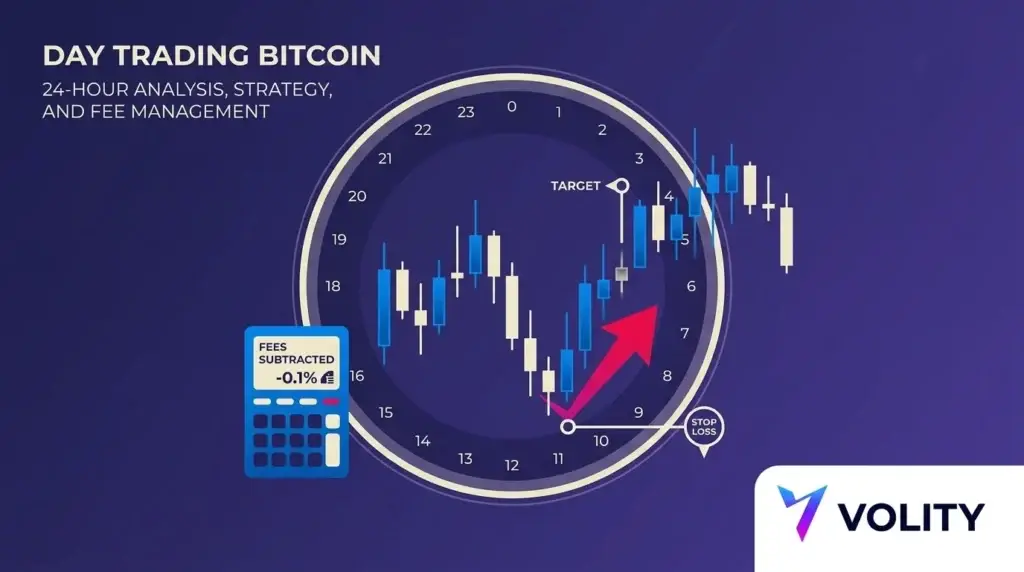
Yes, you can day trade bitcoin. The market runs 24 hours a day, seven days a week. Liquidity in BTC/USD is the deepest in crypto by a wide margin. Tools, charts, and execution rails are mature. The harder question is whether you should, and what the realistic outcome looks like for a trader walking in cold. The honest answer is that day trading bitcoin is one of the most demanding forms of retail speculation in modern markets, and most accounts that try it net negative in year one.
What does day trading bitcoin involve?
A day trade is a position opened and closed within the same session, often within minutes or hours, designed to capture a small piece of intraday movement. In bitcoin specifically, that means:
- Multiple trades per day. Five to thirty trades is common.
- Tight stops. Typically 0.3% to 1% on the underlying.
- Fast execution. Time-in-market is short, so spread and slippage are a much larger share of P&L than on a swing trade.
- Heavy screen time. Crypto runs 24/7 but liquidity peaks during the US and EU sessions; most day traders concentrate there.
What does it cost to day trade bitcoin?
Three line items, and the order matters:
- Spread. On a deep BTC/USD venue, 1-3 basis points per side. Round trip 2-6 bp.
- Commission. Some platforms include this in the spread; others charge 1-5 bp explicitly.
- Slippage. The killer. Stops fill 5-15 bp away from advertised price during news, and bitcoin generates news at a rate equity markets do not.
Worked example. Trader takes 20 day trades a week, average size $10,000 notional, average cost 8 bp round trip including slippage. Weekly cost: 20 * $10,000 * 0.0008 = $160. Annualised: ~$8,000. The strategy needs to clear that bar before it makes a single dollar.
What edge are you actually trading on?
Three buckets that retail can defensibly play:
- Mean reversion in low-volatility regimes. Quiet ranges produce repeatable bounces off the band edges. Works when BTC IV is low; fails fast when IV spikes.
- Breakout follow-through. Clean break of a multi-day range on volume, with a tight stop at the prior range high. Works when there is a real catalyst; fails on fake-out days.
- Macro-event reaction. Trading the second wave after a CPI print, FOMC release, or ETF flow headline. The first 30 seconds belong to algos; the next 30 minutes can be readable.
What does not work as edge: chart patterns alone, indicator stacks, social-media sentiment, anything that is not pre-defined and journaled before the trade.
What about leverage on day trades?
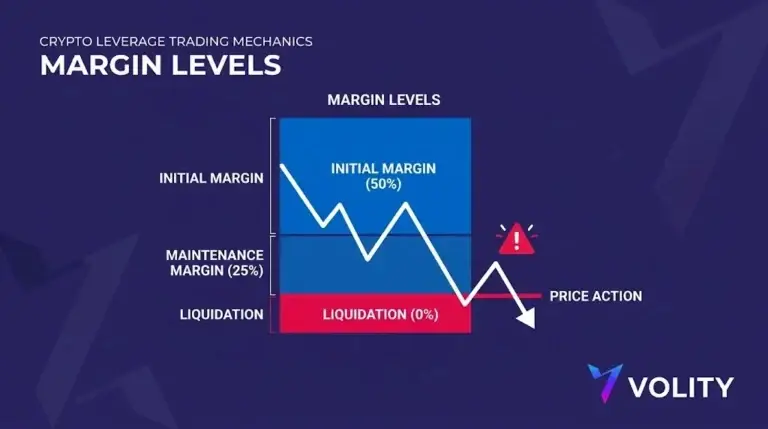
Retail crypto leverage in the EEA is capped at 1:2 under ESMA product-intervention measures. That cap is doing real work for day traders. A 1:2 day trade with a 0.5% stop on the underlying is a 1% account hit. The same trade at 1:10 leverage (offshore territory, not legal for EEA retail) would be a 5% hit. At 1:50 it is a forced exit on a single bad fill. The cap is what keeps a normal losing day from being a career-ending day. Professional clients on request who pass MiFID II suitability can access higher leverage; for most readers of this guide, the retail cap is the right number.
How big should the account be?
Honest math. If your edge is 5 bp per trade after costs (a respectable retail bar), and you take 20 trades a week, that is 100 bp per week of gross expectancy on the trading capital deployed. On a $5,000 account that is $50/week before drawdowns. Discouraging. On a $50,000 account it is $500/week, which starts to look like part-time income but eats real time. Below $10,000, the fixed costs of platform, data, and time-in-seat dominate. Day trading is not a small-account strategy unless you are explicitly funding the learning curve.
What goes wrong
- Overtrading. Boredom is the enemy. Twenty trades on a non-trending day is a way to convert spread into a loss.
- Revenge trading. The trade after a stop-out is statistically the worst trade of the week. Walk away for an hour.
- No journal. Without a record of setup, entry, stop, target, and result, you cannot identify which setup pays. You will keep doing the ones that lose.
- Conflating activity with edge. The screen-time-to-P&L curve is non-linear and starts to plateau hard after about three hours of focused work per session.
A realistic 90-day plan
- Week 1-2. Demo only. Build a journal. Define three setups and trade only those.
- Week 3-4. Funded account at minimum size. 1% risk per trade, max two trades per day.
- Week 5-8. Track the data. Compute win rate and average R per setup family.
- Week 9-12. Cut the worst setup. Increase position size only if expectancy is consistently positive after costs.
If after 90 days the journal is empty or the math is negative, day trading bitcoin is not your edge. Swing trading, spot accumulation, or a different strategy entirely is a better use of your time and capital.
Day trading bitcoin at Volity
Volity offers crypto CFD exposure on 20+ coins on a regulated platform. Retail leverage is capped at 1:2 (ESMA). Negative balance protection applies on retail accounts. Eligible retail clients of UBK Markets are covered by the Cyprus Investor Compensation Fund up to EUR 20,000 per client per firm. Execution is by UBK Markets Ltd (CySEC 186/12).
Volity operates a trading platform and also publishes educational and analytical content about trading. The content on this page is for educational purposes only and should not be considered financial advice. Volity may benefit commercially when readers open trading accounts through links on this site.
Our content is produced and reviewed under documented editorial standards; see our comparison and review methodology.