Investing in financial products involves risk. Losses may exceed the value of your original investment.
The Crypto Trading Starter Kit
A plain-English PDF: what to check before you trade, how orders and risk really work, and the mistakes to skip. Get it free.
Quick answer
AI for crypto trading is useful in three honest places: sentiment analysis from news and social feeds, on-chain pattern detection (whale flows, exchange inflows), and order-flow inference from public order books. Where AI is NOT useful: predicting price direction. Most retail ‘AI trading bots’ are pattern-matching scripts marketed as AI; the real edge is in well-engineered features feeding traditional ML models.
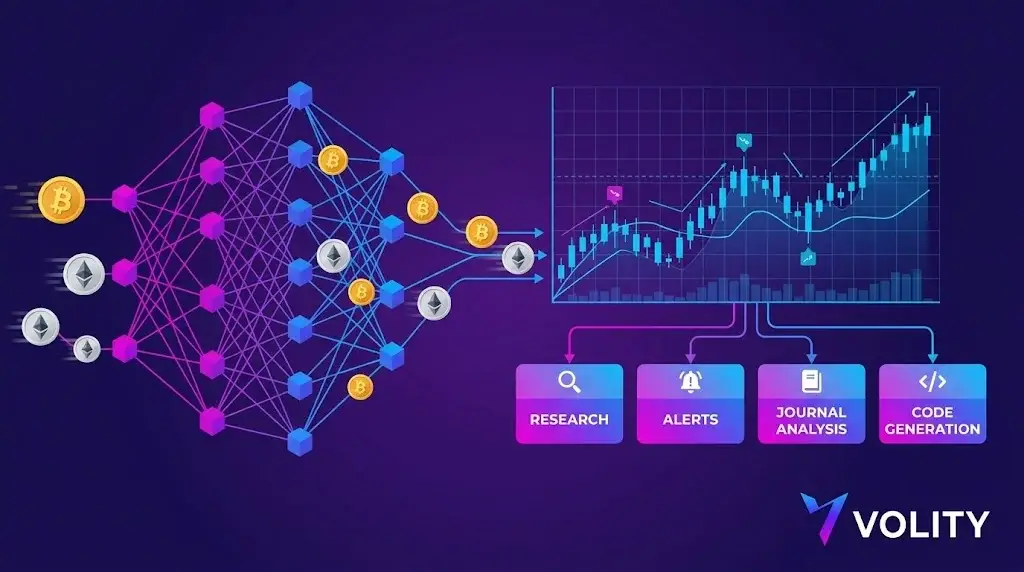
AI in crypto trading is currently oversold and underused. Oversold by every Twitter thread promising a model that picks the next 10x. Underused by serious traders who could be cutting research time by 60% with off-the-shelf tools. The honest framing: large language models are excellent assistants for research synthesis, journal analysis, and code generation, and poor predictors of price. Here is what actually works.
Where AI helps right now
1. Research synthesis
Reading the EIA Weekly Petroleum Status Report, the FOMC statement, and three sell-side notes takes 90 minutes. An LLM with web access can summarise all three into a one-page brief in 4 minutes. The summary is not a trading signal. It is a starting point that frees you to focus on interpretation. Cross-check the summary against the source: hallucinations on numerical data still occur.
2. Alert filtering and triage
Most retail traders run too many alerts: 30 price levels, 8 RSI thresholds, 5 news feeds. The signal-to-noise ratio collapses. An LLM can be plugged into your alert stream to filter and prioritise: “only ping me if the alert is on a tier-1 coin during EU/US session and the 4-hour ATR is above 2%.” The filter logic stays under your control; the LLM applies it consistently.
3. Journal analysis
The trading journal is the highest-value document on your desk. Most traders never re-read it. Feed 100 trades into an LLM with a structured prompt: “identify which setup family has the highest expectancy, which time-of-day window underperforms, and which exit rule consistently leaves money on the table.” The output is a starting point for hypothesis testing, not a verdict.
4. Code generation for backtesting and indicators
Writing a custom MT5 indicator in MQL5 takes a working developer 2-4 hours. With an LLM as a pair-programmer, the same indicator takes 30-60 minutes. The LLM gets the syntax right, you get the logic right. Same for Python backtests using libraries like backtrader or vectorbt: scaffolding in minutes, debugging in hours.
5. Macro context on demand
“Summarise the last three FOMC statements and flag any change in language on inflation expectations.” That query, applied weekly, surfaces shifts in central bank tone that move crypto. The Federal Reserve publishes statements on FOMC meeting days; the ECB publishes monetary policy decisions on its calendar. Both are public, both are searchable, and both feed AI summarisation cleanly.
Where AI fails right now
1. Predicting price direction
LLMs are not designed for time-series prediction. The few academic studies (notably from BIS researchers and central bank economists) consistently find that fine-tuned LLMs underperform standard time-series models on directional forecasting. If a tool promises “AI predicts BTC will hit $80k Tuesday,” it is selling confidence, not edge.
2. Sentiment analysis as alpha
Sentiment scoring of social media works in research papers and underperforms in live trading. The signal degrades rapidly as more participants run the same model. By 2026, most retail sentiment indicators are crowded and front-run.
3. Black-box autopilot
Handing over execution to an opaque AI system without understanding its decision rules is the failure mode that takes accounts to zero. If you cannot articulate why the system entered a trade, you cannot fix it when it stops working.
A workable AI-assisted workflow
Five tasks, mapped to AI:
- Daily macro brief (4 minutes): LLM summarises overnight news and flags catalysts.
- Watchlist screening (2 minutes): LLM applies your filter rules to the universe of CFDs you trade.
- Setup validation (5 minutes): paste chart description and proposed trade into the LLM, ask it to challenge the thesis. Treat the output as devil’s advocate, not approval.
- Post-trade tagging (1 minute per trade): LLM categorises the trade by setup family, market regime, and outcome for the journal.
- Weekly review (15 minutes): LLM analyses the week’s journal entries and surfaces patterns. You decide which patterns to act on.
Total: 25-30 minutes of AI-assisted work that replaces 2-3 hours of manual reading and tagging.
Tooling that works in 2026
- General-purpose LLMs: Claude, GPT-4-class models, Gemini. Use any of them; the marginal differences for trading research are small.
- Coding-specific LLMs: for MQL5 and Pine Script, frontier models handle both adequately. Always test on demo before live.
- Custom prompts: build a prompt library. “Daily macro brief,” “setup challenge,” “weekly review” should each be a saved prompt with consistent structure.
The same caution applies to AI features inside trading apps. Our guide to AI trading apps sets out what they can and cannot do and how to test one on a demo first.
Honest framing
AI is leverage on cognitive work, not on capital. It will not generate alpha you do not already have. It will free 60-80% of your research time so you can deploy more of your day to setup execution, risk management, and review. That is the trade. Anyone selling more is selling.
AI-assisted trading at Volity
Volity supports MT4 and MT5 with custom indicators, expert advisors, and API access for systematic strategies. Trading is executed by UBK Markets Ltd (CySEC 186/12). Retail leverage on crypto is capped at 1:2 under ESMA. Negative balance protection applies.
Volity operates a trading platform and also publishes educational and analytical content about trading. The content on this page is for educational purposes only and should not be considered financial advice. Volity may benefit commercially when readers open trading accounts through links on this site.
Our content is produced and reviewed under documented editorial standards; see our comparison and review methodology.
Frequently asked questions
Can AI predict crypto prices?
No system reliably predicts prices, and any tool presented that way should be treated with scepticism. What machine learning does well is narrower: classifying regimes, filtering signals and processing volumes of text or order data faster than a person can.
What are the honest use cases for AI in crypto trading?
Screening large numbers of assets against defined criteria, summarising news and filings, detecting anomalies in order flow, and testing whether a rule survives out-of-sample data. All of these support a decision rather than replace it.
What is the biggest mistake when using AI tools for trading?
Trusting an output you cannot interrogate. If you cannot explain why a model produced a signal, you cannot tell whether it has stopped working, and you will keep trading it well past the point where the edge has gone.