Investing in financial products involves risk. Losses may exceed the value of your original investment.
Quick answer
To start CFD trading: pick a CySEC- or FCA-regulated broker with negative balance protection, define risk per trade (typically 1% of account equity), learn one or two liquid instruments (EUR/USD, S&P 500, gold), and run at least 60 demo trades before going live. The discipline that separates profitable retail traders from the 80% who lose is risk control, not strategy complexity.
Starting CFD trading is straightforward; surviving it is not. Between 70% and 80% of retail CFD accounts lose money. The reasons are well-documented: oversize positions, no defined stop, leverage used as a multiplier of conviction rather than a tool for capital efficiency. The risk-aware setup below is not a magic formula. It is the structural floor that gives a beginner a fighting chance.
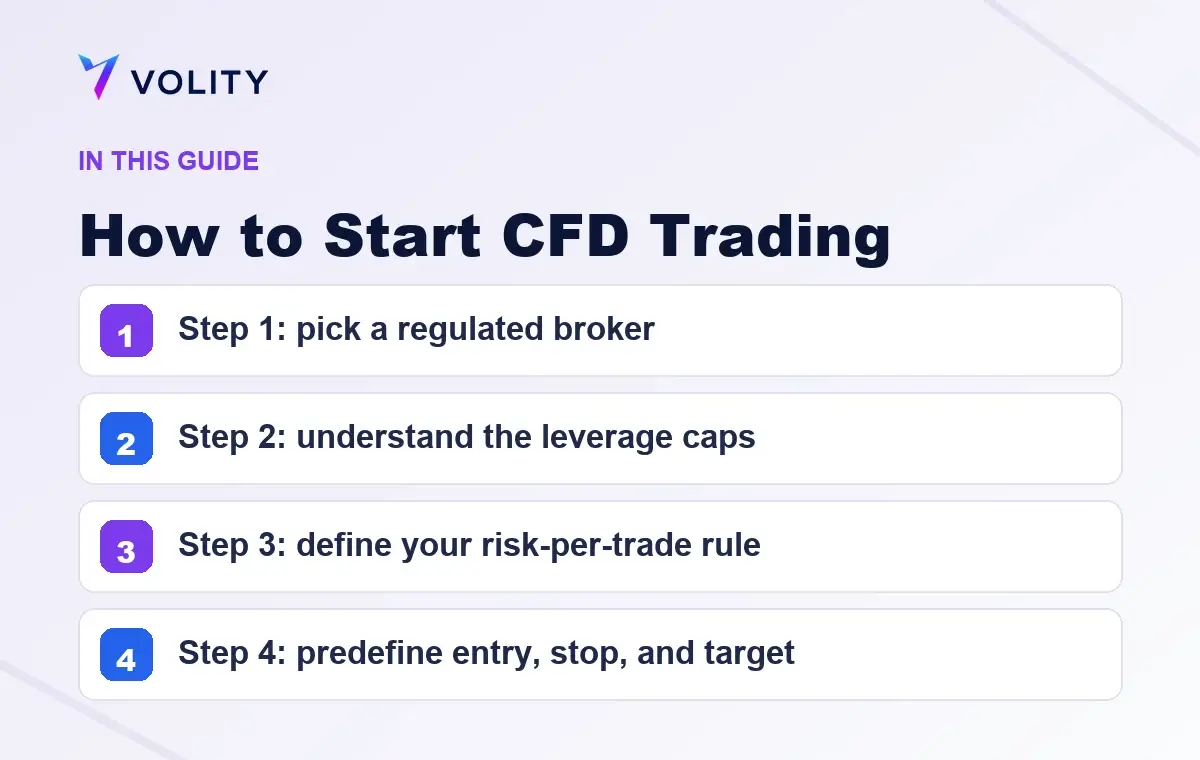
Step 1: pick a regulated broker
Three checks, in order:
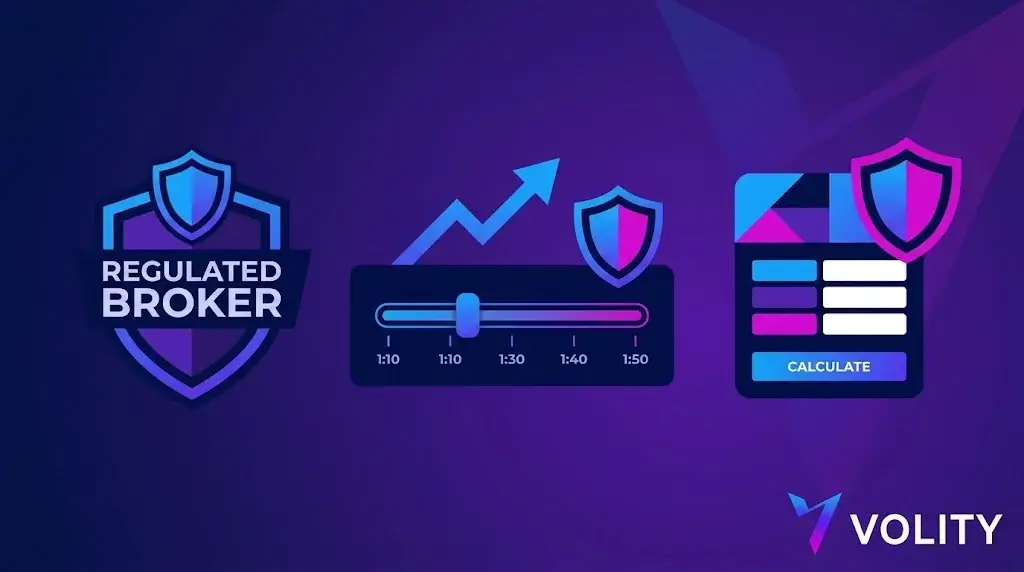
- EU regulator with public register: CySEC, BaFin, AMF, or equivalent. Volity’s trading is by UBK Markets Ltd, CySEC 186/12.
- ESMA product-intervention compliance: leverage caps, negative balance protection, standardised risk warning. These apply to all retail clients of EU-regulated brokers.
- Investor compensation scheme membership: Cyprus ICF covers eligible retail clients up to EUR 20,000 per client per firm in the event of broker insolvency.
An offshore broker offering 1:500 leverage is offering you the rope, not the safety net. The structural protections matter more than the marketing.
Step 2: understand the leverage caps
ESMA caps retail CFD leverage by underlying asset class. Memorise these:
- Major currency pairs (EUR/USD, GBP/USD, USD/JPY): 1:30
- Non-major currency pairs and major indices (e.g. AUD/NZD, S&P 500, DAX): 1:20
- Gold: 1:20
- Other commodities and minor indices: 1:10
- Individual equities: 1:5
- Cryptoassets: 1:2
These are ceilings, not targets. Most successful retail traders use 25-50% of the available leverage. The cap exists because the data shows higher leverage destroys retail accounts.
Step 3: define your risk-per-trade rule
Before your first trade, write down your risk-per-trade percentage. For most retail accounts, that number is 0.5% to 1% of account equity per trade. The rule:
Position size = (account equity x risk %) / dollar distance from entry to stop
Example: $10,000 account, 1% risk, EUR/USD entry 1.0850, stop 1.0820. Distance is 30 pips, $300 per standard lot. Position size = $100 / $300 per lot x 1 lot = 0.33 lots. Notional $33,000. At 1:30 leverage, margin required is $1,100. Plenty of room for the next trade.
This rule does the most important thing in CFD trading: it removes the emotional sizing decision. You stop asking “how much should I trade?” and start asking “is this setup worth taking?”
Step 4: predefine entry, stop, and target
Three numbers go on the chart before any order is placed:
- Entry: the price at which the setup is valid.
- Stop: the price at which the setup is invalidated. Beyond a structural level (swing low for a long, swing high for a short) or 1.5-2x ATR.
- Target: the realistic next level of resistance/support, or a fixed multiple of risk (typically 2R or 3R).
If you cannot draw all three before entry, the setup is not ready. Sit on your hands.
Step 5: paper-trade for two weeks
Open a demo account on the platform you will trade live. Run 30 paper trades over two to three weeks. The point is not the P&L; the point is to verify your process executes cleanly. Track each trade with: setup, entry, stop, target, position size, R-multiple at exit.
By trade 30 you will know two things: whether your setup family has positive expectancy in the current regime, and whether you can execute the plan without deviation. Both must be yes before live capital.
Step 6: go live at half size
The first live capital allocation is 25% of your intended account, with risk-per-trade dropped to 0.5% (half your eventual rule). The first 20 live trades are about three things:
- Verifying execution: do orders fill at expected prices, do stops trigger correctly, does the platform report P&L accurately.
- Calibrating to slippage: a paper fill at 1.0850 might be a live fill at 1.0852. The 2-pip difference compounds.
- Managing the emotional load: live capital changes the psychology. The setups you took easily on demo will feel different. Watch for the urge to widen stops, scale into losers, or take profit too early.
Step 7: review weekly, scale based on data
Sunday evening, 30 minutes, journal in front of you. Three questions:
- Which setups paid? Which did not?
- Did I follow the position-sizing rule on every trade?
- Did I move any stops the wrong way? Why?
After 50 live trades, if expectancy is positive, scale to full size. If not, stay at half size for another 50 while you isolate the problem.
The honest expectation
The first 100 live trades are tuition. Plan to spend the equivalent of a basic course in fees, slippage, and small losses while you build the process. The traders who survive past 100 trades are not the ones with the best setup; they are the ones who held position-sizing discipline through the learning phase.
CFD trading at Volity
Volity offers CFD exposure across forex, indices, commodities, equities, and crypto on MT4 and MT5. Trading is executed by UBK Markets Ltd (CySEC 186/12). ESMA leverage caps apply to retail clients. Negative balance protection applies. Cyprus ICF covers eligible retail clients up to EUR 20,000 per client per firm.
Volity operates a trading platform and also publishes educational and analytical content about trading. The content on this page is for educational purposes only and should not be considered financial advice. Volity may benefit commercially when readers open trading accounts through links on this site.
Our content is produced and reviewed under documented editorial standards; see our comparison and review methodology.
Frequently asked questions
What should I set up before placing a first CFD trade?
A defined risk per trade, a position size derived from your stop distance, and a written rule for when you exit. Setting those before the first order is what separates a plan from a series of reactions.
How much capital do I need to start CFD trading?
Enough that your smallest sensible position risks a small fraction of the account. Because CFDs are leveraged, the constraint is not the margin requirement but whether you can absorb a normal run of losses without breaching your own risk limit.
What is negative balance protection?
A rule under which retail client losses cannot exceed the funds in the account, so a gap through your stop does not create a debt. It is standard for retail clients in several regulated jurisdictions; confirm it applies to the entity you contract with.