Quick answer
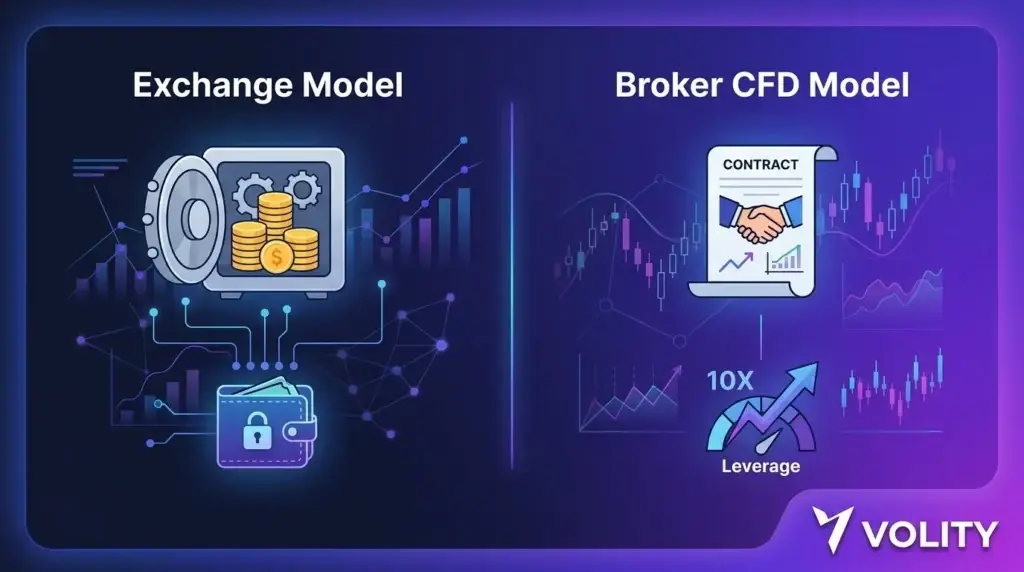
Crypto trading sites fall into two models: exchanges, where you buy and own the actual coins on an order book, and brokers, where you trade crypto, often as CFDs, and other markets from one regulated account. Exchanges suit those who want to hold and withdraw coins; brokers suit those who want leverage, multiple asset classes and regulatory protection.
The Crypto Trading Starter Kit
A plain-English PDF: what to check before you trade, how orders and risk really work, and the mistakes to skip. Get it free.
What are crypto trading sites? Crypto trading sites are platforms that let you buy, sell, or speculate on cryptocurrencies. They fall into two structures: exchanges that custody your coins, and brokers that offer CFD or derivative exposure under a regulated licence. Volity combines both as a CySEC-regulated all-in-one money hub.
Crypto trading sites fall into two structures: exchanges that custody your coins, and brokers that offer CFD or spot exposure under a regulated wrapper. The right site depends on what you want to do with crypto. Volity is your all-in-one money hub combining a wallet, payments, and CFD trading layers in one account.
Crypto trading sites: two models, one decision
Almost every crypto trading site you see online is one of two things:
- Exchange: holds your coins in custody, lets you trade spot pairs, charges maker/taker fees per transaction. Examples: Binance, Kraken, Coinbase, Bitstamp
- Broker: offers CFD or derivative exposure under a regulated licence, with leverage and short-selling. Examples: Volity, IG, Plus500
Volity adds a third element: a wallet layer that lets you also hold crypto in self-custody-style alongside the trading account. So you get broker-style trading plus exchange-style holding under one regulated account.
What to evaluate on any crypto trading site
Five criteria separate solid sites from risky ones.
1. Regulation. Who holds the licence? Tier-1 regulators (CySEC, FCA, ASIC, MAS) impose capital requirements, client-fund segregation rules, and complaint mechanisms. Offshore-only sites (Seychelles, Vanuatu, no licence) carry higher counterparty risk. Volity operates under CySEC 186/12 via UBK Markets.
2. Custody model. Does the site hold your crypto, or do you control the keys? Most exchanges custody; some offer hybrid (Coinbase Wallet, Binance Web3). Broker CFD models do not require custody at all. Volity’s wallet layer holds crypto for you with segregated trustee arrangements; trading positions are CFDs.
3. Fees. Look at the full stack: deposit fees, trading fees (spread or commission), withdrawal fees, FX conversion, swap rates on leveraged positions. Some exchanges advertise zero trading fees but charge 1.5-3% on fiat-to-crypto deposits. Volity charges through the spread (no per-trade commission on Standard), $0 on wallet/SEPA/internal transfers, 1% FX.
4. Leverage and shorting. Spot exchanges typically max at 1:5 to 1:10 leverage and limit short-selling. Broker CFD models support up to 1:50 on crypto, 1:100 on commodities, 1:500 on selected forex, with native short-selling. Choose based on whether you trade directional moves or want long-term spot accumulation.
5. Execution quality. Speed and reliability matter. Volity targets 99.6% sub-1-second fills, 0% rejection rate, no requotes. Many smaller sites cannot match this.
Red flags on any crypto trading sites comparison
If you see these, look elsewhere:
- No verifiable licence number. “Regulated” without naming the regulator and the licence number is marketing, not regulation
- Guaranteed returns. Any site promising fixed daily or weekly returns on a crypto investment is a fraud
- Anonymous teams. Legitimate regulated brokers do not need to hide ownership
- Cash-only or crypto-only deposits. Regulated entities support traceable rails (SEPA, card, bank transfer). Crypto-only with no fiat path is a warning sign
- No segregated funds disclosure. Where do client funds sit? If the answer is not transparent, the answer is “in the same account as company funds,” which is the highest counterparty risk
- Pressure tactics. “Limited-time bonus” trading bonuses are banned in most regulated jurisdictions for good reason
The exchange model in one paragraph
Exchanges match buyers and sellers in an order book. You deposit fiat or crypto, the platform holds it, and you place spot orders. Profits stay in your exchange wallet until you withdraw. The platform earns through maker/taker fees on every trade. Risks: exchange insolvency (FTX, Mt. Gox), key loss if you self-custody, regulatory action on the exchange.
The broker model in one paragraph
Brokers offer CFD exposure to crypto. You never own the underlying coin. The broker matches your position against a liquidity pool or hedges externally. Profits show in your account currency (USD, EUR, etc.) rather than coin. The broker earns through the spread and overnight swap. Risks: counterparty risk to the broker (mitigated by regulation and segregated funds), liquidation if leverage moves against you.
The all-in-one model on Volity
Volity combines both: – Wallet layer: hold BTC, ETH, USDT, USDC, USD, EUR. Buy, sell, send, receive – Trading layer: CFD on 20+ crypto pairs with leverage up to 1:50 – Payments layer: $0 deposits, free SEPA, free internal transfers, 1% FX
One regulated account, one login, one balance view. Long-term holders use the wallet. Active traders use the trading layer. Most users use both.
When to use which structure
| Goal | Best fit | Reason |
|---|---|---|
| Long-term BTC holding | Wallet (exchange or Volity) | Custody matters; trading layer is irrelevant |
| Frequent active trading | Broker (Volity) | Leverage, short-selling, one account for crypto + forex + commodities |
| Day trading specific coins | Exchange or Volity CFD | Both work; exchange has more pairs, broker has leverage |
| Compounding via DeFi | External wallet + DeFi protocols | Volity does not offer DeFi |
| Tax-tracked algorithmic trading | Broker (Volity) | Annual P&L statements, API access, regulated reporting |
Sources
Related Volity platforms
- Crypto Paper Trading: Practice with Real Market Data
- Crypto Trading Software: 4 Categories
- Crypto Trading App: Volity Mobile
- CFD Demo Account: Free Practice on Volity
- Crypto Trading Platform: full Volity MT for live markets
Frequently asked questions
What are crypto trading sites?
Crypto trading sites are platforms where you buy, sell, or speculate on cryptocurrencies. The two main models are exchanges (which hold your coins in custody and match spot orders) and brokers (which offer CFD or derivative exposure under regulatory licences). Volity is an all-in-one broker plus wallet under CySEC 186/12 via UBK Markets.
Are crypto trading sites safe?
Safety depends on three things: regulation, segregated client funds, and counterparty quality. Tier-1 regulated sites (CySEC, FCA, ASIC, MAS) carry the lowest risk. Offshore-only sites carry the highest. Volity operates under CySEC 186/12 with funds held in segregated trustee accounts.
What is the difference between a crypto exchange and a crypto broker?
An exchange custodies coins and matches spot orders. A broker offers CFD exposure to price without coin custody. Exchanges suit long-term holders; brokers suit active leveraged traders. Volity combines both: wallet layer for holding, CFD layer for trading.
Can I trade crypto without owning the coins?
Yes. CFD brokers like Volity let you take long or short positions on crypto prices without ever holding the underlying coin. You make money on price movement; the broker handles all the underlying mechanics. Useful for short-selling, leverage, and avoiding on-chain custody management.
What is the safest crypto trading site for beginners?
Safety comes from regulation plus simplicity. A site that is CySEC-regulated, has segregated funds, offers a free demo, and explains the risks transparently is the safer choice. Volity offers all four. Beginners often start with the demo, learn the platform without capital risk, then graduate to live trading with small position sizes.
Are crypto trading sites legal in my country?
Crypto CFD trading is legal across the EU, UK, Singapore, UAE, Australia, and most of Latin America and Asia. Restricted in the United States. Per-country eligibility is checked at KYC. If your country is not supported, you will see this at signup before depositing funds.