The spread in forex is the gap between the price you can buy a currency pair at, the ask, and the price you can sell it at, the bid. It is the cost of opening a trade, built into the prices, and it is quoted in pips. A spread of 0.2 means 0.2 pip, or 0.00002 on most pairs. This guide shows how to turn any quoted spread into money for your trade size and how to check it before you trade.
TL;DR: The spread is ask minus bid, counted in pips. A pip is 0.0001 on most pairs and 0.01 on yen pairs, so a spread of 0.2 is 0.00002 on EUR/USD. In money, spread cost = spread in pips × pip value × lots. On 100,000 units of a pair quoted in US dollars, 0.6 pip costs $6, paid once per round trip. Check the live spread at the hours you trade, and compare accounts on spread plus commission.
The examples use the European Central Bank reference rate for EUR/USD on 10 November 2026, 1.1214, as a realistic price level. That is a once-a-day mid-rate, and the ECB strongly discourages using its reference rates for transactions, so every quote built around it below is hypothetical. In the UK, the word spread also appears in spread betting, which is a different product. This guide covers the bid-ask spread you see on every forex quote.
The spread is the gap between the buy and the sell price
Every forex quote shows two prices. The bid is the price at which you can sell the base currency, the first currency in the pair. The ask, also called the offer, is the price at which you can buy it, and it is the higher of the two. The difference is the spread. Our glossary entry on the bid-ask spread explains the same idea for every market.
The spread is how a quote carries the cost of trading. If you buy and then sell straight away in an unchanged market, you get back less than you paid. The difference is the spread. IG UK works a simple case: GBP/USD quoted at 1.3089/1.3091 has a spread of 0.0002, or 2 pips.
A pip is the standard price step of a pair: 0.0001 for most pairs and 0.01 for pairs quoted in Japanese yen. Our pip glossary entry has the detail. Many platforms show one extra decimal, a fractional pip, sometimes called a pipette. It is a tenth of a pip, and it is why spreads such as 0.2 or 0.6 exist at all.
The market behind these quotes is very large. Global over-the-counter FX trading averaged $9.5 trillion a day in April 2025, up 27% from 2022, according to the BIS Triennial Survey (BIS Quarterly Review, December 2025). Spot trades, the kind a retail quote refers to, rose from 28% to 31% of that turnover, the BIS commentary shows.
How to read a quote and what a spread of 0.2 means
To find the spread, subtract the bid from the ask. Then divide by the pip size of the pair to get the spread in pips. Two hypothetical quotes show the method:
- EUR/USD at 1.12137 / 1.12143. Ask minus bid is 0.00006. Divided by 0.0001, that is 0.6 pip.
- EUR/JPY at 177.375 / 177.390, close to the ECB level of 177.38. Ask minus bid is 0.015. Divided by 0.01, that is 1.5 pips.
A spread of 0.2 means 0.2 pip. On EUR/USD that is 0.00002, a gap in the fifth decimal place, as in a quote of 1.12139 / 1.12141. On a yen pair, 0.2 pip is 0.002. These are small numbers on screen, which is why the cost only becomes clear once you convert it to money.
Watch the unit before you compare. Some platforms show spreads in points, and a point may equal a fractional pip. A display of 2 can then mean 0.2 pip. Read in the wrong unit, one spread looks ten times larger or smaller than the other.
As a share of the price, a pip is tiny. At 1.1214, one pip on EUR/USD is 0.0001 ÷ 1.1214, about 0.0089% of the price. Percentages hide the cost, so traders count it per trade in money.
What a spread costs in money
The formula is short: spread cost = spread in pips × pip value × number of lots. On a pair quoted in US dollars, such as EUR/USD, one pip on 100,000 units of the base currency is worth 0.0001 × 100,000 = $10. That 100,000 is the conventional standard lot, explained in our guide to lots in forex. Platforms set their own contract sizes, so read the specification on yours.
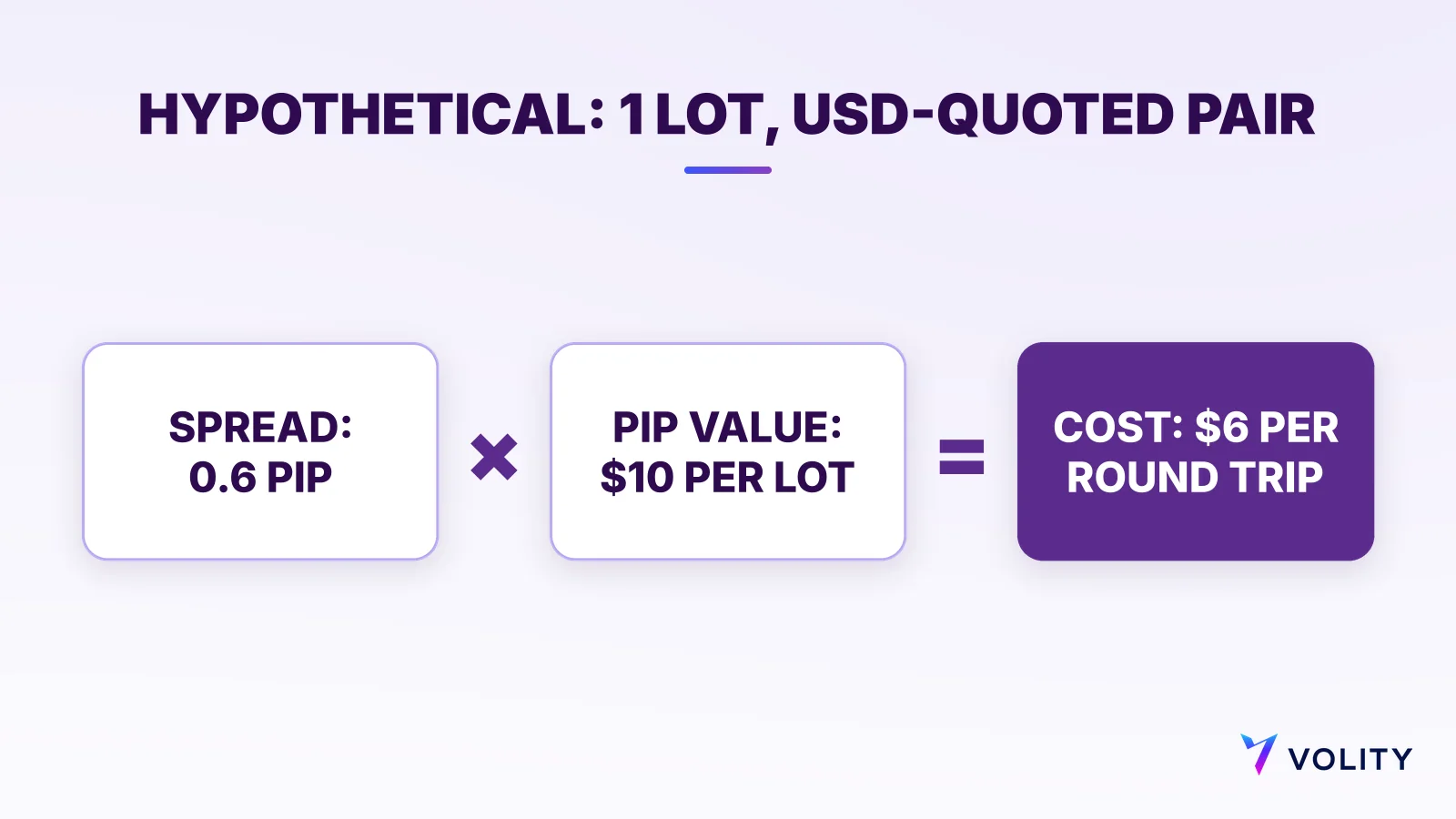
Here is what different spreads cost on 1 lot of a USD-quoted pair, in hypothetical figures:
- 0.2 pip × $10 × 1 = $2
- 0.6 pip × $10 × 1 = $6
- 1.5 pips × $10 × 1 = $15
- 3 pips × $10 × 1 = $30
Say you buy 100,000 EUR/USD at the ask of 1.12143 while the bid is 1.12137. If you sold at once, you would sell at 1.12137 and lose 0.00006 × 100,000 = $6. That $6 is the spread. Before the trade is level, the bid has to rise to 1.12143, a move of 0.6 pip in your favour.
You pay the spread through the prices you open and close at. There is no separate spread charge, and one round trip, opening plus closing, costs one spread. If the spread is wider when you close, your exit price is worse, and that round trip costs more. The spread cost calculator runs the same sums for your pair and size.
Leverage lets you open a larger position with the same deposit. The spread cost follows the position size, so a larger position pays a larger spread in money whatever the deposit. Traders who aim for a few pips per trade feel this most, as our forex scalping guide shows with its break-even maths.
Why spreads widen and narrow during the day
A spread reflects how easily buyers and sellers can be matched at that moment. IG UK notes that very volatile and not very liquid markets have wide spreads. Liquidity here means how much trading is available at each price. In practice, the spread on the same pair can change with:
- The pair. Major pairs, the most traded ones, usually carry tighter spreads than less traded pairs.
- The hour. When fewer dealers are quoting, the gap between bid and ask can grow.
- The news. Around major data releases, prices can jump and spreads can widen for a short time.
- The weekly open. Forex trades 24/5, and the first minutes after the market reopens can be thin.
Two pieces of BIS research show both sides. Over the long run, a 2024 BIS working paper using 25 years of high-frequency data found that bid-ask spreads fell on average in stocks, FX and government bonds. For FX, it found no significant increase in the higher moments of spreads, the statistics that capture rare, extreme widening. Short episodes still happen. Sterling suffered a flash event in early Asian trading hours on 7 October 2016, and the BIS Markets Committee report on it placed significant weight on the time of day as a factor.
A fixed spread is set in advance. A variable spread, also called floating, moves with the market. Our comparison of fixed vs floating spreads covers the trade-offs. On Volity, spreads are dynamic: they change with market conditions, start from 0.6 pip and are tighter on Pro and VIP. The platform shows the current spread for each instrument.
The spread is also separate from slippage, the gap between the price you asked for and the price you got. A limit order sets the worst price you accept, which helps when spreads jump around news.
Spread, commission and the all-in cost
Accounts charge for trading in two main ways. Some build the whole cost into the spread. Others quote a tighter spread and add a commission per lot. Comparing the headline spreads alone favours the second kind, so convert both to one unit first: all-in cost in pips = spread + round-trip commission per lot ÷ pip value per lot. Then compare in pips, or in money for your size.
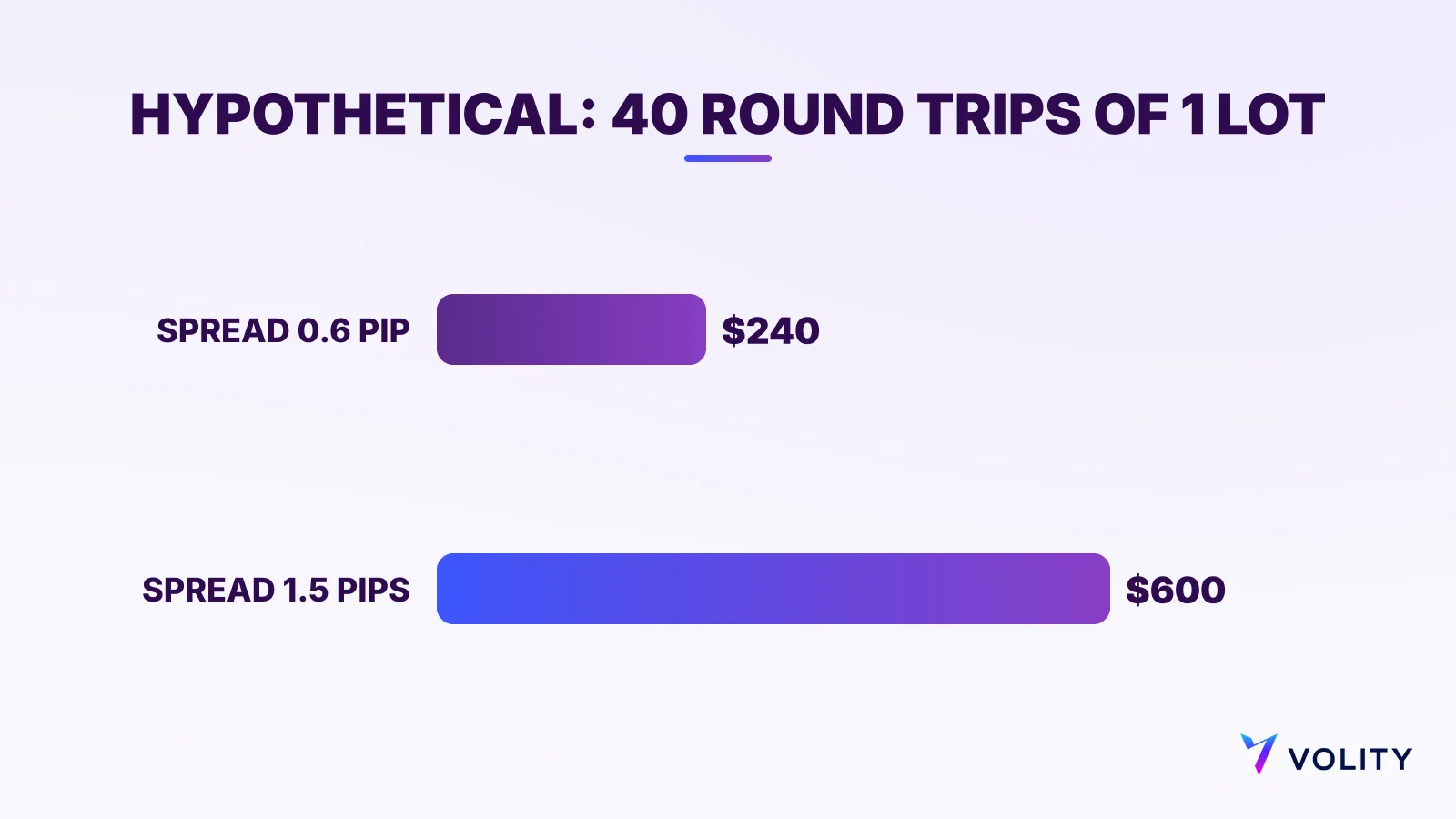
The gap adds up with activity. Say you make 40 round trips a month, 1 lot each, on a USD-quoted pair. At 0.6 pip the spread costs 40 × $6 = $240. At 1.5 pips it costs 40 × $15 = $600. That is $360 a month, or $4,320 over a year, before any commission or overnight amounts. These figures are hypothetical.
On Volity, the Markets account is commission-free, so its trading cost sits in the spread. Pro and VIP trade on tighter spreads with a per-lot commission. The full cost schedule is published on the Volity charges and fees page.
Positions held past 22:00 GMT may pay or receive an overnight amount, also called swap, based on the interest-rate difference between the two currencies. It is separate from the spread, and the rate for each instrument is shown on the platform. The execution policy sets out how orders and overnight positions are handled.
How to check the spread before you trade
A spread you have measured yourself is worth more than any headline figure. Run this routine on the pair you plan to trade:
- Pick the pair and the position size, and work out the pip value per lot in your account currency.
- Open the quote at the hours you actually trade and read ask minus bid. Note whether the platform shows pips or points.
- Check again in a quieter hour and around a scheduled data release, so you see the range, not one moment.
- Convert the widest spread you saw into money with spread × pip value × lots.
- Add any commission and compare accounts on the all-in cost.
- Count the spread in your plan: a trade has to move by at least the spread before it is level.
The free demo is available on every Volity account tier, so you can run this routine before you fund an account.
CFDs are leveraged products, and leverage magnifies losses as well as gains. In 2018, ESMA said national regulators’ analyses showed that 74-89% of retail CFD accounts typically lose money. In the UK, the FCA made its CFD restrictions permanent from 1 August 2019, in policy statement PS19/18. They include leverage limits between 30:1 and 2:1 and a standard risk warning that tells customers the percentage of retail accounts that lose money. These are rules for retail clients in those places.
On Volity, forex, metals, index CFDs and commodities trade with leverage up to 1:500. Crypto CFDs go up to 1:50. Stock CFDs go up to 1:20.
A spread is small per trade and large per month. Before any live trade, know three numbers: the spread on your pair at your hours, its value in money for your size, and the move you need just to get back to level.
Fact check: FX turnover from the BIS Triennial Survey (BIS Quarterly Review, December 2025). Spread research from BIS Working Paper 1229 (November 2024) and the BIS Markets Committee report on 7 October 2016. EUR/USD and EUR/JPY levels from ECB reference rates for 10 November 2026; every quote and cost figure is our own hypothetical arithmetic. Retail CFD rules from ESMA (2018) and the FCA (2019). Broker definition from IG UK, read 11 November 2026. Volity details from volity.io, checked 11 November 2026.
Frequently asked questions
What does a spread of 0.2 mean in forex?
It means the ask is 0.2 pip above the bid. On EUR/USD that is a gap of 0.00002, and on a yen pair 0.002. On 100,000 units of a USD-quoted pair, 0.2 pip is worth $2 per round trip. If your platform shows points, check whether a point is a tenth of a pip.
Is a lower spread always better?
Only when everything else is equal. An account with a tighter spread may add a commission per lot, so compare the all-in cost in pips or money. Also compare spreads at the hours you trade, since a low quiet-hour figure says little about a busy news release.
Who sets the spread in forex?
Your broker quotes the bid and the ask, based on prices in the wider market, and the spread moves with liquidity and volatility. In the wholesale market, the FX Global Code, last updated in December 2024, sets good-practice principles developed by central banks and market participants from 20 jurisdictions. It does not set spread levels.
Do you pay the spread twice, when you open and when you close?
No. A round trip costs one spread in total. You buy at the higher ask and later sell at the lower bid, so the gap is paid once across the two prices. If the spread is wider at the moment you close, that round trip costs more.
Why does the spread widen around news?
Around major data releases, prices can move fast and fewer orders may sit close to the current price. Dealers then quote a wider gap between bid and ask. The widening is usually short, but a trade opened in that window starts further from level.
Should I choose a fixed or a variable spread?
A fixed spread is set in advance, while a variable spread moves with market conditions and can be tighter in liquid hours. Volity spreads are dynamic and start from 0.6 pip. Whichever type you use, measure the spread at your own trading hours.


