Investitionen in Finanzprodukte sind mit Risiken verbunden. Verluste können den Wert Ihrer ursprünglichen Investition übersteigen.
Quick answer
Arbitrage is the simultaneous buying and selling of the same asset on different markets to profit from price discrepancies. Common types include geographic, exchange, statistical, and crypto cross-exchange arbitrage. Margins are typically 0.05% to 0.15% per trade. Arbitrage requires speed, low fees, and strong execution infrastructure to capture fleeting price gaps.
Key Notes
Arbitrage is the practice of profiting from price differences for the same asset in different markets.
Traders buy low in one market and sell high in another simultaneously.
Considered low-risk since profits are based on pricing inefficiencies, not market direction.
Works across stocks, bonds, commodities, currencies, and derivatives.
Types include spot, calendar, statistical, risk, interest rate, and options arbitrage.
What is Arbitrage? Definition, Examples & Types Explained
Learn what arbitrage means in trading, how it works & why it’s considered low-risk. Explore examples and the main types of arbitrage strategies across markets.
What is Arbitrage?
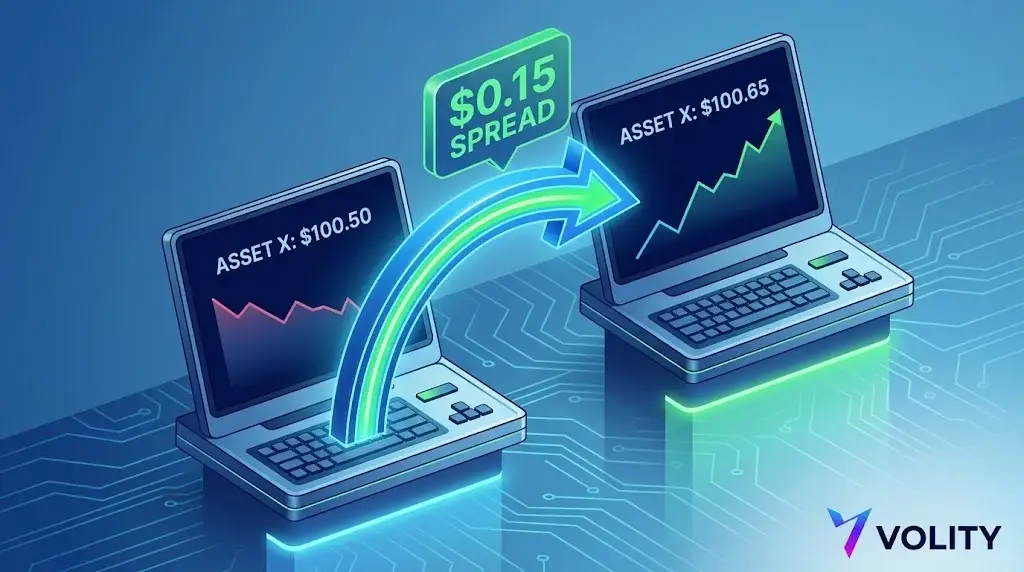
Arbitrage is a trading strategy that seeks to profit from price differences for the same asset across different markets. It works by buying an asset where it is cheaper and simultaneously selling it where it is more expensive, locking in the difference as profit.
Arbitrage opportunities arise when similar assets are traded on different markets and have different prices, resulting in a profit being made when the same asset is bought in one market and sold in the other. Arbitrage opportunities can also arise in the broader sense, involving the divergence of prices across different markets, as well as within a single market.
Arbitrage aims to take advantage of mispricings and make a quick profit for the trader; it is considered to be a low-risk but not risk-free strategy because, as long as the pricing differences exist, a trader can often make a profit, although transaction costs, exchange rates, and execution speed may impact results. For new traders learning how to trade arbitrage, it is crucial to understand both the opportunities and the risks.
Arbitrage is often viewed as an arbitrageur’s quickest way of making a profit since it is based on the speed of trading rather than on the fluctuations of the underlying asset’s market price.
What is an Example of Arbitrage?
An example of an arbitrage opportunity could be buying one share of a company in Europe for €65 and subsequently selling the same share in the United States for $75. In theory, this creates a profit opportunity, although in practice exchange rates, fees, and timing must also be considered.
The concept of arbitrage is further illustrated by a quick example; if a trader believes that a certain stock is undervalued in one market, he can buy a large quantity of such stock and then resell it in another market for a higher price. This transaction can be done extremely quickly and with minimal risk, as the trader is simply exploiting the discrepancy between two markets. The difference in price between the two markets is the arbitrage opportunity and the profit arises from the difference in the prices.
How does Arbitrage Trading Work?
Arbitrage trading is a type of trading where traders take advantage of price discrepancies between two or more markets. It involves buying a security from one market and simultaneously selling it in another market at a higher price, thereby making a profit. Arbitrage trading requires speed, access to multiple markets, and, in modern contexts, often advanced technology or models and can be carried out in any market, including stocks, bonds, commodities, currencies, and even on a crypto trading platform.
What are the Types of Arbitrage?
Arbitrage can occur in the same security on different markets, or across different securities on the same market. There are several different types of arbitrage that traders and investors can take advantage of.
Spot Arbitrage: This involves taking advantage of the difference in price between two similar securities on the same market.
Calendar Arbitrage: This type of arbitrage involves comparing the front-month and back-month futures, and taking advantage of any discrepancies in pricing.
Statistical Arbitrage: This is a form of arbitrage that involves taking advantage of non-arbitrary pricing discrepancies between two related securities.
Risk Arbitrage: This type of arbitrage takes advantage of pricing discrepancies between a target firm’s stock and the purchase price of a merger or acquisition.
Interest Rate Arbitrage: This involves finding differences in interest rates between two different currencies and taking advantage of the discrepancies.
Options Arbitrage: This involves taking advantage of discrepancies between call and put options on the same security.
Risks and Limitations of Arbitrage
While arbitrage is often called „low risk,“ traders must account for:
Transaction costs (fees may erase profits).
Execution speed (opportunities vanish quickly).
Exchange rate fluctuations in cross-border arbitrage.
Market access (requires multiple platforms or brokers, such as an indices trading brokerage or a shares trading broker).
At Volity, we’re passionate about helping our members become successful traders. Our forex trading platform provides educational resources, risk management tools, and access to global markets to help traders make the most of opportunities like arbitrage. With our guidance, you can increase your return on investment and optimize your trading strategies. Join the Volity community and start trading today to take your financial goals to the next level.
Common questions
How does arbitrage actually work in 2026?
Arbitrage exploits price gaps between venues, instruments, or times. The classic case buys an asset cheap on one exchange and sells it dear on another. In 2026 most of these gaps are closed by HFT firms in milliseconds. Retail-accessible arbitrage is now mostly fee-driven (rebates, exchange listings) or structural (basis trades between spot and futures).
Can retail traders profit from crypto arbitrage?
Theoretically yes, practically no. Persistent gaps between centralised exchanges have collapsed; cross-DEX gaps require gas-fee management that ate the edge by 2024. The remaining retail-accessible plays are funding-rate arbitrage on perpetual futures and basis trades during volatility spikes. None are passive income; all need active risk management.
What are the risks of arbitrage trading?
Execution risk (one leg fills, the other does not), withdrawal risk (exchange freezes funds before transfer), counterparty risk (venue insolvency), and timing risk (the gap closes before the round trip). Arbitrage looks risk-free on paper and rarely is in execution. CFDs are complex instruments and come with a high risk of losing money rapidly due to leverage.
Volity betreibt eine Handelsplattform und veröffentlicht außerdem Bildungs- und Analyseinhalte zum Thema Trading. Die Inhalte dieser Seite dienen ausschließlich Bildungszwecken und sind nicht als Finanzberatung zu verstehen. Volity kann kommerziell profitieren, wenn Leser über Links auf dieser Website Handelskonten eröffnen.
Unsere Inhalte werden nach dokumentierten redaktionellen Standards erstellt und geprüft; die Vergleichs- und Bewertungsmethodik wird hier veröffentlicht.