Investir dans des produits financiers comporte des risques. Les pertes peuvent dépasser la valeur de votre investissement initial.
Le kit de demarrage au trading crypto
Un PDF clair et simple : ce qu il faut verifier avant de trader, comment fonctionnent les ordres et le risque, et les erreurs a eviter. Gratuit.
Réponse rapide
Le trading à haute fréquence (HFT) en crypto utilise des serveurs co-localisés, une exécution inférieure à la milliseconde et un routage algorithmique des ordres pour capter de minuscules inefficiences de prix des milliers de fois par jour. Les traders retail ne peuvent pas rivaliser avec les firmes de HFT sur la vitesse. La réponse retail réaliste : trader des unités de temps supérieures où la vitesse n’a pas d’importance, éviter les ordres au marché dans les carnets minces et utiliser des ordres limites pour ne pas se faire prendre de vitesse.
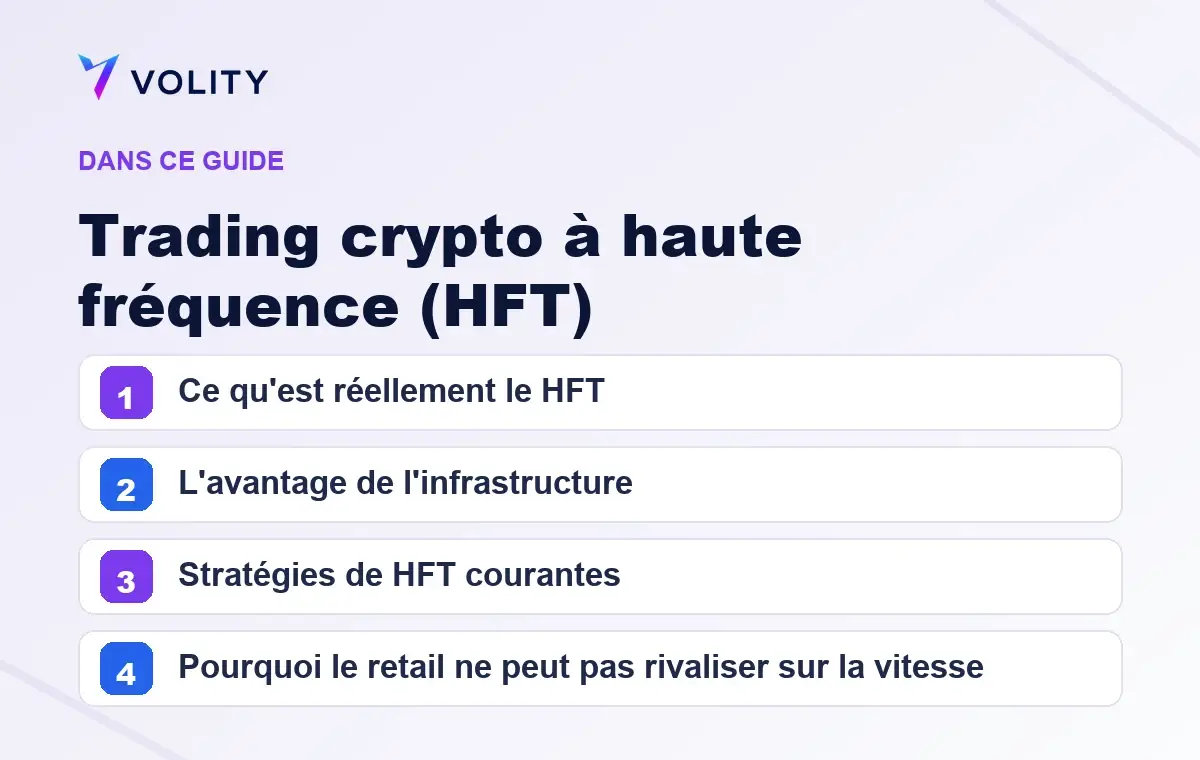
Le trading à haute fréquence est le prédateur institutionnel au sommet des marchés crypto. Il est rapide, gourmand en capital et mathématiquement sophistiqué d’une manière que le trading retail n’est pas. Le message honnête de cet article : vous ne pouvez pas battre le HFT à son propre jeu, et vous ne devriez pas essayer. Ce que vous pouvez faire, c’est comprendre son fonctionnement, reconnaître où il opère et structurer votre trading pour le contourner entièrement.
Ce qu’est réellement le HFT
Le trading à haute fréquence est un sous-ensemble du trading algorithmique défini par la vitesse et la durée de détention. Les positions sont conservées de quelques millisecondes à quelques secondes. Le profit par trade est minuscule, souvent un seul point de base, mais multiplié par des millions de trades par jour, il se compose en revenus considérables. Les stratégies dépendent d’une infrastructure que la plupart des traders retail ne voient jamais.
L’avantage de l’infrastructure
Les firmes de HFT dépensent des fortunes sur trois choses que le retail ne peut égaler :
- La co-localisation. Des serveurs placés dans le même centre de données que le moteur d’appariement de la plateforme d’échange, réduisant la latence à des microsecondes.
- L’accès direct au marché. Des flux bruts de la plateforme d’échange et des passerelles d’ordres, contournant entièrement la couche d’API destinée au retail.
- Du matériel sur mesure. Des puces FPGA et ASIC qui traitent les données de marché plusieurs ordres de grandeur plus vite que des processeurs généralistes.
Stratégies de HFT courantes
Trois dominent en crypto :
- La tenue de marché. Coter les deux côtés du carnet et capter le spread, des milliers de fois par seconde.
- L’arbitrage. Exploiter les écarts de prix d’un même actif entre plateformes d’échange, ou entre le comptant et les produits dérivés.
- L’arbitrage de latence. Voir un changement de prix sur une place quelques microsecondes avant les participants plus lents et trader devant eux.
Pourquoi le retail ne peut pas rivaliser sur la vitesse
Le chemin d’un ordre retail va de votre appareil, à travers l’API de votre broker, sur l’internet public, jusqu’à la plateforme d’échange. Cet aller-retour se mesure en dizaines à centaines de millisecondes. Le chemin d’un ordre HFT se mesure en microsecondes. Le temps que votre ordre au marché arrive, le prix qu’un algo HFT vous a montré peut déjà avoir disparu. Ce n’est pas un complot ; c’est de la physique et du capital.
Comment les traders retail contournent le HFT
Le coup gagnant est de jouer à un jeu différent sur une unité de temps différente :
- Trader des unités de temps supérieures. Sur les graphiques 4 heures et journaliers, un désavantage de latence de 50 millisecondes est sans importance. Le bruit du HFT se moyenne.
- Utiliser des ordres limites. Poster un ordre limite fait de vous le fournisseur de liquidité plutôt que le preneur, évitant le spread que les firmes de HFT récoltent.
- Éviter les carnets minces. Trader des altcoins illiquides pendant les heures de faible volume est là où le HFT prend le plus facilement le retail de vitesse.
- Ne pas courir après le prix. Les ordres au marché dans des prix qui bougent vite sont là où la latence fait le plus mal. La patience neutralise l’écart de vitesse.
Le HFT et la qualité du marché
Le débat est réel. Les partisans du HFT soutiennent qu’il resserre les spreads et ajoute de la liquidité. Les critiques soutiennent que la liquidité est illusoire, s’évanouissant sous tension, et que l’arbitrage de latence est une taxe sur les participants plus lents. Les deux contiennent une part de vérité. Pour le trader retail, la réalité pratique est inchangée : tradez là où la vitesse ne décide pas du résultat.
Un trading conscient du HFT chez Volity
Volity offre une liquidité profonde sur les principales cryptomonnaies via MT4 et MT5, avec des outils d’ordres limites qui permettent aux traders retail de fournir plutôt que de prendre de la liquidité. Le levier crypto retail est plafonné à 1:2 sous l’ESMA. La protection contre les soldes négatifs s’applique. L’exécution est assurée par UBK Markets Ltd (CySEC 186/12).
Volity exploite une plateforme de trading et publie également du contenu éducatif et analytique sur le trading. Le contenu de cette page est uniquement à des fins éducatives et ne doit pas être considéré comme un conseil financier. Volity peut bénéficier commercialement lorsque les lecteurs ouvrent des comptes de trading via les liens présents sur ce site.
Notre contenu est produit et révisé selon des standards éditoriaux documentés ; consultez notre méthodologie de comparaison et de revue.
Questions fréquentes
Quelle infrastructure le HFT exige-t-il réellement ?
Des serveurs colocalisés auprès du moteur d'appariement de la plateforme, des flux de données de marché directs et des logiciels mesurés en microsecondes. Le coût de cet ensemble explique pourquoi le domaine est dominé par des sociétés et non des particuliers.
Reste-t-il un avantage de vitesse pour un particulier ?
Pas face à du véritable HFT. La réponse réaliste consiste à concourir sur un autre axe : des durées de détention plus longues, où quelques millisecondes n'ont aucune importance et où le jugement directionnel compte davantage que la latence.
Le HFT affecte-t-il les ordres des particuliers ?
Pour la plupart des tailles de détail, la tenue de marché par des acteurs rapides tend à resserrer le spread. L'inconvénient apparaît surtout en période de tension, lorsque cette liquidité peut se retirer rapidement et que les spreads s'élargissent fortement.