Bitcoin is doing that maddening thing it does best. It is behaving like the headline is wrong.
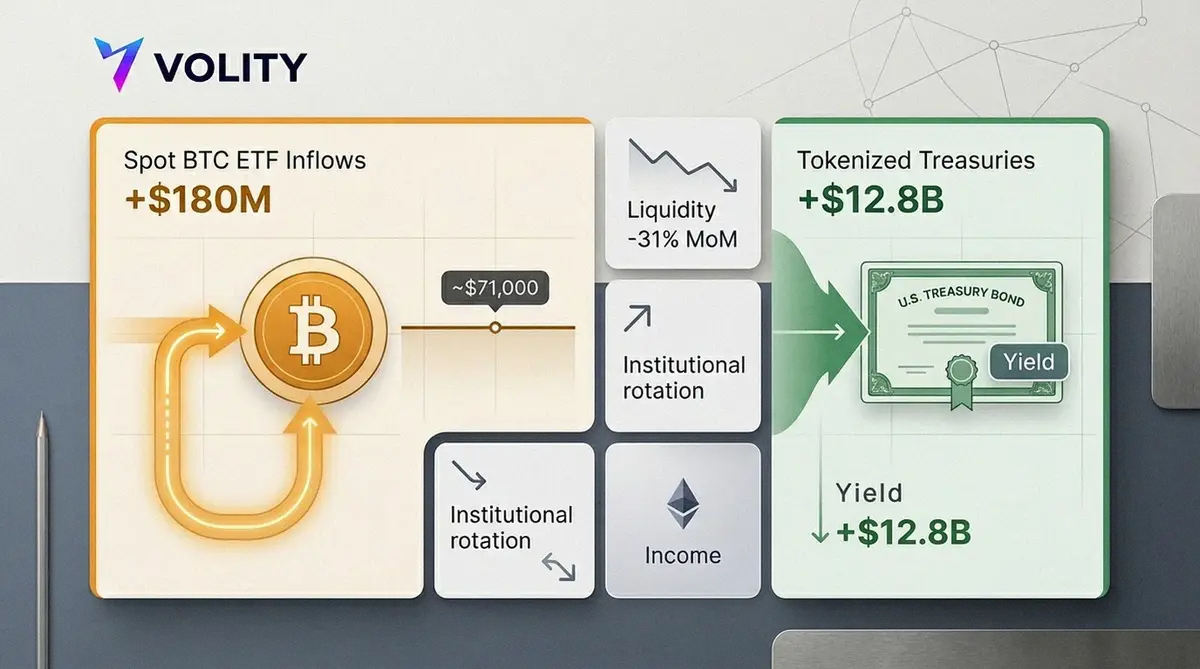
On 13 March, spot Bitcoin ETFs took in $180 million. Yet BTC sat stubbornly around $71,000, pinned in a tight range. Therefore the usual playbook, flows up then price up, looked oddly unreliable. That gap between fresh money and flat price has become March’s central riddle.
February set the bar too high. Bitcoin ETFs pulled in $3.3 billion then, a run that encouraged talk of an institutional second wave. However March, through mid month, has managed only $890 million. That is a 73% drop in pace, and the cooling feels structural rather than mood driven. Importantly, it does not look like a stampede for the exits. Instead, it looks like capital taking a different door.
Tokenised Treasuries take the easy win
While Bitcoin fought for traction, tokenised Treasury products soaked up attention. March flows into those vehicles hit about $12.8 billion. BlackRock’s BUIDL and Franklin’s on chain Treasury funds captured roughly 68% of that total. In other words, institutions found a trade that offers yield, liquidity, and a government backstop. Meanwhile, Bitcoin offered volatility and a debate.
That shift matters because it reframes what “institutional adoption” looks like in 2026. Institutions no longer treat crypto as an alternative system. Instead, they treat it as an extension of the existing one. Therefore a portfolio can hold Bitcoin as an insurance style asset while parking working capital in tokenised bills.
Bitcoin’s inflow streak meets a wall
Last week delivered a clean test of the thesis. Bitcoin ETFs notched their first five day inflow streak of the year, totalling about $767.3 million. Daily intake peaked near $250.9 million on Tuesday, then printed $180.3 million on Friday. Yet the price still failed to break out. That is not a bullish look for momentum traders, even if longer term buyers may not care.
Assets under management in the category rose to about $91.8 billion. However secondary market behaviour looked softer. Liquidity in Bitcoin ETF trading fell about 31% month on month, while average daily crypto ETF volume slipped to around $2.1 billion. Therefore the message is mixed: primary market creation continues, yet day to day churn is fading.
BlackRock’s IBIT still sets the pace, although its March clip looks calmer than February’s. On 11 March, IBIT drew about $115 million. Then, on the following day, BlackRock launched ETHB on Nasdaq, its first yield oriented crypto ETF. The symbolism is hard to miss. Passive accumulation is still there, but the institutional conversation has rotated towards income.
Ethereum finds a cleaner story
Ethereum has offered that income angle, and the market has responded. ETH jumped about 5% as derivatives activity picked up, with open interest pushing beyond $30 billion. Meanwhile Friday flows into Ethereum products came in at roughly $26.7 million. Those numbers are small beside Bitcoin’s, yet they matter because the pitch is different.
Bitcoin gets bought for positioning and optionality. Ethereum, increasingly, gets bought for returns. Therefore ETH can outperform in a market that prizes carry and structure over narrative.
Altcoins wait for catalysts, with Polkadot in focus
Saturday, 14 March, brings a neat calendar hook. Polkadot is set to execute a tokenomics overhaul that cuts annual issuance from 120 million to about 0.88 million DOT, taking inflation from 10% to roughly 3.11%. A supply cap of 21 billion also comes into effect. The marketing writes itself: a quasi halving story without the halving.
DOT traded around $1.58 after breaking above a descending channel that contained it since October. Technical traders also point to a bullish Supertrend flip and a greener MACD histogram. However any “tokenomics day” trade still depends on follow through, not symbolism.
Elsewhere, XRP sat near $1.38 at the apex of a long descending triangle. A break could open a move towards $2.30, about 51% higher, if momentum shows up. Meanwhile Pi Network remained the wild card, up about 30% after a Kraken listing, yet still roughly 95% below its February 2025 high near $2.98.
What traders should take from this
The market does not look broadly bearish. Instead, it looks selective and slightly more grown up. Bitcoin is being treated like a strategic holding, not a daily trading chip. Meanwhile, on chain Treasuries are swallowing the “institutional allocation” headlines, because they fit risk committees neatly. Therefore BTC can see inflows without fireworks, because the marginal buyer is less excitable.
Even in smaller corners, the same pattern holds. A Solana ETF day inflow of about $3.92 million on 12 March, with Bitwise the only issuer capturing flows, hints at discrimination rather than a tide lifting all boats.
- Bitcoin: sticky near $71,000 despite fresh ETF creations.
- Rotation: tokenised Treasuries pulling $12.8bn of March flows.
- Microstructure: Bitcoin ETF liquidity down 31% month on month.
- Theme shift: yield products, including staked ETH exposure, gaining mindshare.
Key takeaways
- Fade simple “ETF inflows equal breakout” trades until BTC clears its range with volume.
- Watch tokenised Treasury flows as a risk appetite barometer inside crypto.
- ETH may trade better than BTC in a yield hungry tape, especially around ETF adoption.
- Event driven altcoin trades need confirmation, as macro liquidity looks less forgiving.