Crypto week: etf outflows, quantum anxiety and a stablecoin world worth $33 trillion
Digital assets walked into 2026 without the usual New Year sugar rush. Instead, money is leaving the neat, regulated wrappers. Meanwhile, lawmakers keep tightening the screws, and a fresh, oddly futuristic fear has floated above the market: quantum computing. However, venture investors still write nine figure cheques, and stablecoins now move sums that look less like “crypto” and more like plumbing.
This week’s tape told a slightly uncomfortable truth. Prices can hold steady for a while, yet flows often confess first. Therefore, the story to watch is not only where Bitcoin trades, but who is actually buying.
Bitcoin and ethereum: etfs put the market on pause
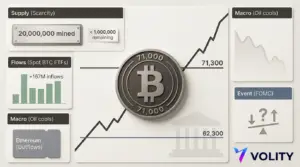
US spot Bitcoin ETFs began January with confidence, then abruptly reversed. From 6 to 8 January, the group logged roughly $1.13bn of net outflows, which largely erased the earlier week’s strong inflows. On 8 January alone, Bitcoin ETF outflows came in near $399m, marking a third straight day of selling. Meanwhile, Ethereum ETFs shed about $159m the same day.
For the first full week of the year, Bitcoin ETF flows were roughly -$681m. Ethereum ETFs sat around -$69m. That weak blotter looks even starker beside the earlier burst, when Bitcoin products pulled in about $471m on 2 January and $697m on 5 January.
Macro is doing what macro does. Traders now stare at looming US inflation prints and the Federal Reserve’s tone. However, hopes for fast, aggressive rate cuts have faded. Therefore, risk appetite has cooled across markets, and crypto has not been spared.
Interestingly, risk has not vanished, it has shifted. While the flagship ETFs leaked, some alt themed products still showed net inflows, including funds tied to Solana and XRP. Consequently, the market feels less “risk off” than “risk redistributed”.
Stablecoin revolution: $33tn of turnover, quietly
While ETFs wobble, stablecoins keep doing the unglamorous work. Annualised stablecoin transaction volume has been put around $33tn, which places it in the same universe as major traditional payment rails. That number matters because it reframes the industry. Speculation still sets the headlines, yet stablecoins increasingly set the habits.
- Stablecoins look less like a trade and more like a settlement layer.
- Therefore, regulatory pressure on issuers and distributors is likely to rise.
- Meanwhile, banks that ignore stablecoin clients risk losing cross border payment flows.
Venture wakes up: big cheques for boring infrastructure
Public market nerves did not stop private funding. Instead, capital leaned into the picks and shovels. This week, stablecoin payments firm Rain raised $250m in a Series C. Meanwhile, investment outfit BlackOpal lined up about $200m for venture deployments across crypto and Web3.
The logic is straightforward. Even if tokens chop sideways, custody, compliance, security and payments still get used. Therefore, infrastructure can compound value while price charts do their usual drama.
Law and politics: tornado cash, prediction markets, reporting rules
The legal backdrop remains twitchy. Ethereum co founder Vitalik Buterin publicly argued for a more lenient sentence for a Tornado Cash developer, warning about the precedent for open source builders. Meanwhile, US lawmakers have pushed a proposal to bar officials from trading on prediction markets, aiming to reduce conflicts and misuse of information.
Elsewhere, Colombia demanded crypto exchanges provide user data linked to Bitcoin, Ether and stablecoins. Therefore, investors should treat regulatory risk as a daily input, not a rare shock. Over time, it will be priced into business models and token valuations.
Quantum anxiety: Jensen Huang turns a distant risk into a near agenda
The week’s most existential headline came from Nvidia chief executive Jensen Huang, who warned that advancing quantum computing could eventually crack today’s encryption standards. The key point is timing. Threat models start before the “perfect” quantum machine arrives. Bad actors can harvest encrypted material now, then decrypt later.
That matters for long lived wallets, archived transactions and private keys. Therefore, the industry’s slow migration towards post quantum cryptography is no longer an academic side quest. Some projects already market “quantum resistant” networks, sometimes citing homomorphic encryption and bespoke consensus designs. However, mass adoption at the base layers of Bitcoin and Ethereum remains distant.
Idiosyncratic shocks: truebit, iran, and the fading nft hangover
Smart contract risk still bites. Truebit suffered an exploit totalling about $26m in ETH, and the token fell as much as 99%. Meanwhile, a case involving Iran’s IRGC alleged roughly $1bn moved through UK linked crypto exchange routes, reviving sanctions questions.
NFT activity also cooled further. Sales dropped about 27% to roughly $62.5m over the measured period, while Bitcoin based NFT sales fell around 65%. Therefore, the market continues to migrate from mania to niche use cases.
Wall Street’s stance: less defence, more controlled offence
Traditional finance did not retreat. Instead, it tightened its grip. Morgan Stanley has been preparing a new digital wallet and broader crypto trading features, alongside ETF filings tied to Bitcoin, Ethereum and Solana. Meanwhile, Bank of America has allowed advisers to recommend selected Bitcoin ETFs, formalising what often sat in a grey zone.
Liquidity plumbing also showed its importance. BlackRock shifted roughly $359m of Bitcoin and Ethereum to Coinbase during the sell off. Therefore, centralised venues remain critical junctions, even in an industry that likes decentralisation as a slogan.
By the numbers
- $1.13bn: US spot Bitcoin ETF net outflows, 6-8 January
- $399m: Bitcoin ETF outflow on 8 January
- $159m: Ethereum ETF outflow on 8 January
- $33tn: estimated annual stablecoin transaction volume
- $26m: ETH stolen in the Truebit exploit
Key takeaways
- ETF outflows signal institutional de risking, therefore expect slower upside follow through in BTC and ETH.
- Meanwhile, persistent inflows to Solana and XRP products point to selective risk taking, not broad capitulation.
- Stablecoin scale keeps rising, so watch regulation and issuer concentration like you would bank risk.
- Quantum talk has shifted from sci fi to roadmap, therefore discount long duration “store of value” narratives accordingly.
- Exploit headlines remain live volatility triggers, so size positions with smart contract risk in mind.
Crypto feels more grown up this January, and not always in a flattering way. There is less easy euphoria, more plumbing, more politics, and more technology risk with a long shadow. However, that is also where the next cycle’s durable winners tend to get built, in plain sight, while the market argues about flows.