Crypto steadies as investors pivot from war headlines to yield
Bitcoin pushed back towards $70,000 on Tuesday, while Ethereum fought to hold the $2,000 line. The price action looked less like panic buying and more like a market exhaling. Overnight, traders had fretted about further escalation in the Iran-US confrontation. By the morning, however, risk appetite returned in patches, helped by calmer rhetoric and a familiar crypto reflex: chase the new product.
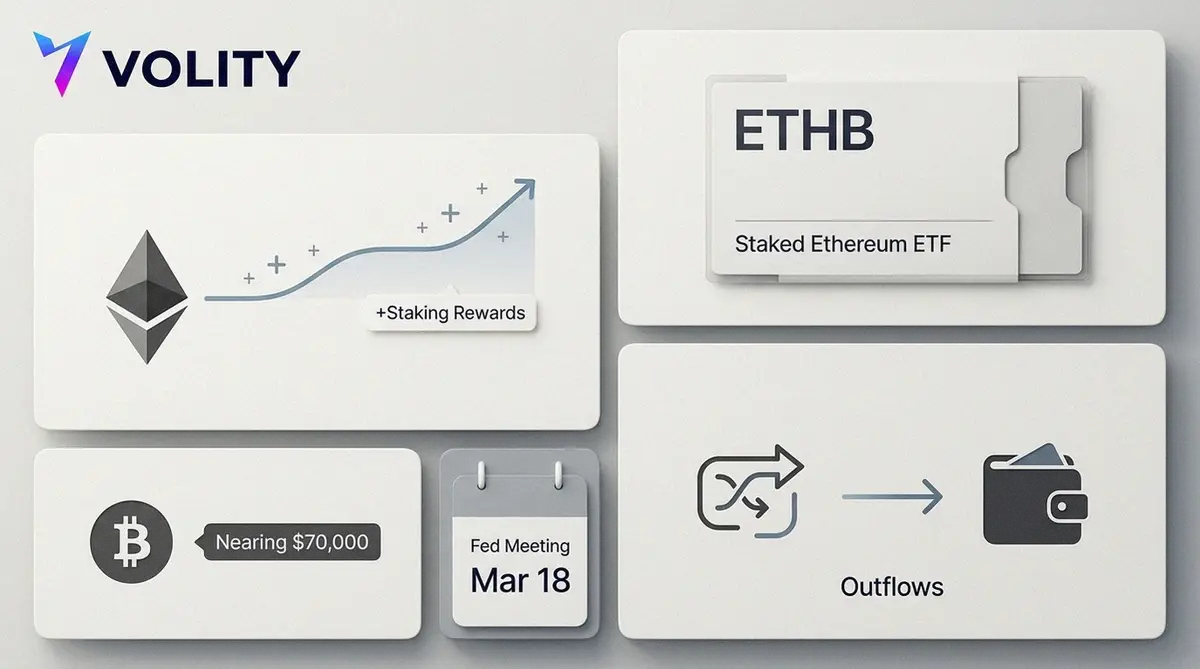
That product came from BlackRock. The asset manager launched the iShares Staked Ethereum Trust ETF, ticker ETHB, on Nasdaq. Therefore, the market’s attention snapped from geopolitics to something more concrete: a yield-bearing Ether wrapper inside a regulated fund. If Bitcoin simply stores scarcity, then Ethereum now pitches income, at least on paper, and that distinction mattered on a day when investors craved a reason to lean in.
BlackRock puts staking on the menu
ETHB offers spot Ether exposure while staking part of the fund’s holdings on-chain. It then passes through 82% of staking rewards after costs. Meanwhile, the fee schedule reads like a land grab: a stated 0.25% that falls to 0.12% for the first $2.5bn of assets or the first year, whichever comes first.
BlackRock has form here. Its spot bitcoin ETF, IBIT, sits at roughly $55bn in assets. Its existing Ethereum vehicle, ETHA, stands near $6.5bn. This third product completes a neat ladder: bitcoin for the allocators, ether for the builders, and now ether plus yield for the spreadsheet crowd. However, the trade comes with a question that never really leaves staking: what happens to distributions if on-chain yields fall, or if operational frictions rise?
Ethereum’s price dipped about 0.3% around the launch, then steadied. That looked like restraint rather than rejection. Traders also watched for supply signals, as large holders reportedly pulled around $155m of Ether off exchanges. Therefore, any sharp break below $2,000 would now have to contend with a cohort that seems comfortable holding inventory elsewhere.
Bitcoin’s bounce, but with levels in mind
Bitcoin’s rebound carried the familiar undertone of a tightening float. Exchange balances have trended lower for months, while long-dormant coins barely budge during sell-offs. Meanwhile, daily crypto trading volumes were cited around $52.6bn, a reminder that liquidity remains deep enough for large funds to express views without turning the market into a wrecking yard.
Still, the chartists have their own map. A push above the recent range highs near $70,000 would keep the path open towards $80,000. However, a slide towards $65,000 stays plausible if macro data bites, or if the geopolitical story regains heat. That tension has kept leverage in check, which is often when the next move arrives.
Altcoins catch a bid, cautiously
With the headline risk fading, some altcoins perked up. Avalanche chatter revived after Grayscale’s Avalanche ETF rolled out, and traders began eyeing a technical break around $10. Meanwhile, XRP holders fixated on talk of a $750m buyback plan, which would tighten supply optics even if execution remains the real test.
Elsewhere, the market stayed true to its nature: always half-fundamental, half-theatre. Pi Coin drew attention on rumours of a Kraken listing and the approach of Pi Day. Solana, meanwhile, flirted with a familiar bull-trap zone around $90. Therefore, the riskiest names moved first, even as the main narrative sat with BlackRock and staking yield.
By the numbers
- ETHB fee: 0.25%, discounted to 0.12% for first $2.5bn or one year
- Staking pass-through: 82% of rewards after fees
- IBIT assets: about $55bn
- ETHA assets: about $6.5bn
- Reported ETH exchange outflows: about $155m
TradFi steps closer as regulators keep the pressure on
Traditional finance kept edging into crypto’s plumbing. Wells Fargo filed a trademark for WFUSD, signalling interest in a bank-branded stablecoin. Mastercard said it had onboarded more than 85 crypto firms to expand stablecoin settlement rails. Revolut notched a UK banking licence, while various jurisdictions pushed sandbox approvals and MiCA-linked milestones.
However, enforcement and operational risk stayed in the background like a low hum. Binance.US named compliance veteran Stephen Gregory as chief executive amid scrutiny tied to sanctions and Iran-related issues. Meanwhile, hacks and glitches continued to provide the market with its most reliable bear case, from wallet-draining domain hijacks to liquidation bugs.
What traders are watching next
Macro stands ready to interrupt the party. The Federal Reserve meeting on March 18 looms, and rate-cut expectations still whip across risk assets. Token unlocks also sit on the calendar, including a $43m unlock for ZRO on March 20. Therefore, the next week could test whether this rally rests on genuine demand, or merely on relief.
Key takeaways
- ETHB changes the pitch: ether now has an ETF wrapper that explicitly targets yield.
- $2,000 matters for ETH: it is both a psychological line and a liquidity magnet.
- BTC levels remain binary: above $70,000 invites $80,000 talk, below invites $65,000.
- Altcoin strength looks fragile: it depends on liquidity staying easy and headlines staying quiet.
- Watch the calendar: FOMC and unlocks can reset positioning faster than any chart pattern.