Oil punches through $100 as strikes and chokepoints jolt markets
Oil traders came back from their screens to a price chart that looked like a panic bid. Brent crude pushed above $100 a barrel, its first clean break of the level since 2022. Meanwhile, WTI followed, with the market suddenly pricing a risk premium that had been dozing for months.
The catalyst was geopolitical, and it was blunt. Fresh U.S.-Israeli strikes hit Iranian targets, and Tehran responded with missiles. However, the bigger trade ran through geography rather than headlines, as traffic in the Strait of Hormuz tightened. Roughly a fifth of global oil flows normally threads that narrow channel, so even partial disruption forces refiners, shippers and insurers to reprice risk in real time.
Equities did what they usually do at first. The broad tape wobbled, with cyclicals losing their footing. Yet energy shares took the wheel, and they did it fast, because higher crude drops straight into cash-flow models. Therefore, the day’s leadership looked old-fashioned: drillers, refiners and integrated majors outperformed while the rest of the index tried to work out whether this was a two-day scare or a longer squeeze.
Rates traders also ripped up yesterday’s script. Petrol is a daily purchase, so it sends inflation expectations higher with unusual speed. As a result, the path to easier monetary policy narrowed, and the market leaned towards fewer cuts in 2026 if crude stays elevated.
Energy was the obvious winner, and refiners mattered most
The cleanest expression was the sector itself. The Energy Select Sector SPDR Fund (XLE) drew fresh inflows as Brent’s move through $100 flipped many trend signals back to “buy”. Meanwhile, oil-linked vehicles such as United States Oil Fund (USO) regained attention as traders chased momentum.
Within the complex, the distinction was important. Integrated giants like Exxon Mobil (XOM) and Chevron (CVX) offer upstream leverage and balance-sheet insulation. However, refiners such as Valero (VLO), Phillips 66 (PSX) and Marathon Petroleum (MPC) can benefit even more when feedstock and product markets dislocate, especially if regional outages and shipping delays widen crack spreads.
Airlines sat on the other side of that see-saw. Higher fuel costs squeeze margins quickly, yet shorting Delta (DAL) or American (AAL) into a market still holding up can be a careless trade. Therefore, many desks waited for confirmation in price action rather than leaning on a neat macro story.
Inflation hedges stirred, while gold behaved like gold again
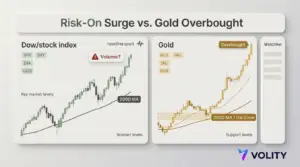
Once crude lifts, the market starts counting second-order effects. Transport costs rise, power prices follow, and consumer inflation looks less tame. Consequently, havens enjoyed a bid, with gold doing its familiar job as both fear hedge and inflation hedge. For many portfolios, SPDR Gold Shares (GLD) is the simplest way to express that view without playing futures.
Industrial commodities also moved with the threat to Middle East output and logistics. However, the risk here is timing, because commodity spikes often overshoot on day one and then mean-revert if shipping lanes reopen. Therefore, traders leaned on technicals for entries rather than chasing the first candle.
AI held its ground, even as energy costs came roaring back
Big tech did not collapse, which was the day’s quiet surprise. Nvidia (NVDA) stayed firm, and the broader AI complex acted like an anchor for risk appetite. Meanwhile, Alphabet (GOOGL), Microsoft (MSFT) and Meta (META) remained tied to the same narrative that has supported them all year: vast spending plans, relentless demand for compute, and the belief that productivity gains can outpace macro drag.
Still, the irony is getting sharper. Data centres keep pulling harder on grids, and higher power costs trickle into operating expenses. However, markets tend to forgive that when revenue growth is accelerating and capex is treated as a moat.
Healthcare found bids, as defensive rotation crept in
Another pocket of strength came from healthcare. UnitedHealth (UNH) held above key levels, while CVS (CVS) and smaller peers caught sympathy flows. In sessions like this, defensives do not need a new story, they only need a reason not to be sold.
By the numbers
- Brent: back above $100 a barrel, first sustained break since 2022.
- Hormuz: about 20% of global oil flows face disruption risk.
- Energy: sector leadership returned as crude repriced supply risk.
- Policy: markets leaned towards fewer 2026 cuts if petrol inflation sticks.
Key takeaways
- Momentum favours energy trend trades, with XLE and USO the clean expressions.
- Refiners like VLO, PSX and MPC matter if dislocation widens product spreads.
- Gold via GLD fits both geopolitical and inflation hedging, especially into volatile CPI prints.
- Airlines are a logical short only after technical breaks, not just a scary oil headline.
- AI megacaps stayed resilient, so hedges may work better than outright tech fades.
The next trade hinges on whether disruption becomes physical and persistent. If shipping and insurance tighten further, $110 to $130 stops looking theatrical. However, if flows normalise, today’s spike becomes tomorrow’s fade, and the market hands back the fear premium as quickly as it found it.