Quick answer
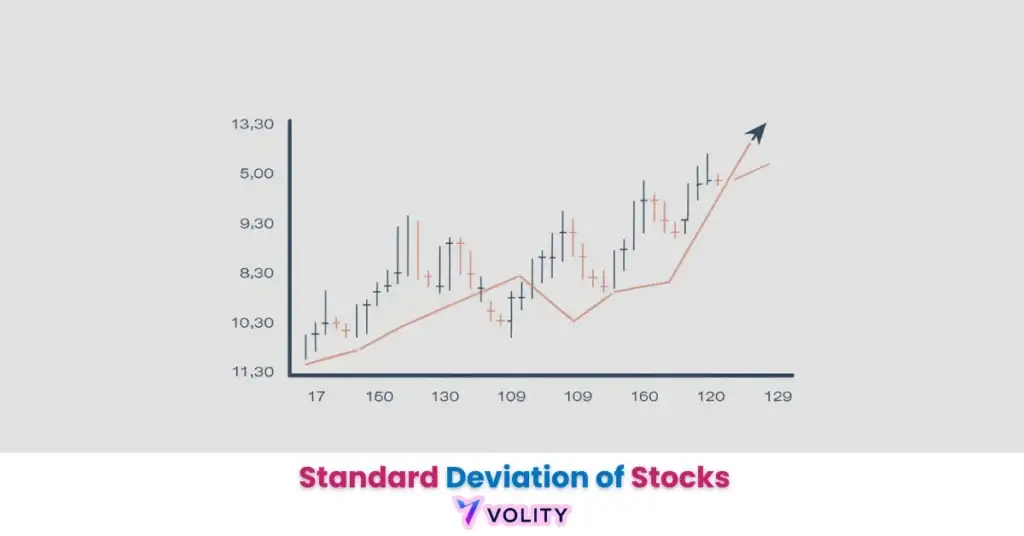
Standard deviation measures how much an asset’s returns vary around their average, making it a core gauge of risk and volatility. A higher standard deviation means bigger, less predictable price swings; a lower one means steadier returns. Traders and investors use it to size positions, compare assets and judge how risky a stock or portfolio is.
Standard deviation calculations applied to investment portfolios carry significant limitations and do not account for all forms of financial risk. Assets exhibiting high standard deviation present elevated volatility and potential for rapid capital losses during market downturns. The statistical tool assumes normal market distributions, which frequently fail during crisis periods when correlations approach 1.0 and diversification benefits evaporate. Past performance is not indicative of future results. Capital at risk.
Standard deviation identifies the historical volatility of a financial instrument by measuring how much its returns vary from the average. This statistical value serves as a universal proxy for risk across all asset classes. A broad, capitalisation-weighted equity index sits in the middle of the risk range: far more variable than cash, far less variable than a single speculative sector.
While understanding Standard Deviation in Finance is important, applying that knowledge is where the real growth happens. Create Your Free Forex Trading Account to practice with a free demo account and put your strategy to the test.
Standard deviation functions as the primary quantitative measure of uncertainty within modern financial markets. This metric identifies the degree to which an asset’s price fluctuates relative to its long-term mean, allowing traders to visualize the potential range of future returns. It serves as a foundational component for building diversified, risk-controlled portfolios in 2026.
The 2026 investment landscape requires a rigorous understanding of how volatility impacts total wealth accumulation. Investors utilize standard deviation to distinguish between stable income generators and speculative assets that exhibit extreme price variance. Understanding this tool reveals why two investments with identical returns can carry vastly different levels of risk.
Why is standard deviation used to calculate risk?
Standard deviation is a statistical tool that measures the dispersion of a dataset relative to its mean, identifying the probability of price fluctuations in an investment. This metric quantifies uncertainty by showing how widely an asset’s historical returns have deviated from its average performance. The tool reveals why investors cannot rely on average returns alone, the range of potential outcomes matters equally.
Variance and standard deviation represent closely related statistical measures. Variance calculates the average squared deviation from the mean, but because it uses squared units, financial professionals apply the square root to return it to the original currency units, creating standard deviation. A normal distribution clusters returns around a central average, forming the classic “Bell Curve” that statisticians reference. This distribution reveals that approximately 68% of outcomes fall within one standard deviation of the mean.
Quantifying uncertainty through standard deviation identifies why wider return spreads represent higher capital loss risk. A stock with a 5% standard deviation exhibits tighter clustering around its mean return, suggesting predictable performance. A stock with a 50% standard deviation displays price fluctuations that span a far wider range, creating elevated probability of experiencing a significant loss. The S&P 500 demonstrates this principle: a diversified index shows far tighter dispersion than any single speculative sector, because sector-specific shocks partly cancel out across its constituents.
Variance measures total return dispersion mathematically. The formula subtracts each year’s return from the historical average, squares the result, and averages these squared deviations. Standard deviation simply takes the square root of variance, converting the metric back to percentage terms that investors understand intuitively. This mathematical process reveals why both high gains and severe losses increase standard deviation, the formula penalizes any deviation from the average, whether positive or negative.
The Empirical Rule (68-95-99.7)
The Empirical Rule identifies the probability that an asset’s return will fall within a specific range based on its standard deviation. In any normal distribution, approximately 68% of observations fall within one standard deviation of the mean, 95% fall within two standard deviations, and 99.7% fall within three standard deviations. This rule allows investors to estimate worst-case scenarios without requiring complex probability calculations.
Consider a stock with a 10% average return and 15% standard deviation. The Empirical Rule reveals that historically, returns fall between -5% and +25% (one SD) approximately 68% of the time. Expanding to two standard deviations shows returns falling between -20% and +40% in 95% of observations. The third standard deviation range captures nearly all outcomes, from -35% to +55%. This mathematical framework allows traders to establish position sizes and stop-loss levels based on statistical probability rather than intuition.
Ready to Elevate Your Trading?
You have the information. Now, get the platform. Join thousands of successful traders who use Volity for its powerful tools, fast execution, and dedicated support.
Create Your Account in Under 3 MinutesWhat does a high standard deviation mean for your portfolio?
A high standard deviation indicates that an asset’s returns are spread over a wide range, representing elevated volatility and higher potential for significant losses. This metric reveals that price movements occur more frequently and with greater magnitude than in stable assets. High-volatility investments create timing risk, exiting a position during an unfavorable market moment becomes more likely as prices swing unpredictably.
Speculative sectors exhibit significantly higher standard deviations than defensive industries. Biotechnology is among the most volatile industries in the US equity market: Damodaran’s Standard Deviations in Equity and Firm Value dataset (NYU Stern, January 2026) puts Drugs (Biotechnology) at 75.68% against 14.96% for Utility (General), which is what extreme price swings driven by clinical trial results and approval decisions look like in a number. The crypto sector demonstrates even higher volatility, with digital assets showing annualized standard deviations exceeding 100%. In contrast, utility stocks typically display standard deviations below 20%, reflecting stable dividend-paying businesses with predictable cash flows.
Timing risk emerges when investors face margin calls or emotional selling pressure during acute downward swings. A stock with 75% standard deviation might experience a sudden 30% daily decline, triggering forced liquidations in leveraged portfolios. The Market Volatility of high-SD assets creates psychological pressure, as investors watch portfolio values fluctuate dramatically over short timeframes. Yet this elevated risk often pairs with higher target returns, the “Risk-Return Tradeoff” rewards investors who tolerate volatility with enhanced long-term wealth accumulation potential.
The reward potential of high-volatility assets creates a paradox. Biotech stocks with 75% standard deviation also exhibit higher average returns than utilities with 20% standard deviation, attracting growth-oriented investors despite the elevated downside risk. Historical data shows that accepting higher volatility over decades generates superior wealth accumulation, the key is matching the high-SD asset to an investor’s time horizon and risk tolerance.
How to compare the risk of two investments using SD
Comparative analysis identifies the superior investment by evaluating which asset provides the most consistent returns per unit of standard deviation. This methodology reveals which security offers “better value” on a risk-adjusted basis, distinguishing between a stable investment and a speculative one. The comparison process prevents investors from conflating high returns with superior performance, a 20% return from a 150% standard deviation asset differs fundamentally from 20% return from a 20% standard deviation asset.
Comparing two assets with identical returns reveals the power of this analysis. Asset A delivers 8% average return with 5% standard deviation, while Asset B delivers 8% average return with 12% standard deviation. The risk-free rate must be subtracted from each return to find the true risk premium. If the risk-free rate is 4%, Asset A offers a 4% premium (8% minus 4%) for accepting 5% volatility, while Asset B offers the same 4% premium for accepting 12% volatility. Asset A clearly provides superior risk-adjusted performance, the Reward-to-Risk Ratio calculation shows Asset A delivering 0.80 return per unit of risk (4% premium divided by 5% SD) versus Asset B at only 0.33 return per unit of risk (4% premium divided by 12% SD).
Using standard deviation to balance a portfolio reveals the power of diversification. Pairing a high-SD technology stock with a low-SD utility creates a combined portfolio SD lower than either component individually. This principle explains why conservative investors often combine 60% stocks (higher SD) with 40% bonds (lower SD), the overall portfolio exhibits lower volatility than pure equity exposure while maintaining some growth potential through diversification benefit.
Work it through with round numbers. Take a real-estate fund at 18% annualised standard deviation and a broad equity index fund at 14%, and construct a 60% index / 40% real-estate portfolio to capture real estate’s income benefits while dampening total volatility. At a correlation of about 0.9 the combined portfolio lands near 15.2% standard deviation, below the 15.6% you would get by simply weighting the two figures, and well below the real-estate fund on its own. Past performance is not indicative of future results.
The Relationship Between Standard Deviation and the Sharpe Ratio
The Sharpe Ratio represents the primary method for calculating risk-adjusted returns by using standard deviation as the measure of total volatility. This metric divides excess return (return minus the risk-free rate) by standard deviation, revealing how much reward an investor receives for each unit of total volatility accepted. The Sharpe Ratio allows direct comparison of investments across different asset classes, time periods, and volatility profiles.
| Asset Class | Illustrative avg return | Illustrative SD | Sharpe Ratio (est) | Risk Profile |
| Cash / Money Market | 4.5% | 0.6% | N/A (Risk-Free) | Minimum |
| S&P 500 (Large Cap) | 10.2% | 14.2% | 0.40 | Moderate |
| Private Equity | 14.5% | 17.3% | 0.58 | Moderate-High |
| Green Infrastructure | 9.1% | 7.9% | 0.58 | Low volatility |
| Biotech Stocks | 18.2% | 75.7% | 0.18 | High-Risk |
The figures above are illustrative inputs chosen to show how the Sharpe Ratio is computed; each row is (return minus the 4.5% cash rate) divided by that row’s standard deviation. They are not a forecast and not a market-data extract.
The Sharpe Ratio reveals that Green Infrastructure and Private Equity both deliver 0.58 return per unit of risk, making them equivalent on a risk-adjusted basis despite vastly different absolute returns. The S&P 500 provides 0.40 return per unit of risk, identifying it as more efficient than Biotech’s 0.18 ratio. This comparison demonstrates why standard deviation matters, Biotech’s 18.2% return appears attractive until adjusted for its 75.7% standard deviation, revealing that the risk undertaken is not proportional to the reward received.
Limitations of using standard deviation as a risk measure
Standard deviation indicates total volatility but fails to distinguish between upward price growth and downward capital loss. This fundamental limitation means the formula treats a surprise 20% gain and a surprise 20% loss as equally risky, an unrealistic characterization of investor preferences. Financial professionals debate whether upward volatility truly represents risk at all, since unexpected gains rarely concern investors.
The assumption of normality reveals a critical weakness in standard deviation models. The formula assumes returns distribute according to a bell curve, yet financial markets exhibit “fat tails”, extreme events occur more frequently than normal distribution theory predicts. The 2008 financial crisis and March 2020 pandemic crash demonstrated this reality: markets experienced losses far greater than three standard deviations predicted should be possible. Standard deviation systematically underestimates tail risk, creating false confidence in risk models.
Upside versus downside volatility creates a conceptual problem. Many practitioners argue that only downside volatility, returns below the mean, truly represents risk to investors. Sortino Ratio and Semi-deviation methodologies focus exclusively on downward volatility, ignoring upward surprises. This distinction reveals why a stock exhibiting extreme gains and stable declines might show high standard deviation yet low true risk from an investor’s perspective.
Modern alternatives to standard deviation address these limitations. Downside Deviation focuses only on negative return deviations, ignoring beneficial surprises. The Sortino Ratio replaces standard deviation with Downside Deviation in the denominator, creating a more focused risk-adjusted return metric. Value-at-Risk (VaR) estimates the maximum loss an investor might experience at a specific confidence level, explicitly incorporating downside focus. The Sharpe Ratio serves as the most widely adopted alternative, while newer frameworks like Conditional Value-at-Risk offer even more sophisticated tail risk assessment.
Turn Knowledge into Profit
You have done the reading, now it is time to act. The best way to learn is by doing. Open a free, no-risk demo account and practice your strategy with virtual funds today.
Open a Free Demo AccountHow to calculate and apply SD in your 2026 strategy
Volatility-based position sizing represents the most effective application of standard deviation for protecting capital in a 2026 market. This methodology scales position sizes inversely with volatility, higher SD assets receive smaller position allocations, while lower SD assets receive larger allocations. This approach equalizes risk contribution across the portfolio regardless of whether positions are in stable utilities or speculative biotech.
Setting stop-losses using two-standard-deviation levels prevents being “stopped out” by normal market noise while protecting against genuine directional reversals. A stock with 10% average return and 15% standard deviation exhibits normal daily fluctuations within a range wider than superficially apparent. Placing a stop-loss at only one standard deviation below the entry point creates frequent false exits during routine volatility. Two standard deviations creates a wider protective band while maintaining capital preservation during true downward trends.
The Portfolio Rebalancing process benefits from standard deviation insights. As assets with high standard deviation generate gains, their portfolio weight increases disproportionately, creating unintended concentration risk. Regular rebalancing restores asset weights to target allocations, automatically selling winners (high-SD winners) and buying losers (lagging diversifiers). This mechanical discipline prevents portfolio drift toward concentrated, high-volatility positions.
Diversification benefit emerges when combining assets with low correlations. Two stocks each with 20% standard deviation might combine into a portfolio with only 15% standard deviation if their returns move independently. The Stop-Loss Order mechanics work more effectively in portfolios where diversification reduces overall volatility. This mathematical reality explains why professional investors emphasize Diversification across uncorrelated assets rather than concentrating in highest-return opportunities.
Key Takeaways
- [Standard deviation] is a statistical measurement that quantifies the total risk of an investment by analyzing return dispersion from the mean.
- [High volatility] is signaled by a high standard deviation, indicating that an asset is prone to large, unpredictable price swings in both directions.
- [The Empirical Rule] allows investors to estimate the probability of returns falling within 68%, 95%, or 99.7% of the average based on SD levels.
- [Risk-adjusted returns] are calculated using the Sharpe Ratio, which divides the excess return of an asset by its standard deviation.
- [Diversification benefits] arise when combining assets with low correlations, effectively lowering the overall standard deviation of the total portfolio.
- [Downside risk] is not perfectly captured by standard deviation, as the formula treats positive gains and negative losses with equal weight.
Frequently Asked Questions
This article contains references to Standard Deviation in Finance, risk measurement methodologies, and Volity, a regulated CFD trading platform. This content is produced for educational purposes only and does not constitute financial advice or a recommendation to buy or sell any financial instrument. Always verify your risk tolerance and consult with qualified financial professionals before applying standard deviation metrics to portfolio construction. Some links in this article may be affiliate links.