The best copy trading platform for you is regulated, says plainly who holds your money, and shows each trader’s full record over several years, including the deepest fall in their account (the maximum drawdown). It also lets you cap how much rides on one trader, lists its costs before you start and gives you a free demo, so you learn how copying behaves before real money is involved.
TL;DR: Copy trading places another trader’s positions in your account automatically, sized to the money you allocate. Judge a platform by its regulator, how it vets the traders you can copy, the limits you control, costs shown upfront and a demo. Judge a trader by drawdown and consistency over years, never by last month’s return. Copied trades are usually CFD trades, and in ASIC’s data 66.53% of copy-trading clients at Australian CFD issuers lost money in FY2023-24.
This guide gives you a test built from what regulators in the EU, the UK and Australia expect from a copy service. You can apply it to any provider, Volity included.
How copy trading works, from the copied trader to your account
Copy trading links your account to another trader’s account. When that trader opens or closes a position, the platform does the same in your account. The size follows the money you set aside for that trader, which is called your allocation. The European Securities and Markets Authority (ESMA) calls the person you follow the “copied trader”, also known as the “signal provider”, in its supervisory briefing on copy trading of 30 March 2023.
Here is a hypothetical example. Say you allocate EUR 1,000 to a trader whose account holds EUR 50,000. Your copy is 2% of their size. If they open a trade that risks EUR 500, which is 1% of their account, your copy risks about EUR 10, which is 1% of yours. Their percentage results become yours.
What gets copied is the position: the market, the direction, the entry and the exit. A buy is called a long position and profits if the price rises. A sell is called a short position and profits if it falls. Your fill price may differ slightly from the trader’s, because your order follows theirs and prices keep moving.
On most platforms the copied positions are CFDs (contracts for difference). With a CFD you trade the price change of a market without owning the asset. CFDs use leverage: a small deposit, called margin, controls a larger position. Leverage makes gains and losses larger by the same factor, so a copied loss can grow fast.
ESMA’s view is that copy trading offered by a firm is “likely to either fall under portfolio management or investment advice”. In plain terms, the firm takes on duties such as checking that the service suits you. ESMA’s announcement addressed the guidance to national supervisors across the EU.
Check a trader before you copy
The headline return is the least useful number on a trader’s profile. ESMA says past performance “should not be the most prominent element” of a firm’s marketing. It also expects the figures to cover the preceding 5 years, or the full life of the service if it is younger, in complete 12-month periods.
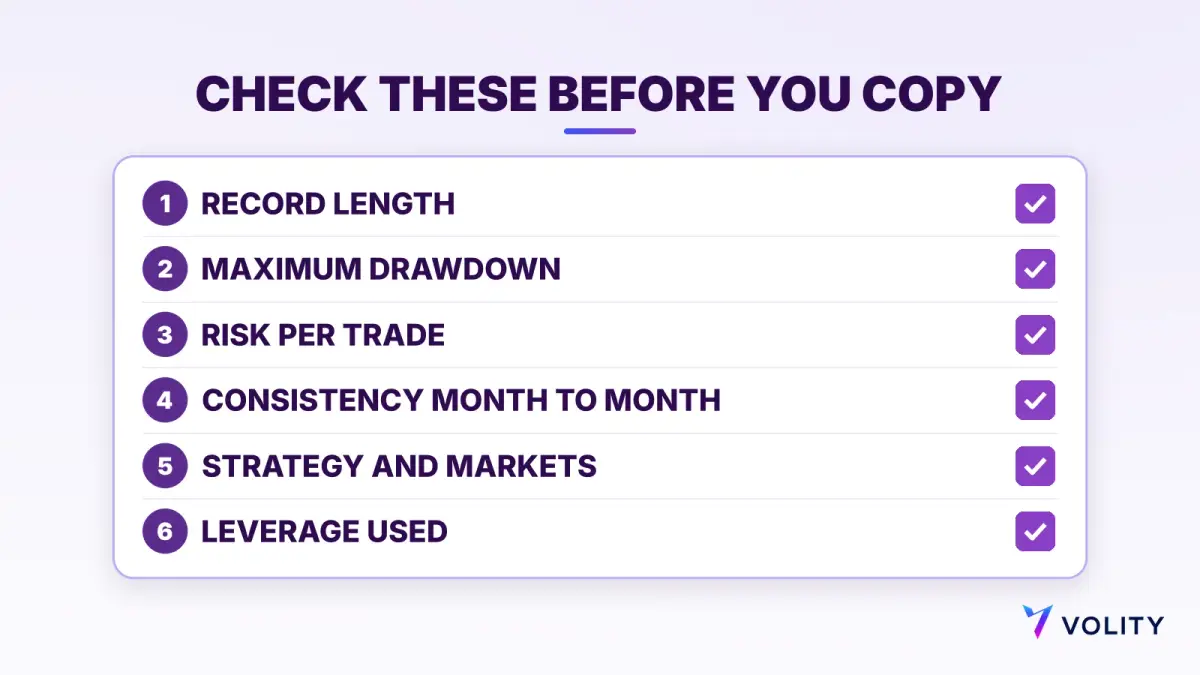
Work through these checks in order before you allocate anything:
- Record length. Look for years of history, ideally including at least one sharp market fall. A few good weeks say almost nothing about skill.
- Maximum drawdown. This is the largest fall from a peak in the account to the low that followed, in percent. Our guide to drawdown in trading shows how to read it.
- Risk per trade. Check how much of the account a single trade puts at risk and whether the trader uses stop-loss orders, which close a losing trade at a set price.
- Consistency. Look at monthly results. Many small, steady months beat one huge month followed by losses.
- Strategy and markets. The trader should say what they trade and how long they hold. A strategy you cannot explain is one you cannot judge.
- Leverage used. High leverage lifts returns in good months and deepens drawdowns in bad ones.
Drawdown deserves the most attention, because losses compound against you. Here is a hypothetical case. A trader’s account grows from 10,000 to 14,000, then falls to 9,800. That is a maximum drawdown of 30%. To get back to 14,000, the account now needs a gain of about 43%. A 50% drawdown needs a 100% gain just to break even.
The number of people copying a trader shows popularity. It does not prove skill, and a crowd can follow a lucky streak. ESMA expects firms to make sure copied traders “act honestly, fairly and professionally” and “meet requirements concerning their minimum skill, trading experience or knowledge”. Ask any platform how it applies that test before a trader can be copied.
What to compare between copy trading platforms
The platform matters as much as the trader. It holds your money, places the copied orders and decides which controls you get. Compare providers on the same five points:
| What to check | What a good answer looks like | How to check it |
|---|---|---|
| Regulation and client money | A named regulator, a licence number and client money kept apart from the firm’s own | Search the regulator’s public register |
| Trader vetting | Published rules on who can be copied | Read the copy trading terms or ask support |
| Your controls | A limit on how much goes to each trader and a way to stop copying at once | Try the controls on a demo first |
| Costs shown upfront | One public page with the full price schedule | Read it before you fund the account |
| Demo account | Free practice with virtual money | Open one before any deposit |
Start with regulation. In the UK, the FCA register shows whether a firm is authorised, and the FCA’s ScamSmart pages list warning signs and firms to avoid. In Cyprus, CySEC publishes warnings to investors about unauthorised firms. A platform that cannot point you to its licence fails the first test.
Next, ask how traders are paid. A trader paid per copier or per trade may be tempted to trade more often or chase attention. The Australian Securities and Investments Commission (ASIC) noted “potential concerns relating to CFD issuers’ supervision and oversight of lead trader conduct, fee transparency and lead trader conflicts of interest”. IOSCO, the global body of securities regulators, raised the same conflicts in its May 2025 report on online imitative trading, including those created by how firms pay lead traders. It asked firms to “regularly review the conduct of lead traders and the outcomes of copy traders” on their platforms.
For a wider view of platforms, see our hub on trading platforms, our guide to the best trading platforms, and this comparison of other social trading platforms.
The real risks of copy trading and how to limit them
The best data on copying comes from ASIC. Its report REP 828, published on 20 January 2026, covers CFD issuers in Australia in FY2023-24. In that year 133,674 retail clients lost money on CFDs, with net losses of over A$458 million, including A$73 million in fees. Overall, 68% of retail CFD clients lost money.
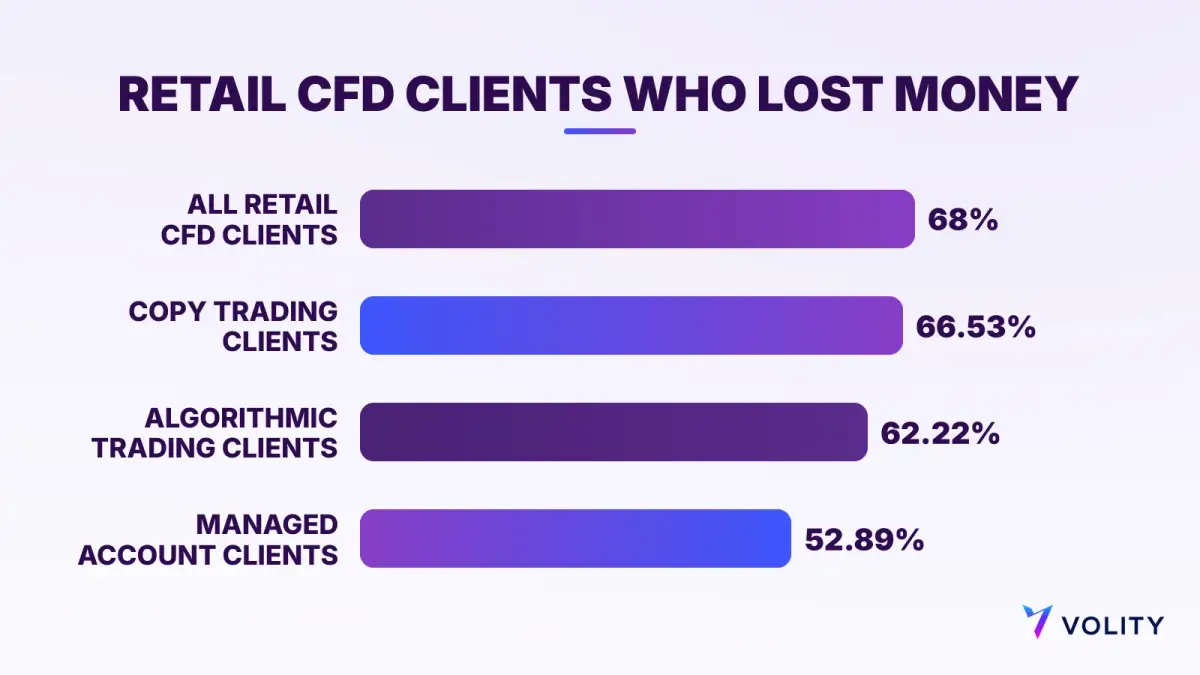
The report splits out copy trading. Of 26,243 retail clients who used copy trading, 66.53% made a loss. Algorithmic trading clients did a little better at 62.22% loss-making, across 8,873 clients. Managed accounts had the lowest share at 52.89%, but only 121 clients used them. ASIC also noted “growing client interest in copy trading services”.
Copying another trader did not turn CFDs into a winning product. Copy traders lost at almost the same rate as CFD clients as a whole.
Regulators limit how much retail clients can lose. ESMA’s 2018 CFD measures capped retail leverage at 30:1 on major currency pairs, down to 2:1 on cryptocurrencies. They also required positions to close when margin falls to 50% of the required level, plus negative balance protection. The FCA made similar rules permanent in the UK in its policy statement PS19/18. Its July 2019 announcement said the rules “guarantee a client cannot lose more than the total funds in their CFD account”.
Those protections have measurable effects. ASIC’s CFD order has applied since 29 March 2021. ASIC reported that in its first six months, retail net losses fell 91%, from A$372 million to A$33 million per quarter. In 2026 it moved to extend and strengthen those protections.
Watch out for social media promotion. In October 2025 the FCA warned that some finfluencers “promise consumers unrealistic returns if they copy trades”. It added: “Over 90,000 people have lost around £75m over a 4-year period” at one firm. In April 2026 it led a week of action against illegal finfluencers, and “Seventeen regulators worldwide took part”.
You can limit the damage with a few habits:
- Allocate only money you can afford to lose in full.
- Spread your allocation across traders with different styles and markets.
- Set your own loss limit for each trader and stop copying when it is hit.
- Review results every month and stop if the trader’s style or leverage changes.
Copy trading and signals on Volity
Copy trading and curated trading signals are part of the Volity trading tools. The tools page describes them in these words: “copy trading to mirror vetted traders, curated buy and sell signals, automation through expert advisors and the API, and full charting to read the market”.
Copying and signals work differently. A copy places the trader’s positions in your account automatically. A signal is a buy or sell call that you read, judge and place yourself, so you keep every decision. Our guide to forex signal providers explains how to judge a signal service.
Volity clients trade real shares, fractional shares, crypto and CFDs in one account. The Markets account is commission-free, and spreads start from 0.6 pip. A spread is the gap between the buy and sell price, and a pip is the smallest standard price step in a currency pair. The full schedule of Volity charges and fees is published before you open an account.
Leverage on Volity goes up to 1:500 on forex, metals, index CFDs and commodities, up to 1:50 on crypto CFDs and up to 1:20 on stock CFDs. Higher leverage also raises the risk of any copied trade, so check the leverage a trader uses before you follow them.
Client deposits go into separate bank accounts, kept apart from the firm’s own money. UBK Markets Ltd is authorised and regulated by CySEC under licence 186/12. Read how client money is protected on the safety of funds page.
Start on a demo account before you fund a copy
A demo account trades with virtual money at live prices. Volity offers a free demo on every account tier. Use it to practise sizing positions and to see how leverage moves your balance and how fast a drawdown builds, without losing real money. See how a CFD demo account works.
Before you copy anyone, write down the most you are willing to lose on that trader. When the account reaches that figure, stop copying and review.
Whichever platform you choose, a trader’s past results do not promise future ones, and a copied loss is your own loss.
Fact check: sources are ESMA’s copy trading briefing (30 March 2023) and CFD measures (27 March 2018), FCA PS19/18 and FCA releases from 2019, 2025 and 2026, ASIC REP 828 (FY2023-24 data), ASIC releases 22-082MR and 26-239MR, and IOSCO’s May 2025 report. Volity details come from volity.io/tools/ and volity.io/safety-of-funds/. Checked on 10 November 2026.
Frequently asked questions
Is copy trading profitable?
It can be, but most retail clients lose money. In ASIC’s FY2023-24 data, 66.53% of copy-trading clients at Australian CFD issuers made a loss, close to the 68% rate for all retail CFD clients. Past results of a copied trader are not a guarantee of future returns.
Is copy trading safe?
The safety depends on the platform and the trader. Use a regulated provider that keeps client money segregated, check the firm on the regulator’s register, and treat any promise of fixed returns as a warning sign. The trades themselves carry the full market risk of CFDs.
How much money do I need to start copy trading?
Start with an amount you can afford to lose in full. On Volity, a Markets account starts from $1, with funding from 10 EUR. A free demo lets you practise first with virtual money before you put real funds behind any trader.
How do I find the best trader to copy?
Read several years of history and focus on maximum drawdown, risk per trade and monthly consistency. Avoid traders whose results come from one big month.
Can I lose more than I invest with copy trading?
Under ESMA and FCA rules, retail CFD clients in the EU and UK have negative balance protection, so their losses cannot exceed the funds in their CFD account. You can still lose your whole allocation, and leverage makes that happen faster.
What is the difference between copy trading and trading signals?
A copy runs the trader’s positions in your account automatically. A signal is a buy or sell call you review and place yourself, so you decide the size and timing.