The best platform for swing trading is one you can trust while you are away from the screen. A swing trade stays open for days or weeks. So the platform must show the overnight cost before you trade, keep your stop working through nights and weekends, state each market’s hours and chart the timeframes you plan on. This guide covers overnight costs, gap risk, central-bank dates and leverage rules, then gives a demo checklist to test any platform before you fund it.
TL;DR: Judge a swing trading platform by what happens while you hold. Positions held past 22:00 GMT may pay or receive an overnight amount, so find the rate for your market on the platform first. A stop-loss closes at the next available price, which can be well past your level if the market reopens beyond it. Mark central-bank dates inside your hold, size from the stop rather than from the leverage on offer, and run the checklist below on a free demo.
Swing trading sits between day trading and long-term investing. You hold a position for days or weeks to catch a larger part of a price move, so most of the trade’s life passes while you are not watching. The BIS Triennial Survey reports that global FX trading hit $9.5 trillion per day in April 2025. That market trades through the night on weekdays. Our separate guide on how swing trading works covers entries and setups. This page is about the platform.
What a swing trading platform must do while you hold
A day trader closes everything before the session ends. A swing trader does not, so the platform is tested in the hours you are not looking.
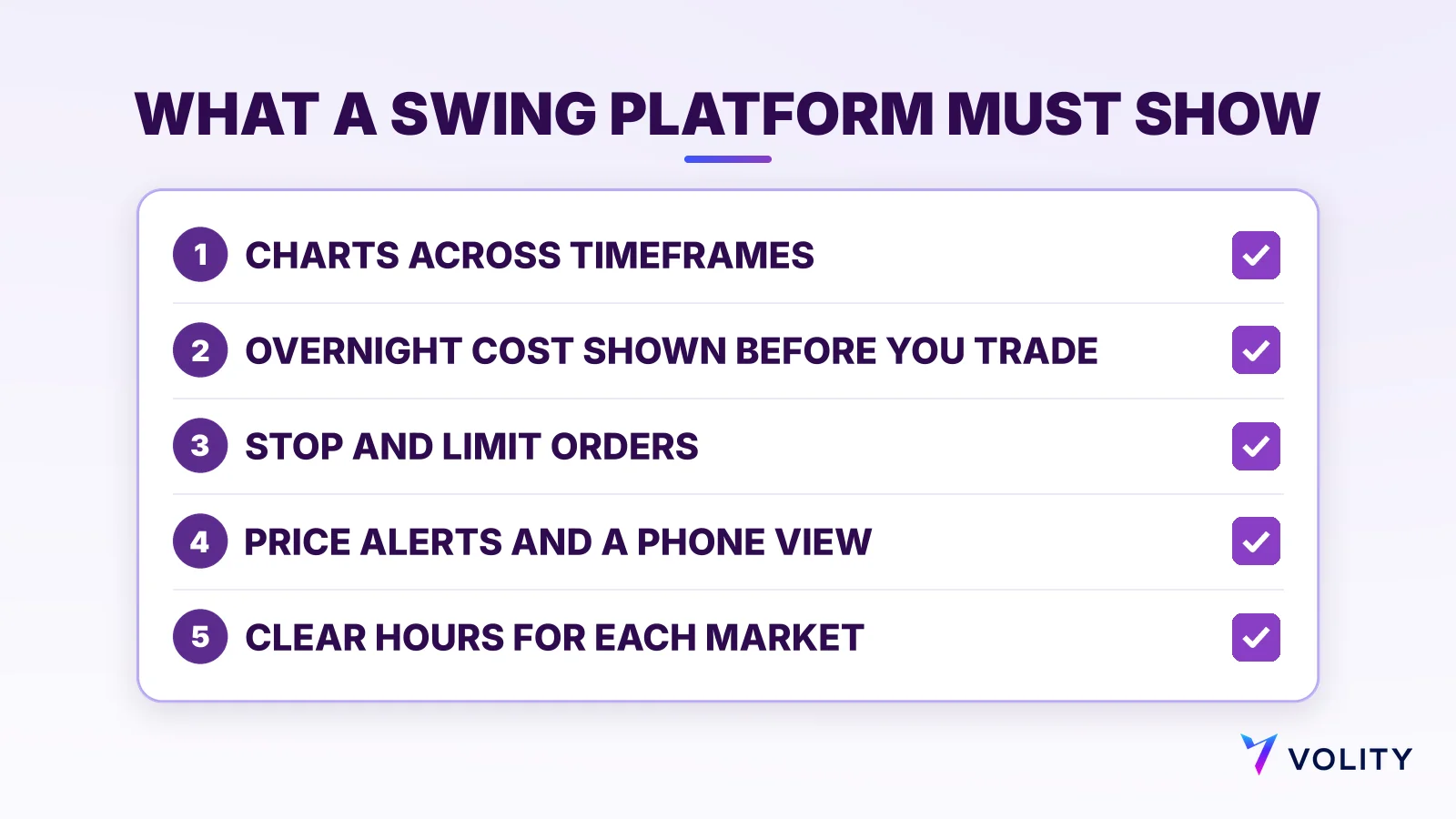
Start with charts across timeframes. Swing traders often plan on daily or weekly charts and time entries on shorter ones. Check that you can switch timeframes on one chart and keep the lines you drew.
Next, the overnight cost should be visible before you click. Each night a position stays open can add a charge or a credit. A platform that shows the rate per instrument lets you price the hold before you enter.
Orders must work without you. A stop-loss closes a trade once price reaches your level. A limit order fills only at your price or better, but it may not fill at all. Our comparison of market and limit orders shows which fits an entry and which fits an exit.
You will not watch the chart all day. Find out how the platform tells you that price has reached a level, and how an open position looks on a phone. Our guide to mobile trading lists what to test on a small screen.
Finally, each market needs clear hours. Some markets pause at weekends and some trade around the clock. The hours decide when your stop can be filled and when the price can jump. The trading platform guides cover each market in turn.
What it costs to hold a position overnight
Overnight costs apply to leveraged CFD positions. A CFD is a contract that pays the difference in an asset’s price between opening and closing, without you owning the asset. A leveraged CFD position is partly financed, so holding it overnight carries a cost or a credit.
On Volity, positions held past 22:00 GMT may pay or receive an overnight (swap) amount. For forex it is based on the interest-rate differential between the two currencies. For non-forex CFDs it reflects the leverage cost. Whether you pay or receive depends on the direction of the trade.
A day trader never meets this amount. A swing trader meets it every night the trade stays open, so set it against your price target before you enter.
Volity shows the per-instrument rate on the platform, and the full cost schedule is on the Volity charges and fees page. Read the rate for your market before you open the trade. The execution policy sets out how orders and overnight amounts are handled. If your faith rules out paying or receiving interest, Islamic (swap-free) accounts are available.
Gap risk and why a stop can fill beyond your level
A gap is a jump in price with no trading in between. It can happen when a market reopens after a pause, or when news lands while few orders are in the market. A stop-loss is an instruction to close at the next available price once your level is reached. If the first available price is already past your level, that is where the trade closes.
Here is a hypothetical example, not a Volity quote. You buy EUR/USD at 1.1000 on a Friday and set a stop at 1.0950, which is 50 pips below. A pip is the smallest standard price step, 0.0001 on EUR/USD. Your position size makes each pip worth $2, so you plan to risk $100. News breaks over the weekend and the pair reopens at 1.0900. Your stop closes the trade there, 100 pips below your entry. The loss is $200, twice the plan, before any costs.
Forex trades 24/5, so the weekend is the longest pause in a currency pair’s week. Crypto and a growing range of other markets, including gold, silver, US500, US100 and WTI, trade 24/7 on Volity. Their prices keep moving while you sleep or travel. A stop and a size you can live with at any hour matter there too.
Gap risk stays with every position held across a pause. What you control is size. Before you enter, ask one question: if the loss were twice your stop distance, could the account take it? If not, trade smaller.
Central-bank dates that fall inside your hold
Interest-rate decisions move currencies, and central banks publish their dates months ahead. A swing trade that spans one is also a bet on the decision, planned or not.
As of 11 November 2026, the Bank of England’s Monetary Policy Committee dates show the next decision due on 17 December 2026, and 2027 dates are already confirmed. The Federal Reserve’s FOMC calendar lists a meeting on 8-9 December 2026. The ECB publishes its own Governing Council meeting calendar. Check all three before you open a trade you plan to hold for weeks. Then decide whether to close first, hold with a smaller size, or wait until after the decision.
Rate decisions can reach your costs too. Overnight amounts on forex are based on the interest-rate differential, so a change in rates can change what you pay or receive on the same position.
Leverage rules on a trade you hold for days
Leverage lets you open a position larger than the money you put up for it, which is called margin. On a multi-day trade, leverage works on every night of the hold, so it has more time to turn against you.
Regulators limit it for retail clients in their own markets. In 2018 ESMA agreed retail CFD leverage limits “from 30:1 to 2:1”. That meant 30:1 for major currency pairs, 20:1 for non-major pairs, gold and major indices, 10:1 for other commodities and non-major equity indices, 5:1 for individual equities and 2:1 for crypto. It added a margin close-out at 50% of the minimum required margin and negative balance protection per account. ESMA then adopted final product intervention measures.
The UK’s FCA confirmed permanent rules in July 2019. Firms must limit leverage to between 30:1 and 2:1 and close out a position when funds fall to 50% of the margin needed. They must also make sure a client cannot lose more than the total funds in the CFD account. The rules apply from 1 August 2019. The detail sits in policy statement PS19/18 and in COBS 22.5 of the FCA Handbook. In Australia, ASIC extended its CFD product intervention order for five years in 2022.
The reason for these rules shows in the ESMA statement. National regulators’ analyses found that “74-89% of retail accounts typically lose money on their investments”. That is a 2018 figure, from before the new limits applied.
On Volity, leverage goes up to 1:500 for forex, metals, index CFDs and commodities, and up to 1:50 for crypto CFDs. Stock CFDs go up to 1:20. Leverage magnifies losses as well as gains.
A hypothetical example shows why size matters more than leverage for a swing trader. A $10,000 position needs $20 of margin at 1:500 and about $333 at 1:30. A 1% move against you costs $100 either way, which is five times the margin in the first case. Leverage decides how much money the trade ties up. Your size decides what each move costs.
How a swing trade works on Volity
Volity’s platform is Volity MT, with charts by TradingView. One account holds real shares, fractional shares, crypto and CFDs, with 350+ CFD instruments and 10,000+ instruments to trade overall. A swing trader can hold a currency pair, a gold position and a crypto trade side by side, each with its own hours.
Precious-metal CFDs cover gold, silver, platinum and palladium. Other commodity CFDs include WTI and Brent crude, natural gas and copper. See the gold trading platform and commodity trading platform pages.
Trading on the Markets account is commission-free. Spreads are dynamic, tighter on Pro and VIP, and start from 0.6 pip. The live spread for each instrument is shown on the platform. Real-time market data is free for active traders, and there is no custody or platform fee. A Volity Markets account starts from $1, with funding from 10 EUR.
Client deposits are kept in separate (segregated) bank accounts, apart from the firm’s own money. Where UBK Markets Ltd provides the trading service, execution and client-money handling are governed by its client agreement and policies. UBK Markets Ltd is authorised by CySEC, licence 186/12. For eligible claims relating to covered investment services provided by UBK Markets Ltd, Cyprus Investor Compensation Fund protection may apply, subject to the scheme’s rules and limits.
Test the platform on a demo before you fund it
A demo account trades virtual money, so you can test a multi-day hold before any money is at risk. Volity offers a free demo on every account tier. Run the test over at least one week, so it includes a weekend.
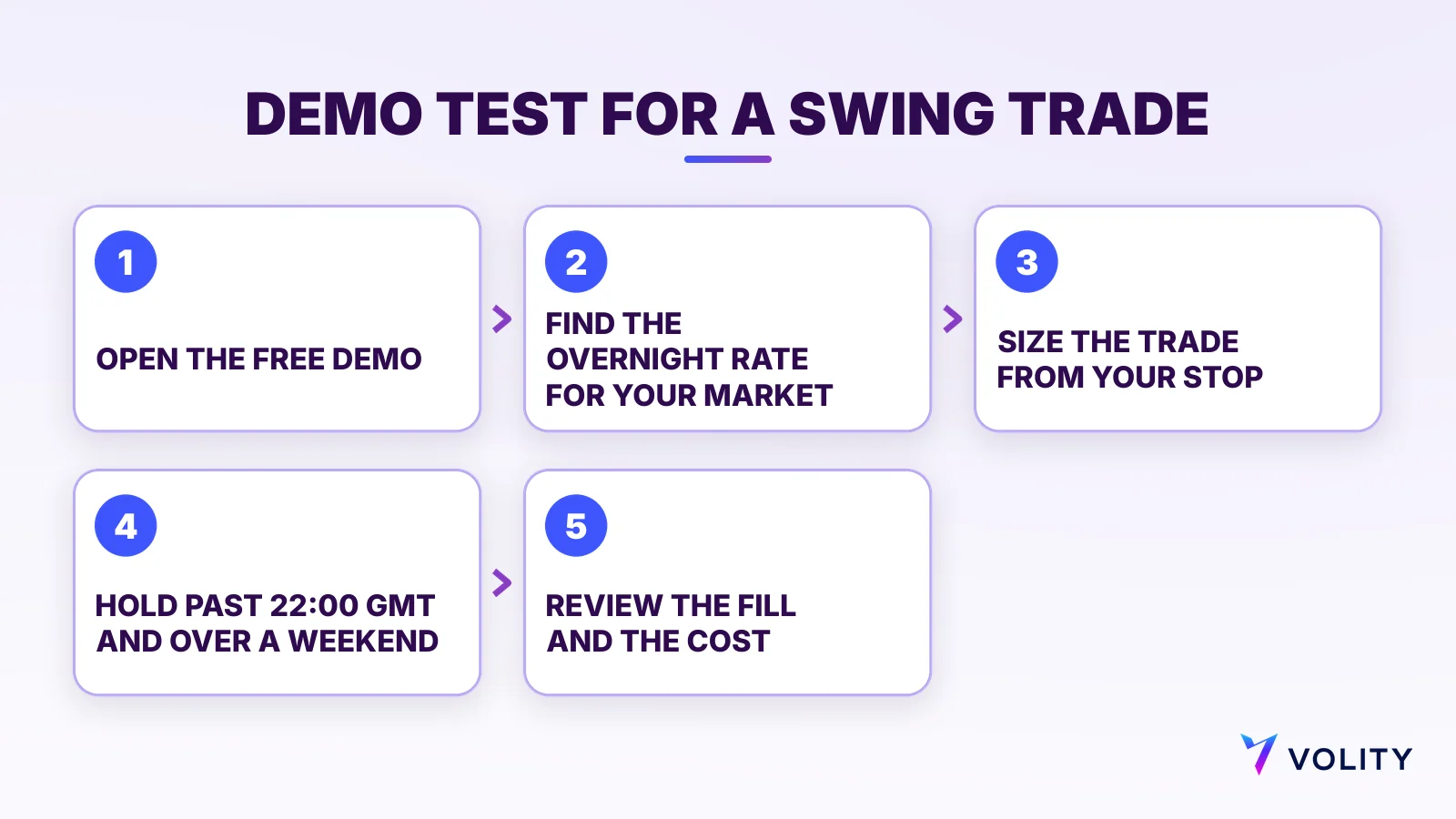
- Open the free demo and pick the one or two markets you plan to swing trade.
- Note the hours of each market: on Volity, forex trades 24/5, while crypto and a growing range of other markets, such as gold, silver, US500, US100 and WTI, trade 24/7.
- Open a chart and check that the timeframes you plan on, such as daily and 4-hour, are there and easy to switch.
- Find the overnight rate for each market on the platform before you open a trade.
- Look at the order ticket: check how you set a stop-loss, a take-profit and a limit entry.
- Check how the platform alerts you to a price level, on a computer and on a phone.
- Size a demo trade from your stop so that twice the stop distance would still be an acceptable loss.
- Hold it past 22:00 GMT and over a weekend, and note how the price moved.
- Review the result: did the stop fill where you expected, and did the cost of holding fit the plan?
If every check passes and the loss at your stop fits your plan, move to a small live account with the same rules.
Fact check: Worked examples are our own arithmetic on hypothetical numbers (11 November 2026). Rules and data from ESMA (March 2018), the FCA (July 2019, PS19/18, COBS 22.5), ASIC (2022), the BIS Triennial Survey (April 2025 data), the Bank of England, the Federal Reserve and the ECB (meeting calendars read 11 November 2026). Volity details from volity.io, checked 11 November 2026.
Frequently asked questions
What is the best platform for swing trading?
The best platform for swing trading shows the overnight cost per market before you trade, states clear hours, gives you stop and limit orders and charts across timeframes. Test those points on a free demo, holding a trade through a weekend, before you fund an account.
Do I pay to hold a swing trade overnight?
Usually there is an overnight amount. On Volity, positions held past 22:00 GMT may pay or receive one, based on the interest-rate differential or the leverage cost. The rate for each instrument is shown on the platform.
Can I swing trade at the weekend?
Yes, on markets that trade 24/7. On Volity, crypto and a growing range of other markets, including gold, silver, US500, US100 and WTI, trade 24/7, while forex trades 24/5.
What is gap risk in swing trading?
Gap risk is the chance that price jumps past your stop while a market is paused or thin. Your stop then closes at the first available price, so the loss can be larger than planned. Size each trade with that in mind.
Can I swing trade with a small account?
Yes. A Volity Markets account starts from $1, with funding from 10 EUR. Keep the size small enough that a loss of twice your stop distance would not hurt the account, and practise on the demo first.
What leverage can I use for swing trading?
On Volity, leverage goes up to 1:500 for forex, metals, index CFDs and commodities, and up to 1:50 for crypto CFDs. Stock CFDs go up to 1:20. Higher leverage ties up less margin but does not reduce the loss per move.