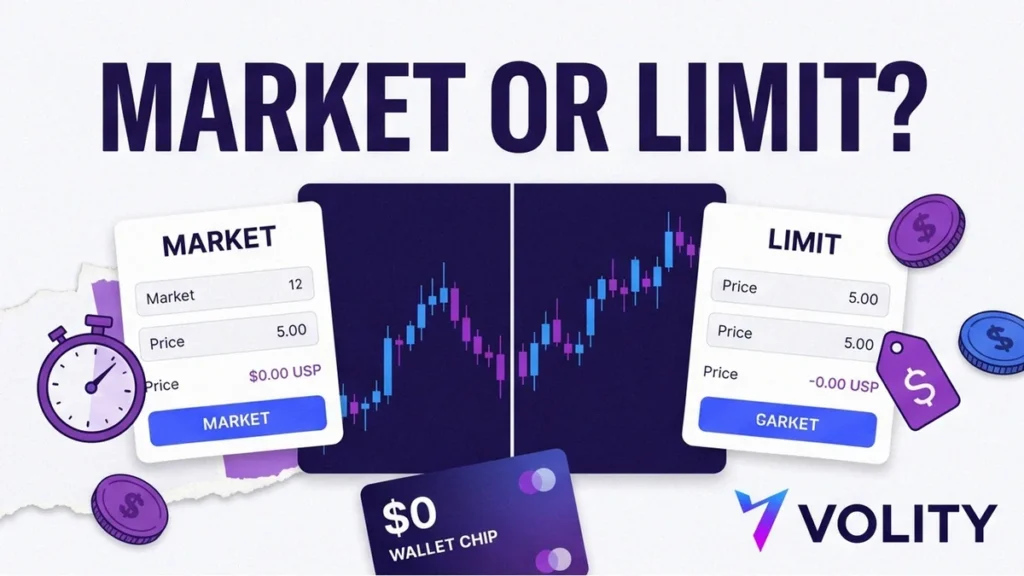
You are about to click buy, and a small panic hits: do you take the price on screen right now, or set your own and wait? That single choice is the whole market order vs limit order question. A market order buys you speed, a limit order buys you price control, and picking the wrong one quietly costs you money. By the end of this guide you will have a fast rule and a checklist that tell you exactly which to click.
TL;DR / Quick insight: A market order fills now at the best available price, so you trade price for speed and accept a little slippage (the gap between the price you saw and the price you got). A limit order fills only at your set price or better, so you trade speed for price and accept that it might never fill. Beginners should default to limit orders to cap the price, and reach for a market order only when getting in or out right now matters more than the exact number. On a commission-free Volity Markets account the broker charge does not flip between the two, so the real cost difference is slippage versus a missed entry, not commission.
Order type is the most underrated skill in trading. People obsess over which asset to buy, then hand back their edge by clicking the wrong button at execution. The logic is identical whether you trade real shares, fractional shares, crypto or CFDs (a contract that tracks an asset’s price without owning it), so learning it once pays off everywhere.
1. Understand the one-line difference: speed vs price control
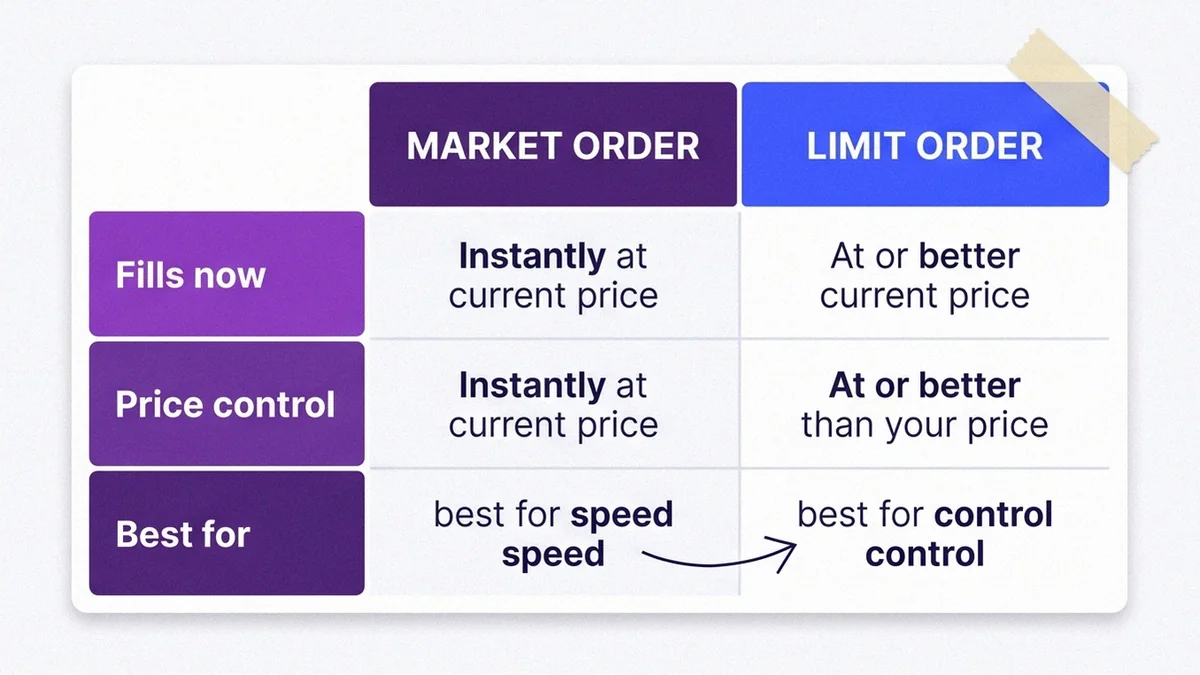
A market order says “fill me now, at whatever the best available price is.” A limit order says “fill me only at this price or better, and wait.” Speed versus price is the trade-off you choose every time.
Two plain-English terms make the rest click. The spread is the small gap between the buy price and the sell price at any moment; it is the built-in cost of entering and exiting. Slippage is when the price moves between your click and the fill, so you get a slightly worse number than you saw. Market orders can suffer slippage; limit orders cannot, because they refuse any price worse than you asked for.
The common mistake is treating this as a personality test (“I am careful, so I always use limits”). It is a per-trade decision. Do this: keep one question by your screen – “Right now, do I care more about getting filled, or about the exact price?” Whichever wins is your order type.
2. See how a market order fills (and weigh the slippage risk)
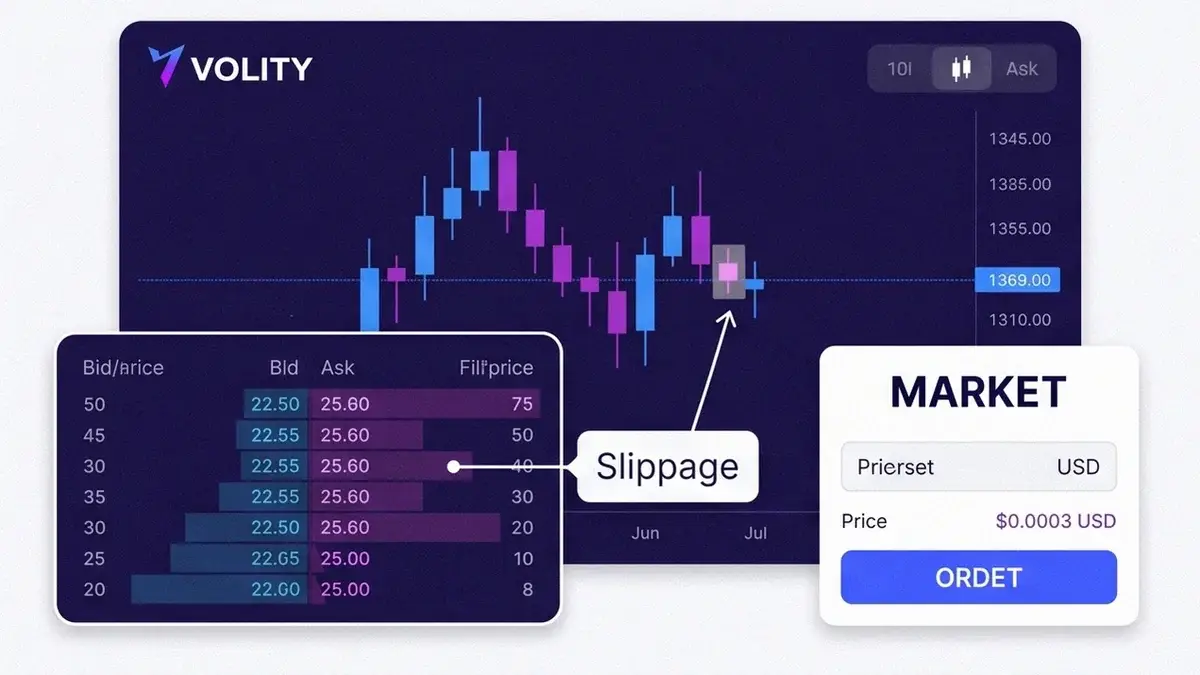
You hit buy, the platform grabs the best price on offer, and you are in, usually in a blink. That speed is the point: when you need to be in or out right now, a market order guarantees it happens. The catch is that “best available price” can move while your click travels. In a fast or thin market (few buyers and sellers, so each trade nudges the price), the number you saw and the number you got can differ. That gap is slippage, and it stacks on top of the spread. An illustrative example, not a Volity figure: you see 100.00, click market buy, and it fills at 100.04, so you paid four extra points.
You can make this cost concrete before you click. On a Volity Standard account spreads start from 0.6 pip (a pip is the smallest standard price step on a currency pair, so this is a very tight entry cost), and spreads are dynamic, widening and tightening with the market. Do this: before any market order, read the live spread and ask “am I happy paying this plus maybe a little slippage to be in now?” If yes, click. If not, switch to a limit.
3. Place a limit order (and plan for why it might not fill)
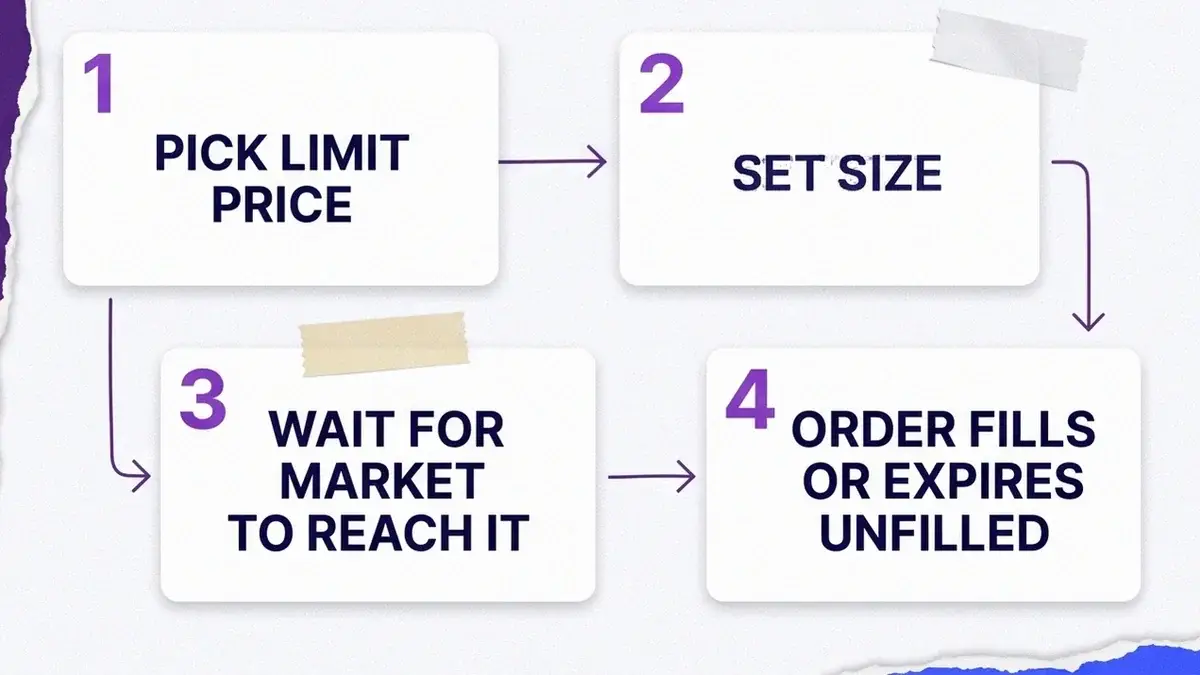
A limit order flips the deal. To buy, you set a limit below the current price and it rests there, filling only if price falls to your level or better. To sell, you set one above price. You get your price or better, never worse. The cost of that promise is uncertainty: if price never reaches your level, you do not get the trade.
Two things trip up beginners. Partial fills: if there is not enough volume at your exact price, you might get only part of your order filled. And the order can sit for days and fire when you have forgotten it. The fix for both is time-in-force – a setting that tells the order how long to stay alive. “Day” cancels it at the close; “good till cancelled” keeps it until you pull it. Think of it as an expiry date on your offer.
The common error is dropping a limit at a random round number and hoping. Do this: set it at a level you can defend – a support zone (a price where buyers stepped in before), a resistance zone, or a price you would be glad to own – then pick a time-in-force so a stale order cancels itself.
4. Compare them side by side
Put the two order types next to each other and the choice stops being fuzzy. This table is the core of the guide.
| What you are weighing | Market order | Limit order |
|---|---|---|
| Cost (broker) | Commission-free Volity Markets account; you pay the spread | Commission-free Volity Markets account; you pay the spread |
| Fill certainty | High – fills now, almost always | Lower – only if price reaches your level; may not fill |
| Price certainty | Low – you accept the best available, including slippage | High – your price or better, never worse |
| Speed | Fast – in or out right away | Patient – waits for the market to come to you |
| Main risk | Slippage in fast or thin markets | Missed or partial fill; opportunity cost |
| Best for | Getting filled now (news, exits, liquid majors) | The exact price (target entries, thin markets) |
| Beginner-friendly | Use with care – speed can cost you when volatile | Yes – it caps the price you pay while you learn |
One myth needs killing. Crypto-flavoured pages bolt on “maker/taker” fee talk and imply a limit order is automatically cheaper. On a commission-free Volity Markets account the broker charge does not flip between order types; there is no hidden “market order tax.” The real difference is slippage versus a possible missed entry, not commission. Confirm exactly what you pay on the published fees and account types page.
Verdict: If getting filled is the priority, use a market order and respect the spread. If the exact price is the priority, use a limit order and accept it might not fill. For most beginners, default to limit orders and keep market orders for moments when being in or out right now beats the price.
5. Match five common situations to the right order type
Rules are easier to use as examples. Here are five situations you will actually meet, with a clear pick and a one-line reason.
- News just hit and you must exit now. Market order. Certainty of the fill beats squeezing the last point of price.
- You want to buy a pullback into support overnight. Limit order at your support level with a time-in-force, so it works while you sleep and only fills at your price.
- A fast, thin pair where slippage scares you. Limit order. It refuses any worse price; a missed trade beats a bad fill here.
- A deep, liquid major and you just want in. A market order is fine. Heavy volume keeps slippage small, and speed gets you positioned.
- You are setting a target entry while away from the screen. Limit order with a time-in-force, so your plan executes itself.
The common error is forcing one favourite order type onto every trade. Do this: match the trade in front of you to the closest of these five, then place that exact order type. The situation decides, not your mood.
6. Run a 7-point checklist before you click buy
This is the habit that makes the decision automatic. Run these seven checks every time until they become a reflex.
- Speed or price? Ask your sticky-note question. Filled now points to market; exact price points to limit.
- Check the spread. Read the live spread so you know the real cost of entering now.
- Is the market fast or thin? Volatile or low-volume conditions raise slippage risk, tilting you toward a limit.
- Do I have a precise level? A defensible price (support, resistance, a target) lets a limit order use it.
- Can I accept a missed fill? If skipping is fine, a limit is safe; if you must be in, lean market.
- Have I set time-in-force? For any limit, choose how long it stays alive so it cannot fire on a stale plan.
- Should I rehearse first? If unsure, place it in a free demo account before risking real money.
One account covers this whole curve, from first practice click to active trading. A Volity trader account lets you practise both order types risk-free in a free demo on every tier, then trade real shares, fractional shares, crypto and CFDs live once the checklist feels automatic. Do this: run the checklist on your next trade in the free Volity demo, then place the same order type live when it stops feeling like work.
What to do next
- Keep your one deciding question by your screen.
- Rebuild the comparison table in your own notes for a two-second pre-trade scan.
- Open a free Volity demo and place one market order and one limit order to feel the difference.
- Run the 7-point checklist on three demo trades before going live.
- Read the Volity forex hub to see how spreads and pips shape the cost of every order.
When the checklist feels automatic, open a Volity account and trade both for real.
Reviewed by: A. Bennett, Volity editorial desk.
Data accuracy: all product facts (commission-free trading on the Markets account, dynamic spreads from 0.6 pip on Standard, and a free demo account on every tier) are verified against Volity account and fee documentation and the published schedule at volity.io/charges-fees as of June 2026. Example slippage and price numbers are illustrative only, not measured Volity figures.
Related coverage on Volity
- Forex Risk Management: A Position-Sizing Framework for Pairs
- Forex Day Trading: Setup, Risk, and What Actually Works
- Best Forex Scalping Strategy for Beginners (2026)
- Mobile Forex Trading: What Actually Works on a Phone
- Forex Swing Trading: A 5-Step Multi-Day Strategy
Frequently asked questions
Is a market or limit order better for beginners?
Default to limit orders while you learn, because they cap the price you pay and remove slippage. Keep market orders for moments when getting filled right now matters more than the exact number, such as exiting after news. Rehearse both in a free Volity demo first.
Do limit orders cost more than market orders?
No. On a commission-free Volity Markets account the broker charge does not change with order type, so neither is cheaper at the desk. The real difference is the cost you risk: slippage on a market order versus a possible missed entry on a limit order.
What is slippage?
Slippage is the gap between the price you saw when you clicked and the price you actually got. It happens on market orders in fast or thin markets, where the price moves in the split second before your order fills. A limit order removes it, because it only fills at your price or better.
Can a limit order miss the trade?
Yes. If price never reaches your level, the order does not fill, and you may also get a partial fill if there is not enough volume at your price. The fix is to set the limit at a defensible level and choose a time-in-force. A missed entry is usually cheaper than a bad fill.
When should I use a market order instead of a limit order?
Use a market order when certainty of the fill beats the exact price: exiting fast after news, or entering a deep, liquid market where slippage stays small. Use a limit order when the price is the priority, when the market is thin or volatile, or when you are setting a target entry away from the screen.
Where can I practise both order types safely?
Use the free Volity demo account, available on every tier, to place market and limit orders with no money at risk. Practise reading the spread, setting a time-in-force, and watching how each order fills, then switch the same routine to a live account.
Sources
This guide draws on the following public sources.
- Global FX Committee – FX Global Code principles for execution and conduct
- Bank of England – Bank of England FX Joint Standing Committee turnover data
- European Central Bank – ECB euro foreign exchange reference rates
- IOSCO – IOSCO principles on market intermediary risk controls
- BIS – Triennial survey, FX turnover by instrument and counterparty
- BIS – BIS Markets Committee on FX execution and liquidity
- European Central Bank – ECB daily euro reference rates
- Bank of England – Bank of England daily spot exchange rate series
- Global FX Committee – FX Global Code, full text on pricing and mark-up