Forex swap rates are interest adjustments that affect positions held overnight, and carry trade strategies compound the exposure across months or years of leveraged speculation. Sudden interest rate changes from central banks can reverse profitable swap positions in hours, particularly during the $1 trillion Yen carry trade unwinding risk. Rollover gaps and market closures can cause swap rates to spike unexpectedly, destroying accounts that were counting on smooth interest income. Capital at risk in all leveraged trading.
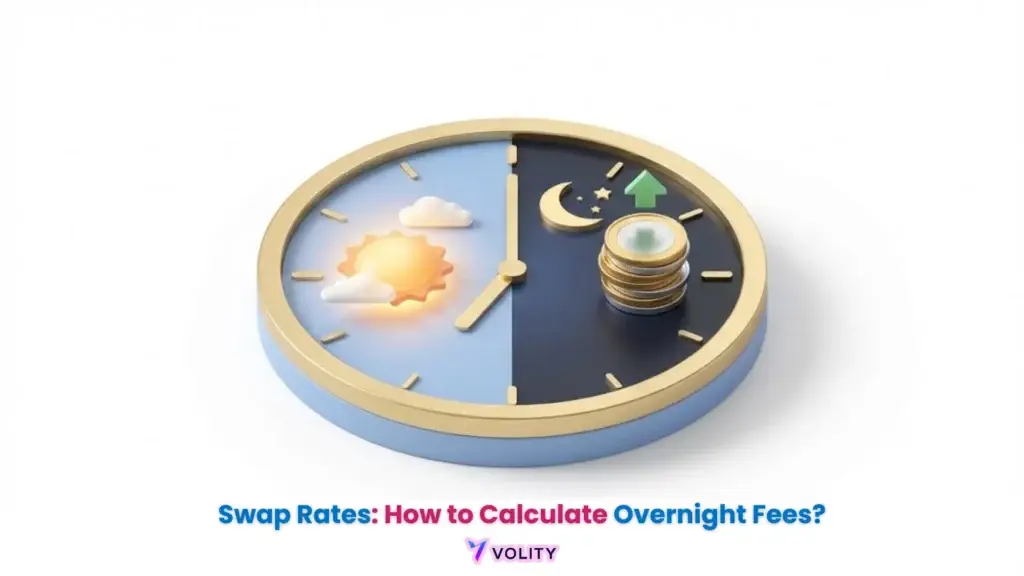
Forex swap rates are the overnight interest adjustments applied to currency positions held beyond the daily market close. These rates identify the yield differential between national central bank policies and broker-specific financing costs. Carry returns depend on the divergence between higher-yielding currencies and the cheapest funding legs, and they shrink as the funding central bank tightens.
Forex swap rates function as the cost of carry for traders seeking to maintain market exposure over multi-day horizons. This mechanism accounts for the time value of money by either crediting or debiting interest based on the yield spread of a currency pair. It serves as a primary determinant of long-term profitability for swing and position traders in 2026.
The 2026 macroeconomic landscape is characterized by the final removal of LIBOR-based pricing engines in favor of the Secured Overnight Financing Rate (SOFR). Investors utilize swap differentials to execute carry trades, capitalizing on the $1 trillion Yen-funded ecosystem that remains a cornerstone of global liquidity.
While understanding Forex Swap Rates is important, applying that knowledge is where the real growth happens. Create Your Free Forex Trading Account to practice with a free demo account and put your strategy to the test.
What are forex swap rates and how are they calculated?
Forex swap rates are the interest adjustments applied to open positions held open past the daily rollover time to reflect currency yield differentials. The calculation operates on a simple principle: interest earned on the base currency minus interest paid on the quote currency, plus or minus the broker’s financing markup. If you hold a EUR/USD position long (earning euros at the ECB’s 2.00% rate while paying dollars at the Fed’s 3.75% rate), you owe approximately 1.75% annually to your broker, applied daily as a negative swap.
The rollover process begins at 5:00 PM EST (New York close), when the forex market automatically resets positions into the next trading day. Traders holding positions past this time are charged or credited overnight financing based on their currency pair’s interest rate differential. SOFR is published every business day by the Federal Reserve Bank of New York as a volume-weighted median of overnight Treasury repo transactions, which is what makes it the reference for USD overnight financing (New York Fed SOFR page).
- The Rollover Process: Holding positions past 5:00 PM EST triggers automatic overnight financing application
- The Calculation Logic: (Interest earned on base – Interest paid on quote) +/- Broker markup determines net swap
- T+2 Settlement: Why the “Triple Swap” occurs to cover the weekend gap in the trading calendar
From LIBOR to SOFR: The 2026 Benchmark Standard
Benchmark transition identifies the shift from unsecured bank-credit rates to risk-free treasury-secured financing for all swap pricing. The legacy LIBOR system allowed banks to estimate overnight rates subjectively; SOFR uses actual transaction data from secured lending markets, eliminating manipulation risk. The 26.161 basis point Credit Spread Adjustment (CSA) fixed for three-month USD LIBOR under the ISDA IBOR Fallbacks Supplement bridges the gap between SOFR and the old LIBOR methodology, ensuring backward compatibility.
Term SOFR, introduced fully in 2026, allows brokers to lock forward-contract discounting rates 1-month, 3-month, and 6-month ahead rather than relying on volatile daily fluctuations. This forward visibility helps both brokers and traders plan multi-week carry trade positions with greater certainty.
Ready to Elevate Your Trading?
You have the information. Now, get the platform. Join thousands of successful traders who use Volity for its powerful tools, fast execution, and dedicated support.
Create Your Account in Under 3 MinutesCurrent Central Bank Policy Rates
Central bank policy rates determine the primary direction of overnight credits and debits across all major currency pairs. The Federal Reserve holds its target range at 3.50% to 3.75% (Federal Reserve open market operations). The ECB deposit facility rate stands at 2.25% (ECB key interest rates), leaving roughly 1.25 to 1.50 percentage points between the USD and EUR legs, which is the spread that funds much of the carry trade ecosystem.
The Bank of England holds Bank Rate at 3.75% (Bank of England Bank Rate), close to US rates. The Bank of Japan has moved its uncollateralised overnight call rate up to around 1.00% (Bank of Japan Statement on Monetary Policy), which is still the cheapest major funding leg and remains the anchor of yen-carry strategies worldwide, though each step up narrows the spread that carry traders are paid for.
These differential rates create the opportunity: borrow JPY at around 1.00%, deploy into GBP at 3.75%, and earn roughly 2.75% in pure interest income before financing costs, unchanged by whether price moves up or down. These rate differentials create tactical entry windows for swing traders to establish positions on fundamental value rather than technical breakouts.
Carry Trade Performance: Profitability in the 2026 Regime
Carry trade strategies identify high-yield currency targets funded by low-interest tenders to capture continuous positive rollover interest. High-yielding emerging-market currencies such as the Brazilian Real (BRL) and Turkish Lira (TRY) carry far wider nominal spreads than the traditional G10 carry pairs, which is why the “Commodity Carry” theme keeps reappearing. The mechanism is straightforward: borrow at around 1.00% (JPY) and lend at a materially higher policy rate for a net spread that accrues daily. The nominal spread is not the return, because currency moves and financing costs sit on top of it.
Performance metrics reveal that positive swap income alone can justify holding neutral or slightly-negative price positions for weeks or months. A trader holding AUD/JPY flat on price but collecting 10 pips of daily swap earns 300 pips (3%) over three months purely from interest, equivalent to a 12% annualized return on a micro account. The critical risk factor is carry-to-vol ratio: holding AUD/JPY is profitable during calm markets but destructive during volatility spikes where 500+ pip daily moves erase months of interest gains instantly.
Real trading example: A trader went long on AUD/JPY at 95.00, borrowing Yen at 0.75% to invest in Aussie Dollars at 4.35% in early 2026. The position earned approximately 10 pips of positive swap per standard lot every night; while the price was flat, the cumulative “interest profit” reached 300 pips over three months. Past performance is not indicative of future results.
Triple Swap Wednesday: The T+2 Settlement Anomaly
Settlement cycles identifies the timing of the triple-interest credit applied to compensate for the market’s two-day clearing window. The forex market operates on a T+2 basis, meaning trades settle (actual currency exchange occurs) two business days after execution. When you hold a position across Wednesday night, you’re covering a gap: a trade that closed on Friday doesn’t settle until Monday, requiring interest to accumulate across Friday night, Saturday, Sunday, and Sunday night. To compress this into the normal nightly swap, Wednesday positions receive triple the normal interest charge.
| Currency | Rollover Time (EST) | Triple Swap Day | 2026 Yield Profile | Funding Status |
| USD | 5:00 PM | Wednesday | High (3.75%) | Target |
| EUR | 5:00 PM | Wednesday | Neutral (2.25%) | Neutral |
| GBP | 5:00 PM | Wednesday | High (3.75%) | Target |
| JPY | 5:00 PM | Wednesday | Low (around 1.00%) | Funder |
| CHF | 5:00 PM | Wednesday | Low | Funder |
Policy rates as published by the Federal Reserve open market operations, ECB key interest rates, Bank of England Bank Rate and Bank of Japan Statement on Monetary Policy. Rollover times are broker settings and vary by venue.
For carry traders, Wednesday is the most profitable night, holding an AUD/JPY position across Wednesday earns 30+ pips instead of 10, tripling your interest income. Professional traders often scale positions into Wednesday to maximize this compounding effect.
Risks of Carrying Overnight: The Yen Unwinding Threat
Liquidity shocks indicates that sudden currency appreciation can instantly erase months of positive swap earnings during a carry trade unwinding. The entire Yen carry trade ecosystem, estimated at $1 trillion in notional exposure, depends on the Bank of Japan maintaining low interest rates indefinitely. If the BoJ suddenly pivots to 2.00% rates (following inflation data or geopolitical crisis), carry traders face a cascading unwinding: positions must be closed, Yen suddenly appreciates against all funded currencies, and margin calls trigger rapid liquidation.
Geopolitical shocks create similar unwinding risk: Taiwan tensions or Middle East escalation triggers “flight-to-safety” rallies in the JPY and USD, crushing AUD, BRL, and TRY positions simultaneously. The 2026 environment remains vulnerable because the Yen sits at historic lows (near 150 USD/JPY) with limited upside room before carry positions become economically irrational. A sharp revaluation in the Yen can erase a long run of accumulated carry income in a matter of weeks, because the currency move is many multiples of the nightly interest.
Volatility represents the final hidden danger. Holding 100:1 leverage on a high-interest carry pair feels safe during calm markets when volatility sits at 8-10%. A geopolitical shock raises volatility to 25+, and your account margin buffer evaporates. This distinction explains why carry-to-vol ratio matters more than raw yield: 6% yield with 25% volatility is riskier than 4% yield with 8% volatility.
Swap-Free Trading: The Rise of Shariah-Compliant Accounts
Islamic account structures represents a specialized solution for traders seeking to eliminate overnight interest debits and credits. Islamic finance prohibits “Riba” (interest-bearing transactions), requiring an alternative mechanism to accommodate the time value of money. Swap-free accounts replace nightly interest with either a wider bid-ask spread (typically +2-3 pips added to every trade) or a flat daily commission (£1-5 per lot) that covers the broker’s financing costs.
Cost offsetting reveals an interesting dynamic: a swing trader holding positions 5-10 days per position pays significantly more through the wide spread than they would through conventional swap interest. However, long-term position traders (holding weeks or months) often benefit from swap-free accounts because they eliminate the compound interest drag that accumulates across calendars. Forex Spread Betting operates similarly to swap-free accounts, charging interest through the spread rather than nightly credits.
Professional use of swap-free accounts extends beyond religious compliance. Some institutional traders intentionally use swap-free structures to avoid the tax complications of reportable swap interest in jurisdictions like Australia or Canada, where swap income carries different tax treatment than capital gains. Understanding how the smallest price movement (each pip) compounds across wider spreads is essential for calculating true position profitability when using swap-free accounts.
Turn Knowledge into Profit
You have done the reading, now it is time to act. The best way to learn is by doing. Open a free, no-risk demo account and practice your strategy with virtual funds today.
Open a Free Demo AccountKey Takeaways
- Forex swap rates are interest credits or debits applied to positions held overnight past the 5:00 PM EST New York close.
- Interest rate differentials between national central banks drive the primary value of the rollover credit or debit.
- SOFR is the 2026 global benchmark for overnight financing, having fully replaced the legacy LIBOR pricing system.
- Triple Swap Wednesday occurs to account for the T+2 settlement cycle, resulting in three days of interest processed at once.
- Carry trade strategies involve borrowing low-yield currencies like JPY to invest in high-yield targets like the USD or BRL.
- Swap-free accounts are used by Islamic traders to avoid interest-based transactions while participating in the currency market.
Frequently Asked Questions
This article contains references to forex swap rates, carry trade strategies, and Volity, a regulated CFD trading platform. This content is produced for educational purposes only and does not constitute financial advice or a recommendation to execute carry trade strategies. Carry trading involves high leverage and significant exposure to central bank policy risk; always consult a financial advisor and verify your broker’s swap rate terms before implementing overnight trading strategies. Some links in this article may be affiliate links.