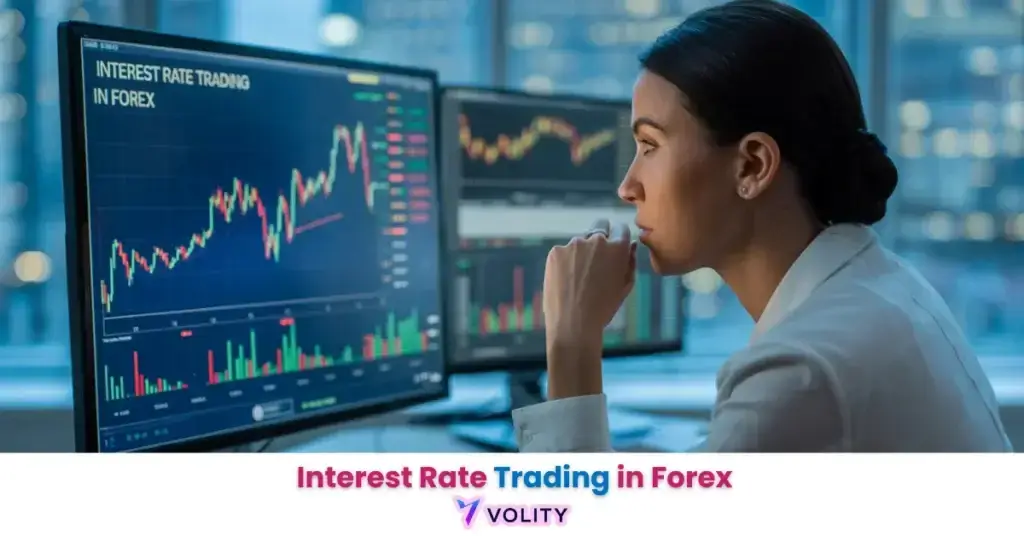
Interest rate trading carries inherent leverage risk amplified by central bank policy surprises. Rate decisions create volatile price gaps that exceed planned stop losses during major announcements. Carry trades are vulnerable to rapid unwinding during “Risk-Off” market conditions, causing sharp reversals. Yield spread analysis can fail during financial crises when bond market liquidity dries up. Past performance is not indicative of future results. Capital at risk.
Interest rate trading identifies the fundamental drivers of currency valuation by tracking central bank policy shifts. These decisions influence global liquidity as investors seek higher risk-adjusted returns on their capital. In 2026, over 65% of long-term forex volume is driven by interest rate differentials, making it the most powerful force in the foreign exchange market.
How to trade interest rates begins with analyzing the “Hawkish” or “Dovish” stance of major central banks like the Federal Reserve or the ECB. This framework allows participants to determine the future purchasing power of a currency relative to its global peers. It serves as the primary engine for sustained, multi-month trends in the FX majors.
The 2026 macro environment is characterized by divergent inflation paths and varying speeds of economic recovery. Mastering the relationship between yields and exchange rates enables traders to build diversified portfolios that capitalize on these global economic shifts.
While understanding Interest Rate Trading is important, applying that knowledge is where the real growth happens. Create Your Free Forex Trading Account to practice with a free demo account and put your strategy to the test.
How do interest rates affect the forex market?
Interest rates identify the cost of borrowing and the reward for saving, serving as the primary magnet for international capital investment. When central banks raise rates under a tight monetary policy, they increase the yield available to foreign investors who purchase government bonds and deposit accounts in that currency. Higher returns attract capital flows that strengthen the domestic currency against weaker-yielding peers.
The mechanism operates through three distinct channels. Yield seeking drives capital toward countries offering superior returns. Inflation control explains why central banks adjust rates, they combat excessive price growth by raising borrowing costs. The discounting mechanism reveals that markets react to expectations of rate changes, not the actual announcement itself.
One verified data point illustrates this impact. A surprise interest rate hike by the BoE typically strengthens the GBP against the USD straight away. This relationship holds across all major pairs when the rate move surprises the market.
Nominal vs. Real Interest Rates
Real interest rates represent the nominal rate adjusted for inflation, identifying the true return on a currency investment. A currency might offer a 5% nominal interest rate, but if inflation runs at 4%, the real return is only 1%. This distinction explains why high-yielding currencies sometimes weaken when inflation expectations rise.
CME FedWatch Tool displays market expectations for future rate moves, showing that investors price in not just current rates but anticipated future hikes or cuts. Real rates attract institutional capital flows more reliably than nominal rates (CME Group, 2026).
Ready to Elevate Your Trading?
You have the information. Now, get the platform. Join thousands of successful traders who use Volity for its powerful tools, fast execution, and dedicated support.
Create Your Account in Under 3 MinutesUnderstanding Interest Rate Differentials and Swaps
The interest rate differential identifies the gap between the policy rates of two different countries, determining the daily ‘Swap’ or ‘Rollover’ cost. Traders holding overnight positions receive or pay interest based on this differential. Higher differentials create more attractive carry trade opportunities but also signal higher volatility risk.
Positive swap scenarios generate income for traders. When holding AUD/JPY, traders earn the differential between Australia’s 4.5% rate and Japan’s near-zero rate, approximately 4.5% per annum. This income compounds on every overnight position held. Negative swap scenarios force traders to pay interest. Holding EUR/JPY generates negative swap because the euro’s yield slightly exceeds Japan’s.
The economics of carry trade execution require careful calculation:
- Identifying high-yielding currency pairs with stable central bank support for the rate differential.
- Monitoring the differential for contraction (the trade becomes less profitable as rates converge).
- Sizing positions to survive the inevitable periods when the carry trade unwinds during market stress.
The AUD/JPY remains the most popular retail carry trade pair in 2026, with an average annual yield differential of 4.5%. Long-term carry traders in this pair earn approximately 4.5% annually on their capital if positions are never forced to close at a loss. However, the pair experienced three major unwinding events in 2026 when risk-off sentiment drove Japanese yen demand.
Managed Forex Accounts often implement carry trade strategies as core portfolio allocations because they profit from both directional moves and yield accumulation. Diversifying across multiple carry pairs reduces concentration risk.
How to trade the Fed interest rate decision (FOMC)
Event-driven trading identifies the volatility spikes associated with FOMC policy statements and the subsequent press conferences. The Federal Open Market Committee meets eight times per year to announce rate decisions. Each meeting creates a predictable volatility pattern exploitable by informed traders.
Analyzing the Dot Plot reveals the future path of rate expectations. The Fed releases individual officials’ projections for future rate levels, these dots form a “plot” showing the consensus estimate. When the Dot Plot shifts hawkishly (higher future rates), USD typically strengthens. When it shifts dovishly, USD weakens. Bank of England monetary policy publishes the exact release times and provides access to historical statements (Federal Reserve, 2026).
The “Two-Stage” reaction pattern occurs reliably across all major rate decisions. The immediate headline reaction focuses on the headline number, did the Fed hike by 0.25% or hold rates steady? Then the press conference reveals forward guidance that often triggers a reversal. The market sells initially on “as expected” hikes, then rallies on dovish guidance suggesting future pauses.
Real trading example: EUR/USD experienced a textbook two-stage reaction during the June 2026 FOMC announcement. The Fed raised rates as expected but removed the word “consistent” from the statement, signaling a potential pause in future hikes. The USD initially spiked higher on the hike, then crashed approximately 150 pips as the market digested the dovish signal hidden in the forward guidance. Past performance is not indicative of future results.
Risk management during FOMC announcements requires cutting position size by 50% compared to normal trading. The volatility spike often exceeds a typical day’s entire range within seconds, stopping traders out of well-positioned setups. Professional traders view FOMC announcements as speculative events best avoided unless specifically positioned for the expected direction.
Popular Interest Rate Trading Strategies in 2026
Strategic rate trading identifies the various methods used to profit from yield shifts and central bank surprises. Five primary strategies dominate professional trading desks and hedge funds globally. Each operates on different timeframes and risk parameters.
| Strategy Type | Objective | Horizon | Key Indicator | Risk Level |
| Carry Trade | Earn Swap Points | Long-Term | Rate Differential | Medium-High |
| Bond Spread | Spot Correlation | Medium-Term | 2Y Yield Spread | Low-Medium |
| News Fading | Trade Volatility | Short-Term | Surprise Factor | High |
| Yield Curve | Macro Growth Bias | Multi-Month | 10Y – 2Y Spread | Low |
| Arbitrage | Discrepancy Profit | Instant | Interbank Rates | Ultra-Low |
Carry trades dominate retail forex volumes. They require minimal timing skill, traders simply hold the position and collect daily swap income. The strategy fails when the high-yielding currency collapses during market stress, eliminating months of swap income in days. Bond spread trades track the correlation between yield spreads and currency pairs, offering lower volatility but also lower returns. News fading strategies trade the reversal of initial overreactions, the USD spiked on the hike but reversal followed on dovish guidance. Yield curve trades exploit the relationship between short-term and long-term bond yields as indicators of economic growth expectations.
The Impact of Yield Spreads on Currency Pairs
Yield spread analysis identifies the relative strength of two economies by comparing the returns on their respective government bonds. The 2-year bond yield spread between two countries serves as the most reliable leading indicator for the direction of their currency pair. When this spread widens in favor of one country, its currency typically strengthens over subsequent weeks.
Using the 2-year bond yield as a proxy for central bank policy reveals economic divergence. A 0.50% spread between US and German 2-year yields signals that the Fed has become hawkish relative to the ECB. Capital flows toward the higher-yielding asset (US bonds), strengthening the USD. Divergence signals occur when price action moves opposite to yield spreads, a powerful contrarian indicator. When EUR/USD rallies while the US-German spread widens, institutional capital is accumulating euros despite unfavorable yields, often preceding major rallies.
The 10-year yield’s role in risk sentiment cannot be overstated. A rising 10-year yield signals growth expectations and attracts capital to risk assets. A falling 10-year yield suggests economic weakness or deflation fears, triggering “Risk-Off” sentiment where investors flee to safety. Risk Management frameworks emphasize tracking 10-year yields as macro regime indicators alongside currency pairs.
Professional macro traders in 2026 use automated dashboards to track “Real Yield” spreads, which subtract inflation expectations from the bond return for a cleaner signal. This approach filters out noise from inflation expectations and isolates the true return differential.
Turn Knowledge into Profit
You have done the reading, now it is time to act. The best way to learn is by doing. Open a free, no-risk demo account and practice your strategy with virtual funds today.
Open a Free Demo AccountCentral Bank Calendar: Preparing for 2026 Policy Shifts
Strategic preparation identifies the high-impact dates for interest rate decisions across the G10 economies. Professional traders structure their entire months around central bank calendars, avoiding major positions before announcements and repositioning afterward. The Federal Reserve, ECB, Bank of England, and Bank of Japan dominate global volatility patterns.
Tracking the Fed requires monitoring eight FOMC meetings per year plus multiple speakers from Federal Reserve officials. The Fed Chair’s speeches often contain forward guidance that moves markets more than actual policy decisions. The ECB publishes a calendar of interest rate decisions affecting 19 countries in the Eurozone. The BoE controls rates affecting sterling and impacts global risk sentiment through its policy stance.
Meeting minutes reveal internal bank divisions and hint at future policy shifts. When dissent occurs, one governor voting against the consensus, it signals uncertainty about the current policy path. This uncertainty often precedes policy reversals. Who are Liquidity Providers explains how central banks themselves participate in FX markets, managing currency values through coordinated intervention.
Key Takeaways
- Interest rates are the primary drivers of long-term currency value, as they determine the return on capital for investors.
- Hawkish central banks favor higher rates to combat inflation, which typically leads to a stronger domestic currency.
- Interest rate differentials create the “Swap” payments earned or paid by traders for holding overnight positions.
- Carry trades involve borrowing in low-yielding currencies to buy high-yielding ones, profiting from the interest gap.
- Bond yield spreads serve as the most reliable leading indicators for directional movements in major currency pairs.
- Market expectations are often more important than the rate decision itself; a “priced-in” hike can lead to a currency drop.
Frequently Asked Questions
This article contains references to interest rate trading, central bank policy, and Volity, a regulated CFD trading platform. This content is produced for educational purposes only and does not constitute financial advice or a recommendation to buy or sell any financial instrument. Central bank decisions carry substantial volatility and can produce unexpected market reversals. Always analyze rate decisions carefully before committing capital and test strategies on demo accounts first. Some links in this article may be affiliate links.