Liquidity providers withdrawing quotes during high-impact news can widen spreads sharply within seconds, turning a favourable setup into an automatic stop-loss execution at heavy slippage. Relying on a broker with poor liquidity connections exposes traders to “internalized” orders where the broker acts as market maker against retail positions, creating inherent conflicts of interest and widened spreads. Colocation advantages held by high-frequency trading firms allow sub-millisecond execution, while a retail trader on a consumer connection is an order of magnitude slower, creating systematic disadvantages in scalping strategies. Past performance is not indicative of future results. Capital at risk.
Liquidity providers (LPs) are the institutional entities that facilitate continuous trading in the Forex market by offering two-way bid and ask prices. They create the “market depth” necessary for large orders to execute without causing massive price shifts. In 2026, the ecosystem is dominated by Tier 1 multinational banks like JPMorgan and Citi, which provide the raw liquidity that eventually filters down to retail traders through prime brokers and aggregators.
Liquidity providers function as the primary market makers for the global foreign exchange ecosystem. These institutions maintain a continuous stream of buy and sell quotes to guarantee that other participants can exit or enter positions at any time. They serve as the critical bridge between fragmented retail orders and the massive capital pools of the interbank market.
The 2026 trading landscape relies on a complex hierarchy of liquidity tiers to maintain market efficiency. From multinational banks to sophisticated algorithmic high-frequency trading firms, these providers dictate the execution speeds and spread widths that retail traders experience on their platforms.
While understanding Who Are Liquidity Providers is important, applying that knowledge is where the real growth happens. Create Your Free Forex Trading Account to practice with a free demo account and put your strategy to the test.
What is a liquidity provider and why do they matter?
A liquidity provider is a financial institution that acts as a market maker by continuously quoting buy and sell prices for a specific asset.
Market liquidity represents the ease of converting an asset into cash without impacting price. Without liquidity providers, currency markets would suffer from massive price slippage, traders seeking to sell would receive dramatically lower prices, while buyers would pay dramatically higher prices, as order flow would lack sufficient opposing participants.
Liquidity providers bridge the gap between buyers and sellers by being willing to act as a counterparty to any trade during market hours. When a retail trader places a buy order, the LP acts as the seller. When a trader places a sell order, the LP acts as the buyer. This constant intermediation creates market depth, the availability of volume at multiple price levels surrounding the current market price.
The BIS Triennial Central Bank Survey: OTC foreign exchange turnover in April 2025 puts global over-the-counter foreign exchange turnover at $9.6 trillion a day, a volume that would be impossible to maintain without institutional liquidity provision.
Ready to Elevate Your Trading?
You have the information. Now, get the platform. Join thousands of successful traders who use Volity for its powerful tools, fast execution, and dedicated support.
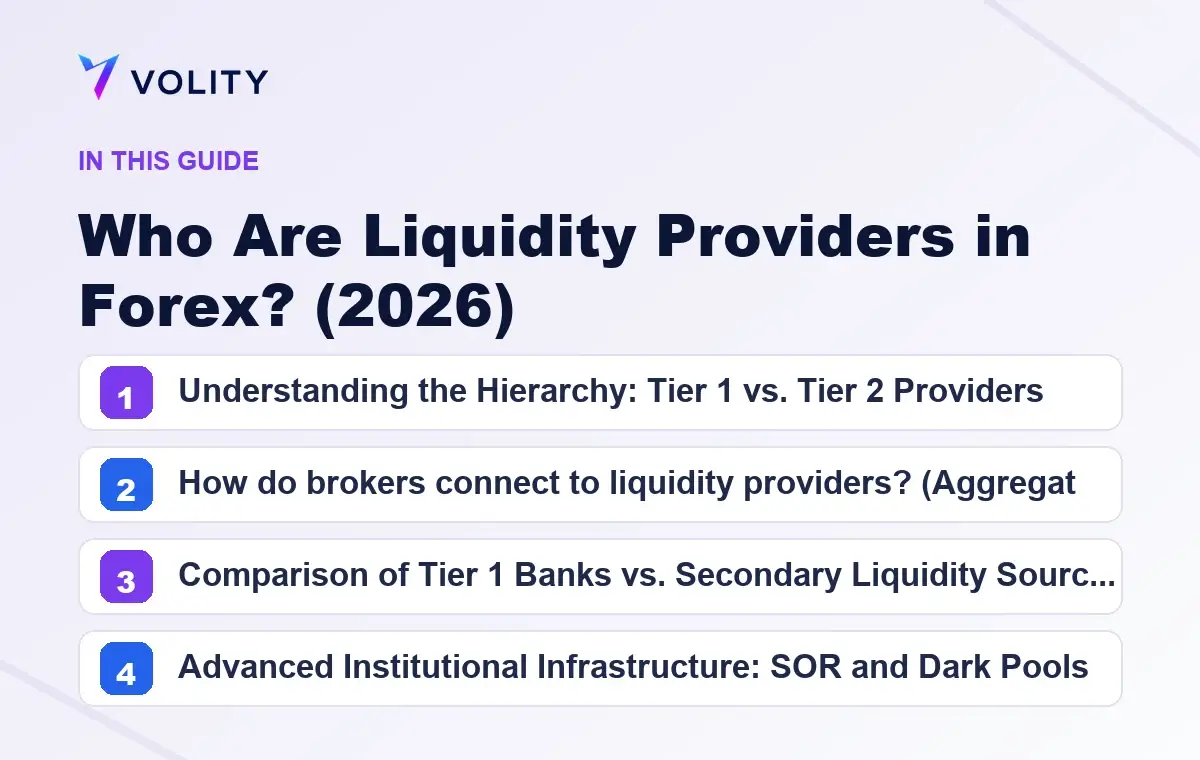
Create Your Account in Under 3 MinutesUnderstanding the Hierarchy: Tier 1 vs. Tier 2 Providers
The liquidity provider hierarchy identifies the structural layers that connect individual retail traders to the massive capital pools of the interbank market.
The institutional structure flows from top to bottom through multiple tiers. Tier 1 banks, the largest global institutions like JPMorgan, Citi, and Deutsche Bank, trade directly with each other in the interbank market, forming the foundation of currency pricing. These banks hold substantial capital reserves that allow them to quote unlimited volume to other market participants while managing their own risk exposure through hedging and position averaging.
Tier 2 providers include smaller banks and sophisticated hedge funds that access Tier 1 pricing feeds through prime brokers, specialized financial firms that provide credit lines, consolidated liquidity access, and settlement infrastructure. Prime brokers aggregate multiple Tier 1 feeds and distribute consolidated quotes to retail brokerage platforms, adding their own small markup (typically 0.1 to 0.5 pips) to the raw interbank spread.
Direct participation in interbank liquidity pools depends on balance-sheet size, credit lines and settlement infrastructure, which in practice restricts membership to the largest financial institutions. Smaller firms reach the same pricing through a prime broker rather than directly.
J.P. Morgan Markets: institutional trading, research and execution sets out how a Tier 1 institution organises its trading, execution and research functions.
Trade during the Most Widely Traded Currency Pairs to ensure consistent access to deep institutional liquidity.
Trade during the London-New York overlap (12:00–17:00 GMT) to access the deepest institutional liquidity; this is when Tier 1 banks are most active, resulting in the tightest spreads for retail traders.
How do liquidity providers make money in 2026?
Liquidity providers generate revenue primarily through the bid-ask spread and volume-based commissions earned on every executed transaction.
The bid-ask spread represents the difference between what the LP will pay to buy from you and what they will charge to sell to you. A EUR/USD spread of 0.6 pips means the LP margin on a standard lot, where one pip is worth about $10, is roughly $6 per round-turn trade. While individual spreads appear small, institutional volume is massive, a Tier 1 bank processing tens of thousands of trades daily generates hundreds of millions in annual spread revenue.
Risk management forces LPs to widen spreads during volatile market conditions. When market uncertainty increases, the LP’s probability of adverse price movement before they can offset their position increases, requiring wider spreads to compensate for increased risk. This explains why spreads that typically measure 0.5 pips can expand to 2-3 pips during central bank announcements or geopolitical shocks.
Spread in Trading Explained documents how the bid-ask spread mechanics function across different market environments and volatility regimes.
WARNING: During high-impact news events, liquidity providers often “pull” their quotes to manage risk, leading to rapid spread widening and significant slippage even with “Tier 1” brokers.
How do brokers connect to liquidity providers? (Aggregators & ECNs)
Liquidity aggregators and ECN networks identify the technological bridges that route retail orders to multiple institutional price feeds simultaneously.
Liquidity aggregators function as software intermediaries that collect real-time price quotes from 10 or more Tier 1 LPs and automatically select the best available bid and ask prices for each trade. A retail trader sees a single EUR/USD price on their platform, but that price is dynamically sourced from whichever LP offers the best quote at that specific moment. This aggregation ensures retail traders access competitive pricing without needing direct Tier 1 bank relationships.
ECN (Electronic Communication Networks) are trading venues where market participants trade directly against each other’s orders. An ECN broker routes retail orders to its ECN venue where they potentially match with other retail orders or institutional algorithms operating on the same platform. This model differs from market maker brokers who internalize orders and act as the counterparty.
STP (Straight Through Processing) routing moves orders directly from the retail platform to an LP without broker intervention, ensuring the trader receives live market prices rather than broker-adjusted quotes. A trader using an STP broker experiences tighter spreads than a retail broker using internalized market making, though they sacrifice the ability to trade with a broker who guarantees execution speed.
A real trading example demonstrates the routing architecture. A retail trader clicks “Buy EUR/USD” on an ECN platform during the New York session open. The order travels through the aggregator system to a Tier 1 bank operating in London. A sell quote from that bank matches the retail buy order in a fraction of a second, but not in the way the marketing implies: light in fibre needs roughly 30 milliseconds each way between New York and London, so a transatlantic round trip on the fastest commercial routes is close to 60 milliseconds. Past performance is not indicative of future results.
💡 KEY INSIGHT: Most 2026 institutional LPs use Smart Order Routing (SOR) algorithms that automatically split large orders across dozens of different venues to find the best possible fill price in microseconds.
Comparison of Tier 1 Banks vs. Secondary Liquidity Sources
Comparative liquidity analysis identifies the differences in pricing, execution speed, and capital requirements between market tiers.
| Feature | Tier 1 Banks (JPM, Citi) | Prime Brokers / Aggregators | Retail Broker Internal Pools |
| Capital Access | Direct Interbank | Indirect (via Credit Lines) | Customer Deposits |
| Spread Type | Raw Interbank (0.0 pips) | Markup (~0.1 – 0.5 pips) | Retail (~0.5 – 2.0 pips) |
| Execution Speed | Sub-millisecond | 2 – 10 Milliseconds | 10 – 50 Milliseconds |
| Volume Capacity | Multi-Billion Dollars | Multi-Million Dollars | Smaller Retail Lots |
| Primary Client | Other Tier 1s, Governments | Retail Brokers, Hedge Funds | Individual Retail Traders |
The ranges above are indicative of how the tiers differ, not measured benchmarks from any single provider.
Advanced Institutional Infrastructure: SOR and Dark Pools
Smart Order Routing (SOR) and dark pool venues determine the ultimate execution quality for high-volume institutional trade flows.
Smart Order Routing algorithms analyze market conditions across multiple venues in real-time and automatically segment large orders into smaller pieces. A $100 million USD/JPY order from a multinational corporation gets split into 15 separate orders sent to different liquidity pools based on the lowest available ask prices at each venue. This technology executes in microseconds, ensuring the institution achieves the best average fill price by leveraging all available liquidity simultaneously.
Dark pools are private electronic trading venues where institutional investors execute large orders away from the public order book. When a major hedge fund needs to buy 50 million EUR without causing a price spike visible to retail traders, the fund routes through a dark pool where the transaction occurs without public visibility. The benefit to the institution is price protection, massive trades visible on public charts would trigger algorithmic responses and move prices against the buyer.
Colocation places client trading servers in the same data center as the liquidity provider’s systems, reducing network latency to microseconds. An institution operating colocated servers at Equinix LD4 in London achieves sub-millisecond connections to major Tier 1 banks based in the same facility.
Equinix LD4, London is the facility most often named in this context, and physical proximity to the matching infrastructure is what creates the execution advantage.
Use a Virtual Private Server VPS Hosting solution to reduce latency and improve execution consistency compared to home internet connections.
Turn Knowledge into Profit
You have done the reading, now it is time to act. The best way to learn is by doing. Open a free, no-risk demo account and practice your strategy with virtual funds today.
Open a Free Demo AccountHow to vet a broker’s liquidity access in 2026
Broker transparency reports identify the reliability and depth of a platform’s connection to institutional liquidity providers.
Regulatory status directly correlates with liquidity access, brokers licensed by the FCA (UK) or CySEC (Cyprus) are required by law to maintain relationships with legitimate tier 1 or aggregated liquidity sources. Unregulated brokers often operate as pure market makers with no institutional liquidity relationships, quoting prices that diverge significantly from true market rates.
Spread measurement reveals quality of liquidity access. Record spreads during news-heavy sessions and compare against major institutional brokers. If your broker’s spreads match those of regulated ECN brokers during volatile periods, you likely have solid liquidity access. If spreads widen to 5-10 pips while major brokers hold 1-2 pips, your broker is likely internalizing flow or lacks quality LP relationships.
Execution quality metrics published by many brokers show average fill times and slippage statistics. Request execution data from your broker and compare against public benchmarks. Fills exceeding 100ms average latency or showing consistent slippage suggest the broker lacks direct LP access.
What Causes Forex Slippage reveals how poor liquidity connections create execution problems for retail traders.
Forex Risk Management demonstrates how to structure positions defensively against execution risks inherent in various broker models.
Key Takeaways
- Liquidity providers are institutional market makers that ensure there is always a buyer or seller for any currency trade.
- Tier 1 banks represent the top level of liquidity, consisting of major global institutions like JPMorgan, Citi, and Deutsche Bank.
- Market depth is the quantity of orders available at various price levels, which directly impacts the stability of a currency pair.
- Liquidity aggregators are technical solutions that combine multiple institutional feeds to provide retail traders with the best possible price.
- Bid-ask spreads are the primary source of revenue for liquidity providers, representing the cost of accessing their market depth.
- ECN broker models provide the most direct access to liquidity providers, often resulting in faster execution and tighter spreads for traders.
Frequently Asked Questions
This article contains references to Liquidity Providers, Tier 1 Banks, Liquidity Aggregators, ECN Models, and Volity, a regulated CFD trading platform. This content is produced for educational purposes only and does not constitute financial advice or a recommendation to buy or sell any financial instrument. Always verify current regulatory status and platform details before using any trading service. Some links in this article may be affiliate links.