Quick answer
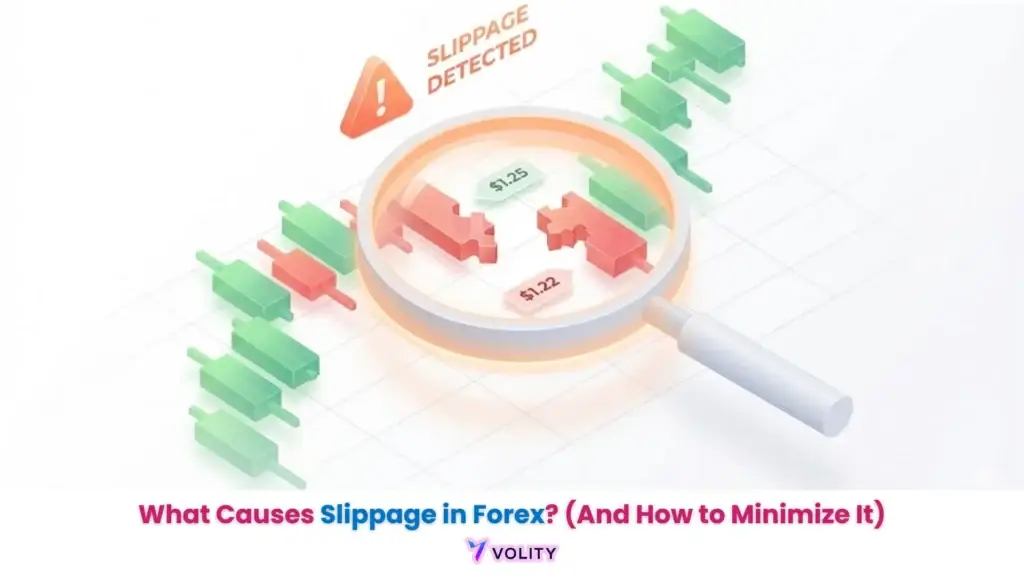
Forex slippage is the difference between the price you expect on a trade and the price it actually fills at, caused by fast-moving markets, low liquidity, or delays in execution. It happens most around news releases and at market open. Slippage can be positive or negative; using limit orders and trading liquid pairs in active sessions reduces it.
Gap risk during economic news events can execute stop-losses 20-50 pips away from requested levels, converting small controlled losses into catastrophic blowouts within milliseconds. High-frequency algorithms detect and hunt retail stop-loss clusters, forcing prices through them artificially before reversing, creating slippage that liquidates positions despite correct trade direction. Spreads on dealing-desk pricing can widen sharply during volatile sessions, so a fill can land far from the last quote a trader saw. Slippage runs in both directions, and the direction that hurts is the one to size for. Past performance is not indicative of future results. Capital at risk.
Forex slippage is the difference between the requested price of an order and the price at which it is actually executed. It is driven by market volatility, insufficient liquidity, and technical latency between the trader and the broker. In 2026, managing slippage requires a combination of smart order types, such as limit orders, and low-latency infrastructure like a VPS to ensure trades are filled as close to the intended price as possible.
Forex slippage functions as an inherent characteristic of decentralized financial markets where prices shift in millisecond increments. It represents the “execution gap” that arises when a market order is filled at the best available price instead of the specifically requested quote. It serves as a primary metric for evaluating broker performance and technical infrastructure efficiency.
The 2026 trading environment emphasizes the need for millisecond-level precision to combat the influence of institutional high-frequency algorithms. Traders who ignore the causes of slippage often find their profit margins eroded by poor execution quality during volatile sessions.
While understanding What Causes Forex Slippage is important, applying that knowledge is where the real growth happens. Create Your Free Forex Trading Account to practice with a free demo account and put your strategy to the test.
What is forex slippage and what are its two types?
Forex slippage is the numerical difference between the expected price of a trade and the price at which the transaction is actually executed.
The execution gap emerges when a market order moves to the “next available” price tier. When a trader requests a buy order at 1.1050 but the market has moved to 1.1052 by the time the order arrives, the trader receives fills at the higher price. This gap exists in all decentralized markets, there is no “price lockdown” mechanism that guarantees the exact quote will still be available milliseconds later.
Negative Slippage occurs when execution happens at a worse price than requested. For buy orders, worse means higher prices. For sell orders, worse means lower prices. Negative slippage directly reduces profits or increases losses. This is the harmful variant that traders fear.
Positive Slippage occurs when execution happens at a better price than requested. For buy orders, better means lower prices. For sell orders, better means higher prices. Positive slippage directly increases profits or reduces losses. Whether you see it depends on the execution model: it is more common where orders are routed to a live order book than where they are internalised.
Common scenarios trigger slippage reliably: Market gaps occur when prices “jump” between levels without intermediate trades, typically during overnight Asian sessions or after major news releases. Stop-loss triggers convert to market orders immediately, executing at whatever price is available, gaps can force fills dozens of pips away. Fast-moving trends can accelerate price action faster than order processing, leaving slower orders unfilled at the requested price.
Negative slippage on market orders clusters around the session overlaps and around scheduled data, because that is when price moves fastest relative to the time an order takes to reach the venue.
Ready to Elevate Your Trading?
You have the information. Now, get the platform. Join thousands of successful traders who use Volity for its powerful tools, fast execution, and dedicated support.
Create Your Account in Under 3 MinutesWhat are the primary market causes of slippage in 2026?
Market volatility and insufficient liquidity are the fundamental drivers of price discrepancies during order execution.
High Volatility pushes price action faster than order processing systems can react. During a major news release, price can move 50+ pips in under a second. A trader’s order request takes milliseconds to transmit but arrives to a market that has already shifted significantly. The rapid-change environment means “current price” is a moving target that diverges constantly from what the trader observes on their live chart.
Low Liquidity reduces the number of opposing buyers or sellers available at each price level. During the Tokyo session overlap into London, a trader requesting a large position in GBP/JPY finds few competing orders to match against. The broker must fill the order at progressively worse prices to source sufficient liquidity, accumulating slippage across multiple price tiers.
Sudden Shocks from economic data create concentrated, predictable slippage events. Non-Farm Payroll (NFP) releases, central bank interest rate decisions, and geopolitical announcements trigger coordinated order flows. All traders simultaneously submit orders in the same direction, if NFP comes in stronger-than-expected, all traders sell the USD. The order flow imbalance requires prices to move dramatically just to find sufficient opposing liquidity.
Gapping occurs when the market “jumps” over price levels without any trades occurring. During the weekend, no forex volume occurs, so Monday’s opening price can gap 20+ pips away from Friday’s close. No trader had an opportunity to trade at the intermediate prices, they simply don’t exist anymore.
Even in EUR/USD, resting liquidity thins out in the seconds before a scheduled central-bank announcement, which is what widens the spread and increases slippage exactly when traders most want to act.
What is a Pip in Forex Trading provides the foundation for understanding pip-magnitude slippage.
How do different order types impact slippage risk?
Strategic selection of order types determines the degree of price protection a trader has against unexpected market movements.
Market Orders guarantee execution but offer zero price protection. A market buy order executes immediately at the best ask price available, regardless of where that price sits relative to the requested entry. If the market has gapped higher, the trader receives fills well above the initial request. Market orders are the fastest execution method but expose traders to maximum slippage.
Limit Orders guarantee price but offer zero execution guarantee. A limit order to buy at 1.1050 will execute only if the market falls to exactly 1.1050 or lower. If the market never touches that price, the order never fills. This eliminates slippage risk by rejecting any execution outside the specified price boundary, but traders miss moves that occur without hitting their limit prices.
Stop-Loss Orders activate when triggered but then convert to market orders. A trader places a stop-loss to sell at 1.0900. When the price drops to 1.0900, the stop converts to a live market order that executes immediately. If the market has gapped past 1.0900, say it jumps from 1.0905 to 1.0885, the stop-loss executes at 1.0885 instead of the intended 1.0900. Gap risk on stop orders represents one of the largest slippage exposures retail traders face.
“Market with Protection” orders represent a 2026 innovation that allows traders to specify a maximum deviation tolerance. A trader places a market order with a maximum 5-pip deviation, meaning the order will execute only if slippage remains below 5 pips. If the actual market slip exceeds 5 pips, the order is automatically rejected, protecting the trader from catastrophic fills while maintaining fast execution when conditions are normal.
A real trading example demonstrates the impact. A trader places a market buy order on GBP/USD at 1.2500 during a flash news event, the Bank of England unexpectedly hikes rates. Algos immediately sell pounds. The order is filled at 1.2515, representing 15 pips of negative slippage. The trader expected a breakout but received a 150 USD loss on a 1-lot position before the trade direction became profitable. Past performance is not indicative of future results.
Limit Orders vs Market Orders details the trade-offs between these order types.
The role of technical latency and broker infrastructure
Network latency and broker execution models identify the technical bottlenecks that contribute to execution delays.
Latency measures the millisecond delay between a trader initiating an action and the broker’s server receiving and processing it. A trader with 120ms latency experiences a 120-millisecond information gap, the market’s price has moved substantially during this window. A trader with 2ms latency experiences a negligible gap. The difference compounds with velocity: in a fast-moving volatile session, 120ms allows the market to move 5-10 pips, while 2ms allows movement of only 0.4 pips.
Broker Models determine how latency impacts execution. ECN/STP brokers route orders to the live interbank market where prices are determined by real supply and demand. The broker’s latency is the delay in reaching the market. Market Maker brokers internalize orders, they take the opposite side and hold inventory. A market maker’s latency reflects their internal systems, not market access, and they have incentive to execute against retail traders at worse prices.
Server Proximity decides latency magnitude. A trader in London using a home connection to a New York broker experiences 120-200ms latency due to the transatlantic distance. A trader using a VPS server located at Equinix LD4 (London) experiences <2ms latency because the VPS sits in the same building as major brokers' servers. Moving trading infrastructure physically closer to the broker is often the single most effective slippage reduction method.
| Order Type | Price Guarantee | Execution Guarantee | Slippage Risk | Primary Use Case |
| Market | No | Yes | High | Urgent Entry/Exit |
| Limit | Yes | No | Zero (Negative) | Specific Price Entry |
| Stop | No | Yes (once hit) | High | Loss Prevention |
| Stop-Limit | Yes | No | Zero (Negative) | Price-Restricted Stop |
| Trailing Stop | No | Yes (once hit) | High | Trend Following |
Order-type behaviour and the maximum-deviation setting: MetaTrader 5 Help, Executing Trades. On how fragmented FX execution actually is: BIS, FX trade execution: complex and highly fragmented.
ECN vs STP Broker Models explains how broker routing determines execution quality.
WARNING: Stop-loss orders become market orders once triggered; if the market gaps during a news event, your stop-loss will execute at the next available price, which could be dozens of pips away from your requested level.
Slippage vs. Spread: Key distinctions for traders
Distinguishing between slippage and spread determines the accurate calculation of total transaction costs for a trading strategy.
Spread represents the fixed or variable “tax” paid to the broker, the difference between the bid price (what the broker will pay to buy from you) and the ask price (what the broker will charge to sell to you). A EUR/USD spread of 2 pips means you pay 0.0002 in price difference when opening a position. Spread is deterministic and predictable, it’s fixed on ECN brokers and variable on market makers.
Slippage represents the unexpected price gap caused by market conditions. When you request a price and the broker fills at a worse price due to volatility, that’s slippage. Slippage is stochastic and unpredictable, it varies with market conditions.
Comparison of predictability reveals the key distinction: You know the spread before trading. You cannot know slippage until the order executes. Spread is the broker’s take. Slippage benefits the broker (when adverse) or costs the broker (when positive). A trader’s total transaction cost is: spread + slippage on entry + spread + slippage on exit.
Spread in Trading Explained provides detailed analysis of how spread affects profitability.
💡 KEY INSIGHT: Positive slippage occurs when your order is filled at a *better* price than requested; this is more common with limit orders and take-profit targets on ECN/STP broker models.
Turn Knowledge into Profit
You have done the reading, now it is time to act. The best way to learn is by doing. Open a free, no-risk demo account and practice your strategy with virtual funds today.
Open a Free Demo AccountStrategies to minimize negative slippage in 2026
Proactive execution protocols are the primary defense against market-driven price discrepancies.
Using a Virtual Private Server (VPS) reduces latency to <2ms by hosting your trading platform in the same data center as the broker. The dramatic latency reduction compresses the time window during which price can move, limiting maximum possible slippage. This is the single most effective structural change a trader can make.
Prioritizing limit orders during news-heavy sessions eliminates slippage risk entirely, the order will either execute at the specified price or not at all. The trade-off is that limit orders miss moves. Setting limit orders 2-3 pips above/below the current price captures most of the move while maintaining slippage protection.
Trading only during peak liquidity hours (London/New York overlap, typically 13:00-16:00 UTC) reduces slippage because order volume is highest when the most buyers and sellers are active simultaneously. Slippage is minimal when supply and demand are balanced.
Splitting large orders into smaller “iceberg” chunks prevents order-size information from reaching the market all at once. Instead of a 10-lot order that moves price 20 pips as brokers source liquidity, submit five 2-lot orders separately. Each smaller order experiences less slippage because the liquidity demand is distributed.
Virtual Private Server VPS Hosting explains how server location and latency directly impact execution quality.
Key Takeaways
- Forex slippage is the difference between the price a trader expects and the price at which the trade actually executes.
- Negative slippage occurs during periods of high volatility or low liquidity, resulting in a less favorable execution price for the trader.
- Market orders carry the highest risk of slippage because they prioritize execution speed over price precision.
- Technical latency measures the time delay in data transmission, which directly impacts the likelihood of experiencing slippage.
- Limit orders are the most effective tool for eliminating negative slippage, as they guarantee execution at a specific price or better.
- News releases such as the Non-Farm Payroll report are frequent triggers for price gaps and significant slippage events.
Frequently Asked Questions
This article contains references to Forex Slippage, Market Orders, Limit Orders, and Volity, a regulated CFD trading platform. This content is produced for educational purposes only and does not constitute financial advice or a recommendation to buy or sell any financial instrument. Always verify current regulatory status and platform details before using any trading service. Some links in this article may be affiliate links.