Forex trading involves significant risk and the potential for total capital loss. Different broker models carry unique risks, including slippage and conflicts of interest.
Always ensure your broker is regulated by a top-tier authority. Past performance is not indicative of future results.
Capital at risk.
Forex broker models facilitate the execution of trades in a global market that reached $9.6 trillion in daily turnover in April 2025, according to the BIS Triennial Central Bank Survey. The same survey puts turnover with institutional investors at $1.3 trillion per day, 13% of the global total, all of it routed through one of the execution architectures below.
Success in navigating these facilitator models requires understanding the transition from internalized dealing desks to direct interbank liquidity access. This guide identifies the three primary structures, the 2026 all-in cost benchmarks, and the regulatory standards necessary for secure trading.
While understanding ECN, STP and Market Maker Models is important, applying that knowledge is where the real growth happens. Create Your Free Forex Trading Account to practice with a free demo account and put your strategy to the test.
What is an ECN broker and how does direct access work?
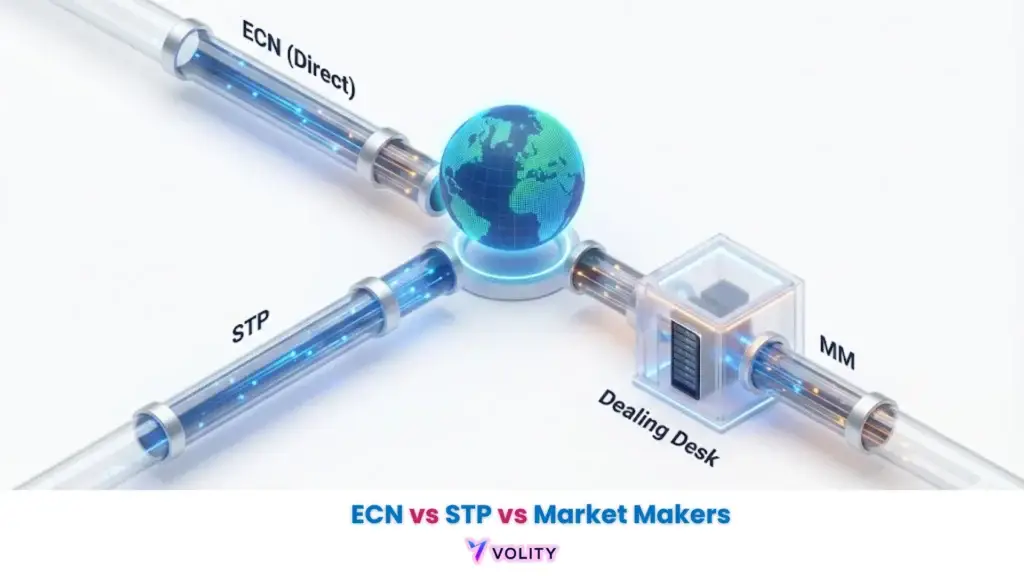
An ECN (Electronic Communication Network) broker is a non-dealing desk (NDD) facilitator that connects participants directly to the interbank market where multiple liquidity providers compete for order flow. Direct Market Access (DMA) removes the broker as a middleman by matching orders against Tier 1 banks and other traders anonymously, your buy order executes against another trader’s sell order in a transparent price competition.
Raw spreads on ECN platforms start at 0.0 pips but require a fixed commission, typically $6.00 per standard lot, creating an all-in cost of approximately $8.00 per lot traded. No re-quotes occur because the broker is not the counterparty, the order either executes immediately at the best available price or it gets rejected if liquidity has moved. This elimination of execution delays is critical for scalpers and high-frequency traders who depend on consistent order execution without dealing desk friction.
professional trading platform selection explains how ECN platforms differ from retail brokers in terms of regulatory architecture and execution guarantee mechanisms.
Ready to Elevate Your Trading?
You have the information. Now, get the platform. Join thousands of successful traders who use Volity for its powerful tools, fast execution, and dedicated support.
Create Your Account in Under 3 MinutesWhat is an STP broker and how does it route orders?
An STP (Straight Through Processing) broker is an intermediary that utilizes bridge technology to automatically route client orders to external liquidity providers without manual dealing desk intervention. Automated Routing scans for the best bid/ask across a smaller pool of banks compared to ECNs, typically 2-5 primary liquidity providers rather than 20+. The STP model delivers faster execution than manual dealing desk evaluation while offering lower spreads than pure Market Makers, creating a “middle ground” cost structure.
Spread Markups are how STP brokers generate profit without a separate commission, they take the interbank spread and add their own markup to generate an all-in cost of approximately $12.00 per lot. The hybrid potential creates risk: some STP brokers use A-Book routing (immediate external execution) for winners but switch to B-Book (internalized dealing desk) for losing trades or large positions, creating a hidden conflict of interest that affects trader profitability.
Our guide to liquidity providers in forex covers who sits on the other side of an A-Book fill and why the depth behind a quote decides what hybrid routing can actually do.
What is a Market Maker broker and why does a conflict of interest exist?
A Market Maker (Dealing Desk) broker is a counterparty facilitator that internalizes client orders by taking the opposite side of every trade, effectively “making the market” for its users. The B-Book Strategy means the broker profits directly from the spread markup and from client losses, when a trader loses $1,000, that $1,000 enters the broker’s P&L. Counterparty risk emerges because the broker has a natural incentive to see traders lose money, creating a fundamental conflict of interest that regulators require brokers to disclose.
Benefits for beginners are nonetheless real: Market Makers provide fixed spreads (no variable slippage during volatility), ultra-low minimum deposits ($10–$200), and micro-lot sizes that enable beginners to learn without devastating losses. For new traders building foundational skills, a reputable Market Maker provides superior “educational environment” compared to the $1,000+ minimums and technical complexity of ECN platforms.
who are liquidity providers in Forex explains the structural role of liquidity providers in the broader market ecosystem.
Which broker type has the tightest spreads and lowest fees?
The tightest spreads are consistently found at ECN brokers, though total trading costs must be calculated as the sum of the raw spread and the fixed commission per lot. On published retail terms an ECN account lands near $8.00 all-in, an STP account near $12.00, and a Market Maker account near $15.00 per standard lot. Variable versus Fixed Spreads create a strategic choice: scalpers prefer raw ECN spreads because they capture the lowest per-trade cost, while swing traders might prefer Market Maker consistency to avoid volatility-driven spread expansion.
Real-world A-Book execution example:
A trader using an STP broker places a 5-lot buy order for EUR/USD. The STP system scans Bank A (bid 1.0800) and Bank B (bid 1.0801) in real-time and executes the 5 lots at the best price: Bank A’s 1.0800. The trader receives institutional pricing; the STP broker earns the $30 commission without any conflict of interest because both sides got the best available market price. Past performance is not indicative of future results.
Mastering bid-ask spread strategies covers the technical implementation of spread-aware trading tactics.
How do I choose the right broker model for my trading style?
Broker model selection is a strategic decision that should align with a trader’s required execution speed, available capital, and psychological tolerance for slippage. Scalpers and HFT require only ECN/STP environments because they provide the sub-50ms latency necessary for high-frequency success, a 100ms delay from a Market Maker dealing desk wipes out the profit margin on trades lasting only 200ms. Beginners benefit most from Market Makers offering micro-lots and fixed costs to learn without excessive friction.
Swing traders gain maximum flexibility from STP models because they hold positions for multiple days where execution speed is less critical than cost certainty. The combination of competitive STP spreads and no minimum $1,000 deposits creates an ideal entry point for intermediate traders building capital before graduating to ECN platforms.
Best mobile app for Forex trading helps traders evaluate whether a broker’s platform quality aligns with their execution model choice.
Turn Knowledge into Profit
You have done the reading, now it is time to act. The best way to learn is by doing. Open a free, no-risk demo account and practice your strategy with virtual funds today.
Open a Free Demo Account2026 Broker Model Comparison
Broker performance benchmarks reveal the technical and financial trade-offs between NDD and DD facilitation architectures. The data demonstrates that ECN provides the lowest all-in costs but requires larger minimum deposits, while Market Makers prioritize accessibility with high cost premiums. Latency metrics show NDD models achieve near-zero execution delays while DD models incur 100ms+ delays due to dealing desk processing.
| Feature | ECN (2026) | STP (2026) | Market Maker (2026) |
| All-in Cost/Lot | ~$8.00 | ~$12.00 | ~$15.00 |
| Avg Latency | <20ms | 25ms – 50ms | 100ms+ |
| Typical Spread | 0.0 – 0.3 pips | 1.0 – 1.3 pips | 1.5+ pips |
| Min Deposit | $1,000+ | $100 – $500 | $10 – $200 |
| Conflict Profile | None (Agency) | Minimal | Principal (Counterparty) |
Cost and latency ranges are indicative of published retail account terms and vary by broker and instrument.
Key Takeaways
- ECN brokers provide direct interbank access with raw spreads and fixed commissions, ideal for high-volume traders.
- STP brokers act as an automated bridge to liquidity providers, offering variable spreads with no separate commission fees.
- Market Makers (Dealing Desk) internalize trades as counterparties, profiting from spreads and potentially client losses.
- ECN execution is usually the cheapest all-in for active retail traders, at around $8.00 per lot on published terms.
- Regulated brokers (FCA/ASIC) are required to disclose their role as either “Principal” (MM) or “Agent” (ECN/STP).
- High-frequency and scalping strategies require the sub-50ms latency typically provided only by NDD (ECN/STP) models.
Frequently Asked Questions
This article contains references to ECN, STP, and Market Maker broker models and Volity, a regulated CFD trading platform. This content is produced for educational purposes only and does not constitute financial advice or a recommendation to buy or sell any financial instrument. Always verify current regulatory status and platform details before using any trading service. Some links in this article may be affiliate links.
What our analysts watch: Broker-model selection rewards traders who read execution data rather than marketing claims, and three reads concentrate the analysis. Effective spread plus commission on a representative trade in your actual instrument set, where the all-in cost (spread plus commission plus financing) is the only meaningful comparison metric across models.
Order-execution quality metrics published by the regulator (slippage statistics, requote frequency, rejection rate), which separates brokers operating in true STP or ECN fashion from those operating dealing-desk practices behind the model label. Counterparty risk on the broker, where regulated venues with segregated client funds, audited financials, and clear regulatory jurisdiction are the only structurally safe choice regardless of the headline cost advantage.
Volity operates under CySEC 186/12 oversight via UBK Markets with entities in Saint Lucia and Cyprus, with execution policies and counterparty arrangements disclosed in compliance with regulatory requirements. The model decision shapes every trade you make; treat it as a structural decision, not a marketing comparison.
Volity operates a trading platform and also publishes educational and analytical content about trading. The content on this page is for educational purposes only and should not be considered financial advice. Volity may benefit commercially when readers open trading accounts through links on this site.
Our content is produced and reviewed under documented editorial standards; see our comparison and review methodology.