Professional money managers may underperform during volatile market conditions or recession cycles. Account losses depend entirely on the manager’s trading decisions and market timing. Leverage amplifies both profits and losses on every managed transaction. Counterparty risk from an insolvent broker can result in complete capital loss despite the manager’s performance. Past performance is not indicative of future results. Capital at risk.
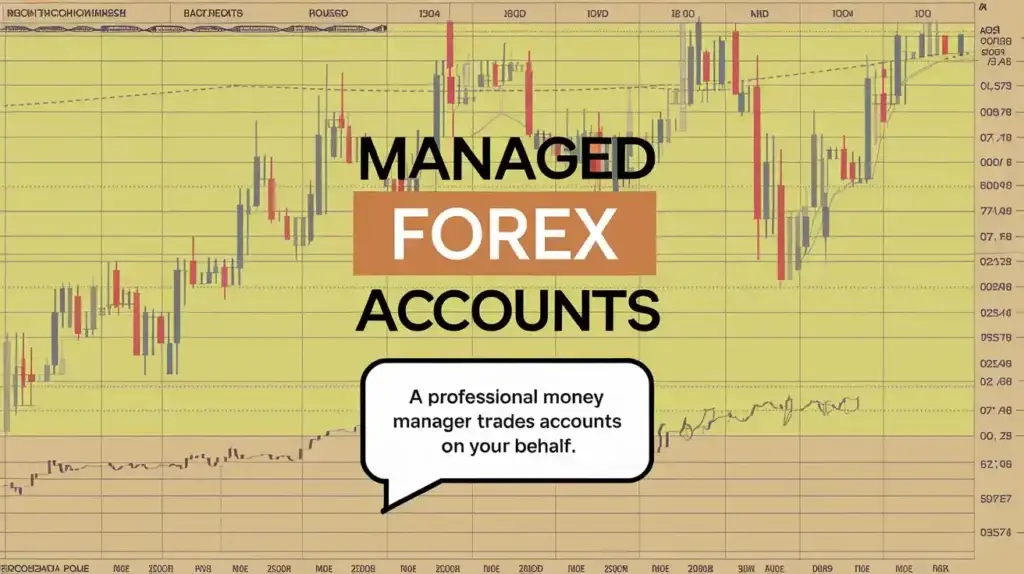
Managed forex accounts are professionally traded investment profiles that identify profitable currency opportunities for passive participants. These accounts utilize Limited Power of Attorney (LPOA) to grant managers trading rights while investors retain total control over their capital. Demand for these accounts tracks appetite for returns that do not move with equity portfolios, which is why interest tends to rise when correlations across mainstream assets tighten.
Managed forex accounts identify the gap between institutional expertise and retail capital by allowing individual investors to replicate the strategies of veteran fund managers. This framework provides access to sophisticated algorithmic and discretionary models that are typically reserved for high-net-worth individuals. It serves as a primary tool for portfolio diversification in the modern financial landscape.
The 2026 investment environment requires a high degree of transparency regarding performance fees and risk metrics. Mastering the selection process for these accounts enables participants to capitalize on currency volatility without the need for manual chart analysis.
While understanding Forex is important, applying that knowledge is where the real growth happens. Create Your Free Forex Trading Account to practice with a free demo account and put your strategy to the test.
What are managed forex accounts and how do they work?
A managed forex account is a brokerage profile where a professional trader executes transactions on behalf of an investor through a legal LPOA agreement. The manager operates the account using discretionary or algorithmic trading models while the investor maintains sole withdrawal authority. This structure combines the expertise of professional traders with the capital of individual participants. The general form is documented as a managed account, and the trading authority is granted through a limited power of attorney.
Three core mechanics define how managed accounts function:
- LPOA (Limited Power of Attorney): Granting the manager trading access without withdrawal access. The investor retains total control over funds and can revoke the manager’s authority at any time.
- Profit Distribution: How gains are shared between the manager and the investor. Most 2026 accounts use a High Water Mark clause, ensuring the manager only earns fees on new profits.
- Transparency: Real-time dashboards allow investors to monitor every transaction and equity change instantaneously.
A high water mark clause is standard practice on performance fees, ensuring a manager only earns on new profits above the account’s previous peak. This mechanism aligns the manager’s incentives with investor success and prevents fee extraction during drawdown periods.
The LPOA Agreement: Your Security Shield
The LPOA identifies the specific legal boundaries of the manager’s authority, ensuring that capital custody remains exclusively with the investor. This legal document outlines exactly which actions the manager can take and which actions are forbidden. It provides the foundational protection layer for all managed account relationships.
The agreement specifies trading authorization, profit distribution percentages, and revocation procedures. The investor can terminate the LPOA at any time without penalty, immediately freezing the manager’s access while preserving all capital. Standard LPOAs include clauses preventing the manager from withdrawing funds or modifying the agreement unilaterally.
Ready to Elevate Your Trading?
You have the information. Now, get the platform. Join thousands of successful traders who use Volity for its powerful tools, fast execution, and dedicated support.
Create Your Account in Under 3 MinutesPAMM vs. MAM vs. LAMM: Which structure is best?
Account modules identify the specific methods used to allocate trades and profits across multiple investor sub-accounts. Each module serves different investor preferences and regulatory requirements. Understanding these structures enables informed selection based on personal risk tolerance and customization needs.
Three primary module types exist in 2026 managed account ecosystems:
- PAMM (Percentage Allocation Management Module): Pooling all funds into one master account. Trades are executed on this combined balance, and profits are distributed proportionally to each investor based on their contribution percentage.
- MAM (Multi-Account Manager): Allowing customized risk profiles for each investor within a single fund. Individual sub-accounts can have different leverage, position sizes, and stop-loss levels while trading the same strategy.
- LAMM (Lot Allocation Management Module): Replicating fixed lot sizes across all sub-accounts. This module prioritizes consistency, ensuring every investor receives identical trade units regardless of account size.
MAM structures exist because they can carry a different risk profile for each investor inside a single fund. This flexibility appeals to investors with different risk tolerances who wish to follow the same manager’s strategy. Types of Traders explains how different trader profiles utilize various account structures for strategic advantage.
PAMM accounts offer simplicity and lower fees due to consolidated trading costs. MAM accounts provide granular control but require higher minimum investments. LAMM accounts balance consistency with proportional profit sharing. Choosing the right module depends on your risk appetite and desire for customization.
How to vet a forex money manager in 2026
Rigorous due diligence identifies the historical reliability and risk management profile of a manager through third-party audited track records. This process separates legitimate professionals from fraudsters and struggling traders. Professional selection requires examining multiple dimensions of performance and operational integrity.
Core vetting criteria include historical drawdown analysis, regulatory status verification, and strategy clarity assessment. A manager’s maximum drawdown reveals how much capital can disappear during adverse market conditions. Authorisation from a recognised regulator such as the FCA, CySEC or ASIC signals legal compliance and oversight.
Strategy transparency is mandatory, understand whether the manager uses “Grid” strategies (which hide losses through averaging), “Martingale” approaches (which amplify risk exponentially), or systematic fundamental models. Avoid managers who obscure their methods or claim to possess “secret” edge strategies.
Real trading example:
An AUD/JPY managed account achieved a 15% annual return but suffered a 35% drawdown during a sudden rate hike. The investor withdrew funds because the drawdown exceeded their predefined 10% risk tolerance. Past performance is not indicative of future results.
Third-party audit services like Myfxbook provide tamper-proof verification of trading records and performance metrics. These platforms allow independent confirmation of a manager’s claimed returns. Never invest in managers who refuse to provide third-party audited track records. Interest Rate Trading explains how central bank decisions impact managed account strategies and account selection.
Understanding the costs: Fees and profit sharing
Fee structures identify the total cost of professional management, typically consisting of management fees and performance-based incentives. Every managed account deducts these fees from your equity, directly reducing your net returns. Understanding the fee breakdown prevents surprises and enables accurate ROI calculation.
| Fee Type | Typical Range (2026) | Description | Impact on ROI |
| Management Fee | 0% – 2% (Annual) | Cost for holding the account | Low – Persistent |
| Performance Fee | 20% – 35% (Monthly) | Share of net new profits | High – Incentive |
| Spread Markup | 0.2 – 1.0 Pips | Indirect cost of execution | Medium – Hidden |
| Withdrawal Fee | 0% – 1% | Cost to remove capital | Low – Periodic |
| Setup Fee | $0 – $500 | One-time entry cost | Minimal (Fixed) |
Fee bands above describe the structures commonly offered rather than a measured market average; the exact numbers vary by provider and should be read from the agreement itself.
Management fees typically range from zero to two percent annually. Performance fees range from twenty to thirty-five percent of net new profits. Spread markup varies by broker and represents the difference between institutional and retail quote pricing. Most legitimate managers use the High Water Mark to avoid double-fee collection. Profit Loss Statement explains how to calculate net returns after fee deduction and how spread costs translate to basis points on your positions.
The Risks of Managed Accounts: Beyond Market Volatility
Systemic risk identification identifies the potential for broker insolvency or manager fraud in jurisdictions with weak regulatory oversight. Market losses are only one risk, operational and counterparty risks often pose greater threats. Professional investors implement strict vetting protocols to minimize these exposure vectors.
Three categories of non-market risk threaten managed accounts:
- Counterparty Risk: Why the broker’s financial health is as important as the manager’s trading skill. An insolvent broker cannot facilitate withdrawals regardless of the account’s profitability.
- “Gleaning” and Rebate Scams: Identifying managers who trade just to generate commissions. These operators churn accounts, generating high commissions while your equity stagnates.
- Liquidity Risk: The danger of being unable to exit during “Flash Crashes.” Some brokers suspend withdrawals during market chaos, trapping capital indefinitely.
Professional investors often diversify across 3-5 different managers using “Account Aggregators” to reduce the risk of a single strategy failure. This approach caps maximum exposure to any single manager’s fraud or incompetence. Risk Management provides frameworks for structuring multi-manager portfolios. A manager who cannot produce an independently verifiable record, or who resists naming the regulated entity holding the funds, has failed the first test of due diligence.
Turn Knowledge into Profit
You have done the reading, now it is time to act. The best way to learn is by doing. Open a free, no-risk demo account and practice your strategy with virtual funds today.
Open a Free Demo AccountIndividual vs. Institutional Managed Accounts
Tier identification identifies the different entry requirements and service levels between retail PAMM accounts and institutional hedge funds. Individual investors access the same trading expertise as institutions at a far lower entry point, though the minimum itself is set per provider rather than by any market-wide standard. Institutional clients receive bespoke risk configurations and direct manager relationships.
Retail PAMM accounts typically open from a few hundred to a few thousand in base currency with standardised risk profiles, while institutional mandates start far higher and come with complete customisation. Larger institutional clients receive dedicated relationship managers and quarterly performance reviews. The tradeoff between accessibility and customization drives these tier distinctions.
Who are Liquidity Providers explains the institutional infrastructure supporting managed account execution and structure selection.
Key Takeaways
- Managed forex accounts allow investors to outsource trading decisions to professional managers while retaining custody of their own funds.
- LPOA agreements provide the legal framework for trading authority, ensuring that only the investor can withdraw funds.
- PAMM and MAM structures are the primary technical modules used to distribute trades across multiple investor accounts.
- Performance fees in 2026 typically range from 20% to 35% and are usually governed by a High Water Mark clause.
- Due diligence is mandatory and must include an audit of the manager’s regulatory standing and verified historical drawdown.
- Counterparty risk remains a critical factor, making the selection of a Tier-1 regulated broker as important as the manager themselves.
Frequently Asked Questions
This article contains references to managed forex accounts, PAMM/MAM structures, and Volity, a regulated CFD trading platform. This content is produced for educational purposes only and does not constitute financial advice or a recommendation to buy or sell any financial instrument. Managed account performance depends entirely on market conditions and manager execution. Always verify current regulatory status and third-party audit records before committing capital. Some links in this article may be affiliate links.