Scalping without proprietary order-flow data or millisecond-level latency exposes traders to massive slippage and market-maker predation; high-frequency losses accelerate during announcement volatility. Day trading with under $5,000 capital triggers forced liquidations during normal market volatility, position sizing becomes impossible. Swing trading creates overnight gap risk where central bank announcements and geopolitical shocks wipe entire week-long gains in seconds. Position trading locks capital for months while missing higher-conviction shorter-term moves; forced holding during drawdowns triggers emotional capitulation sales. The spread of low-cost retail platforms has flooded markets with under-capitalized scalpers competing against AI algorithms with microsecond advantages. Past performance is not indicative of future results. Capital at risk.
Types of traders are categorized by their time horizon, risk tolerance, and analytical focus. In 2026, the trading landscape has been reshaped by low-cost mobile brokers, tighter retail leverage limits under ESMA and FCA rules, and the rise of AI-driven sentiment trading. Whether you choose high-frequency scalping, intraday day trading, multi-day swing trading, or long-term position trading, success depends on aligning your persona with your capital base and lifestyle constraints.
Types of traders function as the primary occupational classifications in the financial markets. These personas range from ultra-short-term scalpers targeting micro-price fluctuations to long-term position traders focused on macro-economic cycles. In the 2026 trading landscape, selecting a style that aligns with your psychological profile is the single biggest determinant of long-term profitability.
The rise of retail automation and low-cost mobile brokers has democratized access to professional-grade strategies. Success in 2026 requires moving beyond simple style definitions toward a deep understanding of capital requirements and technological tools specific to each persona.
While understanding Types of Traders is important, applying that knowledge is where the real growth happens. Create Your Free Forex Trading Account to practice with a free demo account and put your strategy to the test.
What are the four main types of traders in 2026?
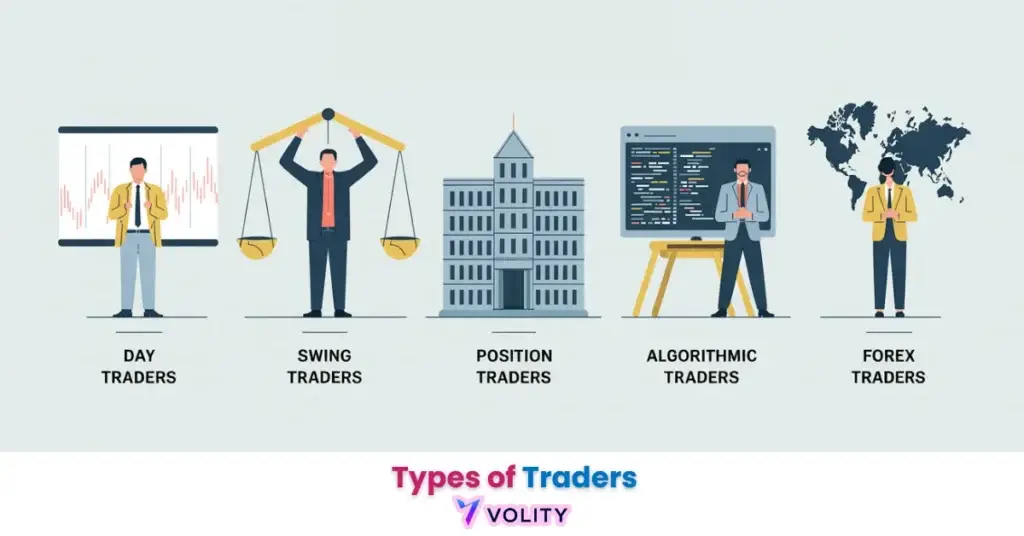
Trading personas identify the four primary methodologies for market participation: Scalpers, Day Traders, Swing Traders, and Position Traders. Each persona operates across different timeframes and carries distinct psychological and capital requirements. The classification system reflects not just holding period but also the total time commitment required for success.
- Scalpers: High-frequency execution on 1m-5m charts for 5-10 pip gains.
- Day Traders: Closing all positions before the session close to avoid overnight risk.
- Swing Traders: Holding for 2-5 days to capture multi-day price “swings.”
- Position Traders: Long-term allocation based on macro fundamentals (months to years).
Day trading skews young, and the shift to mobile-first execution is the reason. This demographic skew reflects the shift toward mobile-first execution and 24/7 market availability. Younger traders have grown up with real-time market data and lack the psychological anchoring to traditional trading hours.
The Surge of the 24/7 Retail Trader
Retail participation has shifted younger, particularly in emerging markets where the first trading account is opened on a phone rather than at a desk. The shift to mobile-first execution allows traders to monitor positions from anywhere, eliminating the desk-bound constraints of traditional day trading. How 24/7 markets (Crypto/ETFs) have eliminated the “Weekend Gap” risk removes one of the oldest trading hazards, position holders no longer face Monday shock gaps from news released over the weekend.
Ready to Elevate Your Trading?
You have the information. Now, get the platform. Join thousands of successful traders who use Volity for its powerful tools, fast execution, and dedicated support.
Create Your Account in Under 3 MinutesDeep Dive: Scalping and Day Trading in the Low-Cost Broker Era
The spread of low-cost, mobile-first brokers has been the most significant shift in retail day trading access, letting participants start with a few hundred pounds rather than a large minimum balance. Unlike the United States, the UK and EU never applied a pattern-day-trader minimum; instead, retail traders operate under ESMA and FCA leverage caps (30:1 on major forex, 5:1 on individual shares, 2:1 on crypto) with negative-balance protection. Access has widened as fractional shares and low minimums removed the old capital barriers to intraday trading. Risk-based margin means brokers calculate buying power from the actual volatility and leverage of positions rather than a fixed floor. Scalping in 2026 requires ultra-low latency execution, and AI alerts are close to mandatory for high-frequency success, because pure human reflexes cannot compete with algorithms operating at millisecond speeds.
The pattern-day-trader minimum equity requirement is a United States rule that never applied to UK or EU retail accounts. Traders outside the US instead face broker-set minimums and ESMA and FCA leverage limits, which keeps intraday access open to smaller accounts while capping risk.
Forex Trading for Beginners provides foundational context for those new to this style.
The 2026 Style Comparison: Capital, Focus, and Risk
Comparative analysis of trading styles identifies a clear hierarchy of capital needs and psychological demands for each market persona. The capital requirements reflect not just the minimum needed to trade, but the realistic amount required to survive account drawdowns without forced liquidation. Success at each level requires matching capital allocation to the style’s volatility and trading frequency.
| Trader Type | Typical Timeframe | Capital Requirement (2026) | Focus Area | Overnight Risk |
| Scalper | 1m – 5m | £10,000+ (for edge) | Order Flow | None |
| Day Trader | 15m – 1H | From about £500 (broker minimum) | Chart Patterns | None |
| Swing Trader | 4H – Daily | £1,000 – £5,000 | Trends/Events | High |
| Position Trader | Daily – Weekly | £5,000+ | Macro/Rates | Very High |
| Sentiment | Event-Driven | Variable | Social/AI Data | Varies |
The capital column above is a practical guide to surviving normal drawdown at each style, not a regulatory minimum. Retail leverage caps come from the ESMA and FCA rules that apply to your account; market-wide turnover context is from the BIS Triennial Central Bank Survey, OTC foreign exchange turnover in April 2025.
In the 2026 market, swing trading is the “optimal” style for individuals with full-time jobs; focusing on Daily and 4-hour charts allows you to filter out the noise of high-frequency AI execution that often traps intraday day traders.
Strategy: Choosing the Right Style for Your Lifestyle
Lifestyle alignment identifies the process of matching a trader’s daily schedule and psychological risk tolerance with the appropriate market timeframe. This alignment is the foundation for sustainable trading success. Attempting to scalp when you work a 9-5 job creates psychological pressure and poor decision-making.
The “Part-Time” Pro: Why swing trading is the standard for those with 9-5 careers, you can analyze charts in the evening and execute trades during the following day without constant monitoring. The “Full-Time” Grind: The high stress and focus required for intraday scalping mean many traders experience burnout within 6 months. The “Passive” Allocator: Using position trading to build long-term wealth without screen fatigue allows traders to maintain normal sleep cycles and avoid the psychological costs of constant decision-making.
Worked illustration: a trader scalping the 1-minute chart into a scheduled central-bank announcement on a £2,000 account meets a spread that widens and a market order that fills well away from the screen price. The position is under water before the move it was sized for has even formed. This illustrates why announcement windows and scalping sizes do not mix; it is not a record of a specific trade. Past performance is not indicative of future results.
WARNING: The pattern-day-trader minimum is a United States rule that does not apply to UK or EU retail accounts. Wherever you trade, using too little capital relative to position size increases the risk of immediate liquidation during high-volatility events, so size positions to survive normal drawdowns.
The Rise of the Sentiment and AI-Driven Trader
AI-enhanced research identifies the 2026 trend where traders utilize unstructured data scraping to find hidden market correlations. Social Scrapers use AI to track Reddit/Twitter sentiment for momentum signals, identifying retail-driven buying or selling before those moves manifest on traditional charts. Correlation Bots find links between Bond yields and Equity breakouts in milliseconds, exploiting the lag between fundamental data release and price response. The “Hybrid” Persona combines human decision-making with AI-generated watchlists, using algorithms to screen thousands of potential trades and human judgment to validate execution.
Advanced Technical Analysis explores how modern technical tools integrate with AI sentiment data.
💡 KEY INSIGHT: Sentiment Traders represent the fastest-growing demographic in 2026, utilizing AI tools to scrape social media and news data for “momentum bursts” that occur outside of traditional technical patterns.
Turn Knowledge into Profit
You have done the reading, now it is time to act. The best way to learn is by doing. Open a free, no-risk demo account and practice your strategy with virtual funds today.
Open a Free Demo AccountCommon Failures: Why Style Mismatch Kills Portfolios
Style mismatch identifies the primary technical error where traders apply high-frequency setups to a long-term position trading account. Overtrading represents the day trader’s temptation to enter low-conviction setups just because the timeframe is comfortable, more trades do not equal more profit. Patience Fatigue describes the swing trader who panics on a 15-minute pullback, exiting a multi-day winner prematurely because short-term volatility triggered emotional exits.
Risk Management in Trading and Forex Trading for Beginners both address how to prevent these common failures through structured position management.
Key Takeaways
- Types of traders are categorized by their holding periods, trade frequency, and the specific technical or fundamental tools they prioritize.
- Swing trading is the optimal choice for individuals with full-time careers, utilizing high timeframe charts to capture multi-day price moves.
- The US pattern-day-trader minimum does not apply to UK or EU retail accounts, where leverage is instead capped by ESMA and FCA rules with negative-balance protection.
- Scalping remains the most intense trading style, requiring ultra-low latency execution and constant focus on 1-minute to 5-minute price action.
- Sentiment trading is a rapidly growing 2026 category that integrates AI social media scraping with traditional technical patterns for momentum entries.
- Style mismatch warning indicates that applying high-frequency tactics to long-term accounts is a leading cause of retail portfolio failure.
Frequently Asked Questions
This article contains references to Types of Traders, Day Traders, Swing Traders, Scalpers, Position Traders, Sentiment Traders, and Volity, a regulated CFD trading platform. This content is produced for educational purposes only and does not constitute financial advice or a recommendation to buy or sell any financial instrument. Always verify current regulatory status and platform details before using any trading service. Some links in this article may be affiliate links.