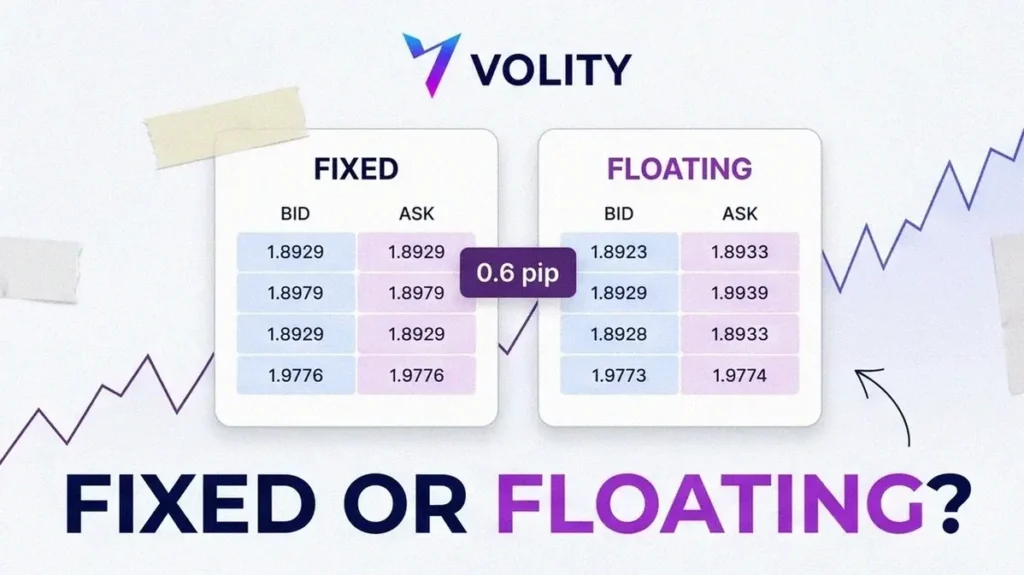
You open a trade, and before the price even moves you are already slightly down. That gap is the spread – the cost you pay the moment you click buy. The honest answer to “fixed or floating” is this: a fixed spread is predictable but quietly more expensive, while a floating spread is cheaper in calm markets but widens when news hits. Here is how to pick the right one for your style fast.
TL;DR / Quick insight: The spread is the difference between the buy and sell price of a currency pair – your entry cost. A fixed spread never changes, so your cost is certain, but the broker pads it and may requote or slip you in fast markets. A floating (variable) spread moves with the market: tight when liquidity is high, wider around big news. Scalpers and cost-sensitive active traders usually win with tight floating spreads; nervous beginners sometimes prefer the certainty of fixed. Volity uses dynamic (floating) spreads from 0.6 pip on Standard, commission-free on the Markets account, and you can watch the spread move on a free demo before funding.
One disambiguation first. This guide is about the forex and CFD broker spread – the bid-ask cost on every trade, not home-loan rates or bond credit spreads. It matters because it is the one cost you pay on every trade, win or lose.
The one-line difference (and what it means for your money)
A spread is the gap between the price you can sell at (the bid) and the price you can buy at (the ask). It is measured in pips – a pip being the smallest standard price move in a pair – and it is how most commission-free brokers get paid.
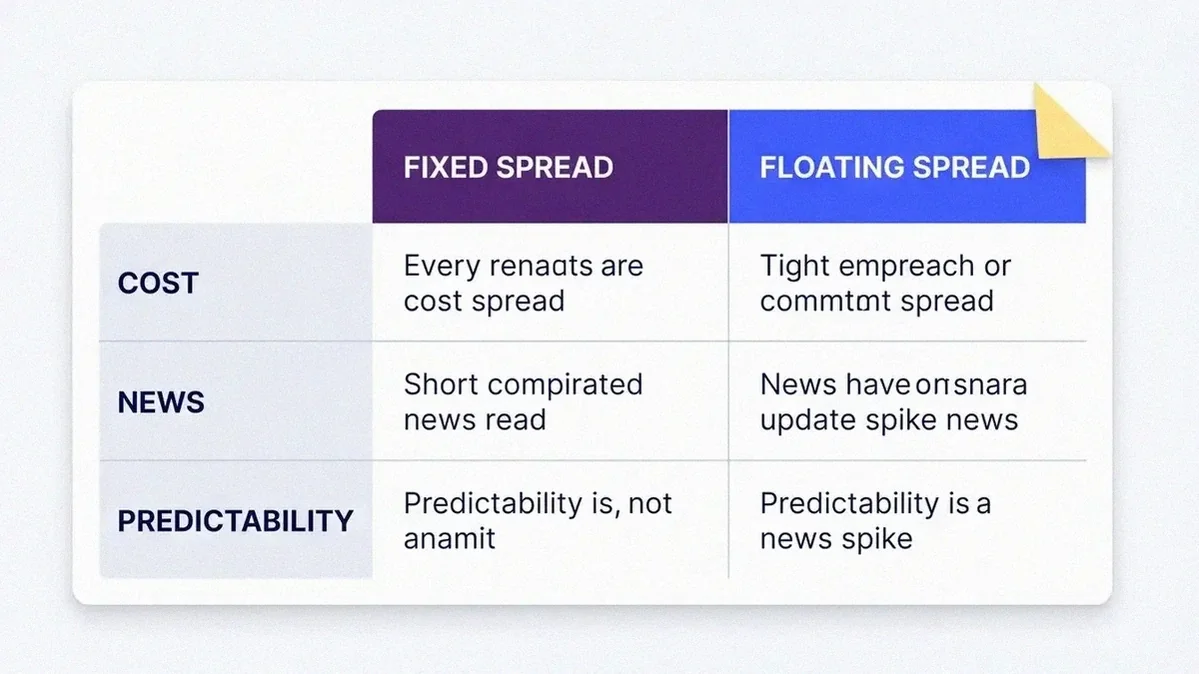
A fixed spread stays the same number of pips no matter what the market does. A floating spread (also called variable) changes second by second: tight when buyers and sellers are active, wider when liquidity dries up. That single difference decides how much you pay, how cost behaves around news, and whether you can know it in advance. Recommendation: decide now which matters more to you – a price you can predict to the pip, or the lowest cost when the market is calm.
How a fixed spread works – and the trade-off it hides
A fixed spread is sold as simplicity: the broker promises a pair will always cost the same, so you know your cost before you click. But the trade-off hides in two places. First, the baseline is wider – to guarantee a constant spread even during chaos, the broker prices in volatile moments at all times, so you pay that insurance premium on every trade, including the calm ones. Second, fixed does not mean frictionless: in violent markets the broker often cannot honour the quote and gives you a requote (a new price to accept) or slippage (a fill worse than you clicked).
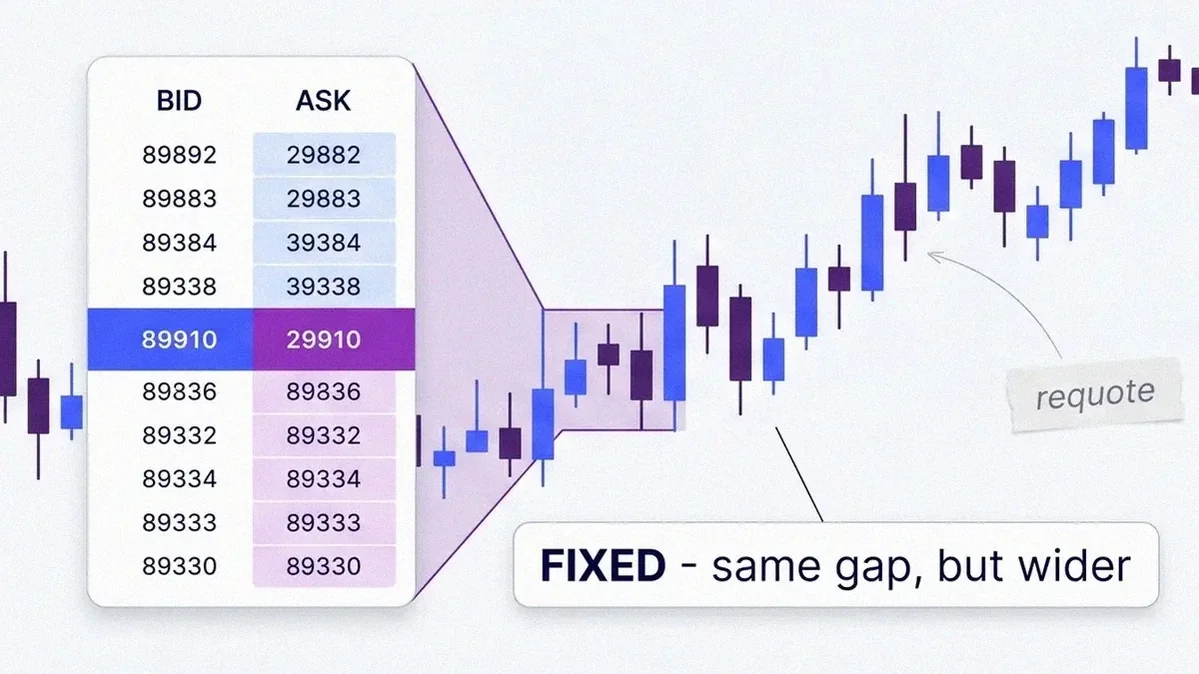
Recommendation: do not pick a fixed spread on the calm headline alone. Ask the broker whether they requote or slip in fast markets – if they do, the “fixed” promise has a loophole right when it matters.
How a floating spread works (Volity uses dynamic spreads from 0.6 pip on Standard)
A floating spread reflects the real, live market. The broker passes through pricing from liquidity providers, so it is as tight as the market allows right now. On major pairs in liquid hours it can be very tight; around a high-impact release – a central bank decision, a jobs report – it widens, because liquidity thins and risk rises for everyone quoting prices.
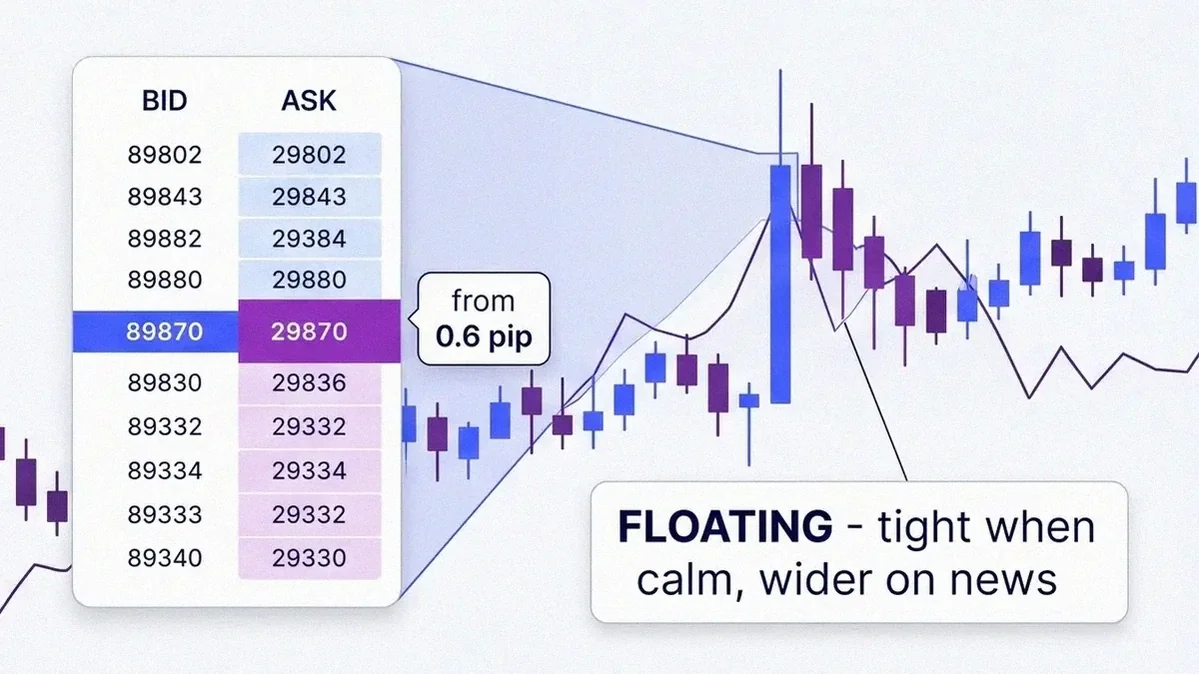
This is the model Volity uses. Volity spreads are dynamic and start from 0.6 pip on the Standard offering, and trading on the Markets account is commission-free, so the spread is your main cost; PRO and VIP are tighter again. The honest downside is uncertainty: you do not know to the pip what a trade will cost until you place it.
Recommendation: the cleanest way to understand a floating spread is to watch one move. Open a FREE DEMO ACCOUNT, pull up a major pair, and watch the dynamic spread tighten in liquid hours and widen around news – without risking a cent. The Volity trader hub covers reading costs in more depth.
Side-by-side: cost, news behaviour, slippage, predictability
Here is the comparison that actually decides it – the four dimensions traders really compare, plus requotes and gaps, each translated into what it means when you click buy.
| Dimension | Fixed spread | Floating (variable) spread |
|---|---|---|
| Cost (baseline) | Wider; a padded average on every trade, even calm ones | Tight in liquid hours; live cost (Volity: dynamic from 0.6 pip, commission-free) |
| News behaviour | Looks the same, but execution can break (requotes/slips) | Visibly widens around big releases, then tightens |
| Slippage | More likely to slip or requote in fast moves | Fewer requotes; you fill, but wider in volatility |
| Predictability | High – you know the cost before clicking | Lower – cost known only when you place the trade |
| Requotes / gaps | Requotes possible; held wide at the open | Requotes rare; opens wider after a gap, then settles |
Verdict: If certainty is everything and you trade rarely, a fixed spread buys a predictable cost – paid for with a wider baseline and requote risk. If you trade often, or want to pay the least in normal conditions, a tight floating spread wins, as long as you avoid the worst of a news spike.
Which suits scalpers, swing traders and beginners
The right model depends on how often you trade, how long you hold, and how cost-sensitive you are. Match yourself to the closest profile.
- Scalpers and high-frequency traders live and die on cost. Dozens of trades a day make the spread your biggest expense, so a tight floating spread almost always wins – provided you avoid trading into scheduled news.
- Day traders usually favour floating too, but watch the calendar so they are not caught entering during a widen.
- Swing and position traders hold for days or weeks, so the entry spread is a tiny fraction of the move they target. For them, overnight rollover (the charge on positions held past 22:00 GMT) matters far more than fixed vs floating.
- Total beginners sometimes prefer the certainty of a fixed spread while they learn. Most graduate to tight floating spreads once cost starts to bite.
Recommendation: pick the profile that fits you today. The same Volity account carries a beginner on a demo and a high-volume trader alike, so you never switch platforms as you grow.
Checklist: read the live spread before you trade
Whatever model you choose, never trust the marketing number alone. Read the actual spread you will pay, at the times you actually trade, with this five-point check.
- Check the spread at your real trading hours. Note the live spread on your main pair at the time you usually trade. A great spread at lunchtime in London is useless if you trade at midnight.
- Check it around scheduled news. Look a minute before and during a high-impact release. This shows the worst case, not the brochure case.
- Check it at the open and close. Watch the spread after the weekend gap and near the daily session roll – the widest moments.
- Compare total cost, not just the spread. Add any commission to the spread before comparing accounts, so you weigh true cost like for like.
- Factor in holding cost. If you hold past 22:00 GMT, add the overnight rollover – irrelevant for short trades, decisive for swing trades.
Recommendation: run all five checks on a free demo first, then place your first live trade with your eyes open. When ready, OPEN A VOLITY ACCOUNT and trade real shares, fractional shares, crypto and CFDs from one login, and SEE FEES AND ACCOUNT TYPES before you commit. The Volity forex hub covers spreads, order types and strategy.
Reviewed by: Alexander Bennett, Volity editorial desk.
Data integrity: all Volity product details (dynamic spreads from 0.6 pip on Standard, commission-free Markets account, free demo on every tier) are verified against the published Volity fee schedule at volity.io/charges-fees as of June 2026. Fixed vs floating mechanics are general market education.
Related Volity guides
- How to read a forex spread (and what 0.6 pip costs)
- Market order vs limit order
- Volity trading tools and calculators
Related coverage on Volity
- How to Read a Forex Spread: Bid, Ask, Pips and Cost
- Market Order vs Limit Order: Which to Use and When
- Low Spread Forex Broker: How to Read Real Spreads
- Forex Day Trading: Setup, Risk, and What Actually Works
- What Is Liquidity in Forex Trading? (2026)
Frequently asked questions
Is a fixed or floating spread better?
Neither is universally better; it depends on how you trade. A fixed spread suits you if you value a predictable cost and trade infrequently. A floating (variable) spread is usually better if you trade often or want the lowest cost in normal conditions, because you pay the live market price instead of a padded average.
Do floating spreads widen during news?
Yes. A floating spread reflects live liquidity, and around high-impact releases liquidity thins and volatility rises, so the spread widens briefly before tightening as calm returns. The practical fix: avoid placing fresh trades into the first seconds of a scheduled release.
What is a good floating spread?
A good floating spread stays tight during the hours you actually trade and only widens for short moments around news. Rather than chasing a headline number, watch the spread move on a demo at your real trading times. Volity uses dynamic spreads from 0.6 pip on Standard.
Which spread is best for beginners?
Beginners sometimes prefer a fixed spread because it removes one variable while they learn. The smarter move is to open a free demo, watch how a floating spread behaves in calm and volatile conditions, and learn to read the live cost – then most graduate to tight floating spreads, which are cheaper in normal markets.
Does Volity offer fixed spreads?
Volity uses dynamic (floating) spreads from 0.6 pip on the Standard offering, with commission-free trading on the Markets account and tighter spreads on PRO and VIP. You can watch them move in real time on a free demo before you fund, so you see exactly what you will pay.
Sources
This guide draws on the following public sources.
- Bank of England – Bank of England FX Joint Standing Committee turnover data
- European Central Bank – ECB euro foreign exchange reference rates
- IOSCO – Regulatory Issues Raised by the Impact of Technological Changes on Market Integrity and Efficiency (consultation report, 2011)
- BIS – OTC foreign exchange turnover in April 2025
- BIS – BIS Markets Committee, FX execution algorithms and market functioning
- Bank of England – Bank of England daily spot exchange rate series
- Global FX Committee – FX Global Code, full text on pricing and mark-up
- Bank for International Settlements – BIS Triennial Central Bank Survey of FX and OTC derivatives markets, 2025