Investing in financial products involves risk. Losses may exceed the value of your original investment.
Quick answer
A low spread forex broker advertises raw spreads on EUR/USD as tight as 0.0 pips, but real all-in cost includes commission per lot ($3 to $7 round-trip on Raw accounts), overnight financing, and slippage during news events. Compare brokers on the all-in cost on EUR/USD over a typical 30-day window, not on the marketing headline spread.
A low spread forex broker is the one that prices honestly across all sessions, not the one with the smallest headline number on the marketing page. The number that matters is the time-weighted spread you actually pay across the 24-hour cycle, on the pairs you actually trade, including commissions and including the volatility windows when spreads widen. Most published “from 0.0 pips” advertising is a London-fix peak number that you, as a retail trader, will rarely capture.
What a forex spread actually is
The spread is the gap between the bid (the price you can sell at) and the ask (the price you can buy at), quoted in pips. On EUR/USD, a quote of 1.08701 / 1.08715 is a 1.4-pip spread. The spread is your built-in cost of round-tripping the trade: open at the ask, close at the bid, the spread is gone before the market even moves.
Two pricing models dominate retail forex:
- Spread-only. The broker marks up the raw interbank spread by 0.5-1.5 pips and charges no commission. Easy mental model.
- Raw-spread + commission. The broker passes the raw spread through (often 0.0-0.3 pips on majors) and charges a fixed commission per lot per side, typically $3-7. Lower headline spread, but the all-in cost can land in the same place.
The four numbers worth checking
- Average spread on the pair you trade most. Not the headline minimum, the time-weighted average across a full week. Most regulated brokers publish this.
- Spread during news events. NFP, CPI, ECB. A broker quoting 0.8 pips at noon may quote 8 pips at 14:30 on payrolls Friday.
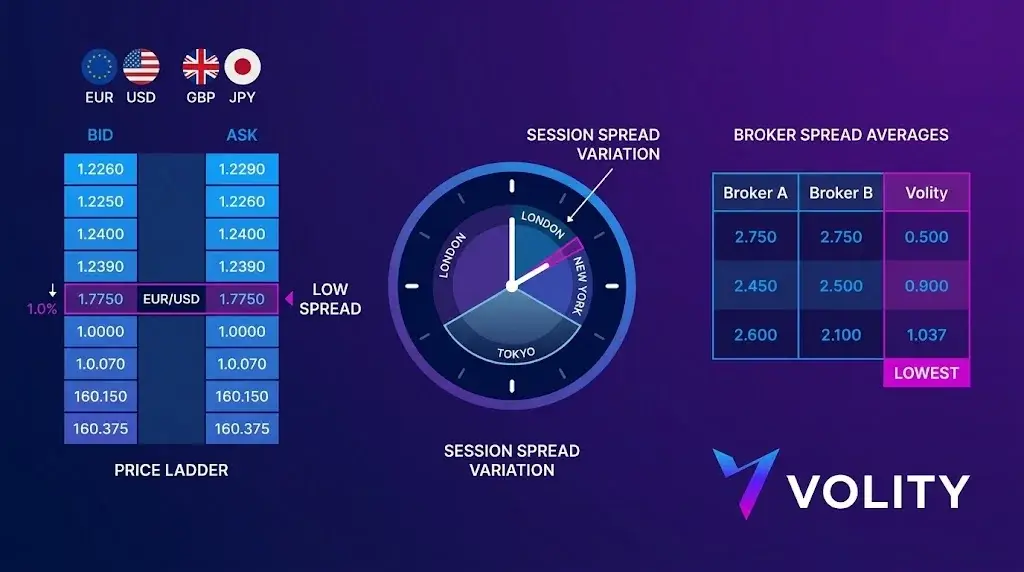
- Spread during the Asian session. EUR/USD averages 0.6-1.0 pips London hours and 1.5-2.5 pips Tokyo hours. If you trade Asian hours, the Tokyo number is your real cost.
- Commission per lot. On a raw-spread account, $3.50 per side per standard lot is the median. $7+ is high.
How to convert commission to pips
One standard lot of EUR/USD has a pip value of $10. A $3.50 commission per side per lot is 0.35 pips per side, or 0.7 pips round-trip. So a 0.2-pip raw spread + $3.50 commission account costs 0.9 pips all-in. That is the number to compare against a 1.4-pip spread-only account.
What “variable spread” really means
All retail forex spreads are variable. The broker quotes a tight spread when liquidity is deep (London-New York overlap) and a wider spread when liquidity is thin (Asian session, end-of-day rollover, news events). “Fixed spreads” exist at some venues but typically run 2-3x the variable average and absorb the variance into the markup.
What you want is a broker that publishes its variable spreads transparently and does not requote during news. Slippage is acceptable. Requotes (broker rejects your order and asks you to confirm at a worse price) are a structural problem.
Beyond spread: the four costs you forget
- Swap / overnight financing. Holding a position past 22:00 GMT triggers a swap charge or credit based on the rate differential between the two currencies. On a multi-day swing, swap can dwarf the spread.
- Inactivity fees. Some brokers charge after 90 days of no trades. EUR 10-25 per month is typical. Read the schedule.
- Withdrawal fees. Bank wires can run EUR 20-40. SEPA and card withdrawals are typically free at regulated EU brokers.
- Currency conversion. Funding in EUR and trading USD-quoted pairs triggers a conversion. Some brokers charge 0.5% on the conversion.
The honest comparison framework
Build a spreadsheet with five columns: average spread (your pair, your session), commission per lot per side, swap rate per night long, swap rate per night short, withdrawal fee. Multiply spread + commission by your monthly trade count. Multiply swap by your average holding period and trade count. Add withdrawal fees if you withdraw monthly. The all-in number is the only number that matters.
For a swing trader doing 20 round-trips a month on EUR/USD with 5-day holds, the swap line is often 30-40% of total cost. For a scalper doing 200 round-trips a month, the spread + commission line is 90%+ of cost. Pick the broker that wins on your actual trade profile.
Regulation as a precondition, not a feature
A broker quoting 0.0 pips on EUR/USD with no regulator is not a low-spread broker; it is a counterparty risk you are paying to hold. The minimum bar in the EEA is a MiFID II-passported investment firm regulated by an EEA national authority. Client funds are segregated and covered by an investor compensation scheme up to EUR 20,000 per client per firm in case of broker insolvency. Anything below that bar is not part of the comparison set.
Spreads at Volity
Volity quotes variable spreads on 50+ FX pairs across MT4 and MT5. Trading is executed by UBK Markets Ltd, a Cyprus Investment Firm authorised by CySEC under licence 186/12. Retail leverage is capped at 1:30 on major currency pairs and 1:20 on non-majors under ESMA. Negative balance protection applies. Eligible retail clients are covered by the Cyprus Investor Compensation Fund up to EUR 20,000 per client per firm.
Volity operates a trading platform and also publishes educational and analytical content about trading. The content on this page is for educational purposes only and should not be considered financial advice. Volity may benefit commercially when readers open trading accounts through links on this site.
Our content is produced and reviewed under documented editorial standards; see our comparison and review methodology.
Frequently asked questions
Is the advertised spread the spread I will pay?
Usually not. Advertised figures are often a best-case or minimum spread observed in ideal conditions. The figure that matters is the average across the hours you actually trade, including around scheduled news.
Does a zero spread account mean trading is free?
No. Accounts marketed with very tight or zero spreads normally charge a commission per lot instead. The comparison that matters is the total cost of a round turn, spread and commission combined.
When are forex spreads widest?
Around major economic releases, at the daily rollover, and during thin liquidity between the New York close and the Tokyo open. Strategies that trade in those windows should be assessed on the spread available then.