Spinning tops are neutral patterns prone to generating false signals, and tested reversal rates sit at roughly a coin flip, so trading them without next-candle confirmation has no edge. The pattern is short by construction, which keeps the achievable reward small relative to the stop and makes it unsuitable as a primary entry trigger. Algorithmic stop-hunting during Asian sessions creates artificially long-wicked patterns that trap retail traders; these should be ignored unless they retest London or New York extremes. Early exits based solely on spinning top formation often trigger whipsaws before genuine reversals materialize. Past performance is not indicative of future results. Capital at risk.
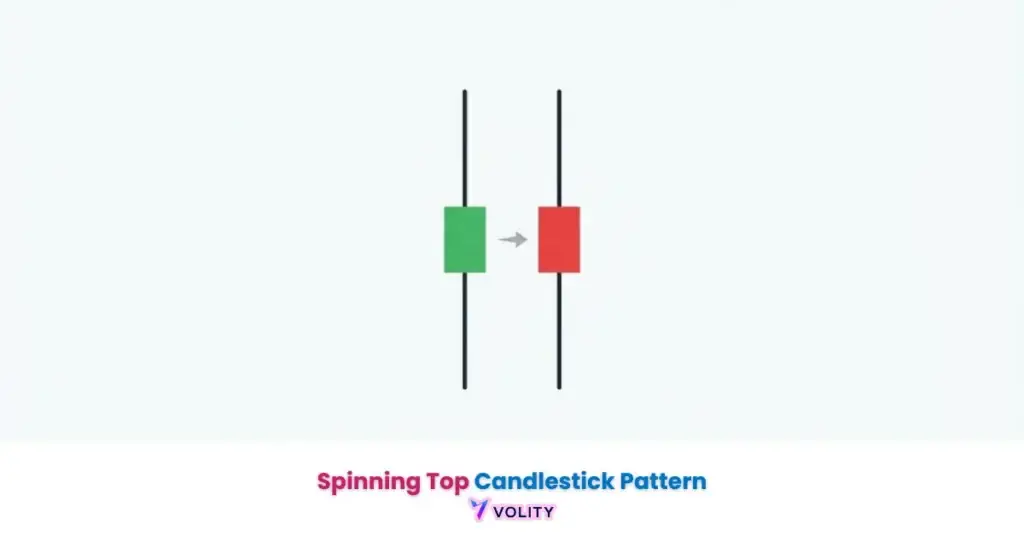
A Spinning Top is a single-candle price formation characterized by a small real body and long, balanced upper and lower wicks, signifying a state of market indecision. Thomas Bulkowski’s testing puts it at a 51% reversal rate for the black spinning top and 50% for the white one, which is as close to a coin flip as a pattern gets. Traders utilize the Spinning Top as an early warning signal to tighten risk management, requiring decisive volume expansion and next-candle confirmation to validate any directional shift.
Spinning top candlestick mechanics function as a “warning light” on a chart, indicating that the prevailing momentum is losing steam. This formation allows traders to observe the exact moment when the market enters a temporary state of stalemate between horizontal boundaries. It remains a critical tool for detecting volatility contraction before a decisive breakout occurs.
The 2026 trading environment is characterized by rapid reversals and high-frequency “noise” during session overlaps. Mastering the spinning top requires a disciplined approach to confirmation, as standalone patterns often fall toward a coin-flip probability.
While understanding Forex is important, applying that knowledge is where the real growth happens. Create Your Free Forex Trading Account to practice with a free demo account and put your strategy to the test.
What does a spinning top candlestick mean in 2026 trading?
A spinning top is a single-candle technical formation that identifies a state of market indecision where neither buyers nor sellers have achieved session control. The pattern displays a small real body (the difference between open and close) combined with long, relatively balanced upper and lower wicks (shadows). This construction tells an order flow story: buyers and sellers battled throughout the session, driving price across a wide range, but ultimately neither side secured decisive control, price closed near where it opened.
- Definition of the small real body and relatively long, balanced wicks
- The ‘Order Flow Story’: High volatility during the session followed by a close near the open
- Identification: Why the pattern is neutral until confirmed by external context
Bulkowski tested both variants against 103 candlestick patterns. The black spinning top acts as a reversal 51% of the time and ranks 73rd for overall performance; the white spinning top reverses 50% of the time and ranks 69th. Both rank 1st and 2nd for frequency, so you will see them constantly. The pattern’s value is therefore not standalone profitability at all. It is a risk-management signal that tells you momentum has stalled.
Ready to Elevate Your Trading?
You have the information. Now, get the platform. Join thousands of successful traders who use Volity for its powerful tools, fast execution, and dedicated support.
Create Your Account in Under 3 MinutesIs a spinning top candlestick bullish or bearish?
The sentiment of a spinning top is inherently neutral, and its directional bias identifies the preceding trend and the subsequent confirmation close. A spinning top appearing at a major support floor after a downtrend serves as a warning that bulls may be preparing to take control. Conversely, a spinning top at a resistance peak after an uptrend signals seller exhaustion. The pattern’s actual interpretation depends entirely on context, what precedes it and what follows it. Candlestick patterns covers the wider family, and how to read candlesticks covers the anatomy the classification rests on.
The tested reversal rate sits within a point of 50% either way, so the honest reading is that a spinning top tells you nothing about direction on its own. That does flip the conventional wisdom, which treats the pattern as a reversal warning: it is a stall signal, and the direction is decided by what comes next, not by the candle itself.
The distinction between reversal and continuation depends on reading the next candle’s direction. If the candle following the spinning top closes above the spinning top’s high, bulls have won the battle. If it closes below the low, sellers have reclaimed control. The spinning top itself is merely the setup; the confirmation candle is the resolution.
Focus on the ‘Body-to-Range’ ratio; to qualify as a true Spinning Top in 2026, the real body should occupy less than one-third of the total candle range. Any larger, and the signal is considered a ‘small-body trend candle’ rather than a high-volatility stalemate.
How do you trade a spinning top candlestick pattern?
Trading a spinning top identifies a process of waiting for price to break the pattern’s high or low to confirm a high-probability directional resolution. The Confirmation Rule is non-negotiable: enter only after the next candle closes decisively outside the spinning top’s range. The requirement is what converts a directionless candle into a directional trade, because the close outside the range is the market resolving the stalemate for you.
Stop-loss placement uses the opposite wick as the invalidation point. If trading a bullish breakout above the spinning top’s high, place the stop below the lower wick. This placement allows for volatility while ensuring the trade is abandoned if the reversal thesis fails. Profit targets aim for at least a 1:2 Reward-to-Risk ratio based on the vertical height of the pattern’s range (high minus low).
Worked illustration of the rule, not a recorded trade: a green spinning top prints into resistance at 1.2650. Nothing is done on that candle. The next hourly bar closes at 1.2640, below the pattern’s low, which is the confirmation. The short goes on there and the stop sits above the spinning top’s high at 1.2675, so the risk is defined by the pattern itself rather than by a round number. Past performance is not indicative of future results.
What is the difference between a spinning top and a doji?
Indecision pattern analysis identifies the specific real body thickness that distinguishes a ‘perfect’ Doji from a ‘marginal’ Spinning Top. A Doji has virtually zero body, the open and close are at the same price or within a single pip. A spinning top has a small but visible body, indicating that one side managed a marginal but inconclusive advantage.
| Metric | Spinning Top (2026) | Doji |
| Body Size | Small but Visible | Near Zero (Cross) |
| Sentiment | Marginal Bias | Perfect Indecision |
| Tested Outcome | Reversal 50-51% (Bulkowski) | No directional edge on its own |
| Bulkowski Performance Rank | 69th-73rd of 103 | Not separately ranked |
| Best Context | Trend Pause | Reversal Warning |
Tested outcomes and ranks are Thomas Bulkowski’s, from Black Spinning Top and White Spinning Top, measured against 103 candlestick patterns.
The difference is subtle but significant. Doji candlesticks represent perfect equilibrium where buyers and sellers are locked in complete stalemate. Spinning tops show that one side managed a slight edge but couldn’t convert it into sustained momentum. Practically, this means spinning tops are more reliable for continuation trades (buyers won the day marginally, so they’ll likely continue winning) while Dojis function better as reversal warnings (perfect stalemate often precedes explosive moves as one side decisively breaks the tie).
WARNING: a spinning top traded without confirmation is close to a coin flip on Bulkowski’s tested figures; always wait for the next candle to close above the high or below the low of the pattern to ensure the indecision has resolved in your direction.
How reliable is the spinning top candlestick pattern in 2026?
The reliability problem is really a geometry problem. A spinning top is a short candle, so the stop distance it defines is small in absolute terms but large relative to the move it can reasonably produce, which is why it works as a warning light rather than a primary entry trigger. Traders who want a better ratio go to higher-conviction formations such as engulfing patterns or the morning star, which Bulkowski ranks far higher for performance.
Volume confluence is what separates a meaningful stall from noise. A spinning top forming on above-average volume (relative to a 20-day SMA) means both sides committed size and neither won, which makes the eventual resolution more decisive than one formed on a quiet session. AI filtering using scanners to find spinning tops aligned with multi-year horizontal levels eliminates noise and captures only structurally significant formations.
The core driver of spinning top behavior is market sentiment. The long wicks show that both bulls and bears were active during the session, they entered positions aggressively, testing both the high and low. But neither could secure a decisive advantage by session close. This balance of power creates a temporary gridlock that must eventually break in one direction or the other.
💡 KEY INSIGHT: a spinning top on above-average volume (relative to a 20-day SMA) is the version worth watching; heavy participation during the stalemate makes the eventual resolution more decisive.
Does the color of a spinning top candlestick matter?
The color of a spinning top identifies which side maintained a marginal advantage, though its significance is secondary to the pattern’s wicks and location. A red spinning top at resistance indicates that sellers managed to push price back down slightly from intraday highs, which is slightly more bearish than a green spinning top at the same location. However, color is a minor consideration compared to the pattern’s context.
Emotional traders often over-interpret color while ignoring structural breaks. A green spinning top at major resistance is still a bearish warning because the pattern itself (regardless of color) signals indecision, and indecision at a resistance peak typically precedes selling. Professional traders focus on the wicks (the real story of order flow), the location against support and resistance, and volume rather than fixating on the single-candle color.
Turn Knowledge into Profit
You have done the reading, now it is time to act. The best way to learn is by doing. Open a free, no-risk demo account and practice your strategy with virtual funds today.
Open a Free Demo AccountKey Takeaways
- Spinning top candlesticks are single-bar formations with small bodies and long wicks that identify market indecision.
- The spinning top has no directional edge of its own; tested reversal rates sit at 50% to 51%, so it signals a pause and nothing more.
- Next-candle confirmation is mandatory, because the candle alone resolves nothing about direction.
- Bulkowski ranks the spinning top 69th to 73rd of 103 candlestick patterns for overall performance, which is why it is a risk-management warning light rather than an entry signal.
- Volume expansion during the stalemate is the filter that separates a meaningful spinning top from routine noise.
- Stop-loss placement should be set just beyond the opposite wick of the pattern to allow for modern market volatility.
Frequently Asked Questions
This article contains references to Spinning Top Candlestick Pattern, Market Indecision, and Volity, a regulated CFD trading platform. This content is produced for educational purposes only and does not constitute financial advice or a recommendation to buy or sell any financial instrument. Always verify current regulatory status and platform details before using any trading service. Some links in this article may be affiliate links.