Bull Flag Pattern is a technical continuation signal that depends on volume confirmation and market context to execute successfully. Trading patterns on leveraged CFD positions carries extreme risk, false breakouts can trigger margin calls and liquidate capital within minutes. Always verify the 50% volume threshold and maintain stop-losses outside consolidation ranges. Past performance does not guarantee future results. Capital at risk.
Bull Flag Pattern is a bullish continuation setup that resolves in the direction of the prior trend more often than not. It comprises a vertical “pole” followed by a rectangular “flag” consolidation. Traders execute entries on volume-confirmed breakouts to capitalize on momentum, provided they manage capital according to 2026 risk-based margin standards.
While understanding Bull Flag Pattern is important, applying that knowledge is where the real growth happens. Create Your Free Forex Trading Account to practice with a free demo account and put your strategy to the test.
Bull Flag Pattern is a premier continuation signal that identifies temporary price consolidation within an aggressive uptrend. Traders monitor the formation of the “pole” and “flag” to execute precision entries before the trend resumes its upward trajectory. This pattern earns its reputation when the breakout is supported by a clear expansion in volume.
Market participants utilize the Bull Flag to manage risk-reward ratios effectively in trending environments. The same geometry reads the same way across forex, indices, commodities and crypto, which is why it travels so well between asset classes.
What is a Bull Flag Pattern in Technical Analysis?
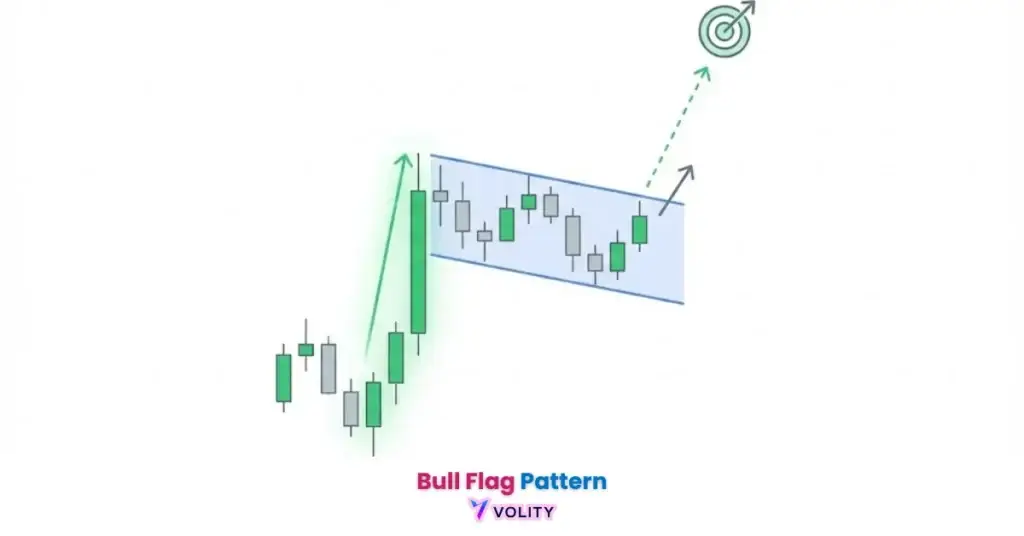
Bull Flag Pattern is a bullish continuation formation signaling a brief pause in a strong upward price movement. The pattern comprises two components: the “pole” (the initial vertical rally) and the “flag” (the orderly consolidation). Psychological drivers behind the pattern involve profit-taking from aggressive initial buyers balanced against underlying demand from longer-term holders.
The formation is categorized as a continuation rather than a reversal because the pattern predicts that the original uptrend will resume after consolidation. Bull Flags confirm continuation when volume decreases during the flag phase, indicating weak selling pressure, then surges at the breakout point as institutional buyers step in. Bull Flags are most dependable in confirmed breakout scenarios, where the close clears the channel on expanding volume.
Anatomy of the Pole and the Flag
The pole is the initial vertical price surge that defines the pattern’s momentum. Measuring the pole height, the distance from its base to its peak, provides the calculation for projected price targets. A 100-pip pole followed by a 50-pip consolidation projects a 100-pip move above the flag breakout point.
Flag consolidation follows the pole as an orderly rectangular channel sloping downward or sideways. The flag’s upper and lower trendlines remain roughly parallel, distinguishing it from triangles that converge toward an apex. Flags typically form over 5-15 trading days on daily charts, requiring patience before the inevitable breakout.
Continuation vs. Reversal Signals
Continuation signals differ from reversals by projecting the resumption of the original trend. A Bull Flag predicts upward continuation; a Bear Flag predicts downward continuation. Distinguishing between the two requires identifying the direction of the prior pole. If the prior move was upward, the subsequent flag formation signals bullish continuation.
Failed continuations occur when price breaks below the flag’s lower boundary instead of above the upper boundary. These failures resolve more cleanly on higher timeframes where institutional participation filters noise. Daily and Weekly timeframes read far more accurately than intraday charts.
Ready to Elevate Your Trading?
You have the information. Now, get the platform. Join thousands of successful traders who use Volity for its powerful tools, fast execution, and dedicated support.
Create Your Account in Under 3 MinutesHow Do You Identify a Valid Bull Flag Pattern?
Bull Flag identification requires a vertical price rally followed by a downward-sloping rectangular channel. Drawing upper and lower trendlines on the consolidation phase creates the visual flag structure that distinguishes this pattern from random noise.
The 50% retracement rule holds that pullbacks exceeding half the flagpole height sharply increase the failure rate. A 100-pip pole followed by a 60-pip flag (60% retracement) breaks that rule and fails noticeably more often. Conversely, a 30-pip flag (30% retracement) keeps the setup inside its normal, higher-probability shape. This threshold identifies the maximum consolidation depth that preserves continuation probability.
how to read candlesticks reveals the internal structure of the flag consolidation. Inside bar patterns within the flag indicate declining volume and building compression, ideal conditions for the breakout explosion. types of breakouts shows why Daily and Weekly charts read more cleanly than intraday noise.
The Role of Volume in Bull Flag Confirmation
Volume is the primary verification tool for confirming a Bull Flag breakout. The 50% Volume Benchmark is the working rule that a breakout should exceed the 20-day average by half again to confirm that buying pressure is sufficient to sustain the move.
Decreasing volume during flag formation indicates lack of selling pressure, long-term holders remain committed while profit-takers have exited. This declining volume sets up the compression necessary for explosive breakout volume. When volume suddenly spikes above the 50% threshold at the upper trendline break, institutional accumulation confirms the continuation signal.
How to Execute a Bull Flag Trading Strategy?
Bull Flag execution involves entering a long position at the breakout point with a predefined exit strategy. Entry points divide between immediate breakout execution (higher risk, better entry price) and retest entry (lower risk, worse entry price). Aggressive traders capture the initial momentum; disciplined traders wait for price to retrace to the flag’s upper trendline before entering.
Calculating price targets uses the pole projection method: measure the flagpole height from base to peak, then project that exact distance upward from the breakout level. A 100-pip pole projects a 100-pip target above the upper flag trendline. This mathematical approach removes discretion and creates predetermined profit objectives.
how to set stop loss should position stops just below the flag’s lower boundary, typically 2-3 pips below to avoid minor wicks. This placement sacrifices a small amount of precision to avoid being stopped out by algorithmic noise within the consolidation zone.
Real trading example:
Executing a breakout buy at 1.1050 on EUR/USD following a 100-pip pole resulted in capturing the full projected 100-pip move to 1.1150. The flag consolidated for 8 trading days before the breakout, providing clear geometric setup. Past performance is not indicative of future results.
Strategic Risk Management for 2026 Market Standards
Risk management is the systematic protection of trading capital against pattern failure. Margin is assessed against the real-time risk of the position rather than a fixed account threshold, so the discipline that matters is sizing each flag against its own invalidation level.
Position sizing based on 1-2% capital risk per trade protects against catastrophic losses from pattern failures. A $100,000 account executing 1% risk trades can lose $1,000 on failed flags without devastating the account. Scaling position size inversely to pattern reliability maintains consistent risk exposure.
The EAV table below quantifies 2026 environment parameters for Bull Flag execution:
| Pattern Metric | Specification | Value |
| Bull Flag Pattern | Success Rate | Higher when volume confirms |
| Bull Flag Pattern | Breakout Volume | >50% above the 20-day average |
| Bull Flag Pattern | Max Retracement | <50% of the flagpole |
| Bull Flag Pattern | Timeframe Accuracy | Highest on D1 and W1 |
| Bull Flag Pattern | Invalidation | Close below the lower channel |
Pattern behaviour described here follows the standard technical-analysis treatment set out in the CMT Association curriculum.
Bull Flag vs. Pennant vs. Bear Flag
Bull Flag variations include the Pennant pattern and the inverse Bear Flag formation. Comparing rectangular consolidation (Flag) vs. triangular (Pennant) reveals structural differences that impact execution probability. Flags maintain parallel upper and lower trendlines; pennants converge toward an apex like a compression triangle.
pennant chart pattern shows equal continuation probability to Bull Flags but provides less precise price target calculation. Pennants project breakout distance as an estimated percentage (50-100% of the pole), whereas flags calculate exact pole-length targets. bear flag pattern operates identically to bull flags but predicts downward continuation instead of upward.
Turn Knowledge into Profit
You have done the reading, now it is time to act. The best way to learn is by doing. Open a free, no-risk demo account and practice your strategy with virtual funds today.
Open a Free Demo AccountKey Takeaways
- Bull Flag Pattern signals a continuation of the prior trend, and the odds improve sharply when volume confirms the breakout.
- Volume confirmation requires a 50% surge above the 20-day moving average at the breakout point.
- Pole projection provides a mathematical price target by adding the flagpole height to the breakout level.
- Retracement limits should not exceed 50% of the flagpole to maintain a high-probability setup.
- A close below the lower channel boundary of the flag invalidates the setup and is the mechanical stop-out.
- Daily timeframes are more reliable than intraday charts because noise is filtered and follow-through is easier to confirm.
Frequently Asked Questions
This article contains references to Bull Flag Pattern and Volity, a regulated CFD trading platform. This content is produced for educational purposes only and does not constitute financial advice or a recommendation to buy or sell any financial instrument. Always verify current regulatory status and platform details before using any trading service. Some links in this article may be affiliate links.
What Volity Editorial watches: The bull flag is one of the highest-base-rate continuation patterns in technical analysis, but only when filtered correctly. The Volity desk applies three filters before sizing a trade: trend confirmation (is the broader timeframe in an uptrend), consolidation quality (does the flag form on contracting volume and orderly price action), and breakout confirmation (does the upper-channel break close with volume expansion). All three present, the measured-move projection carries weight. Skipping any filter turns a high-quality setup into a weak one.
Volity desk Q&A
How do I identify a high-probability bull flag?
Look for four visual elements: a clear impulse leg of substantial range, an orderly downward-sloping channel with two or more touches on each trendline, contracting volume during the consolidation, and a breakout candle that closes above the channel’s upper boundary with above-average volume. Patterns that lack volume contraction or that consolidate sideways instead of sloping down often fail the breakout test. The CMT Association technical analysis curriculum sets out the canonical structure.
Where do I place the stop and target on a bull flag?
Convention places the stop just below the lower channel boundary, with size calculated from the stop distance. The conventional target equals the flagpole length measured from the breakout point. Most disciplined traders take partial profit at the prior swing high or at one times the flagpole, then trail the remainder. Anchoring the entire position on the full target maximises statistical edge but introduces psychological strain that many retail traders cannot maintain consistently.
What timeframes work best for bull flags?
Higher timeframes (4-hour, daily, weekly) produce the cleanest bull flags because noise is filtered and follow-through is more reliable. Intraday flags (5-minute, 15-minute) work but require tighter risk management and faster execution because false breakouts are more frequent. Day traders typically combine intraday flags with a higher-timeframe bias filter to avoid trading against the dominant trend. The Nasdaq day-trading guide covers the broader timeframe context.
What invalidates a bull flag pattern?
A close below the lower channel boundary on increased volume invalidates the flag. So does a multi-bar consolidation that exceeds the typical duration (more than fifteen to twenty bars on the timeframe being analysed) without breakout, which usually signals momentum exhaustion rather than continuation. A break of the prior swing low that started the flagpole confirms invalidation entirely. Treat invalidation as a mechanical stop-out, not a discretionary reassessment, to capture the pattern’s positive expectancy across many trades.
External references
- CMT Association technical analysis curriculum
- Nasdaq day-trading guide
- CMT Association technical analysis
Volity operates a trading platform and also publishes educational and analytical content about trading. The content on this page is for educational purposes only and should not be considered financial advice. Volity may benefit commercially when readers open trading accounts through links on this site.
Our content is produced and reviewed under documented editorial standards; see our comparison and review methodology.