Quick answer
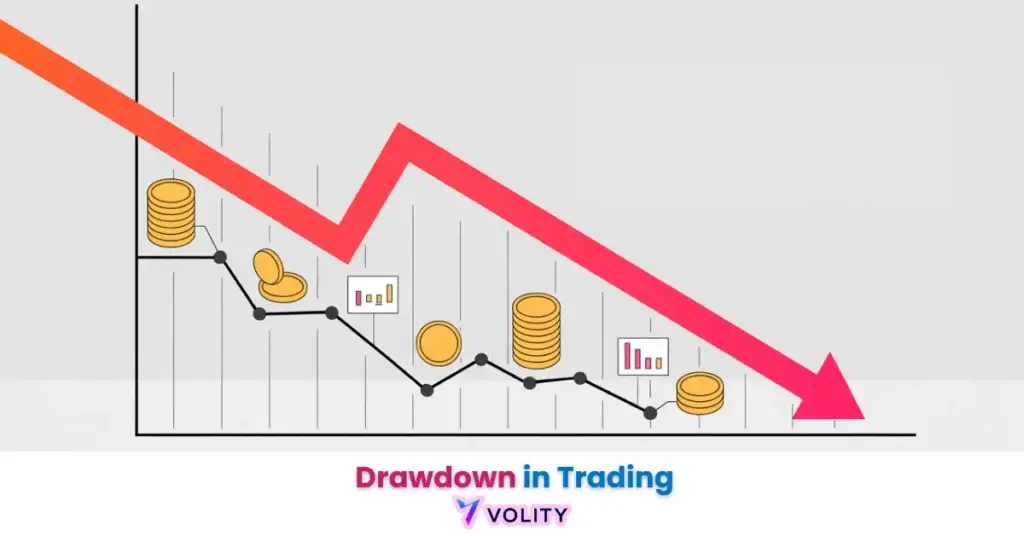
Drawdown in trading is the drop from a peak in your account balance to a later low, measured as a percentage. It shows how much you have lost from your high-water mark and is a key risk gauge: a 50% drawdown needs a 100% gain to recover. Managing drawdown through position sizing and stops is what keeps traders in the game.
Trading drawdowns are an inherent part of all investment strategies. Excessive leverage significantly increases the depth and duration of equity drawdowns, often leading to total capital loss. Never risk more than you can afford to lose. Past performance is not indicative of future results. Capital at risk.
Drawdown in trading is the peak-to-trough percentage decline in an account’s equity before a new high is reached. Statistics from early 2026 highlight extreme volatility, with Bitcoin enduring a 52.4% drawdown and the S&P 500 experiencing an 18.9% correction. Professional 2026 risk standards mandate strict daily drawdown caps of 3-5% for prop firm traders to prevent catastrophic mathematical recovery gaps.
Drawdown in trading reveals the most accurate measurement of a strategy’s downside risk and institutional viability. Current market data indicates that Bitcoin (BTC) suffered a 52.4% peak-to-trough decline between October 2025 and February 2026, illustrating the extreme volatility inherent in digital asset cycles.
Success in managing equity curves requires moving beyond simple win rates to understand the mathematical difficulty of recovering from significant losses. This guide identifies the primary drawdown types, the 2026 institutional benchmarks, and the psychological frameworks required to endure extended losing streaks.
While understanding Drawdown in Trading is important, applying that knowledge is where the real growth happens. Create Your Free Forex Trading Account to practice with a free demo account and put your strategy to the test.
What Volity Editorial watches: Drawdown management is more behavioural than technical for most accounts. Three metrics frame durable practice. Maximum historical drawdown of the strategy under live conditions (not backtested) versus the live drawdown the trader can tolerate without abandoning the system; the gap between those two numbers is where most accounts fail. Average daily and weekly drawdown rather than peak figure alone, since the rate of equity bleed is what triggers behavioural error. And recovery rate, measured as time-to-new-equity-high after each drawdown, which separates strategies that work in one regime from those that compound across regimes. Track all three on a rolling basis, set hard thresholds for de-risking before they breach, and the worst behavioural mistakes (revenge trading, over-leveraging into a recovery, abandoning the system at the bottom) become harder to make.
Ready to Elevate Your Trading?
You have the information. Now, get the platform. Join thousands of successful traders who use Volity for its powerful tools, fast execution, and dedicated support.
Create Your Account in Under 3 MinutesWhat is drawdown in Forex and how does leverage amplify it?
Drawdown in Forex is the rapid erosion of account equity caused by minor price movements acting on high leverage ratios, often exceeding 50:1 in retail accounts. A standard 1-lot position on a 1.3000 EUR/USD move will generate a 1,000-pip movement that translates to a catastrophic 10% account loss on a 1:50 leverage account, and a margin call on 1:100 leverage. Floating Drawdown refers to tracking unrealized losses on open leveraged positions; as these losses accumulate, the trader’s available margin shrinks and exposes them to forced stop-outs at exactly the wrong moment.
Margin call triggers occur when floating drawdown plus realized losses reduce the account equity below the broker’s maintenance requirement, typically 10-20% of the notional position size. In March 2026, the DXY-Equities correlation reached -0.94, leaving traders with few places to hide during USD-based drawdowns as every asset moved inversely in a synchronized sell-off. Prop Firm Limits represent the 2026 industry standard: 3% daily maximum drawdown caps and 8% total maximum drawdown limits prevent emotional “revenge trading” spirals that cascade into total account destruction.
stop out and margin levels explains the specific mechanics of how leverage amplifies small percentage moves into catastrophic account events.
What is a healthy drawdown level for hedge funds vs retail?
A healthy drawdown level is a risk threshold that varies significantly between institutional hedge funds targeting 1-5% and retail traders who often tolerate up to 20%. Institutional benchmarks reveal that Asia-focused hedge funds hit a hard 7.3% drawdown cap in March 2026 before triggering systematic de-risking, this discipline is what separates professional capital from retail gambling. A 15% drawdown persisting for 3 months signals a “broken” strategy in professional retail circles because it indicates the original thesis is flawed and capital should be redeployed.
The Sharpe Ratio evaluates the quality of performance by comparing returns to the volatility of the drawdown, penalizing strategies that generate returns through excessive risk-taking. A strategy delivering 15% annual returns with a 40% maximum drawdown (Sharpe Ratio: 0.38) is mathematically inferior to a strategy delivering 10% returns with a 5% maximum drawdown (Sharpe Ratio: 2.0). Retail traders should target maximum drawdown limits under 15% to maintain psychological resilience, while professional traders target under 5%.
Forex backtesting tracker utility provides the tools to analyze historical drawdown data on your trading strategy.
How do you calculate maximum drawdown percentage?
Maximum drawdown (MDD) calculation is the quantitative measurement of the largest historical percentage drop from any peak in an account’s equity curve to its absolute trough. The step-by-step formula is straightforward: (Peak Value – Trough Value) / Peak Value 100 = Drawdown %. If an account reaches $100,000 at its peak and then drops to $75,000 at its trough, the drawdown is ($100,000 – $75,000) / $100,000 100 = 25%.
Calmar and Sterling Ratios use MDD to calculate risk-adjusted return efficiency, comparing the strategy’s annual return to its historical maximum drawdown. A strategy with a 20% annual return and a 50% MDD delivers a Calmar Ratio of 0.4, while a strategy delivering the same 20% return with only a 10% MDD delivers a Calmar Ratio of 2.0. The higher ratio indicates superior risk-adjusted performance and proves that the second strategy is mathematically superior despite identical gross returns.
Real-world example:
The S&P 500 reached an all-time high in January 2026 at approximately 5,900. The subsequent geopolitical crisis in March 2026 (Strait of Hormuz blockade) triggered a rapid decline to 4,800, generating an 18.9% peak-to-trough drawdown. Recovery required an 11% surge in late April to begin the climb back toward the prior peak. Past performance is not indicative of future results.
Finding a consistent trading edge helps traders understand whether their strategies justify their historical drawdowns through superior risk-adjusted returns.
What is the math of drawdown recovery and why is it asymmetrical?
The math of drawdown recovery is asymmetrical because the percentage gain required to return to break-even increases exponentially as the loss percentage deepens. A 10% loss requires an 11.1% gain to recover; a 50% loss requires a 100% gain; and a 75% loss requires a 300% gain to return to the original account balance. This asymmetry is why position sizing discipline is non-negotiable in professional trading, a 50% drawdown is mathematically twice as difficult to recover from as a 25% drawdown, making the difference between 6 months and 2 years of recovery time.
Time-in-Drawdown often proves more psychologically damaging than the depth of the drawdown itself. A trader who experiences a 40% drawdown that lasts 2 weeks (followed by rapid recovery) sustains far less psychological damage than a trader enduring a 25% drawdown that persists for 6 months. Behavioral circuit breakers, implemented as automated cooldown periods after a 5% account dip, prevent overtrading during emotional periods when judgment is compromised.
risk management in Forex trading covers the specific position sizing and stop-loss rules required to prevent cascading drawdowns.
Turn Knowledge into Profit
You have done the reading, now it is time to act. The best way to learn is by doing. Open a free, no-risk demo account and practice your strategy with virtual funds today.
Open a Free Demo Account2025-2026 Asset Class Drawdown Benchmarks (EAV Table)
Asset class benchmarks reveal the stark differences in maximum drawdown risk between equities, forex, and cryptocurrency during the 2026 market cycle. The data demonstrates that Bitcoin’s 52.4% drawdown vastly exceeds traditional equity and forex volatility, making it unsuitable for risk-averse traders. Institutional hedge funds maintain drawdown discipline through systematic rebalancing and leverage constraints, achieving MDD levels 3-4x lower than retail traders.
| Entity | 2025 Max Drawdown | 2026 YTD High/Low | 2026 Outlook |
| Stocks (S&P 500) | -18.9% | -10.0% (Feb Correction) | Target < 15% |
| Bitcoin (BTC) | -52.4% | -45.0% (Oct-Feb) | Cycle Bottom near $57k |
| Forex (Hedge Funds) | -4.3% | -7.8% (March Peak) | Cap at 10% |
| Retail Pro Trader | -12.0% | -15.0% (Avg Limit) | “Broken” if > 3 months |
| US Dollar Index (DXY) | +1.1% | +2.2% (April Surge) | Inversely correlated |
Drawdown and maximum-drawdown definitions follow the standard peak-to-trough drawdown measure.
Key Takeaways
- Drawdown is the percentage decline from a portfolio’s peak to its lowest trough, measuring the realistic risk of a strategy.
- Statistics from 2026 indicate that 50% of retail traders experience drawdowns exceeding 30%, making recovery mathematically difficult.
- The “Asymmetry of Recovery” means a 50% account loss requires a 100% gain just to return to the original starting balance.
- Professional prop firms in 2026 enforce strict 3-5% daily drawdown limits to prevent emotional “revenge trading” spirals.
- Bitcoin endured a massive 52.4% drawdown in early 2026, highlighting the high-risk nature of digital asset “long-only” positions.
- Advanced risk metrics like the Calmar Ratio help evaluate if a strategy’s returns justify its historical maximum drawdown.
Frequently Asked Questions
This article contains references to Drawdown in Trading and Volity, a regulated CFD trading platform. This content is produced for educational purposes only and does not constitute financial advice or a recommendation to buy or sell any financial instrument. Always verify current regulatory status and platform details before using any trading service. Some links in this article may be affiliate links.
Volity operates a trading platform and also publishes educational and analytical content about trading. The content on this page is for educational purposes only and should not be considered financial advice. Volity may benefit commercially when readers open trading accounts through links on this site.
Our content is produced and reviewed under documented editorial standards; see our comparison and review methodology.