Which forex traders have a record you can actually check, and what can you copy from them? A short list holds up: George Soros and Stanley Druckenmiller on sterling in 1992, Bill Lipschutz at Salomon Brothers, Richard Dennis and his Turtles, and Bruce Kovner. Most of them traded bank or fund money across many markets. Regulators report that most retail forex and CFD accounts lose money, so the part you can copy is their risk process, not their results.
TL;DR: Few famous forex traders have records that good sources confirm. The best documented are Soros and Druckenmiller against sterling in 1992, Lipschutz at Salomon Brothers and Dennis’s Turtles. Regulators find that most retail forex and CFD accounts lose money. Copy the process: a fixed risk per trade, a stop-loss set before entry and a position sized from that stop.
The market these traders worked in is huge. The Bank for International Settlements (BIS) found that trading in OTC FX markets reached $9.6 trillion per day in April 2025, up 28% from $7.5 trillion three years earlier, according to its Triennial Survey release. A market this deep has room for big winners and for many losers. Lists of “richest traders” rarely show the losers.
Which forex traders have a record you can check
A record you can check is one that a central bank, a regulator or a serious financial publication describes. Many online lists repeat net worth and income claims with no source. The table keeps only sourced lines. Figures that rest on an encyclopedia entry are marked “reportedly”.
| Trader | Main markets | What the sources say |
|---|---|---|
| George Soros and Stanley Druckenmiller | Currencies, rates, stocks | Sold sterling short in 1992; profit reported at around a billion |
| Bill Lipschutz | Currencies | Built Salomon Brothers’ FX business in the 1980s |
| Richard Dennis | Commodities, currencies, bonds | Reportedly $1,600 to $350 million; big losses in 1987-1988 |
| Bruce Kovner | Commodities, then a macro fund | Founded Caxton Associates in 1983 |
| Michael Marcus | Commodities | Reportedly turned $30,000 into $80 million |
| Paul Tudor Jones | Stocks, commodities, macro | 1987 gain came from shorting US stocks |
Lipschutz is the closest to a pure forex trader on the list. Euromoney reported in 2006 that he joined Salomon Brothers as a newly graduated MBA in 1982 and built its FX trading business in six years. By the end of the 1980s, the magazine wrote, “Salomon was making as much money with 21 traders worldwide as Citibank was with 70 dealing rooms, and Lipschutz was regarded as one of the world’s top-five FX traders.” Income figures often attached to him online are not in that profile.
Almost everyone on the list traded a bank’s or a fund’s money, and most traded rates, stocks or commodities as well as currencies. That is a different job from trading a personal account from home.
What the 1992 sterling trade shows
In 1992 the UK was a member of the European Exchange Rate Mechanism (ERM), a system that kept the pound inside a band against other European currencies. Many traders judged the pound’s level too high to defend, and the Bank of England bought sterling to hold it up. Its Quarterly Bulletin recorded the outcome: “On 16 September, in exceptionally turbulent market conditions and after heavy official purchases of sterling, the United Kingdom suspended sterling’s membership of the ERM.”
The Bank of England’s history page says the crash “was referred to as ‘Black Wednesday'” and that “It was estimated to have cost HM Treasury over £3 billion.” Soros’s Quantum Fund had sold the pound short. Selling short means selling something you have borrowed and hoping to buy it back cheaper. Druckenmiller was the fund’s lead portfolio manager from 1988 to 2000, according to his Wikipedia entry.
The profit is reported at around a billion, but accounts differ on pounds or dollars. Wikipedia’s Black Wednesday entry says over £1 billion, and its Druckenmiller entry says “reputedly” more than $1 billion. Neither supports the popular claim of a billion dollars in a single day.
For a retail trader, the useful part is the shape of the trade: a clear reason and a clear point where the idea would be proven wrong. A small account can copy both. It cannot copy a fund’s capital or the result.
How the other famous names made, and lost, money
Richard Dennis borrowed $1,600 in the early 1970s and reportedly made $350 million, according to his Wikipedia entry. In December 1983 and December 1984 he trained 23 people, the “Turtles”, for two weeks on a simple trend-following system across commodities, currencies and bond markets. Trend-following means buying rising markets, selling falling ones and holding while the move lasts.
Most lists skip the next part. In the Black Monday crash of 1987 he reportedly lost $10 million, with a reported $50 million lost over 1987-1988. He stopped managing money for others in spring 1988.
Bruce Kovner drove a cab before he traded. His Wikipedia entry says his first trade, in 1977, was in soybean futures, with $3,000 borrowed on a credit card. He founded Caxton Associates in 1983, and at its peak the firm reportedly managed over $14 billion.
Michael Marcus was a commodities trader who learned money management from Ed Seykota. Wikipedia says he reportedly turned $30,000 into $80 million.
Paul Tudor Jones founded Tudor Investment Corporation in 1980. Wikipedia says his fund reportedly returned 125.9% after fees in 1987, from a short on US stocks around Black Monday, not forex.
Every name here is a survivor. Lists of winners leave out the many people who used similar methods and failed, a distortion called survivorship bias. Dennis’s own losses show that a documented winner can give back large sums when a method stops working. For background reading, see the best books on forex trading.
Why their results do not copy onto a retail account
Regulators have measured what happens in real retail accounts. In France, the AMF (the French markets regulator) looked at the results of 14,799 clients at several firms from 2009 to 2012. Its October 2014 newsletter says 13,224 of them lost nearly EUR 175 million in total, while 1,575 gained EUR 13.8 million. Both documents are in French.
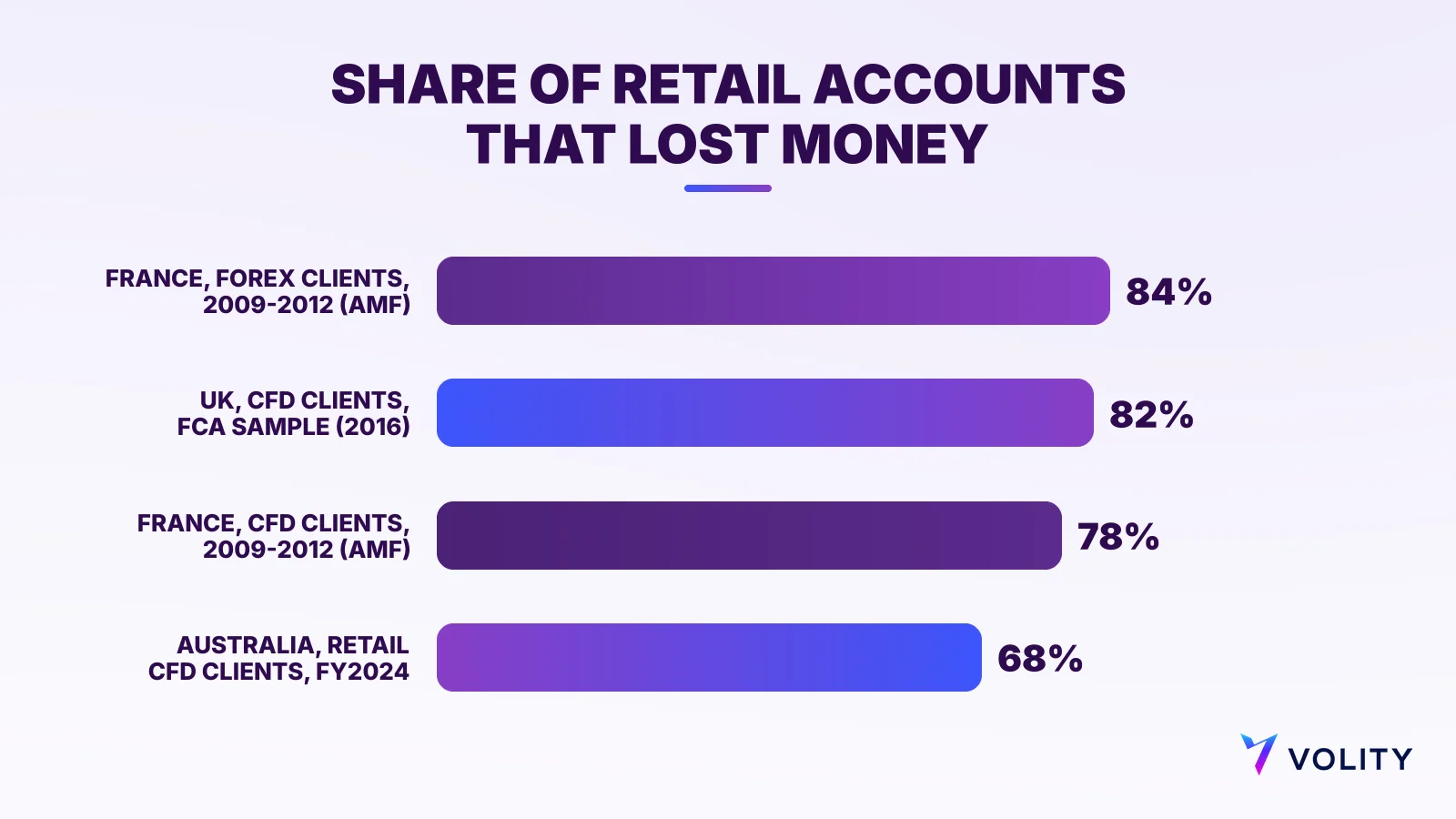
That is 89.4% of clients losing money, with an average result of minus EUR 10,887 per client. This figure pools forex, CFDs and binary options. Where firms reported products separately, 84% of active forex clients lost money, against 78% for CFDs. A CFD, or contract for difference, pays the change in a price without you owning the asset. The AMF adds that nine clients in ten losing does not mean nine trades in ten lose, because one large loss can cancel several small gains.
Other regulators found the same pattern:
- EU: in March 2018, ESMA reported national analyses showing that “74-89% of retail accounts typically lose money on their investments” in CFDs, with average losses per client from EUR 1,600 to EUR 29,000.
- UK: the FCA’s 2016 review of CFD firms found that 82% of clients lost money. A December 2025 discussion paper says approximately 80% lost money on CFDs in 2022.
- Australia: ASIC reported that 68% of retail CFD investors lost money in the 2024 financial year. Its Report 828 counts 133,674 clients with a net loss of A$458.01 million, about A$3,426 each, or 68.4% of clients.
The gap has plain causes. Retail accounts usually trade with leverage, which lets a small deposit control a large position, so losses grow as fast as gains. A retail trader also has no fund behind them to absorb a bad year. In the UK, the FCA’s permanent rules from 1 August 2019 limit retail CFD leverage to between 30:1 and 2:1. They also require a standard warning showing the share of retail accounts that lose money.
What carries over is risk per trade and position size
You cannot copy a fund’s capital or its results. You can copy a way of controlling risk. A common rule is to risk a small fixed share of the account on each trade, often 1%, and to set the stop-loss before you enter. A stop-loss is an order that closes the trade at a price you choose if the market moves against you.
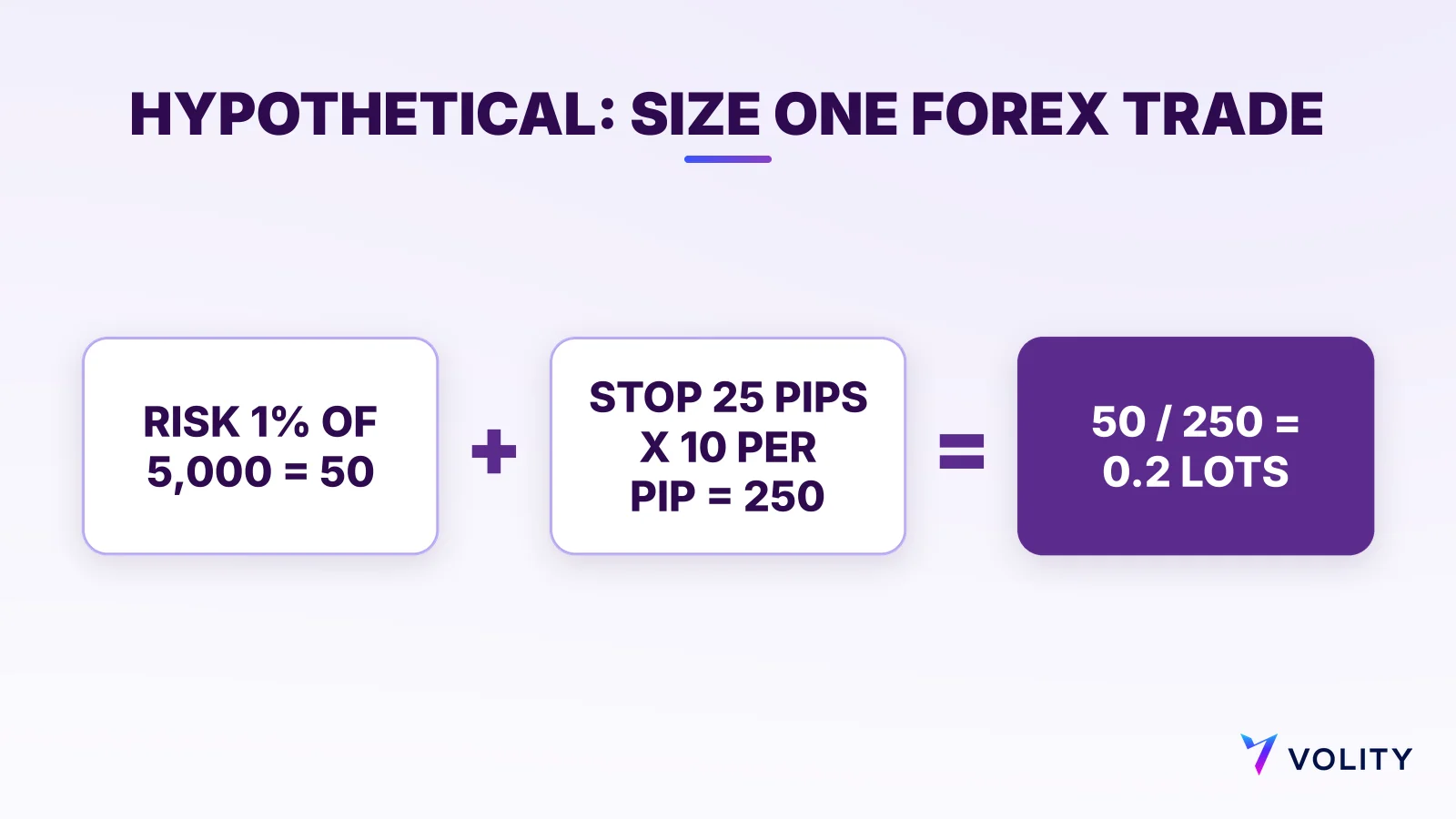
Here is a hypothetical example. Say your account holds 5,000 in US dollars and you risk 1% per trade. You want to buy EUR/USD with a stop-loss 25 pips below your entry. A pip is the standard small step in a currency price, 0.0001 for EUR/USD. On a pair quoted in US dollars, one standard lot of 100,000 units moves about 10 per pip.
- Risk in money: 1% of 5,000 = 50.
- Risk per standard lot at the stop: 25 pips x 10 per pip = 250.
- Position size: 50 / 250 = 0.2 lots, or 20,000 units.
If the stop is hit, you lose 50, which is 1% of the account. The example leaves out the spread and any overnight amount, so a real loss would be a little larger. In a fast market a stop can also fill at a worse price than you set, which is called slippage.
Leverage does not change this sum. On Volity, forex trades with leverage up to 1:500, which only sets the margin, the deposit a position ties up. The loss at your stop still depends on size and stop distance, so treat leverage as a ceiling, not a target. The same sum works for other pairs with their own pip value, and the size is only as good as the stop.
A sensible stop sits where your idea would be proven wrong, such as beyond the point where a bearish pennant, an inverse head and shoulders, a wedge pattern or a swing failure pattern stops making sense. The same sizing rule applies whether you hold for weeks, as the Turtles did, or for minutes, as in scalping. More on risk and trading habits sits in the Trader hub.
Practise the process on a free demo first
A demo account runs on live prices with virtual money, so you can test sizing and stops without risking cash. The Volity demo is free on every account tier. Forex trades 24/5, while crypto and a growing range of markets, including gold, silver, US500, US100 and WTI, trade 24/7. This routine takes one session:
- Open the demo and choose a major pair such as EUR/USD.
- Write down your risk per trade, for example 1% of the demo balance.
- Mark the level where your trade idea would be wrong, and set the stop-loss there.
- Size the position from that stop with the sum above.
- Check the live spread, then place the trade with the stop attached.
- Record the result and confirm that a losing trade cost what you planned.
The spread is the gap between the buy and the sell price, and you pay it on every trade. Volity spreads are dynamic and start from 0.6 pip, and the Markets account is commission-free. The full cost schedule is on the charges and fees page. A Volity Markets account starts from $1, with funding from 10 EUR, so a first live account can stay small.
The famous names show that a big currency trade can pay, and the regulators’ data show that most small accounts lose. What you can use is the plain part: decide the loss before the trade, size from the stop and keep each mistake small.
Fact check: Sources are the BIS Triennial Survey (April 2025), the Bank of England, Euromoney (2006), Wikipedia for figures marked “reportedly”, the AMF (2014, in French), ESMA (2018), the FCA (2016, 2019, 2025), ASIC Report 828 (January 2026) and volity.io. Checked 11 November 2026.
Frequently asked questions
Who is the most successful forex trader?
No ranking is reliable, because most trading results are private. The best-known documented case is the 1992 short on sterling by George Soros and Stanley Druckenmiller. Euromoney wrote that Bill Lipschutz was regarded as one of the world’s top-five FX traders by the end of the 1980s.
How much did George Soros make on the pound in 1992?
The profit is reported at around a billion, but accounts differ on pounds or dollars and on how long it took. The Bank of England records an estimated cost to HM Treasury of over £3 billion.
Do most forex traders lose money?
Regulator data say most retail accounts do. In France, 84% of active forex clients lost money in 2009-2012 (AMF). ESMA reported 74-89% for retail CFD accounts in 2018, and ASIC reported 68% in Australia in the 2024 financial year.
Can I copy a famous trader’s strategy?
You can copy the risk process, not the results. The famous names traded fund or bank money. What transfers is a fixed risk per trade, a stop-loss set before entry and a position sized from that stop.
How much money do I need to start trading forex?
A Volity Markets account starts from $1, with funding from 10 EUR, and the demo is free. A sensible live amount is one where the loss at your stop, such as 1% of the balance, is easy to accept.
Is the forex market open 24 hours?
Forex trades 24 hours a day, five days a week (24/5). On Volity, crypto and a growing range of markets, including gold, silver, US500, US100 and WTI, trade 24/7.