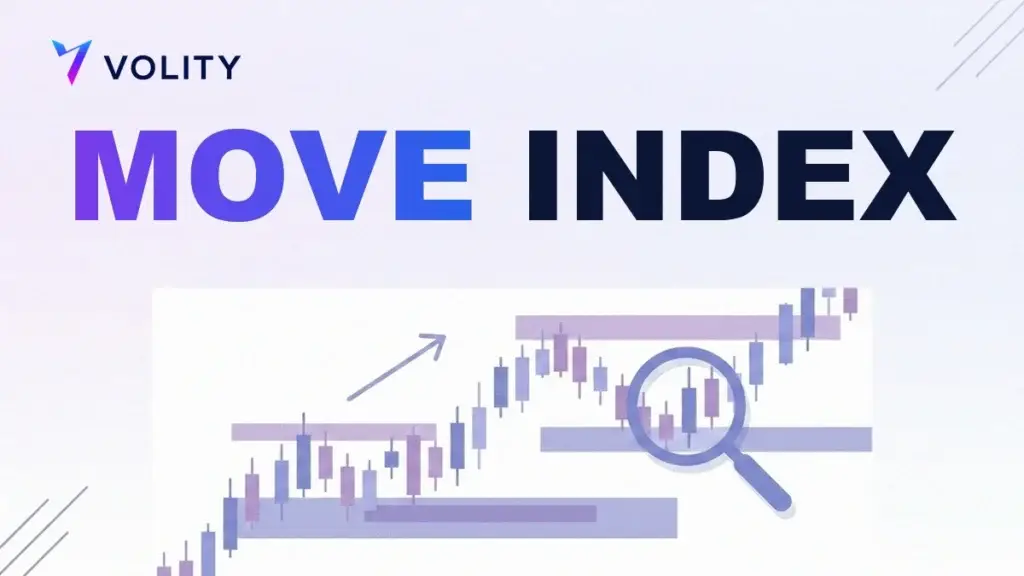
The MOVE Index is the bond market’s fear gauge. It tracks the volatility that options traders expect in US Treasury yields over the coming month, taken from the prices of one-month Treasury options across the two, five, ten and thirty year maturities. A rising MOVE Index means the market is bracing for bigger swings in interest rates, and that kind of stress rarely stays put in the bond market. It tends to spill into almost everything else you trade.
What is the MOVE Index?
MOVE stands for Merrill Lynch Option Volatility Estimate. It is a yield-curve-weighted index of the implied volatility priced into one-month options on US Treasuries, published today under the ICE BofA name and quoted in basis points of annualised yield volatility. In plain terms, it reads the options market and reports how much movement traders are paying up to cover over the next month.
Harley Bassman built the index in 1994 while he was at Merrill Lynch, so investors could follow expected rate volatility in a single number, and he still writes about it in his Convexity Maven commentary. Because government bond yields sit under the price of almost everything else, the MOVE Index ended up as a barometer of financial conditions far beyond the bond desk. When you want the raw yield data behind it, the daily Treasury par yield curve is published at source.
Is the MOVE Index the VIX for bonds?
That is the shorthand, and it is a fair one. The VIX measures expected volatility in the S&P 500 from equity options. The MOVE Index measures expected volatility in US Treasury yields from bond options. Both are forward-looking gauges built from option prices, and each one jumps when fear rises and settles back down when markets calm.
The difference is what they watch. The VIX tracks stocks; the MOVE tracks rates. Rates often move first, because the bond market is where the biggest institutions place their bets on inflation and the path of interest rates. So when the MOVE Index is climbing while the VIX stays quiet, it can be an early sign that stress is building under the surface before equities react.
How do you read a MOVE Index chart?
Reading a MOVE Index chart comes down to levels and direction, not one magic number. Over the years the index spends calm stretches in a lower band and then lurches higher when a shock hits. The zones below are a practical guide rather than official thresholds.
| MOVE Index level | What it usually signals |
| Below 80 | Calm rate market, low expected volatility, steady risk appetite |
| 80 to 120 | Normal range, ordinary two-way movement in yields |
| 120 to 150 | Elevated stress, larger swings expected, caution warranted |
| Above 150 | Crisis conditions, sharp yield moves, broad risk-off |
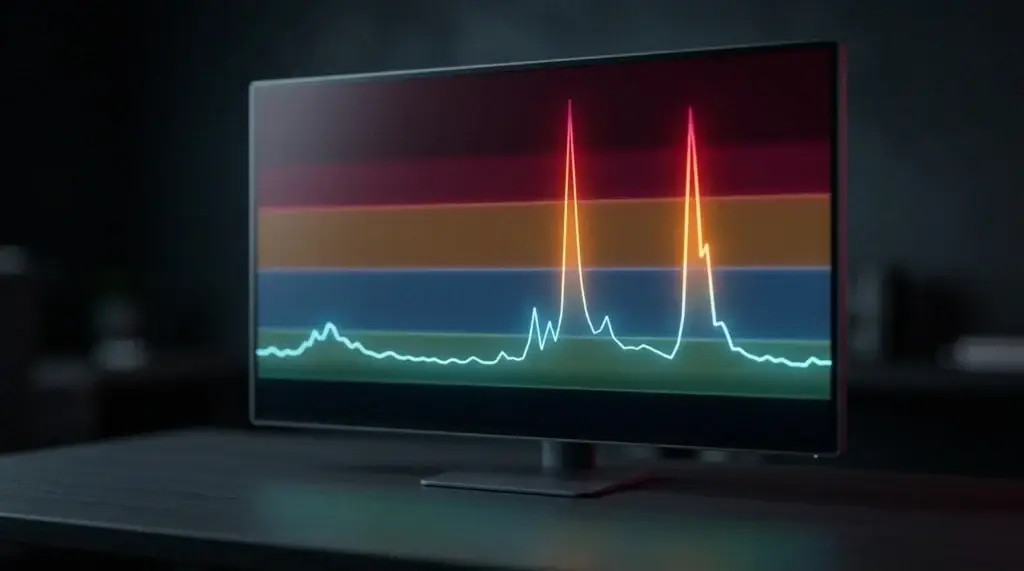
Direction counts as much as the level. A MOVE Index that is climbing fast is telling you volatility is being repriced higher there and then, which usually tightens financial conditions and weighs on riskier assets. Once it rolls over from a spike, that is often the moment panic starts to drain out and beaten-up markets can steady. Watch the slope of the line, not just today’s reading.
Why does the MOVE Index matter to traders?
You cannot buy the MOVE Index directly, but it is one of the cleaner reads on conditions across the markets you do trade. Because it captures expected interest-rate volatility, it feeds through to the instruments on your watchlist in fairly reliable ways.
- On the indices, a spiking MOVE Index tends to line up with equity drawdowns and choppier sessions, as higher rate volatility lifts the discount rate on future earnings.
- In currencies, rate volatility feeds straight into FX volatility, and a jump in the MOVE Index often sends safe-haven flows into the US dollar and rattles the major pairs.
- Gold frequently catches a bid when rate stress climbs and confidence in the financial plumbing starts to wobble.
- For risk sizing, a high and rising MOVE Index is your cue to widen stops and cut position size while ranges are expanding everywhere.
Read this way, the MOVE Index is a context tool. It will not call the direction of any single chart for you. Its job is to tell you how much respect to give your risk, and whether the backdrop favours calm trend trades or something more defensive. The same rate-volatility signal sits behind most published assessments of how tight or loose global financial conditions have become, including the BIS work on global liquidity.
What has the MOVE Index history looked like?
Across three decades the shape repeats. Long stretches of relative calm, broken by violent spikes. The index surged through the 2008 financial crisis and blew out again in the March 2020 pandemic shock. It then pushed to multi-year highs through 2022 and into 2023, as central banks raised rates at the fastest pace in a generation and regional banking stress flared.
Every one of those spikes lined up with turmoil in the assets most traders actually hold. Put a long MOVE Index chart next to an equity index and the dollar and the relationship teaches itself. When rate volatility explodes, correlations tighten and almost everything moves together. That is the practical lesson the index keeps offering.
Using the MOVE Index alongside Volity
The MOVE Index is a lens, and the trades happen elsewhere. When rate volatility shifts the backdrop, Volity gives you the instruments to act on it, whether that means trading the major indices as contracts for difference, or turning to forex and gold as the stress plays out. The Volity MT platform lets you lay that volatility context over your own charts and go long or short as conditions demand.
Because a rising MOVE Index means wider ranges, sober risk control matters more than usual. Set your stop first, then size the position to fit it. Treat leverage with the same care. Volity offers up to 1:500 depending on the product, and that leverage cuts both ways. Leveraged CFDs can magnify losses as fast as gains, so size the position to the stop rather than to the margin the account will allow. Trading execution is regulated by CySEC through UBK Markets under licence 186/12.
None of this needs a big outlay to learn. You can open an account for nothing, practise on a free demo that mirrors live pricing, invest from $1 and start trading from $1. Confirm the numbers on the charges and fees page and browse the full markets list before you start. If the risk side is new to you, the risk management basics in our education hub are the place to begin.
MOVE Index FAQ
What does a high MOVE Index mean?
A high MOVE Index means the options market expects large swings in bond yields, which usually reflects stress in the financial system. It tends to coincide with risk-off moves in equities and a rush into safe-haven assets, with wider trading ranges across the board.
Can you trade the MOVE Index directly?
Not as a retail product in the way you trade a share or a currency pair. The MOVE Index is a benchmark, so traders use it to gauge conditions and then take positions in the currencies and index markets that react to changing rate volatility.
What is the difference between the MOVE Index and the VIX?
The VIX measures expected volatility in the S&P 500 from equity options, while the MOVE Index measures expected volatility in US Treasury yields from bond options. Both are fear gauges, though the MOVE often moves first because the bond market leads on policy and growth.
What is a normal level for the MOVE Index?
Historically the index has spent much of its time between roughly 80 and 120, with readings above 150 marking crisis conditions. Levels drift over time with the rate environment, so the trend of the line matters as much as any fixed number.