You open a forex quote, see two prices and a tiny number like 0.6, and have no idea what it actually costs you. That number is the spread, and it is the price of doing business on most accounts. By the end of this guide you will read any live quote, count the pips, and turn a 0.6 pip spread into an exact cash figure in your own currency before you ever click buy or sell.
TL;DR / Quick insight: The spread is the gap between the buy price (ask) and the sell price (bid), measured in pips. A pip is normally the 4th decimal of the price (the 2nd decimal on JPY pairs). On EUR/USD with a US dollar account, one pip is worth about USD 10 per standard lot, so a 0.6 pip spread costs roughly USD 6 per standard lot, USD 0.60 per mini lot, and USD 0.06 per micro lot. On a commission-free Markets account at Volity, that dynamic spread from 0.6 pip is the cost you watch.
A spread is not a fee charged on the side; it is baked into the two prices you already see. Read it correctly and you stop overpaying by accident.
Read a live quote: spot the bid, ask and spread in 10 seconds
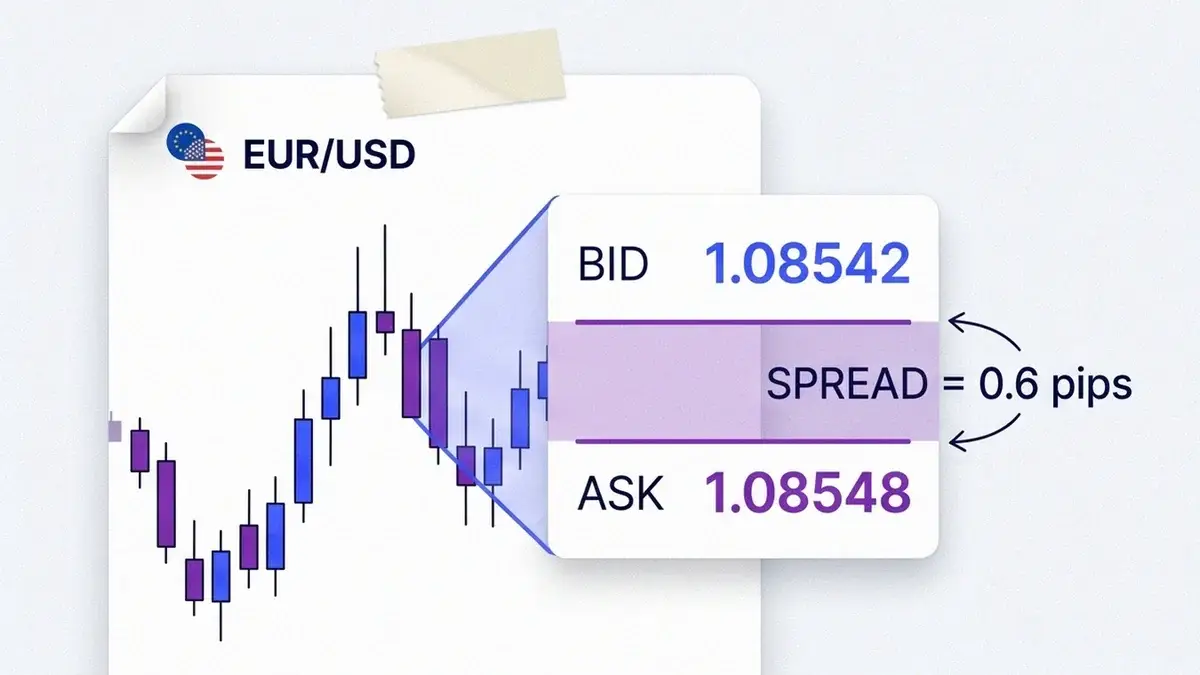
Every forex quote shows two prices. The bid is the price you sell at. The ask (or offer) is the price you buy at. The ask is always a little higher, and that gap is the spread. Think of an airport exchange booth: it sells you euros at one rate, buys them back at a worse one, and keeps the gap.
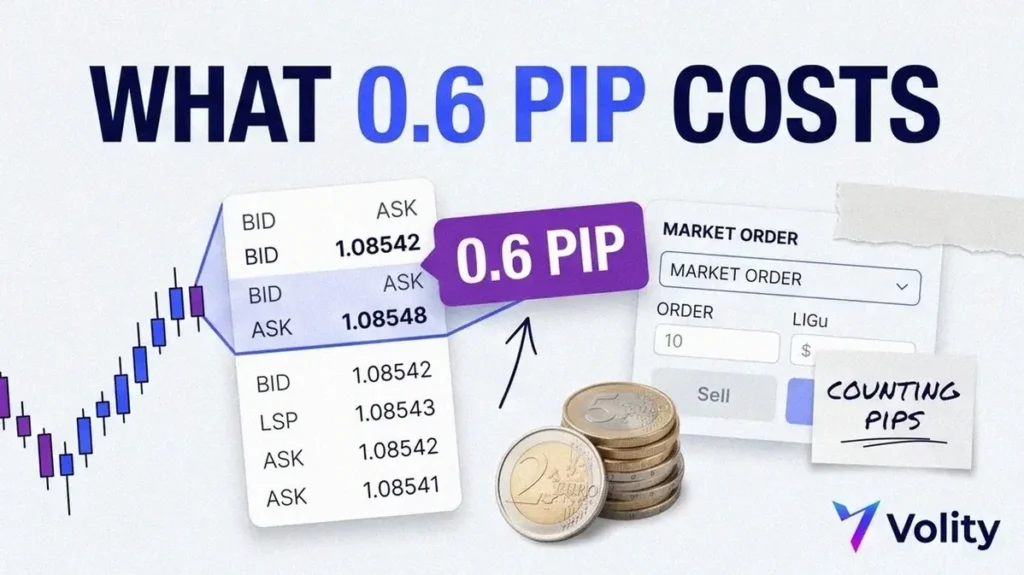
To find the spread, subtract the bid from the ask. If EUR/USD shows a bid of 1.08542 and an ask of 1.08548, the spread is 0.00006, which we read as pips next. Do this: open a live quote, or a free Volity demo, and watch the two prices move before any math. Do not assume the spread is fixed; on most accounts it moves second by second.
Count the pips correctly, including the fractional pip
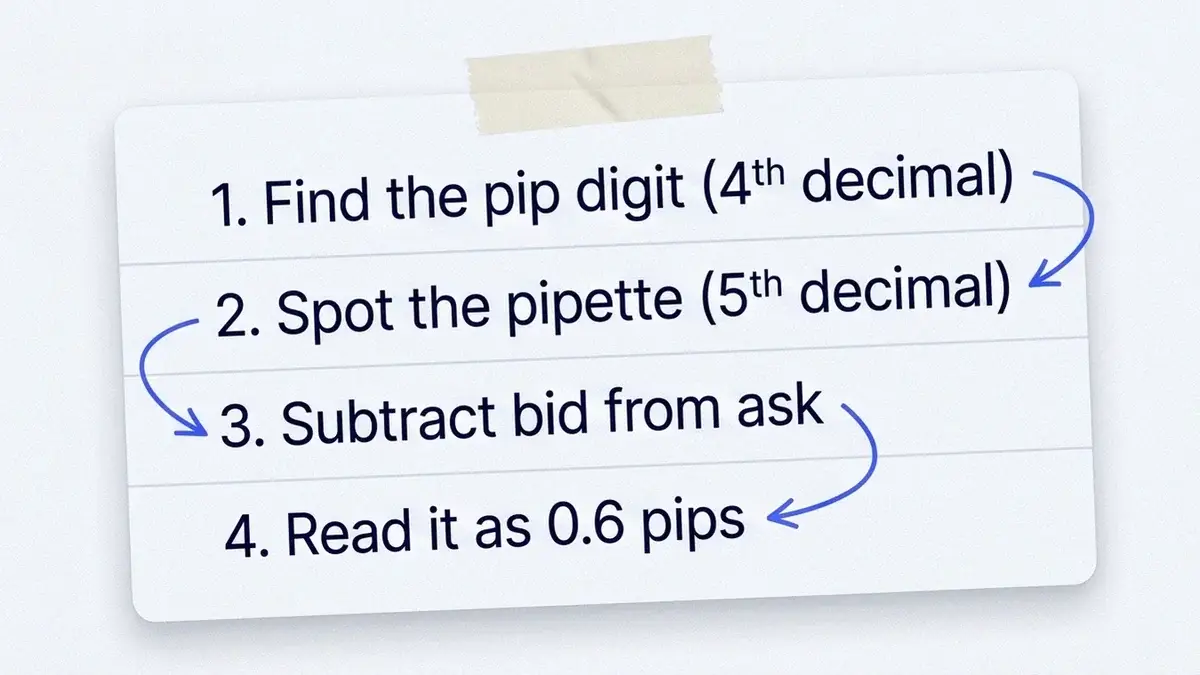
A pip is the standard unit traders use to measure how far a price moves. On almost every pair the pip is the 4th decimal place of the quote. On pairs that include the Japanese yen (like USD/JPY) the pip is the 2nd decimal place, because those prices carry fewer decimals.
Modern platforms add one more digit, the 5th decimal, called a pipette or fractional pip, which lets the price move in tenths of a pip. In 1.08548, the 4 is the pip digit and the final 8 is the pipette.
Back to our example: ask 1.08548 minus bid 1.08542 is 0.00006. Reading the 4th decimal as the pip, that is 0.6 of a pip, written as 0.6 pips. Do this every time: locate the pip digit first, then read the spread as a clean pip number. Do not confuse a 6 in the pipette column with 6 full pips; on EUR/USD that is a tenfold error in your cost.
Turn the spread into real money in your account currency
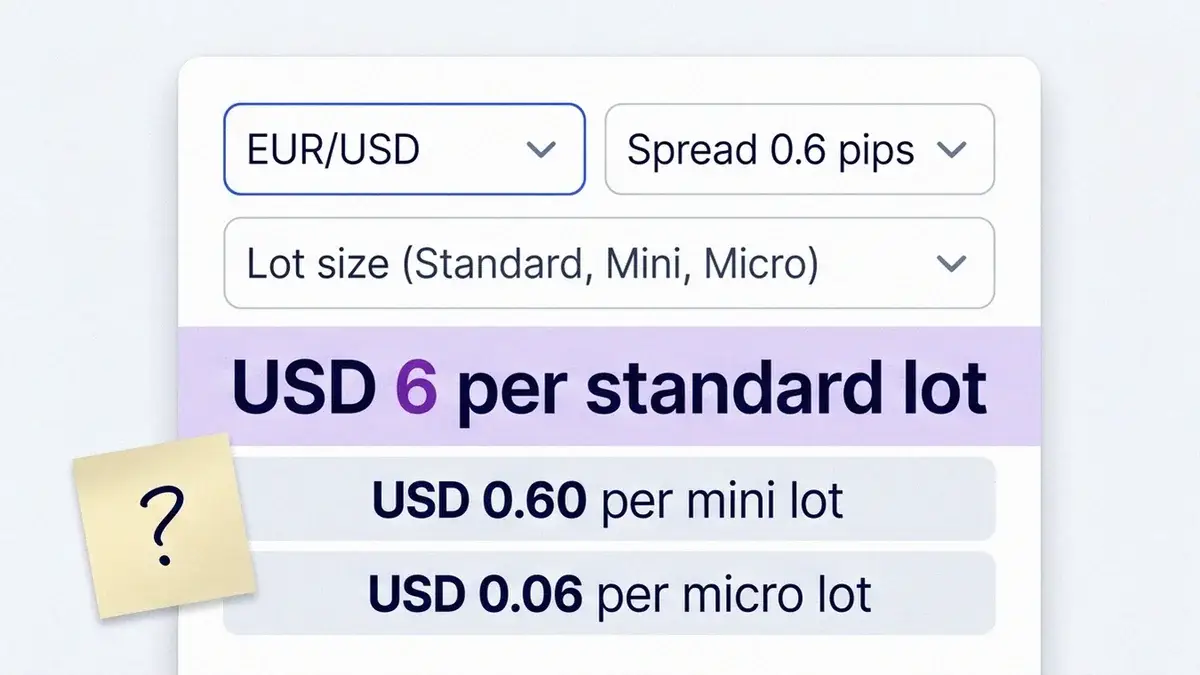
Here is the formula that does all the work:
Spread cost = spread (in pips) × pip value × number of lots
You only need the pip value, which depends on the pair and your lot size. A lot is a standard trade size: a standard lot is 100,000 units of the base currency, a mini lot 10,000, a micro lot 1,000. On EUR/USD with a US dollar account, the pip values are worth memorising:
- Standard lot (100,000): one pip is worth about USD 10.
- Mini lot (10,000): one pip is worth about USD 1.
- Micro lot (1,000): one pip is worth about USD 0.10.
Now plug in our 0.6 pip spread. On EUR/USD it costs 0.6 × USD 10 = USD 6 per standard lot, USD 0.60 per mini lot, and USD 0.06 per micro lot. Do this before any trade: multiply the spread by the pip value for your lot size. Do not skip it for small lots; the math scales fast as you size up. To avoid the hand math on every pair, drop your pair and lot size into the live Volity Spread Cost Calculator and read the figure off.
What 0.6 pip actually costs you, and whether commission-free is really free
On a commission-free account, the broker does not bill a separate per-trade fee. So is it really free? For commission, yes; the spread is how the account is priced instead. Volity’s Markets account is commission-free, with dynamic spreads from 0.6 pip on Standard, so on a standard EUR/USD lot the spread sits near that USD 6 figure, with no commission on top.
Some accounts instead charge a thin spread plus a fixed commission, and you must add both to know your real cost. Do this: always total spread plus any commission, not the spread alone. Do not be impressed by a low advertised spread until you check whether a commission sits behind it.
Tight vs wide spreads: read what the number is telling you
A tight spread is a small one; a wide spread is a large one. On a major like EUR/USD in active hours, a fraction of a pip is tight and means conditions are liquid and cheap. A spread that jumps to several pips on the same pair is wide and is a warning: liquidity has thinned or news is hitting. Keep it simple: tight equals cheap and liquid, wide equals expensive and risky.
Do this: judge the current spread against what is normal for that pair, not another pair. Do not send a market order when the spread on a major has ballooned to several times its usual size; wait for it to settle.
Why spreads move: liquidity, news and account tier
Spreads are dynamic because the market is. Three forces move them:
- Liquidity. When many traders are active (the London and New York overlap), spreads are tightest. In thin hours they widen.
- News. A rate decision or jobs report can blow a spread out for seconds as liquidity providers step back.
- Account tier. Higher tiers get tighter pricing. Volity offers Markets (min $1), PRO (min $500) and VIP (min $10,000), with PRO and VIP tighter than Standard.
Do this: check the economic calendar and avoid firing a market order into a scheduled news spike. Do not size up into thin overnight liquidity expecting the midday spread.
Add the costs the spread hides: overnight rollover and holding time
The spread is the entry cost, not the only cost. If you hold a position past 22:00 GMT, an overnight or rollover fee applies. It is based on the interest-rate difference between the two currencies and can be positive (paid to you) or negative (charged to you). On a quick intraday trade it does not apply; on a multi-day swing it can outweigh the spread.
Do this: before you commit, ask whether the trade holds past 22:00 GMT, and if so factor the rollover in. Do not judge a longer-term position on spread alone. For a swap-free setup, Volity offers Islamic accounts with no overnight charge.
Checklist: confirm the true cost before you click buy or sell
Run this five-point check on every trade. It takes seconds once it is habit.
- Pair. Confirm which pair you are trading and where its pip digit sits (4th decimal, or 2nd for JPY).
- Lot size. Decide standard, mini or micro, because pip value depends on it.
- Current spread. Read the live spread in pips (ask minus bid).
- Spread cost. Multiply spread × pip value × lots, or drop the numbers into the Volity Spread Cost Calculator.
- Rollover. If the position holds past 22:00 GMT, add the overnight cost.
For more on quotes, indicators and order types, keep learning at the Volity forex hub. Run this before entry, not after. Do not place a trade until the spread cost is a number you have actually seen.
What to do next
You can read a spread now. To practise without risk, open a free demo and watch live spreads move.
- Open a free Volity demo account and watch EUR/USD bid and ask in real time.
- Read the spread in pips, then calculate the cost for a micro lot.
- Check the same pair an hour later to see the spread move.
- Review the transparent Volity fee schedule to see every cost up front.
When the math is second nature, open a commission-free Volity account and trade forex, stocks, crypto and more from one login, with the spread as a cost you control.
Reviewed by: A. Bennett, Volity editorial desk.
Data integrity: all Volity figures are verified against the published Volity fee schedule as of June 2026 (commission-free Markets account; dynamic spreads from 0.6 pip on Standard). Pip values quoted are standard forex arithmetic for a US dollar account on EUR/USD.
Related coverage on Volity
- Low Spread Forex Broker: How to Read Real Spreads
- What Is Liquidity in Forex Trading? (2026)
- What Is Forex Spread Betting? How It Works (2026)
- Forex Day Trading: Setup, Risk, and What Actually Works
- Forex Risk Management: A Position-Sizing Framework for Pairs
Frequently asked questions
What is a good spread in forex?
There is no single magic number, so judge it per pair. On a major like EUR/USD in active hours, a fraction of a pip is tight and good; on an exotic pair a few pips can be normal. Compare the live spread to what is usual for that pair, and treat anything far above normal as a reason to wait.
How much does a 0.6 pip spread cost?
On EUR/USD with a US dollar account it costs about USD 6 per standard lot, because one pip is worth roughly USD 10 and 0.6 times 10 is 6. That is USD 0.60 per mini lot and USD 0.06 per micro lot. Multiply spread by pip value and number of lots for any size.
Why did my spread widen?
Almost always liquidity, news or the session. Spreads tighten when many traders are active and widen in thin hours or around scheduled news like a rate decision. If you see a sudden jump on a major pair, wait for it to settle rather than send a market order into the spike.
Is a commission-free account really free?
Free of commission, yes; the spread is the cost instead. On Volity’s commission-free Markets account there is no separate per-trade commission, and the dynamic spread from 0.6 pip is the number to watch. The published fee schedule lists every charge, including overnight rollover on held positions.
How do I read a pip on a JPY pair?
On pairs that include the Japanese yen, the pip is the 2nd decimal place, not the 4th, because those prices carry fewer decimals. So on USD/JPY a move from 156.20 to 156.21 is one pip. The extra third decimal, where shown, is the pipette.
Sources
This guide draws on the following public sources.
- BIS – Triennial survey, FX turnover by instrument and counterparty
- BIS – BIS Markets Committee on FX execution and liquidity
- European Central Bank – ECB daily euro reference rates
- Bank of England – Bank of England daily spot exchange rate series
- Global FX Committee – FX Global Code, full text on pricing and mark-up
- Bank for International Settlements – BIS Triennial Central Bank Survey of FX turnover
- Global FX Committee – FX Global Code principles for execution and conduct
- Bank of England – Bank of England FX Joint Standing Committee turnover data
- European Central Bank – ECB euro foreign exchange reference rates