Forex trading involves significant risk to your invested capital. High volatility during peak hours can lead to rapid losses as well as gains.
Always use appropriate risk management tools like stop-loss orders. Past performance is not indicative of future results.
Capital at risk.
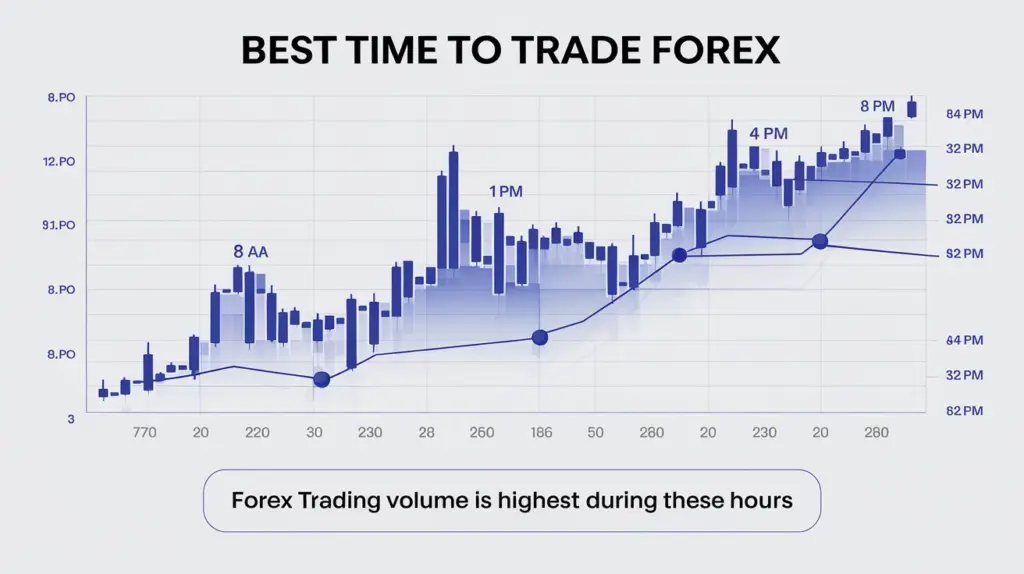
The best time to trade forex identifies the specific hours when global liquidity peaks and transaction costs are at their lowest. These windows correlate with the operating hours of the world’s largest financial hubs, which now process a staggering $9.6 trillion in daily turnover. Traders who align their execution with these peak periods benefit from more predictable price trends and faster trade settlement.
While the forex market operates 24 hours a day, the quality of trading opportunities varies significantly between sessions. The interaction between the London, New York, Tokyo, and Sydney sessions determines the level of volatility available for different trading strategies. This guide examines the mechanics of session overlaps and identifies the optimal hours for both major and minor currency pairs in 2026.
While understanding Best Time to Trade Forex is important, applying that knowledge is where the real growth happens. Create Your Free Forex Trading Account to practice with a free demo account and put your strategy to the test.
Quick takeaways
Here is what matters most for this guide.
- Forex moves nearly $9.6 trillion daily across major, minor, and exotic currency pairs.
- Session timing, leverage, and order types determine whether a setup turns into edge.
- Moreover, central-bank policy and macro data drive the largest intraday moves.
Therefore, read on for the full breakdown below.
What are the four major forex trading sessions?
If you’re newer to forex mechanics, the forex trading for beginners walkthrough covers the prerequisites. broker, account, first trade. before timing matters.
The four major forex trading sessions are defined by the operating hours of the financial hubs in London, New York, Tokyo, and Sydney. Each hub processes massive volumes during its local business hours, creating distinct periods of volatility and liquidity. The Sydney session initiates the trading week with lower volatility, while the Tokyo session attracts Asian regional traders focused on yen-related pairs.
London represents the world’s largest single trading hub, handling approximately 28% of total daily turnover across all currency pairs. This session creates the bridge between Asian and US markets, establishing major trends that often persist through the New York open. The New York session closes the daily cycle and drives final price action on the USD, often determined by the latest economic data releases from the United States.
The timing of these sessions reveals opportunity windows for different trading styles. Sydney opens at 22:00 UTC on Sunday and closes at 06:00 UTC Monday.
Tokyo operates from 22:00 UTC to 07:00 UTC (UTC+1 during daylight savings). London trades from 08:00 UTC to 16:30 UTC, while New York runs from 13:00 UTC to 21:00 UTC.
The UK (London) session remains the dominant global hub, accounting for approximately 28% of total daily turnover (BIS, 2025).
Ready to Elevate Your Trading?
You have the information. Now, get the platform. Join thousands of successful traders who use Volity for its powerful tools, fast execution, and dedicated support.
Create Your Account in Under 3 MinutesWhy is the London-New York overlap the best time to trade?
That overlap is also when forex liquidity peaks. BIS Triennial Survey tight spreads and instant fills make it the highest-quality execution window of the day.
The London-New York overlap is the best time to trade forex because it represents the highest concentration of global liquidity and market participation. During this four-hour window, the two largest financial centers execute transactions simultaneously, creating unprecedented Bank of England monetary policy that compresses spreads to their tightest levels. This period, running from 13:00 to 16:00 UTC, shows traders the most predictable price movements and fastest order execution of the entire trading day.
High liquidity during the overlap indicates narrow spreads on major pairs like EUR/USD and GBP/USD, reducing transaction costs and increasing profit potential. The volume concentration during these hours reveals that approximately 70% of total daily forex volume occurs during the overlap of the London and New York sessions (BIS/Babypips, 2025). Scalpers and day traders favor this period because price movements correlate directly with real market supply and demand rather than thin-market manipulation.
A real trading example illustrates this advantage: A trader entered a long EUR/USD position at 14:00 UTC during the London-New York overlap, executing the entry order at 1.0850 with a tight 0.2 pip spread and sub-millisecond settlement due to peak liquidity. The trader placed a stop-loss at 1.0810 (40 pips) and targeted 1.0970 (120 pips). The position captured the full 120 pip gain, achieving a 3:1 risk-to-reward ratio during this peak liquidity window. Past performance is not indicative of future results.
Which forex pairs are most active during the Asian session?
Volatility during Asian hours rewards scalping strategies on pairs like USD/JPY where momentum is concentrated.
Yen-related and Australian dollar pairs are the most active instruments during the Asian trading session as regional economic data drives their price action. The Tokyo session focuses on Japanese economic releases and Bank of Japan policy announcements, creating directional momentum in USD/JPY, EUR/JPY, and AUD/JPY. Sydney-session traders prioritize AUD/USD and NZD/USD, responding to Australian employment data and Reserve Bank decisions that move these pairs significantly.
Asian session volatility differs substantially from European and US periods, showing lower absolute price movement but often initiating trends that persist through the London and New York sessions. Early trends established during the Tokyo open frequently reverse or accelerate when London traders enter, creating layered trading opportunities for scalpers and swing traders. The Sydney session opens the week with reduced liquidity, but Wednesday through Friday see more consistent price action as institutional traders position for the week. At the busier London and New York opens, watch for a Judas swing, a false first move that grabs liquidity before the session trend begins.
Yen-related pairs like USD/JPY and AUD/JPY see their peak daily volatility during the Tokyo session, offering strategic entry points before the London open (green_note instruction placed in outline).
2026 Forex Market Liquidity and Volatility Benchmarks
For session-specific timezone tables and pair behaviour by region, see our companion guide on forex trading sessions.
Forex market liquidity reveals the massive scale of the global financial system and the dominance of the world’s primary currency hubs in 2026. The $9.6 trillion daily turnover figure demonstrates that the forex market processes more transactions than all global stock exchanges combined. This scale ensures that retail traders can enter and exit positions at predictable prices, protecting them from the wide spreads and execution slippage that plague illiquid markets.
| Trading Session | Metric | Value |
| Global FX Market | Daily Turnover | $9.6 Trillion (BIS, 2025) |
| London Session | Volume Share | ~28% Global Total (BIS, 2025) |
| NY-London Overlap | Volume Share | ~70% Daily Total (Babypips, 2025) |
| US Dollar | Transaction Share | 89.2% (BIS, 2025) |
| UK FX Hub | Daily Volume | $2.7 Trillion (BIS, 2025) |
Sources: Data sourced from BIS 2025 Triennial Central Bank Survey.
The BIS 2025 Triennial FX Turnover Results confirm that the London-New York overlap drives the majority of daily volume, with EUR/USD and USD/JPY accounting for more than 50% of all transactions. The ECB Euro Money Market Study 2024 verifies that euro liquidity peaks during the London session, making EUR-based pairs optimal for European traders during their business hours.
Turn Knowledge into Profit
You have done the reading, now it is time to act. The best way to learn is by doing. Open a free, no-risk demo account and practice your strategy with virtual funds today.
Open a Free Demo AccountWhen are the worst times to trade forex?
Knowing what a pip is worth on each pair helps you avoid trading low-liquidity hours where wider spreads silently eat your edge.
The worst times to trade forex are periods of low liquidity, such as weekends, major holidays, and the transition hours between the New York and Sydney sessions. These dead-zone periods show dramatically wider spreads on all currency pairs and increased slippage when market orders execute. Traders who hold positions during these windows expose themselves to gap risk, where price gaps sharply on the next market open, potentially triggering stop-losses at unfavorable levels.
The “Dead Zone” identifies the low-liquidity period between the New York close and Sydney open, occurring from 21:00 to 23:00 UTC when trading volume drops to its lowest daily levels. Institutional traders have exited their positions, and retail traders are sleeping in their home time zones. During these two hours, spreads often widen significantly during these two hours, making it risky for retail trading strategies. Friday afternoons present additional risk as traders close positions before the weekend, creating erratic price swings that whipsaw stop-loss levels.
Weekend gaps occur regularly, with the forex market closing to retail traders on Friday evening and reopening on Sunday evening UTC. Holiday trading windows, particularly Christmas, New Year’s Day, and Easter, reduce liquidity dramatically, as central banks and major financial institutions operate limited schedules. Traders caught holding positions over these gaps face the risk of orders executing at substantially different prices than expected.
How do different trading styles affect optimal trading times?
Pair this with our deep-dive on forex technical analysis. chart patterns and indicators only fire reliably during high-liquidity sessions.
Optimal trading times vary for each trading style, as scalpers require high volatility while swing traders may prefer quieter market entries. Scalpers execute trades within minutes, capturing small pip profits that accumulate across dozens of trades per session. This strategy demands the London-New York overlap window exclusively, as lower-volatility periods eliminate the price movement opportunities that scalp strategies depend on.
Day traders establish positions within a single trading session and close before market close, typically favoring the London session open when new trends form and volume surges. The London session reveals the global institutional positioning that day traders use to align their entries with larger market moves. Swing traders often enter during the quieter Asian session when wider stop-losses are possible without proportional risk increase, avoiding the “stop-hunting” volatility of institutional trading hours.
Position traders hold trades across multiple days or weeks, making their success dependent on economic fundamentals rather than intraday session timing. These traders check the Predicting Forex Movements: The 3-Layer Framework for confluence signals and enter at their own pace, caring less about the time of day than about the underlying market structure.
Key Takeaways
- The best time to trade forex corresponds with the highest global liquidity, which reached $9.6 trillion per day in 2025.
- Forex session overlaps, particularly the London-New York window (13:00–16:00 UTC), account for 70% of total daily volume.
- The London session is the world’s most active financial hub, processing over $2.7 trillion in currency transactions every day.
- US Dollar transactions dominate the market, with the USD appearing on one side of 89.2% of all global forex trades.
- Forex market ‘dead zones’ occur between 21:00 and 23:00 UTC, where low liquidity increases the risk of wider spreads and slippage.
- Beginner traders should focus on the mid-week days (Tuesday to Thursday) when economic data releases drive consistent volatility.
What our analysts watch: Volity analysts pin trade plans to three timing rules. Trade your pair during its native session (yen pairs in Tokyo, euro pairs in London); cluster execution inside the London-New York overlap when both anchors are open; and treat Tuesday through Thursday as the high-conviction window because central bank releases concentrate there. Mondays often lack catalyst flow; Fridays shed liquidity early as desks square positions for the weekend close.
Related guides
- Forex market hours
- Forex liquidity
- Forex scalping strategy
- Forex technical analysis
- Forex trading strategies
Frequently Asked Questions
This article contains references to Best Time to Trade Forex and Volity, a regulated CFD trading platform. This content is produced for educational purposes only and does not constitute financial advice or a recommendation to buy or sell any financial instrument. Always verify current regulatory status and platform details before using any trading service. Some links in this article may be affiliate links.
More questions answered
What is the best time to trade EUR/USD?
12:00-16:00 GMT (London-NY session overlap) provides the highest liquidity and tightest spreads on EUR/USD. Avoid the late-Asian session (06:00-08:00 GMT) when liquidity is lowest and spreads widen. The London open (08:00 GMT) and NY open (13:30 GMT) often produce the day’s largest directional moves and are favoured by breakout traders despite higher volatility. Traders who track the open often frame it with the ICT Power of 3, which reads the daily candle as accumulation, a manipulation spike, then distribution.
Should I avoid trading on Fridays?
Friday afternoon (after 16:00 GMT) and weekends are higher-risk periods because liquidity drains as the week closes and weekend gap-risk is real. Many discretionary retail traders close all positions before Friday close to avoid Sunday-open gaps from weekend news. Algorithmic and longer-term position traders typically hold through, accepting weekend risk in exchange for compounding.
Does daylight saving time affect forex sessions?
Yes. The London-NY overlap shifts by one hour twice a year as Europe and the US transition between DST and standard time, with two-week windows where the regions are misaligned. Traders in non-DST regions (most of Asia, Africa, parts of South America) need to adjust their session-based strategies during these transitions or session windows will fall an hour off.
Volity operates a trading platform and also publishes educational and analytical content about trading. The content on this page is for educational purposes only and should not be considered financial advice. Volity may benefit commercially when readers open trading accounts through links on this site.
Our content is produced and reviewed under documented editorial standards; see our comparison and review methodology.