Quick answer
A forex scalping strategy aims to make many small profits from tiny price moves, holding trades for seconds to minutes. Scalpers rely on tight spreads, fast execution and high-probability setups, often on the 1-minute or 5-minute charts. It is intense and cost-sensitive: spreads and commissions eat scalping profits, so it suits disciplined traders on a low-cost platform.
Forex scalping is a high-risk trading style where leverage amplifies the impact of frequent transaction costs, spreads, and slippage. Scalping produces dozens of trades daily, meaning even small negative edge accumulates rapidly into account destruction. Brokers often restrict scalpers through “Fair Use” clauses, holding time minimums, or sudden spread widening on winning positions. Execution technology failures on low-latency servers can cause catastrophic losses if stop-loss orders fail to trigger. Capital at risk in all leveraged trading.
Forex scalping is a high-frequency trading methodology focused on capturing 5–10 pip price movements over durations of seconds or minutes. Success in 2026 depends on using ECN brokers with spreads below 0.5 pips and maintaining a strict mechanical entry discipline.
Forex scalping strategy functions as a high-precision tool for navigating the most liquid hours of the currency market. This technique allows traders to minimize market exposure by entering and exiting positions within seconds to capture 1–10 pip movements. It serves as the primary gateway for intermediate traders seeking to capitalize on institutional order flow in 2026.
The 2026 trading environment utilizes AI-assisted filters to identify “Volume Traps” and liquidity gaps. Modern scalpers prioritize ECN accounts and low-latency setups to remain competitive against institutional high-frequency algorithms (HFT).
While understanding Forex Scalping Strategy is important, applying that knowledge is where the real growth happens. Create Your Free Forex Trading Account to practice with a free demo account and put your strategy to the test.
What is forex scalping and how does it function?
Forex scalping is a high-frequency trading methodology where market participants capture dozens of small price movements daily to build cumulative profitability. The strategy differs fundamentally from swing trading, scalpers hold positions for 30 seconds to 5 minutes, whereas swing traders hold for days or weeks. This ultra-short duration exposes scalpers to minimal directional risk but maximizes their vulnerability to transaction costs, spread widening, and execution delays.
Micro-gains of 5-10 pips represent the standard profit target for scalping strategies. A trader targeting 10 pips on EUR/USD with a 1.5-pip spread must overcome the spread cost first, then generate an additional 10 pips of real market movement to achieve the profit target. This tight margin explains why scalping demands absolute discipline, a single 5-pip loss wipes out the expected gain from two successful trades.
Speed represents the scalper’s ultimate edge in 2026. A trader executing a market order on a low-latency ECN connection at 0.35ms gains a critical 5-10 millisecond advantage over a trader on a mainstream retail broker executing at 50ms. Over 100 trades per day, those small latency advantages accumulate into significant profitability differences. Without this technological edge, scalping becomes impossible because transaction costs consume all alpha.
A scalper who aims for 5 pips, risks 5 pips and pays a 2-pip spread nets 3 pips on a win and loses 7 on a loss, so the strategy needs a win rate of 70% just to break even. This fact explains why scalping is restricted to intermediate and advanced traders, the mathematical requirement for consistent profitability is more stringent than other trading styles.
The Scalper’s Daily Routine
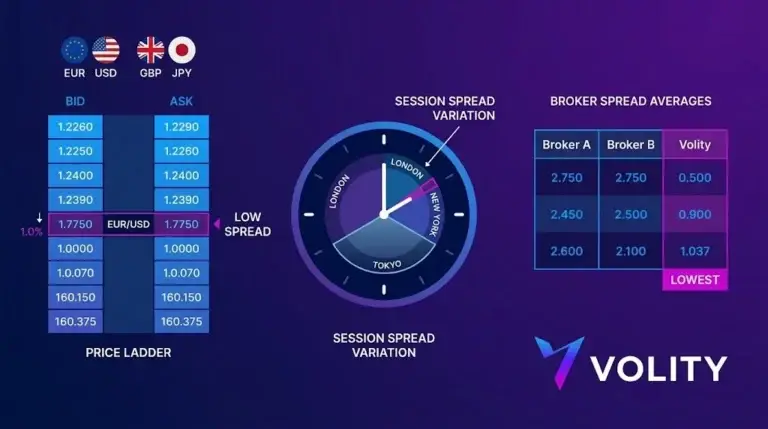
Session timing determines the available liquidity and spread stability required for profitable high-frequency execution. The London-New York overlap window (13:00-16:00 GMT) represents peak scalping opportunity because both the world’s largest trading hubs trade simultaneously, creating massive order flow and tight spreads. During this window, EUR/USD spreads typically compress to 0.8-1.2 pips, whereas Asian session spreads widen to 3-5 pips due to lower volume.
Avoiding “Dead Zones” is critical for avoiding widened spreads that destroy scalping edge. Late New York hours (20:00-21:00 GMT) experience declining liquidity as American traders begin closing positions. The subsequent early Asian session (21:00-02:00 GMT) is characterized by skeleton crews at Tokyo banks, producing spreads too wide for scalp profitability. Professional scalpers schedule their trading exclusively within high-liquidity windows, abandoning the market entirely when spreads exceed 3 pips.
Ready to Elevate Your Trading?
You have the information. Now, get the platform. Join thousands of successful traders who use Volity for its powerful tools, fast execution, and dedicated support.
Create Your Account in Under 3 MinutesComparing Top 2026 Scalping Strategies
The scalping strategies below differ in their entry logic and in the risk-to-reward ratio each one targets. Liquidity Sweep Reversal strategy involves identifying where institutional algorithms deliberately trigger stop-loss clusters, then entering the opposite direction as price reverses back toward internal value. The setup depends on price running a cluster of retail stops and then reversing, so it rewards scalpers who can read institutional market structure.
The 5-Minute EMA Cross strategy tracks the crossover of a 5-period and 20-period exponential moving average on the M5 timeframe. This mechanical signal fires only a few times a day, which suits traders who prefer fewer, more selective trades. The weakness is that trending moves often produce false crossovers during consolidation, triggering low-reward trades that consume time without profit.
The 1-Minute RSI/Bollinger strategy combines mean-reversion logic by fading RSI extremes (>70 overbought or <30 oversold) within Bollinger Band ranges. This approach works best in sideways market regimes but fails during strong trending moves when RSI remains extreme for extended periods. Traders using this strategy often find themselves stopped out repeatedly before the expected mean reversion occurs.
Range-bound market conditions favor scalping because price oscillates within predictable support and resistance zones without trending directionally. Professional traders approaching scalping typically use ECN brokers that support high-frequency execution, contrasting with position traders who prioritize lower costs over speed.
Turn Knowledge into Profit
You have done the reading, now it is time to act. The best way to learn is by doing. Open a free, no-risk demo account and practice your strategy with virtual funds today.
Open a Free Demo AccountHow to Apply a Forex Scalping Strategy: A 2026 Step-by-Step Guide
Systematic execution identifies the exact technical triggers and risk parameters required for consistent high-frequency trading. Step 1 requires choosing the right broker, only true ECN brokers with zero-pip spreads and no holding time restrictions qualify. Market maker brokers prohibit scalping through “Fair Use” clauses, while most retail brokers widen spreads asymmetrically for winning traders. Legitimate ECN firms like IC Markets and Pepperstone publish their actual spreads and execution times, allowing traders to verify their claims independently.
Step 2 involves selecting the timeframe that balances signal quality against trading frequency. The 5-minute chart offers superior signal-to-noise ratio compared to the 1-minute chart, reducing false triggers. However, 1-minute charts provide 5x more trading opportunities per session, allowing mechanical traders to accumulate larger position stacks within the high-liquidity window. Professional scalpers typically use the 5-minute chart for initial entry signals, then enter on the 1-minute chart breakout within that signal zone.
Step 3 requires defining the mechanical trigger with absolute precision. Examples include “Enter when a 1-minute candle engulfs the previous candle’s range AND RSI crosses above 50” or “Enter when price touches the 5-period MA on M5 after a liquidity sweep.” The specificity matters because vague rules like “buy when you see an opportunity” introduce emotional discretion that destroys scalping edge.
Step 4 establishes the “Kill Switch”, a predetermined exit from the market after consecutive losing trades. A scalper might trade only until 3 consecutive losing trades occur within a single session, then stop trading for the remainder of the day. This mechanical rule prevents the overtrading that occurs when traders chase losses with larger position sizes, desperately trying to recover losses in the remaining time.
Real trading example: In February 2026, a scalper identified a liquidity sweep occurrence below the London session low in USD/JPY, followed immediately by a bullish engulfing candle on the M1 chart. The trader entered long at 145.20 with a 5-pip stop-loss (at 145.15) and an 8-pip target (at 145.28). Price snapped back to the internal value range as institutional buyers absorbed the trapped stops, reaching the profit target in just 4 minutes. Past performance is not indicative of future results.
Broker execution models determines whether a high-frequency strategy will be penalized by artificial slippage or account freezing. Many brokers classify high-frequency winning traders as “Toxic Flow”, orders that cannot be easily hedged and represent a liability to the broker. Brokers respond by widening spreads selectively for winning traders, implementing holding time requirements (minimum 5 minutes per trade), or outright account termination with capital confiscation claims.
Minimum Holding Time restrictions represent the most common broker defense against scalpers. A market maker broker might allow “trading” but implement a hidden rule that stops are pulled and shorts are liquidated if they aren’t held for at least 5 minutes. This artificial requirement destroys scalp edge because price movements that should reach targets within 2 minutes are forced to hold until the 5-minute minimum expires, exposing traders to larger directional risk.
Regulatory Oversight is increasing in 2026 as ESMA and ASIC recognize that unequal scalping restrictions create retail-versus-institutional advantages. Brokers must now disclose “fair use” policies and cannot selectively enforce them, if spreads widen for scalpers, spreads must widen equally for all traders. This regulatory shift is gradually improving scalping feasibility for retail participants by preventing discrimination.
The TradersUnion: Broker Scalping Restrictions and Fair Use Audit 2026 provides a comprehensive audit of which brokers genuinely allow scalping without discrimination.
Speed matters on every entry and exit, so many scalpers keep a mobile trading app with price alerts ready, even if they place most trades from a desktop platform.
Technology and AI: The 2026 Scalper’s Edge
Artificial intelligence filters represents the modern standard for identifying volume traps and liquidity gaps in real-time. Scalpers using AI-driven volume filters receive automated alerts when suspicious price spikes suggest institutional activity, allowing human traders to confirm entries with higher probability.
Autonomous Kill Switches are software systems that prevent emotional overtrading, the leading cause of scalp account destruction. A professional trader’s system monitors consecutive losing trades and automatically blocks new orders after 3 losses, preventing revenge trading that turns a small loss into account liquidation. This automation separates professional scalpers from retail losers.
Server Co-location represents the final technological advantage. Ultra-low latency brokers offer data center co-location (LD4 in London, NY4 in New York), allowing traders to rent server space 50 meters from exchange servers. This proximity reduces signal round-trip time to sub-1ms, eliminating latency disadvantage entirely. A scalper without co-location cannot profitably compete against a scalper with institutional-grade latency.
Scalping ranks among the most demanding retail trading methodologies because it requires institutional-grade technology and absolute mechanical discipline. The technical indicators underlying modern scalping, RSI, Bollinger Bands, and moving averages, form the foundation of mechanical entry rules. Scalping differs fundamentally from mean reversion trading, which also targets small profits but extends holding periods to 5-15 minutes instead of seconds.
A complete scalping foundation requires understanding the smallest unit of price movement (the pip), the time windows offering the most liquid trading, and the capital allocation principles that prevent account destruction through overleveraging.
Key Takeaways
- Forex Scalping Strategy is a high-frequency trading style that targets small, frequent profits from minor price fluctuations.
- Smart Money Concepts like liquidity sweeps and fair value gaps are now the dominant logic for high-probability retail scalping.
- ECN broker models are mandatory for scalpers to ensure sub-0.5 pip spreads and avoid “fair use” holding time restrictions.
- The London-New York overlap remains the most reliable time window for scalping, offering the deepest liquidity and tightest spreads.
- AI-assisted filters are used in 2026 to identify volume traps and protect traders from false breakouts in volatile micro-ranges.
Frequently Asked Questions
This article contains references to forex scalping strategies, high-frequency trading methods, and Volity, a regulated CFD trading platform. This content is produced for educational purposes only and does not constitute financial advice or a recommendation to execute scalping strategies. Scalping is a high-risk trading style that demands institutional-grade technology and significant capital. Always verify your broker’s actual scalping policies before depositing capital. Some links in this article may be affiliate links.