The Stochastic Indicator generates false signals in strong trending markets, particularly when the oscillator “pegs” at extremes for extended periods. Relying on oversold readings alone without trend confirmation creates significant whipsaw losses. The indicator lags price movement and cannot predict turning points independently. Crossover trades executed without structural support confirmation are unreliable on their own. Past performance is not indicative of future results. Capital at risk.
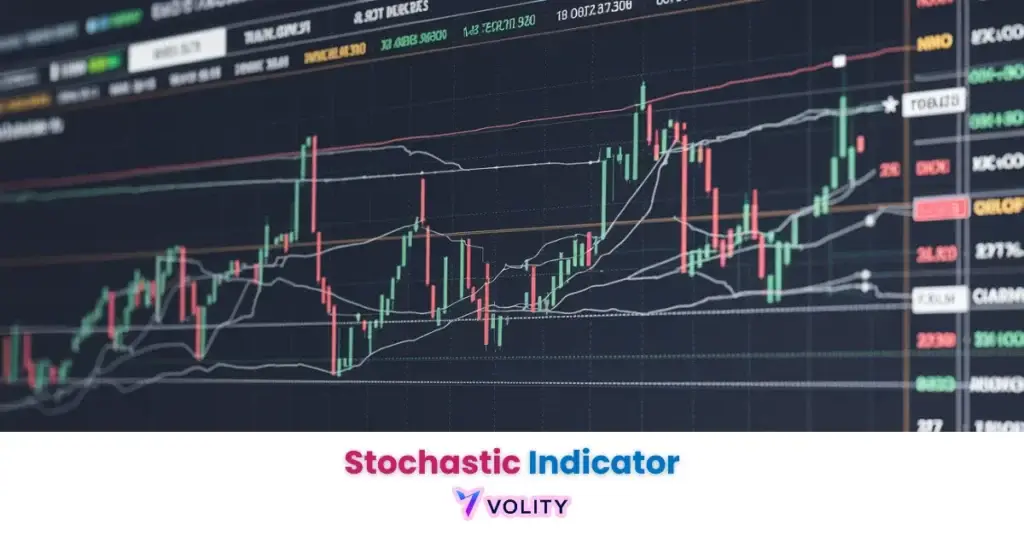
The Stochastic Indicator is a momentum oscillator that identifies overbought (>80) and oversold (<20) conditions by comparing an asset’s closing price to its recent high-low range. The oscillator is at its most dependable in sideways market regimes, which the ADX confirms when it holds below 25. Traders utilize %K and %D line crossovers alongside structural divergence to time high-probability entries in $9.6 trillion daily global markets, though secondary confirmation is mandatory to avoid the traps of trending ‘pegging’ events.
Stochastic indicator mechanics function as a “location tracker” for current price action, identifying where a close sits within its recent historical volatility. This oscillator allows traders to visualize whether an asset is overextended at psychological boundaries before a momentum shift occurs. It remains a foundational requirement for executing mean-reversion strategies in the $9.6 trillion daily forex market.
The 2026 investment landscape is defined by volatility contraction cycles where momentum signals often precede macro-economic shifts. Mastering the stochastic oscillator requires a deep understanding of market regime detection and the role of smoothing factors in filtering HFT noise.
While understanding Forex is important, applying that knowledge is where the real growth happens. Create Your Free Forex Trading Account to practice with a free demo account and put your strategy to the test.
What is the stochastic indicator and how does it work in 2026?
The stochastic indicator is a technical oscillator that identifies overbought and oversold conditions by measuring the position of a closing price relative to its high-low range over a specific period.
The stochastic operates on a 0-100 scale with two critical thresholds: 80 identifies overbought conditions (potential pullbacks), and 20 identifies oversold conditions (potential bounces). The indicator displays two lines: the %K line (the main line) and the %D line (a 3-period average of %K used for confirmation). When %K crosses above %D in oversold territory, a bullish signal emerges; when %K crosses below %D in overbought territory, a bearish signal triggers.
George Lane developed the stochastic in the late 1950s to track price momentum velocity, and it remains one of the most widely used momentum tools across all timeframes. Range-bound markets are where its edge is clearest, because the oscillator measures where a close sits inside a stable range rather than chasing an expanding one. A trend filter such as ADX below 25 is the usual way to confirm that regime before acting on a reading.
Ready to Elevate Your Trading?
You have the information. Now, get the platform. Join thousands of successful traders who use Volity for its powerful tools, fast execution, and dedicated support.
Create Your Account in Under 3 MinutesWhat are the best stochastic settings for day trading in 2026?
Optimal stochastic settings identify the balance between indicator sensitivity and signal smoothness based on the specific timeframe and asset volatility.
The standard day trading configuration uses (14, 3, 3) settings on 15-minute and 1-hour charts, providing reliable crossover signals while filtering HFT noise. Scalpers accelerate sensitivity by reducing the lookback to (5, 3, 3), capturing rapid momentum exhaustion within minutes but at the cost of increased false signals. Swing traders using (21, 9, 9) settings achieve significantly smoother oscillation through extended smoothing factors, reducing algorithmic whipsaws on the Daily and 4-hour timeframes.
Crossovers taken at established support zones behave differently from crossovers taken in open space, which is why the level matters as much as the signal. Different asset volatility profiles require parameter adjustments, crypto pairs in 2026 benefit from the (21, 9, 9) configuration due to extreme intraday volatility, while major forex pairs trade reliably with standard (14, 3, 3) settings throughout London and New York sessions.
Adjust your Stochastic settings to (21, 9, 9) for swing trading in 2026; while the default (14, 3, 3) is suitable for intraday charts, the smoother 21-period lookback significantly reduces algorithmic noise on the Daily and 4-hour timeframes.
How do I read stochastic divergence for high-probability reversals?
Stochastic divergence identifies a structural mismatch between price action and momentum that often signals an imminent trend exhaustion or structural pivot.
Bullish divergence forms when price creates a lower low while the stochastic prints a higher low, indicating that downside momentum is failing despite new lows. Bearish divergence appears when price makes a higher high while the stochastic makes a lower high, signaling that upside momentum is decelerating. These divergences predict reversals more reliably than standalone overbought/oversold readings because they measure momentum deceleration rather than just price extremes.
Confirmation requires watching for a %K/%D crossover that re-enters the 20 or 80 zones, this dual confirmation reduces false reversal signals. Worked illustration: price pushes to a new high on GBP/JPY while the 1-hour stochastic prints a lower high, which is bearish divergence. The divergence alone is not the trade. The trade is the bearish crossover that follows it, with the divergence high as the invalidation level. This is an illustration of the rule, not a record of a specific trade.
What is the difference between fast and slow stochastic?
Smoothing analysis identifies the specific mathematical adjustments that distinguish a high-frequency Fast Stochastic from a trend-aligned Slow Stochastic.
| Indicator Type | Lookback Period | Smoothing Factor | 2026 Market Use | Signal Character |
| Fast Stochastic | Raw %K | 3-period %D | Scalping (1m) | Noisy |
| Slow Stochastic | Smoothed %K | 3-period %D | Day Trading (1h) | Standard |
| Full Stochastic | Customizable | User Defined | Swing Trading | Robust |
| RSI Oscillator | Velocity | N/A | Trending Markets | Momentum-based |
| Williams %R | High-Low Range | N/A | Range Extreme | Aggressive |
Formula definitions follow the stochastic oscillator and relative strength index references.
The Fast Stochastic uses the raw %K without smoothing, creating an oscillator that touches extremes frequently but also generates whipsaws. The Slow Stochastic applies a 3-period smoothing to the %K line before plotting, reducing false signals at the cost of slightly delayed entries. Full Stochastic allows traders to customize all three parameters, enabling volatility-specific tuning that both Fast and Slow variants cannot match.
WARNING: Beware of ‘Stochastic Pegging’ in strong trends; the indicator can stay above 80 or below 20 for weeks as price continues to push higher or lower. Never use an extreme reading as a reversal signal unless it is confirmed by a ‘Break of Structure‘ on the price chart.
How does the stochastic indicator compare to RSI for range trading?
Oscillator comparison identifies the Stochastic as a range-optimized tool that tracks price position, while the RSI functions as a trend-momentum gauge that tracks price speed.
The Stochastic oscillates more reliably between 0-100 in sideways markets because it compares price to recent highs and lows directly. RSI measures the ratio of average gains to average losses, making it superior for identifying sustained directional momentum rather than localized exhaustion. Professional traders often combine both indicators: using RSI to determine market bias (above 50 = bullish, below 50 = bearish) and Stochastic to time precise entries within that bias direction.
Systematic traders increasingly favor the ‘Stochastic-RSI’ hybrid approach where Stochastic provides crossover entry timing while RSI confirms momentum alignment. Crossovers that occur beyond the 80/20 thresholds carry more information than crossovers in the 60-40 neutral zone, because the neutral zone is where the oscillator spends most of its time and most of those crossings resolve nowhere.
💡 KEY INSIGHT: Stochastic divergence is far more dependable on the Daily chart than on the 15-minute chart; higher timeframes filter out the liquidity sweeps that frequently create false signals for short-term scalpers.
Turn Knowledge into Profit
You have done the reading, now it is time to act. The best way to learn is by doing. Open a free, no-risk demo account and practice your strategy with virtual funds today.
Open a Free Demo AccountWhat is a ‘stochastic pegging’ event and how do I avoid it?
Stochastic pegging identifies a momentum state where the oscillator remains pinned at extreme thresholds during strong trending expansions.
Pegging occurs when price accelerates so forcefully that the recent high-low range expands dramatically, forcing the Stochastic to stay above 80 or below 20 for multiple consecutive candles. Attempting to short when Stochastic reads above 90 during a strong uptrend creates catastrophic losses as price continues to rise despite the extreme reading. The solution requires using trend detection filters: when ADX exceeds 25, treat the Stochastic as a pullback entry tool rather than a reversal indicator.
During trending markets, reverse your Stochastic strategy, instead of selling overbought extremes, buy the oversold dips within the trend. This pullback trading approach aligns Stochastic signals with directional momentum rather than fighting the trend. Professional traders layer ADX >25 as a mandatory trend filter before accepting Stochastic reversal signals in isolation.
Key Takeaways
- The stochastic indicator is a momentum oscillator that identifies overbought and oversold conditions by comparing price to its recent high-low range.
- Range trading with the Stochastic works best when the market regime is confirmed as sideways by an ADX below 25.
- %K and %D crossovers serve as the primary entry signals, and they carry more weight when they occur at extreme zones (>80 or <20).
- Stochastic divergence is a leading indicator that identifies trend exhaustion by highlighting mismatches between price direction and momentum strength.
- Stochastic pegging occurs in strong trends where the indicator stays at extremes, requiring traders to switch to a pullback strategy aligned with momentum.
- Higher timeframes matter: 4-hour and Daily Stochastic signals carry less noise than high-frequency intraday signals.
Frequently Asked Questions
The Stochastic Momentum Index refines this oscillator by measuring the close against the range midpoint and double-smoothing the result for cleaner signals; see our guide to the Stochastic Momentum Index.
This article contains references to Stochastic Indicator, Momentum Oscillators, and Volity, a regulated CFD trading platform. This content is produced for educational purposes only and does not constitute financial advice or a recommendation to buy or sell any financial instrument. Always verify current regulatory status and platform details before using any trading service. Some links in this article may be affiliate links.