Smart money concepts (SMC) is a way of reading price through the footprints that large institutional traders leave behind. Rather than leaning on lagging indicators, it uses market structure, liquidity, order blocks and fair value gaps to work out where banks and funds are probably buying or selling, then lines up entries with that flow instead of fighting it.
What are smart money concepts?
Smart money concepts is a framework for reading charts the way large operators are thought to trade them. The core claim is simple: markets rarely move at random. They move to reach liquidity, banks and institutions leave repeatable footprints when they fill large orders, and a retail trader who learns to read those footprints can position on the same side. Most of the vocabulary of smart money concepts trading (order blocks, liquidity sweeps, fair value gaps, market structure shifts) comes from the Inner Circle Trader (ICT) material, and before that from Richard Wyckoff’s century-old work on how professional money accumulates and distributes stock.
The appeal is that it swaps “the RSI is oversold” for a story about who is buying, where, and why. That story can still be wrong, and no method removes risk, but it gives shape to a chart that otherwise looks like noise.
Who is the smart money in the market?
“Smart money” is shorthand for the participants large enough to move price: banks, hedge funds, asset managers and the market makers who sit between them. In foreign exchange, a handful of dealing banks handle a very large share of daily turnover, which is why order flow, not retail sentiment, sets the tone. These players cannot buy a full position in one click without pushing the market against themselves, so they work their orders around visible pools of liquidity, the clusters of stop-loss and pending orders that sit above obvious highs and below obvious lows. Smart money concepts is really a toolkit for guessing where those orders sit and how the big players will reach them.
What are the core building blocks of smart money concept trading?
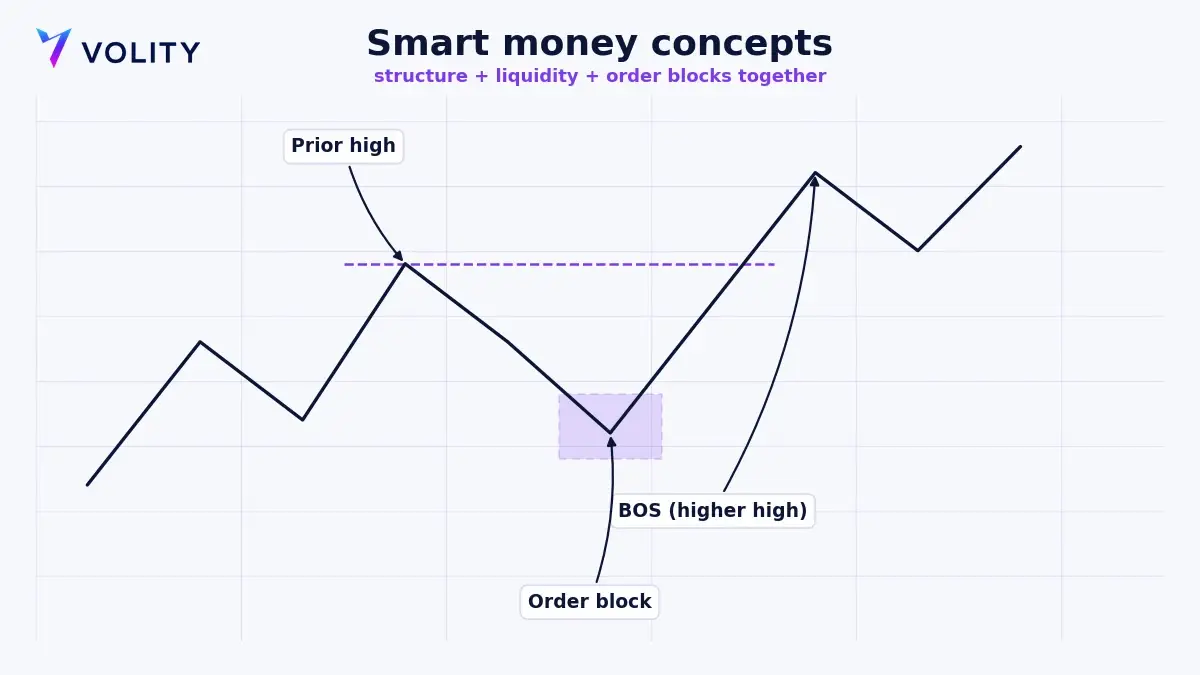
Every smart money concept trading setup is built from the same five pieces. Learn these and the rest of the vocabulary falls into place.
- Market structure is the sequence of highs and lows that defines the trend. A break of structure (BOS) confirms it is continuing; a change of character (CHoCH) warns that it may be turning.
- Liquidity is resting orders. Buy-side liquidity sits above swing highs and equal highs, sell-side liquidity below swing lows and equal lows, and price is drawn toward it.
- Order blocks are the last opposing candle before a strong, structure-breaking move, marking where institutions likely loaded up.
- Fair value gaps are the imbalance a fast move leaves behind when one side overwhelms the other, often revisited before the trend resumes.
- Premium and discount split a defined range at its midpoint, the 50% equilibrium level; smart money buys in the discount half and sells in the premium half.

How do you read market structure?
Market structure is the backbone of the whole method, so read it first. An uptrend is a staircase of higher highs and higher lows; a downtrend is lower highs and lower lows. While the staircase holds, you trade with it. Two events matter. A break of structure happens when price takes out the previous high in an uptrend, or the previous low in a downtrend, confirming the trend continues. A change of character is when that staircase breaks the wrong way, the first lower low inside an uptrend, which flags that control may be passing to the other side. In practice you read structure on a higher timeframe to set your bias, then drop to a lower timeframe to time the entry.
How does a smart money concepts trading setup work?
Most SMC entries follow the same seven-step logic. The example below is a long; mirror it for a short.
- Read the higher-timeframe trend and set your directional bias. Only hunt longs while structure is bullish.
- Mark your tools: unmitigated order blocks, open fair value gaps, and the liquidity pools above and below price.
- Wait for a liquidity sweep, a spike that runs the stops beyond a swing low and taps sell-side liquidity.
- Confirm a change of character on the lower timeframe, where price rejects the sweep and breaks short-term structure back up.
- Enter as price returns into the order block or fair value gap, ideally in the discount half of the range.
- Place the stop just beyond the sweep wick, the point where the idea is proven wrong.
- Target the opposing liquidity, the buy-side pool above the nearest highs, and manage the trade as structure builds.
No single tool is a signal on its own. The edge, if there is one, comes from confluence. A sweep into an order block that sits in discount and leaves a fair value gap behind is far stronger than any one element read alone.

How is SMC different from traditional technical analysis?
Classic technical analysis reads the outcome of order flow through indicators; smart money concepts tries to read the order flow itself. Neither is magic, and the two overlap more than their fans admit. A trader who already uses support and resistance is halfway there, since liquidity tends to pool at exactly those obvious levels. The table sets out the practical difference.
| Feature | Traditional technical analysis | Smart money concepts |
| Primary lens | Indicators (RSI, MACD, moving averages) | Price, structure and liquidity |
| Entry logic | Signal crossover or level touch | Sweep, then structure shift into an order block or gap |
| View of a stop hunt | Noise or a false breakout | The point of the move: liquidity being taken |
| Strength | Objective, easy to backtest | Context-rich, explains why levels hold |
| Weakness | Lagging, can whipsaw | Subjective, easy to over-fit in hindsight |
What are the risks of trading smart money concepts?
The honest risk is subjectivity. Order blocks and fair value gaps are easy to draw perfectly after the fact and much harder to read in real time, so two traders can look at the same chart and disagree. Backtest a fixed rule set, keep a trade journal, and treat any “guru” screenshot with suspicion. Market risk sits on top of that. SMC setups are usually traded with leverage through CFDs, and leverage magnifies losses as readily as gains, so a position sized too large can be closed out by the very sweep you were trying to trade. Regulators such as ESMA and the FCA treat retail leverage as high-risk and restrict how leveraged products are sold, which tells you how seriously to take it. Know your costs before you commit, size every position from its stop distance, and keep the fee side transparent by checking the published charges and fees.
How do you trade smart money concepts on Volity?
Volity is an all-in-one money hub, and its trading layer is where SMC setups actually get executed. You can run the whole framework across forex, indices, crypto and commodities from one account, going long or short through contracts for difference on Volity MT. Structure-based entries ask a lot of a platform: clean charts, fast fills and tight spreads, because a wide spread eats the edge on a precise order-block entry. Volity fills 99.6% of orders in under a second, quotes forex from 0.6 pips, and offers leverage up to 1:500 on selected forex pairs, 1:100 on commodities and 1:50 on crypto, all under CySEC regulation through UBK Markets (licence 186/12). Practise the seven-step routine on a free demo first, then fund a live account once your reads are consistent.
Related patterns
Frequently asked questions about smart money concepts
What is the difference between smart money concepts and ICT?
They overlap almost entirely. ICT (Inner Circle Trader) is the body of teaching that popularised most of the terminology; smart money concepts is the broader, community-driven label for the same ideas, often stripped down to structure, liquidity, order blocks and fair value gaps. Learn one and you have effectively learned the vocabulary of the other.
Do smart money concepts actually work?
SMC is a framework, not a guarantee. It gives a logical reason for entries and stops, which many traders find more repeatable than indicator signals, but its accuracy depends entirely on the person applying it. Tested with discipline and sound risk management it can be an edge; used to justify random trades it is just decoration.
Is SMC good for beginners?
The ideas are beginner-friendly, but the execution is not. Start with market structure until reading highs and lows is second nature, add one tool at a time, and trade a demo account until your reads hold up. Rushing into full multi-tool setups is the fastest way to over-complicate the chart.
Where can I find a smart money concepts PDF?
Plenty of free smart money concepts PDF summaries circulate online, and the essentials genuinely fit on a single page: take your bias from structure, mark your liquidity and order blocks, wait for a sweep and a shift, enter at a discount, and target the opposing pool. Rather than collecting more documents, screenshot a handful of live setups and study your own charts, which teaches the concept far faster than any PDF.