A fair value gap is a price imbalance left behind when a market moves so fast in one direction that buying and selling never meet in the middle. On a three-candle sequence it is the gap between the first candle’s wick and the third candle’s wick, unfilled by the middle candle. Price often returns to it before the trend continues.
What is a fair value gap?
The fair value gap meaning is best understood through imbalance. In a balanced market, every price level is traded by both buyers and sellers, and liquidity sits on both sides of the book. When a large order pushes price hard in one direction, some levels get skipped: the market prints through them too quickly for the other side to participate. That skipped zone is the fair value gap, sometimes called an imbalance or an inefficiency. Traders who use smart money concepts treat it as unfinished business, a pocket of “unfair” pricing that the market tends to revisit and rebalance before moving on.
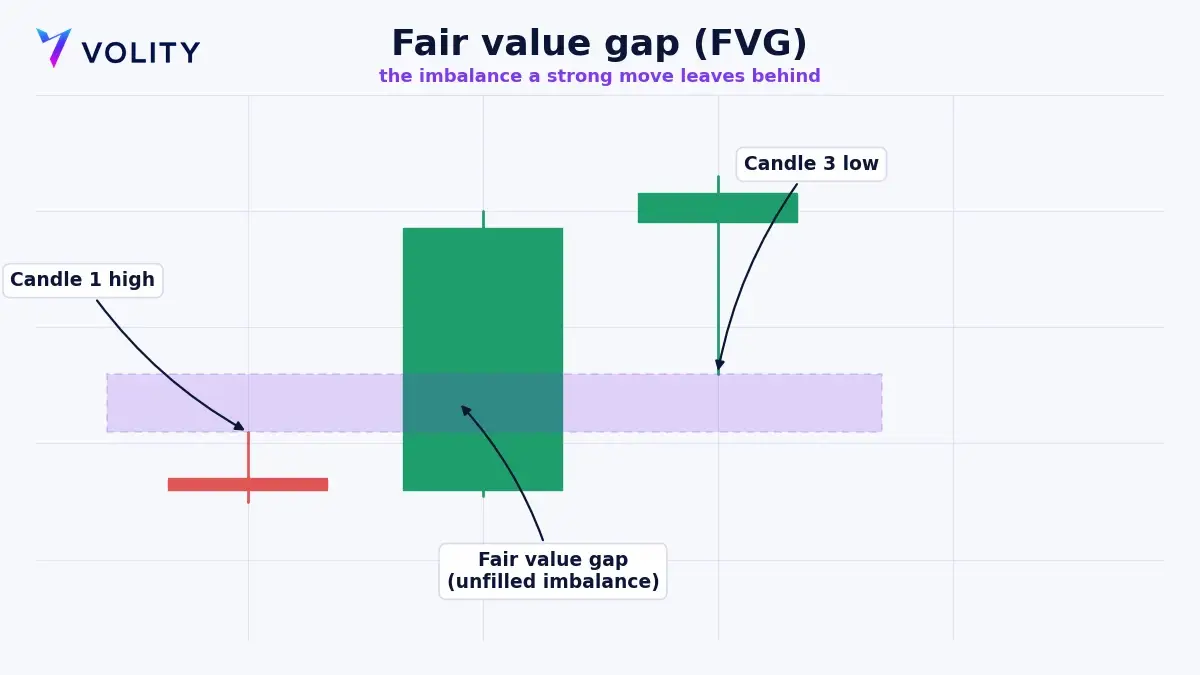
Mechanically, you find it on any three consecutive candles. Look at candle one and candle three. If there is clear air between the high of candle one and the low of candle three (in a strong up-move), or between the low of candle one and the high of candle three (in a strong down-move), that clear air is the gap. The large middle candle is the engine that created it. That is the fair value gap explained in one picture: two wicks that never overlap, with empty space between them.
How does a fair value gap form?
Fair value gaps form on displacement: a sudden, one-sided expansion in price. A news release, a stop cascade, or an institution filling a large order can all do it. The tell is a long-bodied candle with small wicks, printed on a burst of volatility, that leaves the surrounding candles unable to overlap. Research by the Bank for International Settlements on FX market liquidity shows how quickly one-sided flow can move price when depth on the other side thins out. Because the move was one-sided, the market has, in effect, run ahead of fair value. That is why the zone acts like a magnet later: when momentum cools, price drifts back to fill the gap, giving the traders who missed the first move a second chance to participate at a better price.
Bullish and bearish fair value gaps, with an example
There are two directions, and a quick fair value gap example for each makes them obvious.
A bullish fair value gap forms when price rockets up. The gap is the unfilled space between candle one’s high and candle three’s low. It sits below current price and often acts as support when revisited. Say EURUSD spikes on a soft inflation print and leaves a gap ten pips wide; two hours later price eases back into it and bounces.
A bearish fair value gap forms when price drops hard. The gap is the space between candle one’s low and candle three’s high. It sits above current price and often acts as resistance on the retrace. An index sells off into the close, leaves a gap, then retraces into it the next session and rolls over.
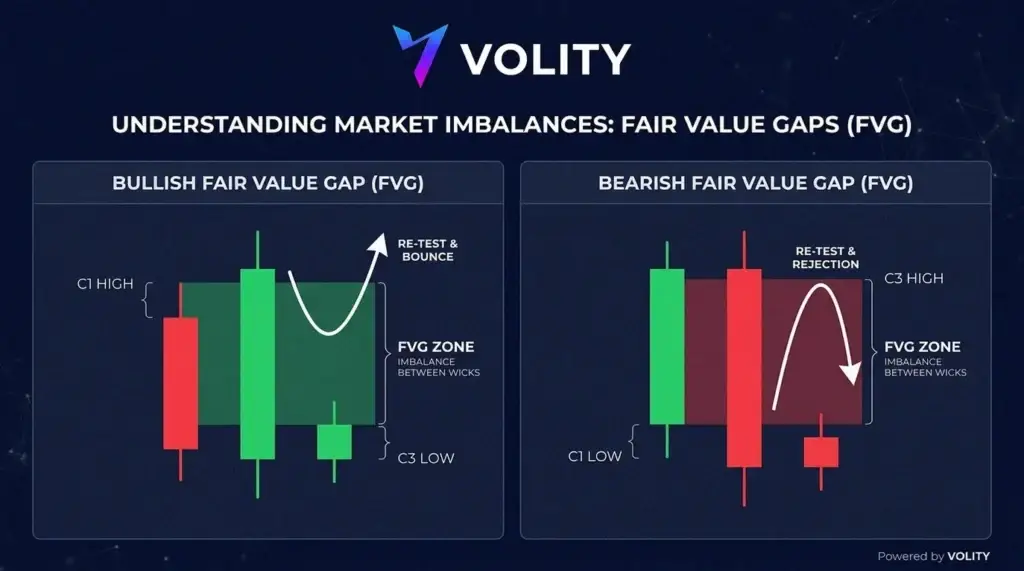
Not every gap is equal. The strongest fair value gap examples appear in the direction of the higher-timeframe trend, sit alongside an order block, and coincide with a break of structure. A gap printed against the trend, in the middle of a choppy range, is far less reliable.
What is an inverse fair value gap?
An inverse fair value gap is what a gap becomes after it fails. Normally a bullish gap is expected to hold as support. If price slices straight through it and closes decisively on the other side, the zone flips polarity: the former support becomes resistance. That flipped zone is the inverse fair value gap, and it is one of the clearest tells that momentum has changed hands. Traders use it both as a warning that the original idea is void and as a fresh level to trade from in the new direction. A bearish gap that gets reclaimed to the upside flips the same way, from resistance into support.
How do you trade a fair value gap?
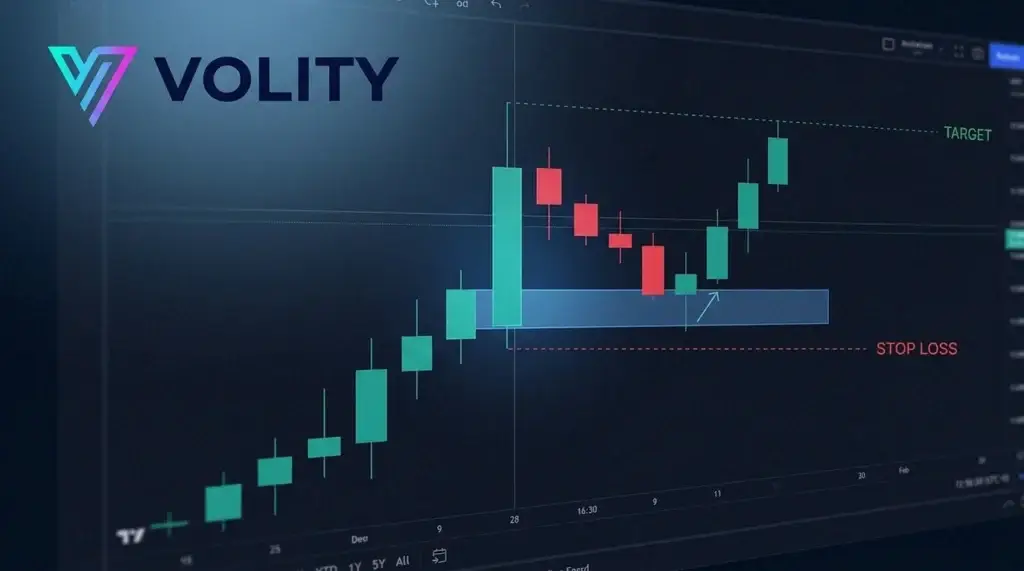
Fair value gap trading is a retracement game. You skip the fast move and wait for price to pull back into the imbalance. A repeatable routine looks like this.
- Confirm the higher-timeframe trend so you only trade gaps in its direction.
- Mark the gap as a zone, from the wick of candle one to the wick of candle three.
- Wait for price to return into the zone instead of entering on the initial displacement.
- Look for a reaction: a rejection wick, a lower-timeframe structure shift, or a close back out of the zone.
- Enter on that confirmation, with a stop just beyond the far edge of the gap.
- Target the next liquidity pool or the prior swing, and manage the position as structure builds.
How does a fair value gap differ from an ordinary gap or an order block?
The terms get muddled, so keep them separate. A fair value gap is an intrabar imbalance across three candles, while an ordinary gap opens between one session’s close and the next session’s open.
| Concept | What it is | How it is used |
| Fair value gap | Intrabar imbalance across three candles | Retracement entry zone, expected to be partly filled |
| Common gap | Space between one session’s close and the next session’s open | Often “closed” as price returns to the prior level |
| Order block | Last opposing candle before a strong move | Origin of the move, often overlaps a fair value gap |
In practice these tools work together. The best entries appear where a fair value gap and an order block sit in the same zone, because two independent reasons to expect a reaction are stronger than one.
What are the risks, and where can you trade fair value gaps?
Gaps do not have to fill, and plenty never do. Price can accelerate away and leave the imbalance open for weeks, so treat a gap as a zone of interest. It marks where a reaction is likely and guarantees nothing. Combine it with clear support and resistance, size every position from the stop distance, and remember that these setups are usually traded with leverage through contracts for difference, which magnifies losses as much as gains.
That risk is why the FCA restricts how CFDs are sold to retail clients, and why ESMA product intervention measures across the EU cap the leverage a provider may offer. Positions held past 22:00 GMT also accrue overnight financing that reflects prevailing interest rates, so factor that into any longer hold. Trading on leverage means you can lose money faster than the market moves, and risk management comes before any entry.
On Volity you can trade fair value gaps across forex, indices, crypto and commodities on Volity MT, with spreads from 0.6 pips, 99.6% of orders filled in under a second, and leverage up to 1:500 on selected forex pairs. Execution is regulated by CySEC through UBK Markets (licence 186/12), with client funds held in segregated accounts. Keep your fee assumptions honest by checking the published charges and fees, and rehearse the setup on a free demo before you go live.
Related patterns
Frequently asked questions about fair value gaps
What is a fair value gap in trading?
A fair value gap in trading is a price zone skipped by a fast, one-sided move, visible as clear space between the first and third candles of a three-candle sequence. It marks an imbalance the market often revisits, which is why traders use it as a retracement entry area in the direction of the trend.
Do fair value gaps always get filled?
No. Many gaps are revisited, but a strong trend can leave one open indefinitely. Treat a gap as a zone where a reaction is likely, not a level price is guaranteed to reach. Trading it without a confirmation and a stop is how open gaps turn into losses.
What timeframe is best for fair value gaps?
Gaps appear on every timeframe. Higher timeframes such as the 1-hour and 4-hour produce fewer but more reliable gaps, while the 1-minute and 5-minute produce many that fill quickly and noisily. A common approach is to mark higher-timeframe gaps for bias and refine the entry on a lower timeframe.
How is an inverse fair value gap different from a normal one?
A normal fair value gap is expected to hold in the trend’s direction. An inverse fair value gap is a gap that failed: price closed through it, flipping support into resistance or the reverse. It signals a momentum change and becomes a level to trade from in the new direction rather than the old one.