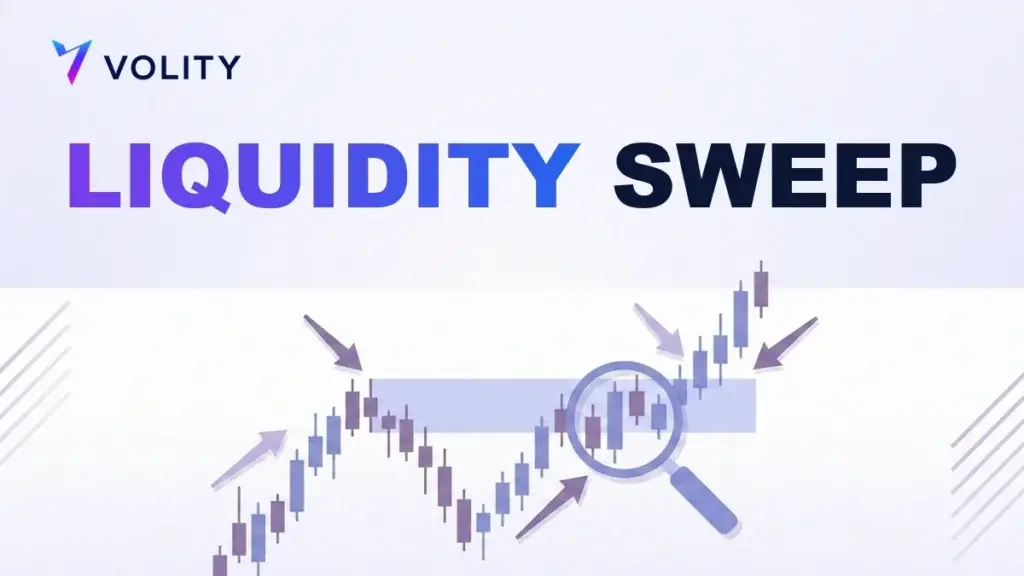
A liquidity sweep is a fast move that pushes price just beyond a key high or low to trigger the orders resting there, then reverses. Large traders use these sweeps to fill big positions against the stops and breakout orders they collect, which is why a level can break for a moment and then snap back the other way.
What is a liquidity sweep?
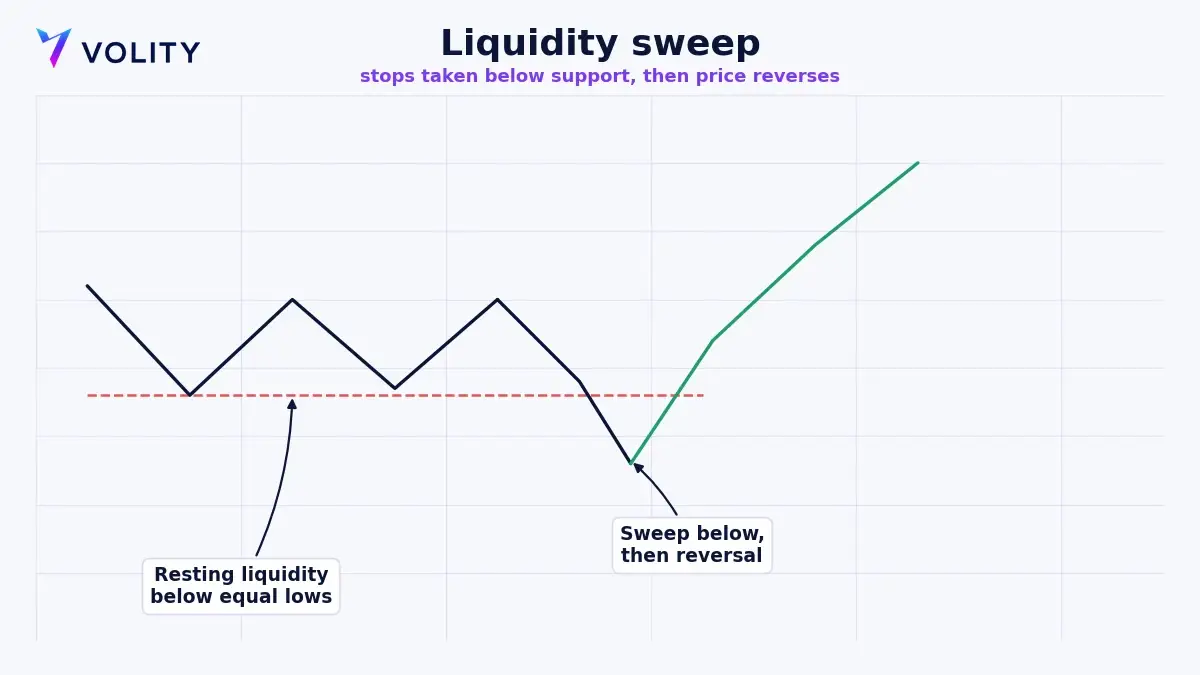
The liquidity sweep meaning comes straight from how markets fill large orders. To buy a big position, an institution needs someone to sell to it, and the richest pool of sell orders sits just below obvious swing lows, where stop-losses from longs and breakout sells from shorts cluster together. Price is nudged down through that low, the resting orders fire, the institution gets its fill from the order flow, and then price reverses upward. That spike and reverse is the liquidity sweep. Some traders call it a stop hunt or a liquidity grab, and it sits at the heart of Inner Circle Trader (ICT) methods, though the mechanics are identical whatever you call it. Understanding what a liquidity sweep is in trading reframes a familiar false breakout as the point of the move rather than an accident.
Where does liquidity sit in the market?
Liquidity pools sit wherever orders cluster in predictable places, so knowing where liquidity sits in forex trading is the first read. There are two kinds.
- Buy-side liquidity rests above swing highs and above equal highs. It is built from buy stops left by short sellers and breakout buy orders, and price sweeps up into it before turning down.
- Sell-side liquidity rests below swing lows and below equal lows, the kind of support longs lean on. It is built from sell stops left by long holders and breakout sell orders, and price sweeps down into it before turning up.
Equal highs and equal lows are the clearest targets of all. When price prints two or more tops at almost the same level, a wall of stop orders builds just above them, and that wall is an obvious magnet. The same logic applies to round numbers, prior-day highs and lows, and session extremes. The currency market is the deepest and most liquid market in the world, so these pools can be large enough to move price sharply when they are taken.
How is a liquidity sweep different from a real breakout?
This is the distinction that separates a good entry from a bad one. A genuine breakout takes a level and holds, with price accepting the new range and building structure beyond it. A liquidity sweep takes the level and rejects it, closing back inside within a candle or two. The tell is in the follow-through. A breakout keeps going; a sweep turns around. In practice you never assume which one you are watching. You wait for price to close back inside the range and for a shift in market structure before you treat it as a sweep.
How do you spot a liquidity sweep?
Learning how to spot a liquidity sweep comes down to a short list of signs that show up together.
- A clear pool to target, such as an obvious swing high, swing low, or equal highs and lows.
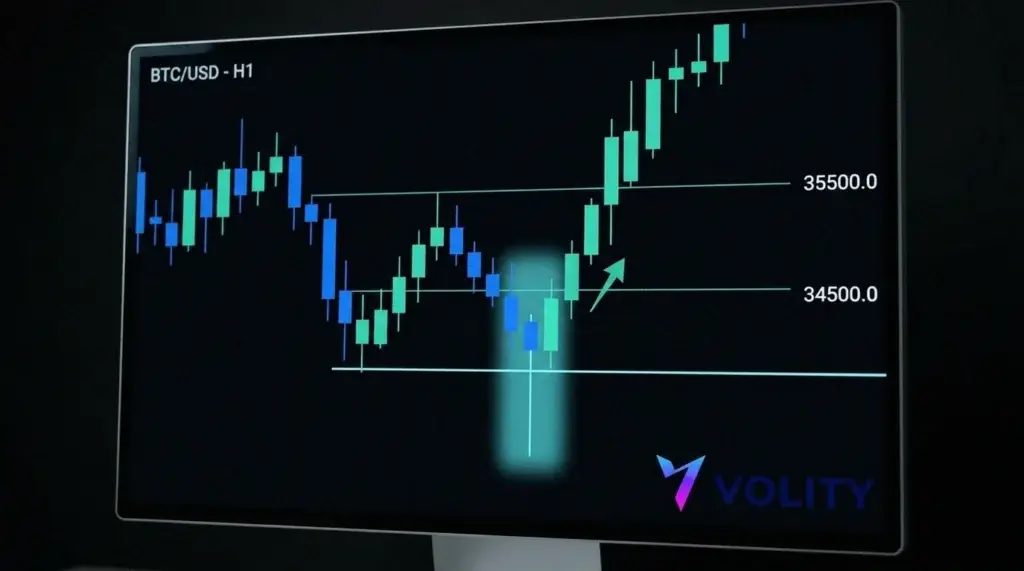
- A sharp spike beyond it, usually a long wick that pierces the level rather than a steady push.
- A fast rejection, with price closing back inside the range within one or two candles.
- A structure shift straight after, a change of character on the lower timeframe that confirms intent.
- Often an imbalance left behind, a fair value gap in the new direction.
How do you trade a liquidity sweep?
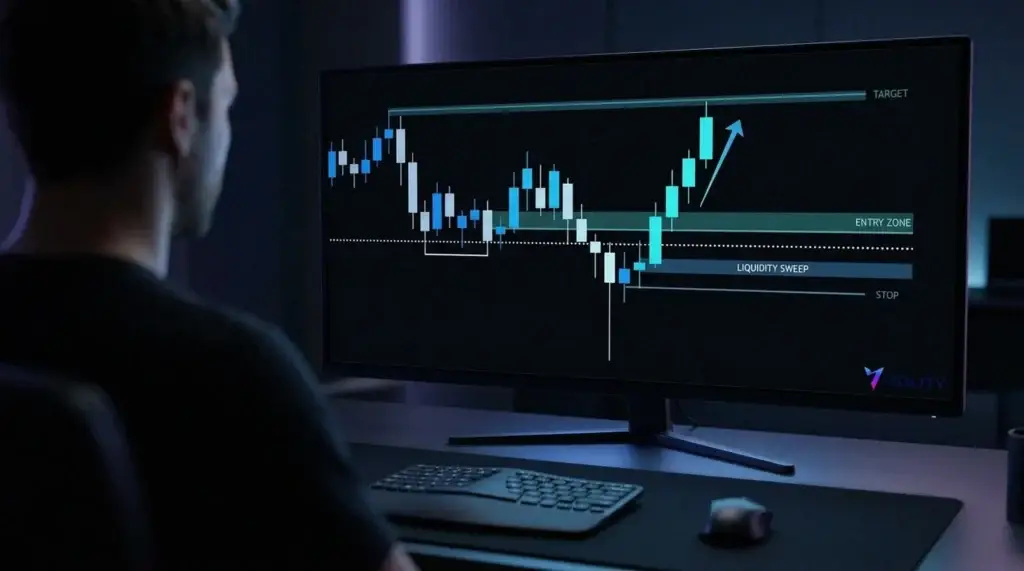
Liquidity sweep trading is a reversal method built on patience. You let the sweep happen, then trade the snap-back. Here is a repeatable routine for a bullish reversal after a sweep of sell-side liquidity, and you reverse every step for a short.
- Mark the liquidity pool, the swing low or equal lows you expect to be swept.
- Wait for the spike through it, then for price to close back inside the range.
- Confirm a change of character on the lower timeframe as price breaks short-term structure upward.
- Enter on the return into the origin of that shift, often an order block or a fair value gap.
- Place the stop just beyond the sweep wick, where the reversal idea is proven wrong.
- Target the opposing liquidity, the buy-side pool above the nearest highs.
The stop placement is the quiet strength of the setup. Because a real sweep should not be swept again straight away, the wick gives you a natural, tight invalidation level, which keeps risk defined before you ever think about reward.
A liquidity sweep example, step by step
Here is a concrete liquidity sweep example. GBPUSD spends the London morning printing two matching lows at 1.2700, so a pool of sell stops builds just underneath. Early in the New York session a spike drives price to 1.2688, triggers those stops, and closes back at 1.2705 inside the same 15-minute candle. On the 5-minute chart, price then breaks its most recent lower high, a change of character. You enter long as price retests the small order block left by that break, place the stop at 1.2685 below the sweep wick, and target the buy-side liquidity above the session high near 1.2760. The stops that were hunted became the fuel for the move you are now riding.
Which sessions produce the best liquidity sweeps?
Sweeps are not spread evenly through the day. They cluster around session opens, when fresh volume arrives and the previous session’s highs and lows become obvious targets. The London open frequently sweeps the quiet Asian range before the real move begins, and the New York open often runs the highs or lows set during London. Daily, weekly, and prior-session extremes act as the biggest pools because so many traders anchor stops to them, and research on foreign-exchange market structure shows how order flow concentrates around these times. Map the previous day’s high and low, the current session’s highs and lows, and any equal highs or lows, and you have a short list of the levels most likely to be swept. A sweep of a well-watched level during an active session tends to give a cleaner reversal than a sweep of a minor level in a dead hour, simply because the liquidity being taken is larger and the follow-through is stronger.
What are the risks, and where can you trade liquidity sweeps?
The main trap is jumping in on the spike itself. If what looked like a sweep turns out to be a real breakout, entering early puts you on the wrong side of a strong move, so wait for the close back inside and the structure shift every time. These setups are usually traded with leverage through contracts for difference, which amplifies losses as well as gains, so keep positions sized to the stop distance. Regulators including the FCA and ESMA restrict how leveraged CFDs are sold to retail traders, because most retail accounts lose money on them. On Volity you can trade liquidity sweeps across forex, indices, crypto, and commodities on Volity MT, with spreads from 0.6 pips, 99.6% of orders filled in under a second, and leverage up to 1:500 on selected forex pairs, all regulated by CySEC through UBK Markets (licence 186/12). Confirm your cost assumptions against the published charges and fees, and practise the entry on a free demo before you risk real capital.
Related patterns
Frequently asked questions about liquidity sweeps
What is a liquidity sweep in trading?
A liquidity sweep in trading is a quick move beyond a swing high or low that triggers the stop and breakout orders resting there, then reverses. It lets large participants fill positions against that liquidity. Traders treat the reversal after the sweep as the entry, not the spike itself.
Is a liquidity sweep the same as a stop hunt?
Effectively yes. Stop hunt, liquidity grab, and liquidity sweep all describe price reaching beyond an obvious level to trigger resting orders before reversing. The terms come from different trading communities, but they point at the same behaviour and the same trading response.
How do I avoid being caught in a liquidity sweep?
Place stops with room rather than right at the obvious swing high or low where everyone else clusters. Sweeps target the tightest, most crowded levels, so a stop a sensible distance beyond structure is less likely to be picked off by a spike that then reverses in your favour.
What timeframe works best for liquidity sweeps?
Sweeps show up on every timeframe, but many traders map liquidity on the 1-hour or 4-hour chart and execute the reversal on the 5-minute or 15-minute. Higher-timeframe pools carry more weight, while the lower timeframe gives the precise change-of-character entry and a tighter stop.