Trading with technical indicators like the Awesome Oscillator (AO) involves high risk. Signals from momentum oscillators can be lagging or produce false crossovers, especially in ranging markets. Integrating multiple filters and maintaining strict risk management is essential. Past performance is not indicative of future results. Capital at risk.
The Awesome Oscillator (AO) is a momentum indicator developed by Bill Williams that subtracts a 34-period simple moving average of median price from a 5-period simple moving average of median price. Filtered AO strategies pair the histogram with a directional trend filter rather than trading crossovers on their own. By utilizing zero-line crossovers and Saucer signals, traders can effectively identify and execute shifts in market energy.
Awesome Oscillator (AO) serves as a “market thermometer,” measuring the current momentum (energy) of an asset compared to its recent historical average. Developed by Bill Williams, this non-lagging histogram calculates the difference between a 34-period and 5-period Simple Moving Average, uniquely utilizing median price (High+Low/2) rather than closing prices. Williams built the AO as part of a wider toolkit that also includes the Alligator and the market facilitation index.
Executing trades on standalone crossovers is often insufficient; when used as a secondary filter alongside a trend read, the AO narrows entries to moments when momentum and direction agree. Combining the oscillator with RSI and MACD is the common practice, because each answers a different question about the same move.
While understanding Awesome Oscillator (AO) is important, applying that knowledge is where the real growth happens. Create Your Free Forex Trading Account to practice with a free demo account and put your strategy to the test.
What is the Awesome Oscillator (AO)?
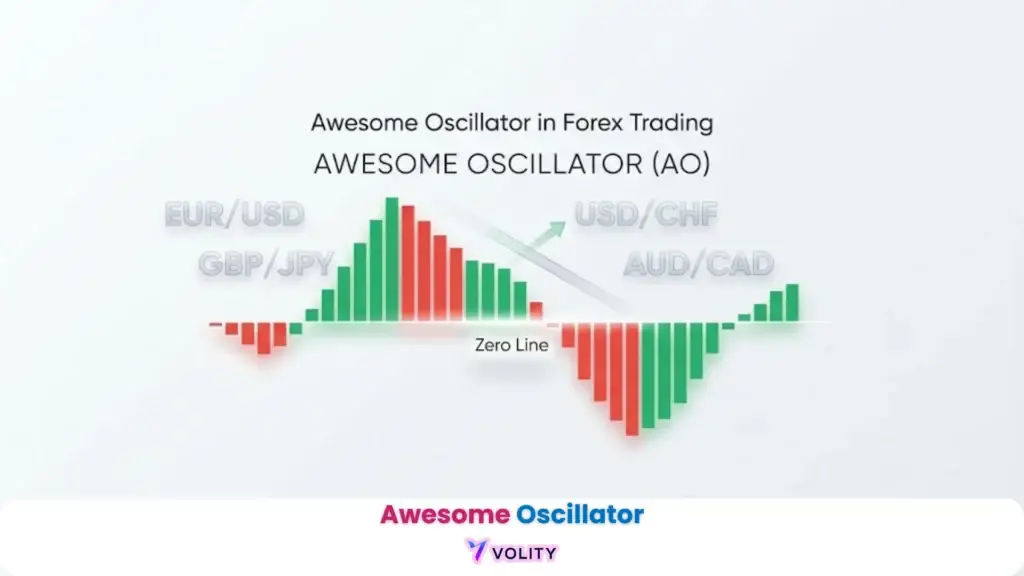
Awesome Oscillator (AO) is a momentum indicator that displays the difference between a long-term and short-term Simple Moving Average to reveal changes in market energy. The metric identifies shifts in market momentum by comparing short-term market behavior against the longer-term historical average. This comparison reveals whether current energy is expanding or contracting, creating a visual histogram where expansion indicates increasing momentum and contraction signals weakening energy.
AO’s role in Bill Williams’ “Trading Chaos” theory positions the indicator as a foundational tool for understanding market structure. The indicator uses a unique calculation basis that reduces lag compared to traditional momentum metrics. The use of median price [(High + Low) ÷ 2] means the AO reads the centre of each bar rather than its closing print, so it registers a shift in range before a close-based oscillator such as MACD confirms one.
AO vs. MACD: Understanding the Median Price Edge
The AO distinguishes itself from the MACD by focusing on the average range price rather than being biased toward the daily close. MACD’s calculation incorporates exponential moving averages of closing prices, creating a dependency on final session prices that can be distorted by intraday volatility spikes. The AO calculates median price (the midpoint between the high and low), representing the “true” average price during the period by capturing the center of price action rather than its endpoints.
This median price methodology identifies how AO provides “energy” focus through mean-reversion smoothing. When the high and low compress into a narrow range, median price reflects that compression accurately. When the high and low diverge dramatically, median price captures the average outcome rather than only the closing level. This approach reveals why professional quantitative traders prefer AO for identifying genuine momentum shifts compared to closing-price-dependent indicators.
The top technical indicators for trading in 2026 framework demonstrates AO’s position as a leading momentum measurement tool in modern trading systems.
MetaQuotes publishes the exact definition in the MetaTrader 5 Awesome Oscillator reference: AO = SMA(MEDIAN PRICE, 5) - SMA(MEDIAN PRICE, 34), where median price is (High + Low) / 2. The MQL5 iAO function reference documents the same calculation for automated systems.
Ready to Elevate Your Trading?
You have the information. Now, get the platform. Join thousands of successful traders who use Volity for its powerful tools, fast execution, and dedicated support.
Create Your Account in Under 3 MinutesHow do you use the Awesome Oscillator?
Awesome Oscillator (AO) identifies trade opportunities through three specific histogram patterns: Zero-Line Crossover, Twin Peaks, and the Saucer. The Zero-Line Crossover represents the simplest momentum shift signal, occurring when the histogram transitions from below zero to above zero (bullish crossover) or vice versa (bearish crossover). This transition indicates that the 5-period short-term average has recently exceeded (or fallen below) the 34-period long-term average, signifying a shift in market energy direction.
Twin Peaks identify divergence and trend exhaustion by comparing successive peaks in the histogram. A bullish Twin Peak pattern manifests when two peaks both remain below zero but the second peak rises higher than the first, indicating that bearish momentum is weakening despite remaining negative overall. This pattern often precedes a reversal into positive territory as the declining strength of the negative momentum creates conditions for reversal.
The Saucer Signal executes on intraday pullbacks within a trend by identifying a three-bar histogram sequence. A bullish saucer appears when the histogram shows two bars on one side of zero followed by a bar moving toward the opposite side, representing a temporary momentum dip followed by continuation. The mandatory “Three-Bar Rule” requires confirmation that the entire three-bar sequence visually validates the pattern before executing, eliminating false signals that might occur from isolated bars.
Standalone zero-line crossovers fire often, and in ranging conditions most of those crossings resolve back through zero without a durable move. That is why the simplest AO signal is treated as a starting filter rather than an entry rule on its own.
The simple moving average (SMA) foundations documentation explains how the underlying 5-period and 34-period SMAs calculate the histogram values.
Bill Williams set out the Saucer and Twin Peaks rules in his own trading books; his published work is the origin of the three-bar sequence used here.
Professional quants in 2026 use the “Momentum Hurdle” strategy. Use the AO to validate Bollinger Band breakouts; only execute if the AO histogram is expanding in the direction of the break to ensure genuine momentum strength.
How to execute AO strategies in 2026 markets?
Awesome Oscillator (AO) execution requires integrating trend filters and volume indicators to maximize win rates and manage drawdowns in volatile environments. A three-filter approach combines AO, MACD and RSI, requiring all three to align before executing. AO identified momentum shifts, MACD confirmed the sustained directional bias, and RSI ensured that price action remained within reasonable overbought/oversold bounds, creating a high-confidence confluent entry.
Using a 200-period EMA establishes a trend filter that removes standalone zero-line crossovers occurring against the prevailing trend. A bullish AO crossover beneath the 200 EMA identifies false signals generated by mean-reversion activity within a downtrend rather than genuine trend reversals. By requiring AO signals to align with price trading above (bullish) or below (bearish) the 200 EMA, traders discard the crossovers that fire against the prevailing trend, which is where most of the noise sits.
Managing “Momentum Hurdle” exits during volatility requires monitoring whether the AO histogram remains expanded in the direction of the trade. As volatility spikes, the AO histogram can expand dramatically, encouraging traders to hold positions longer. However, when volatility collapses and the histogram suddenly contracts, this reversal signals that momentum is exhausting, creating an exit signal distinct from price action alone.
Worked example: a BTC/USD long on the 4-hour chart is taken only when three conditions hold together, namely the AO histogram crossing above zero, RSI above 50, and price above the 200 EMA. Any one of the three on its own would have produced entries against the trend. This is an illustration of the rule set, not a record of a specific trade. Past performance is not indicative of future results.
The MACD indicator signals and execution documentation details how MACD confirms AO signals and combines with the oscillator in integrated momentum systems.
AO Performance Metrics and 2026 Backtest Data
Awesome Oscillator (AO) performance metrics reveal the critical importance of timeframe selection and strategy integration for professional traders. The data identifies clear separation between standalone signals and filtered approaches, with substantial ROI improvements when secondary confirmation filters align with AO signals.
| Strategy/Metric | Performance Indicator | Value |
| Crossover Signal | Zero-line crossovers | Frequent, and unfiltered |
| Crypto ROI (2025) | Confluence requirement | Requires AO, MACD and RSI to agree |
| Max Drawdown | Position sizing | Size positions for the drawdown you can hold |
| Timeframe Reliability | D1/H4 vs Intraday | Higher timeframes carry less noise |
| Signal Basis | Price Input | Median price, (High + Low) / 2 |
Reference: the AO definition and its 5/34 median-price parameters are documented in the MetaTrader 5 indicator reference. The behavioural columns describe how the signal is applied, not measured performance.
The gap between a filtered and an unfiltered approach is the whole argument for confluence. Even a well-filtered momentum strategy still exposes capital to sustained drawdowns, and an account sized without room for those drawdowns will be forced out of a position that would otherwise have recovered.
Momentum filters are only as good as the trend read behind them. The relative strength index and MACD reference definitions set out what each of the confirming indicators actually measures.
What is the best setting for the Awesome Oscillator?
Awesome Oscillator (AO) is optimized when utilizing the standard 5 and 34-period parameters on higher timeframes like the Daily or 4-Hour charts to filter market noise. Bill Williams insisted on the 5/34 periodicity specifically because this combination captures short-term (5-bar) momentum relative to longer-term (34-bar) context in a way that resists curve-fitting to specific markets. Fixed parameters across forex, crypto, stocks, and commodities indicate that the indicator’s calculation remains universally applicable.
Why D1 and H4 timeframes behave better than M15 comes down to the noise ratio on higher timeframes. Intraday timeframes (5-minute through 1-hour) contain substantial noise from individual market participants, algorithmic order execution, and temporary liquidity constraints. Daily and 4-Hour timeframes filter this noise by aggregating price action across many trading sessions, allowing genuine momentum patterns to emerge above the noise floor. The same AO calculation becomes considerably more useful when applied to less-noisy price data.
Integration with the Bill Williams Alligator indicator completes the momentum identification framework. The Alligator identifies whether a trend is “alive” (with properly spaced moving averages indicating a strong trend) or “asleep” (with moving averages tangled, indicating consolidation). Traders combine Awesome Oscillator signals with Alligator confirmation to ensure they trade only in clearly trending environments rather than choppy consolidations.
The Bill Williams Alligator indicator mechanics documentation explains how the Alligator’s three moving average lines complete the momentum framework that AO initiates.
How to validate momentum shifts with Bollinger Bands?
Awesome Oscillator (AO) serves as a secondary validation tool for Bollinger Band breakouts, confirming if a price move has sufficient volume energy to sustain a trend. When price breaks above the upper Bollinger Band, the question remains: does this breakout represent genuine momentum expansion or merely a volatility spike? The AO histogram reveals the answer by expanding in the direction of the break if momentum is truly behind the move.
The “Momentum Hurdle” test with Bollinger Bands executes trades only when the AO histogram is visibly expanding in the direction of the Bollinger Band breakout. If price breaks above the upper band but the AO histogram contracts or remains flat, this divergence signals that the breakout lacks sufficient momentum energy to sustain, predicting reversal back into the band. By requiring both price (Bollinger Band break) and momentum (AO expansion) confirmation, traders discard the breakouts that have no energy behind them.
Using RSI to identify overbought/oversold exhaustion at AO peaks completes the validation framework. When the AO histogram reaches an extreme peak (both in height and positioning), RSI at overbought levels (above 70) suggests that momentum is exhausted. This combination predicts that the momentum peak will reverse before sustaining, enabling traders to exit profitable positions before reversals erase gains.
The Bollinger Bands and breakout validation framework shows how bands identify statistically extreme price positions suitable for momentum confirmation checks.
The RSI indicator overbought levels documentation details overbought/oversold thresholds and how RSI complements momentum oscillators in exhaustion identification.
Turn Knowledge into Profit
You have done the reading, now it is time to act. The best way to learn is by doing. Open a free, no-risk demo account and practice your strategy with virtual funds today.
Open a Free Demo Account💡 KEY INSIGHT: AO’s median price calculation ensures that the indicator reveals true energy shifts even when price closes far from the day’s high or low, a critical advantage in volatile markets.
Key Takeaways
- Awesome Oscillator (AO) calculates momentum as the difference between 34-period and 5-period SMAs based on median prices.
- Awesome Oscillator signals are filtered by requiring MACD and RSI to agree before an entry is taken.
- Awesome Oscillator signals are more dependable on Daily and 4-Hour timeframes than on intraday charts, where noise dominates.
- Awesome Oscillator Saucer signals identify intraday trend continuations using a mandatory three-bar histogram pattern.
- Awesome Oscillator zero-line crossovers need a 200-period EMA filter to avoid counter-trend signals in ranging markets.
- Awesome Oscillator uses median price, (High + Low) / 2, where MACD uses the close.
Frequently Asked Questions
This article contains references to Awesome Oscillator (AO) and Volity, a regulated CFD trading platform. This content is produced for educational purposes only and does not constitute financial advice or a recommendation to buy or sell any financial instrument. Always verify current regulatory status and platform details before using any trading service. Some links in this article may be affiliate links.
What our analysts watch: Three reads turn the AO from a histogram into an executable filter. Histogram colour persistence beats absolute value on the y-axis; an uninterrupted run of green or red bars is the durable trend signal, while a colour flicker is noise. Saucer signals taken only in the direction of the dominant trend filter (a separate moving-average regime check, the Alligator stack, or a higher-time-frame structure read) outperform Saucer signals taken in isolation. And Twin Peaks at zero-line proximity carry far more signal than Twin Peaks formed deep into a trend, because the proximity to zero reflects an actual contest between short-term and medium-term mean. The MetaTrader 5 reference for the Awesome Oscillator sets out the median-price mechanic, and Bill Williams is the source of the Saucer and Twin Peaks rules themselves. Volity offers FX, indices, and CFD execution under CySEC oversight via UBK Markets (licence 186/12).
The Awesome Oscillator was designed by Bill Williams; his Alligator Indicator is a natural companion for confirming trend direction.
Volity operates a trading platform and also publishes educational and analytical content about trading. The content on this page is for educational purposes only and should not be considered financial advice. Volity may benefit commercially when readers open trading accounts through links on this site.
Our content is produced and reviewed under documented editorial standards; see our comparison and review methodology.