Trading with technical indicators involves leverage risk and signal limitations. Moving averages lag price action and generate false signals in choppy markets. Past performance is not indicative of future results. Capital at risk.
The Exponential Moving Average represents one of the most widely used trend-following indicators in technical analysis, favored by retail traders and institutional algorithms alike. This indicator expresses market momentum through a weighted average that prioritises recent price action over older data, and it sits in the lagging half of the technical analysis toolkit by design.
In 2026, EMA strategies dominate forex scalping, crypto momentum trading, and equity day trading due to their responsiveness and low computational overhead. Understanding EMA mechanics, optimal settings, and risk management around this indicator proves essential for professional traders.
While understanding Exponential Moving Average (EMA) is important, applying that knowledge is where the real growth happens. Create Your Free Forex Trading Account to practice with a free demo account and put your strategy to the test.
What is an Exponential Moving Average and how is it calculated?
An Exponential Moving Average identifies a trend-following indicator that assigns exponentially decreasing weights to historical prices, prioritizing recent market action.
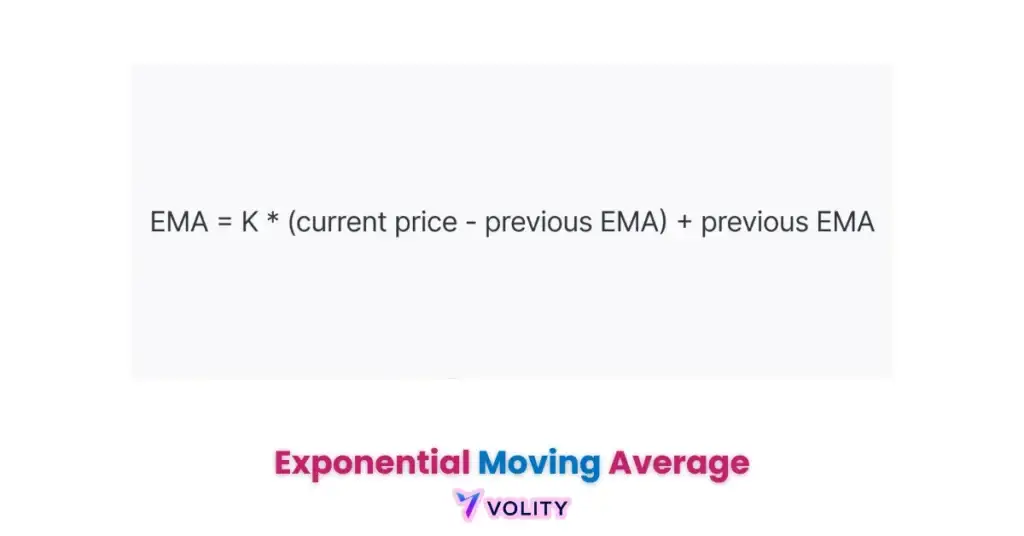
The EMA calculation begins with a simple moving average (SMA) for the first period, then applies a multiplier formula: EMA = Price × Multiplier + EMA(prior day) × (1 – Multiplier). The multiplier, calculated as 2 ÷ (Period + 1), determines how much weight recent prices receive.
A 10-period EMA applies a multiplier of 0.1818, since 2 divided by 11 is 0.1818, meaning the newest closing price receives about 18% of the weight and the previous EMA carries the other 82%. That smoothing factor is the standard definition, set out in the entry on the moving average. This recursive calculation creates the “exponential” nature, each new price point influences not just the current EMA but all future calculations, creating a true weighted average.
The practical result: EMA responds to price changes approximately twice as fast as a Simple Moving Average (SMA) of the same period.
The recursive weighting above is standard exponential smoothing, the same construction used well outside finance, and the reference entry on the moving average sets out both the simple and the exponential forms side by side.
Ready to Elevate Your Trading?
You have the information. Now, get the platform. Join thousands of successful traders who use Volity for its powerful tools, fast execution, and dedicated support.
Create Your Account in Under 3 MinutesEMA vs SMA: Why Traders Prefer Exponential Over Simple Averages
For the slower-but-cleaner alternative, see our deep dive on the simple moving average (SMA), same purpose, different responsiveness curve.
The distinction between EMA and SMA identifies a fundamental trade-off between responsiveness (EMA’s advantage) and stability (SMA’s advantage).
SMA treats all prices equally over the lookback period, creating a smoother line that resists false breakouts but lags price action. EMA weights recent prices more heavily, so it turns sooner. How much sooner depends entirely on the period and the size of the move, and no fixed number of bars applies across settings.
This speed advantage proves invaluable in intraday trading where quick exits prevent catastrophic drawdowns, a 50-pip adverse move that SMA fails to recognize becomes a critical exit signal on EMA before equity damage accumulates. The trade-off emerges in choppy markets: EMA’s responsiveness triggers whipsaws more frequently than SMA, generating false signals that cost capital.
Professional traders therefore use context-dependent selection: EMA for momentum entry timing, SMA for range-bound confirmation and mean-reversion targeting.
The reference entry on the moving average crossover documents how a fast and a slow average are combined, and why the crossover is a description of what has already happened rather than a forecast.
EMA Trading Strategies: Identifying Entries and Confirming Trends
EMAs pair well with the MACD indicator, which is itself built from two EMAs, confluence between price-cross and MACD-cross filters out most false signals.
EMA-based trading strategies operate through multiple methodologies: crossover trading, slope analysis, and confluence with support/resistance.
EMA Crossover Strategy executes buy orders when a fast EMA (9-period) crosses above a slow EMA (21-period), signalling a transition from downtrend to uptrend. No published win rate for that rule survives checking, and any figure quoted for it is really measuring the exit rule and the market period it was tested on.
Slope Analysis evaluates the angle of the EMA line: steep upward slope confirms strong bullish momentum while flattening slope signals trend exhaustion. Support and Resistance Confluence treats EMA as a dynamic support line in uptrends, price bouncing at the EMA provides high-probability entry opportunities.
Volume on an EMA bounce is worth checking because a bounce that happens on real participation is a different event from one that happens on none. No reliable figure exists for how much that improves outcomes, and none is claimed here.
Position sizing does more for an EMA system than parameter choice: the 1-2% risk rule below is what keeps a run of whipsaws survivable.
Optimal EMA Settings for Different Timeframes in 2026
EMA effectiveness depends critically on timeframe selection, identical EMA settings produce dramatically different results across 1-minute, 5-minute, hourly, and daily charts.
Scalping (1-5 minute charts) uses 5-9 period EMAs, responding to micro-movements and capturing intraday volatility spikes. Day Trading (15-minute to 1-hour charts) uses 10-21 period EMAs that filter noise while capturing 4-8 hour trend moves.
Swing Trading (4-hour to daily charts) uses 20-50 period EMAs identifying multi-day trend direction. The critical principle: EMA period should match your intended holding period, a 200-period EMA on a 1-minute chart serves no purpose because the trend it identifies plays out over days while your positions close within hours.
Settings misalignment represents the #1 reason traders fail with EMA systems.
Turn Knowledge into Profit
You have done the reading, now it is time to act. The best way to learn is by doing. Open a free, no-risk demo account and practice your strategy with virtual funds today.
Open a Free Demo AccountRisk Management Around EMA-Based Signals
Stop-loss placement and position sizing prove more important for EMA trading success than indicator optimization.
Stop-loss placement typically extends beyond the most recent swing low (uptrends) or swing high (downtrends), protecting against reversals that invalidate the EMA signal. The 1-2% risk rule limits losses to maximum 1-2% of account equity per trade, a framework where an EMA-based entry with a 50-pip stop on a $10,000 account risks only $100-$200. Risk-to-reward targets aim for 2:1 or 3:1 ratios where potential profit significantly exceeds potential loss. Drawdown management assumes losing streaks happen to every strategy, whatever its hit rate. Capping consecutive losses at three to five before reassessing market conditions is what prevents account depletion during whipsaw clusters.
Key Takeaways
- Exponential Moving Averages weight recent prices more heavily, responding to trend changes approximately twice as fast as Simple Moving Averages.
- EMA works as a regime filter and fails as a standalone trigger, because it is lagging by construction.
- The 9-period EMA on 5-minute charts is a common scalping choice for its responsiveness-to-noise balance, not a measured optimum.
- EMA effectiveness depends critically on timeframe alignment, EMA periods should match intended holding duration to filter appropriate noise levels.
- Stop-loss placement beyond swing extremes and the 1-2% risk rule provide the primary defense against EMA whipsaws and drawdowns.
- EMA trading success depends more on discipline and risk management than indicator optimization or parameter fine-tuning.
Frequently Asked Questions
What our analysts watch. EMAs are useful as filters, fragile as triggers. Three rules keep them honest.
First, use slope, not crossover. A 50-EMA whose slope flips from negative to positive after a flat zone is a more reliable signal than a 50/200 cross that prints inside a range.
Second, demand price-and-EMA confluence. Long-only above a rising 200-EMA, short-only below a falling 200-EMA.
Trades that fight both are statistical donations. Third, never optimise period values per asset.
The whole point of a simple filter is generalisability; tuned EMAs almost always reflect curve-fit rather than insight, and degrade live.
This article contains references to exponential moving averages, technical analysis, and Volity, a regulated CFD trading platform. This content is produced for educational purposes only and does not constitute financial advice. Always test strategies on demo accounts before deploying live capital. Some links may be affiliate links.
Volity operates a trading platform and also publishes educational and analytical content about trading. The content on this page is for educational purposes only and should not be considered financial advice. Volity may benefit commercially when readers open trading accounts through links on this site.
Our content is produced and reviewed under documented editorial standards; see our comparison and review methodology.