Most people pick a trading platform off a “best of 2026” list: they trust the headline and learn the truth after they have already paid. The fix is not another ranking – it is a method. This guide hands you a concrete 10-point checklist you can print and run against any platform, your shortlist or ours – so you judge what you trade, the true all-in cost, whether your money is safe, and how fast you can withdraw.
TL;DR / Quick insight: A trading platform is right for you only if it covers the markets you trade, shows the full cost (not just the headline spread), is run by a regulator you can verify, holds client money safely, and lets you withdraw quickly. Don’t trust a “best platform” badge – score each finalist out of 10 on the checklist below, test it on a free demo, then fund the highest verified score. Volity is the worked example because one account ticks every box.
Ranking lists tell you which platform someone else liked, but they go stale and never teach you how to judge one they did not cover. A checklist does. Each section ends with one action, building toward a printable list.
1. Start with what you actually want to trade
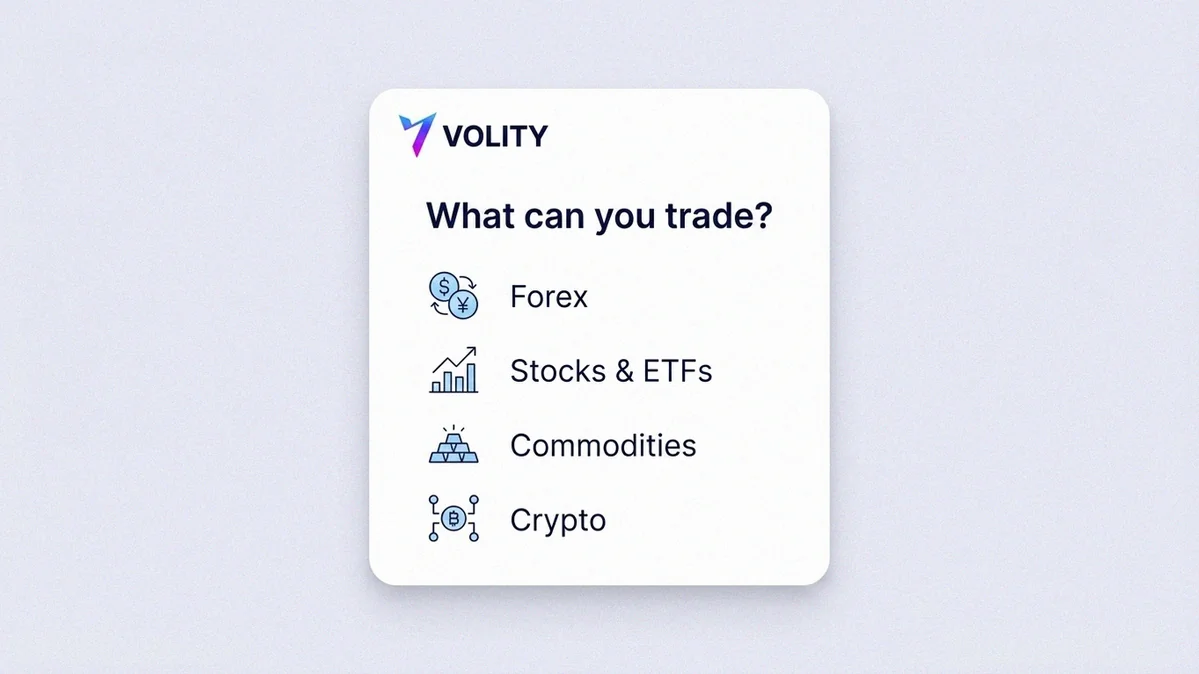
A platform is only “good” relative to your markets – some do only forex, some only stocks, some only crypto, a few do all of it in one login. Quick glossary, since the rest leans on it: a spread is the gap between the buy and sell price (how most platforms get paid even with “no commission”); a pip is the tiny unit a currency price moves in, so “from 0.6 pip” measures that gap; leverage controls a larger position with less money, magnifying gains and losses; a fractional share is a slice of one share ($20 of a $300 stock); a CFD tracks an asset’s price without owning it. The common mistake is picking a single-market platform, then juggling a second account later. Volity, for example, trades shares, fractional shares, crypto and CFDs from one account.
Action: write your one-line profile – “what I trade now and might trade in 12 months” – and keep it handy.
2. Work out the true cost, not just the spread
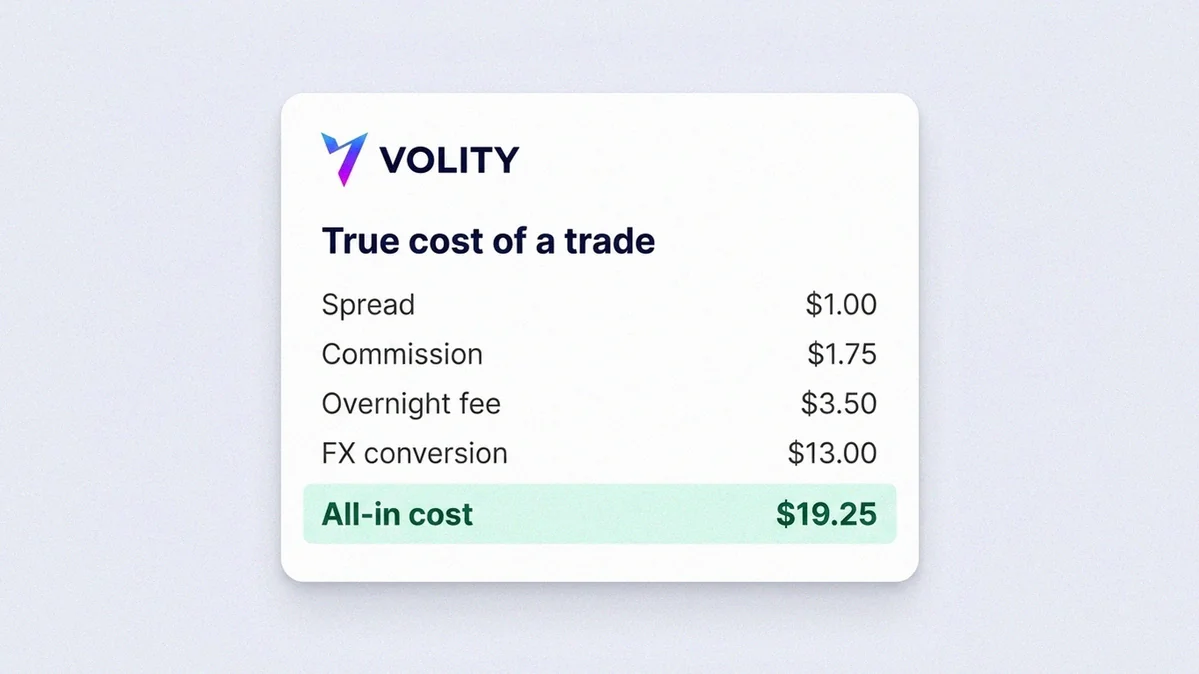
The headline spread is the bait. The real bill is a stack: spread plus commission plus overnight (swap) charges plus deposit, withdrawal and inactivity fees. A dynamic spread moves with the live market, tight when calm and wider during news; a fixed spread stays constant but is usually set wider; the overnight (swap) fee charges you to hold a leveraged position overnight. Judging on the spread alone is the mistake. Volity’s Markets account, for example, is commission-free with dynamic spreads from 0.6 pip on Standard and publishes its full fee schedule – the transparency to demand.
Action: add up the full cost stack for a typical month and compare that total, not the spread. You can SEE FEES AND ACCOUNT TYPES as a model of a transparent schedule.
3. Check regulation and the safety of your funds
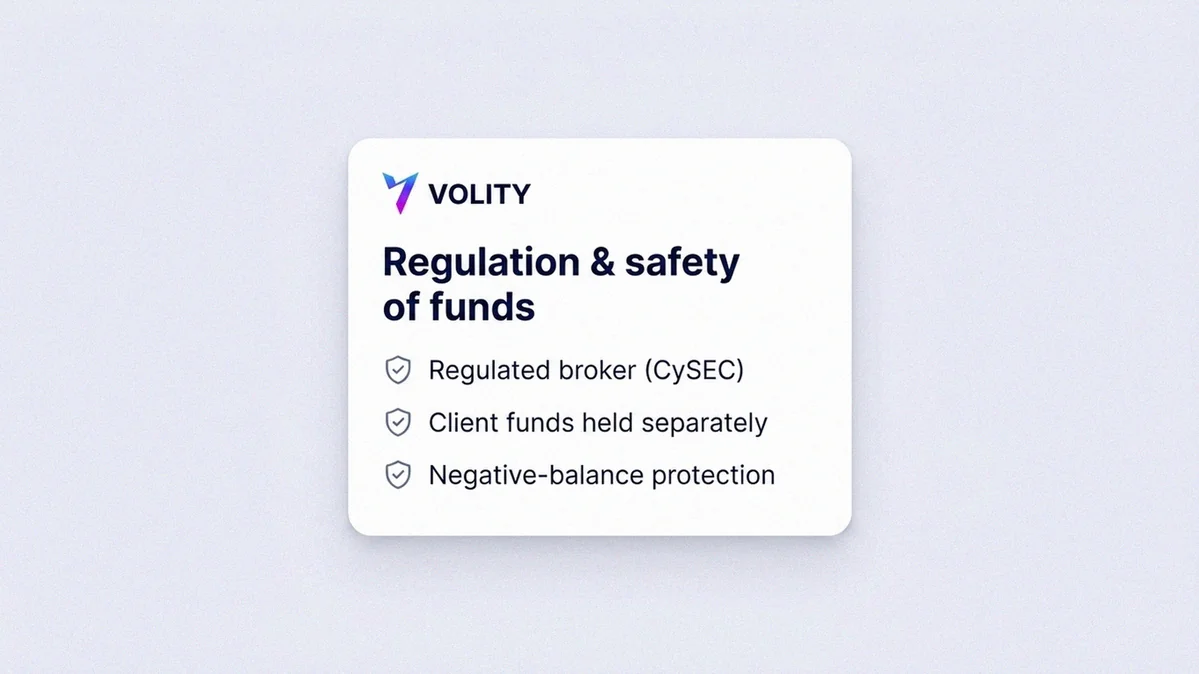
A “regulated” badge alone proves nothing. You need two answers: who regulates the platform, and how your money is held if the firm fails. Every serious platform names its licence and regulator on its own site – authorities like the FCA, ASIC, BaFin and CySEC are recognisable, but what matters is that the regulator is named and checkable. On the second, look for segregated client funds (your money sits separate from the company’s own cash) and negative balance protection (you cannot lose more than you put in). Volity, for example, holds a CySEC licence (number 186/12, via UBK Markets) alongside Saint Lucia and Cyprus entities.
Action: find the licence and regulator on the site, confirm how client money is held, and reject any platform you cannot verify.
4. Judge the platform, tools and ease of use
The interface is where you live, and it needs the basics: clean charts, the order types you use, price alerts, a watchlist, and a mobile app matching the desktop. The mistake is shortlisting on looks: a platform can be beautiful and still miss the one order type your strategy needs. Volity, as the example, runs on the “Volity MT” platform (a professional white-label trading system) plus TradingView for charting, with copy trading and signals. Our trader hub helps.
Action: list the three tools you will actually use – say a watchlist, alerts and a specific order type – and confirm each exists before you shortlist a platform.
5. Check funding, withdrawals and test on a free demo
Getting money in is always easy; getting it out quickly, cheaply, and by your preferred method is the real test, so check which methods are supported, what each costs, and how fast withdrawals clear – “instant deposit, slow withdrawal” is a classic trap. Then prove the platform with a free demo – a practice account of virtual money where you trade at zero risk – on the mobile app during a busy session, and message support once. Volity, for example, withdraws 24/7 generally within 4 hours and has a free demo on every tier. Never fund one you have not driven.
Action: confirm your withdrawal method and its speed, then open a free demo, trade during a busy session, and message support before funding. You can TRY A FREE DEMO ACCOUNT to see how the test feels.
6. The 10-point checklist to compare any platform
Print this list and score each platform yes or no on every point. Ten clear yeses is a platform worth funding; a few nos tells you to keep looking.
- Does it cover what I trade – forex, stocks, fractional shares, crypto, CFDs – ideally in one account?
- Is trading commission-free, or are commissions clearly disclosed?
- Are spreads transparent, with the dynamic-or-fixed type and the “from” figure stated?
- Is the full cost stack (overnight, funding, inactivity) low and published?
- Is it regulated by an authority I can verify, with the licence number shown?
- Are client funds segregated, with negative balance protection where offered?
- Is the toolset usable for my level – order types, charts and a full mobile app?
- Are deposits and withdrawals fast, low-cost and on my preferred method?
- Is there a free demo to test before I fund anything?
- Is support responsive and the mobile app fully featured?
Action: score each finalist out of 10 and pick the highest verified score – checked yourself, not the loudest ad.
7. A worked example: how one account ticks the boxes
The checklist applied to one multi-asset account – a clean scorecard to model yours on.
| Checklist point | What to look for | Volity as the worked example |
|---|---|---|
| Markets covered | One account, many assets | Forex, real and fractional shares, crypto and CFDs in one login |
| Commission | Free or disclosed | Commission-free on the Markets account |
| Spreads | Type and “from” figure published | Dynamic from 0.6 pip on Standard, tighter on PRO and VIP |
| Funding | Fast, low-cost withdrawals | 24/7, generally within 4 hours; EUR 10 minimum; card and crypto free |
| Regulation | Named, verifiable licence | CySEC 186/12 via UBK Markets, plus Saint Lucia, Cyprus, Hong Kong |
| Free demo | Test before funding | Free demo on every account tier |
The verdict for you: Beginners should run this checklist against a free demo first; active and high-volume traders should weight the cost stack and withdrawal speed most, since they compound across many trades. Either way, one account across several markets saves juggling logins.
What to do next
You now have a method that outlasts any “best of” list: profile what you trade, shortlist a few platforms, total each cost stack, verify each licence, then demo and score the finalists. For an account built to pass this checklist, see the Volity trading platforms hub or OPEN A VOLITY ACCOUNT once a platform clears all 10 points.
Reviewed by: A. Bennett, Volity editorial desk.
Data accuracy: the worked-example figures are verified against Volity’s published account and fee documentation as of June 2026. The checklist is platform-neutral and applies to any provider.
Related Volity guides
- How to read a forex spread and the true cost
- Market order vs limit order
- Demo vs live trading account
Related coverage on Volity
- Demo vs Live Trading Account: A 7-Step Checklist Before You Go Live
- How to Read a Forex Spread: Bid, Ask, Pips and Cost
- Market Order vs Limit Order: Which to Use and When
- Low Spread Forex Broker: How to Read Real Spreads
- Best Forex Exchange Trading Platform 2026
One item worth adding to any platform checklist is what happens when you want a venue the platform does not run itself. Our guide to connecting external trading platforms to your wallet covers what that link actually does, where the balance is held afterwards and what to confirm before you fund anything.
Frequently asked questions
What should I look for in a trading platform?
Five things: that it covers the markets you trade, that its full cost is low and published, that it is regulated by an authority you can verify, that client funds are held safely, and that you can withdraw quickly. The checklist above scores each.
How do I know a trading platform is safe?
Two checks. Find the licence number and regulator named on the site and confirm the authority is one you can look up. Then confirm how your money is held – look for “segregated client funds” and “negative balance protection” (you cannot lose more than you deposit). If you cannot verify in a couple of minutes, that is a red flag.
What fees matter most when choosing a platform?
The ones beyond the headline spread: any commission, overnight (swap) charges, deposit and withdrawal fees, and inactivity fees. Add up a full typical month and compare that total. A platform publishing its whole fee schedule, like Volity, is easier to trust than one advertising a tight spread.
Can one platform do stocks, crypto and forex together?
Yes, and a multi-asset account is usually smarter because it avoids splitting your money across several logins. Volity, for instance, trades shares, fractional shares, crypto and CFDs from one account with a $0 wallet. Apply the same checklist to any all-in-one platform first.
Should I use a demo account before funding a real one?
Always. A free demo is a practice account with virtual money that mirrors the live platform, so you can test the charts, order types, mobile app and support at zero risk. Trade during a busy session, when weaknesses show. Volity has one on every tier.
Sources
This guide draws on the following public sources.
- European Commission – Single Euro Payments Area rules for euro transfers
- BIS – CPMI on correspondent banking and cross-border cost
- FCA – How to check a firm's authorisation on the FCA register
- CySEC – CySEC public register of Cyprus investment firms
- ESMA – ESMA register of EU investment firms and passporting
- European Commission – EU payment services rules including SEPA and transparency
- European Central Bank – ECB on SEPA and euro retail payments integration
- Bank for International Settlements – CPMI report on cross-border payment costs
- FCA – FCA guidance on avoiding investment scams and clone firms