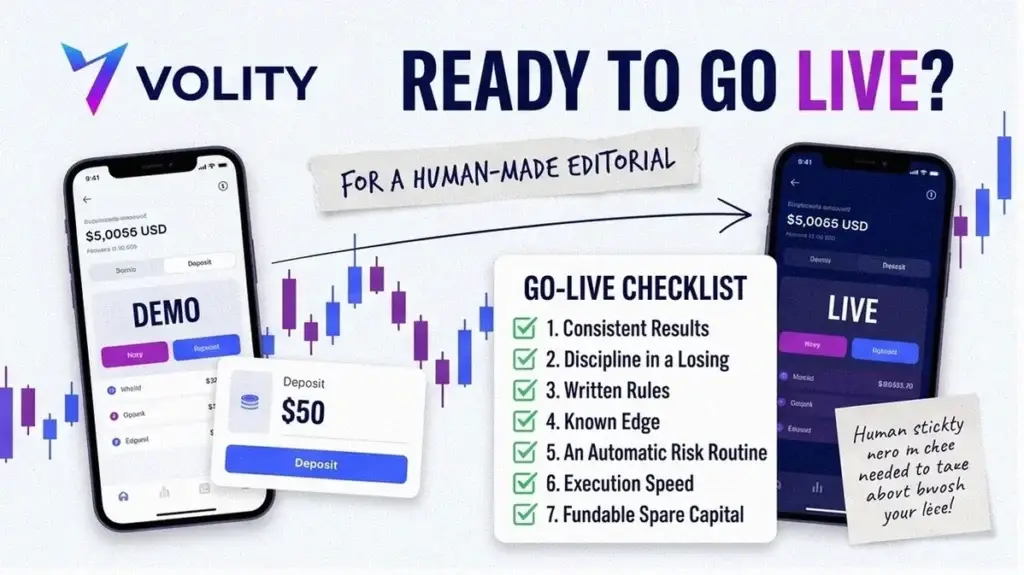
You ran a great month on a demo account, so why does the first real trade feel like a different sport? Because it is. A demo teaches your strategy; a live account tests your nerve, and most of the gap is in your head and in the real costs a practice account quietly hides. This guide hands you a 7-step go-live checklist to tick before you click “go live,” plus a settings list to copy across.
TL;DR / Quick insight: A demo vs live trading account differ in three things that matter: real money brings real emotion, live spreads move while demo spreads sit still, and live orders meet real liquidity. You are ready to go live when you are consistent across a meaningful run of demo trades including a losing streak, not after a fixed number of weeks. Copy your demo settings to live, start at the smallest size, and fund only what you would be calm losing. Volity gives you a free demo on every account tier, so you practise and go live on one login and the same Volity MT platform.
Most articles on this topic are long essays; this one is a do-this-now checklist, with every term in plain English.
1. See what actually changes between demo and live
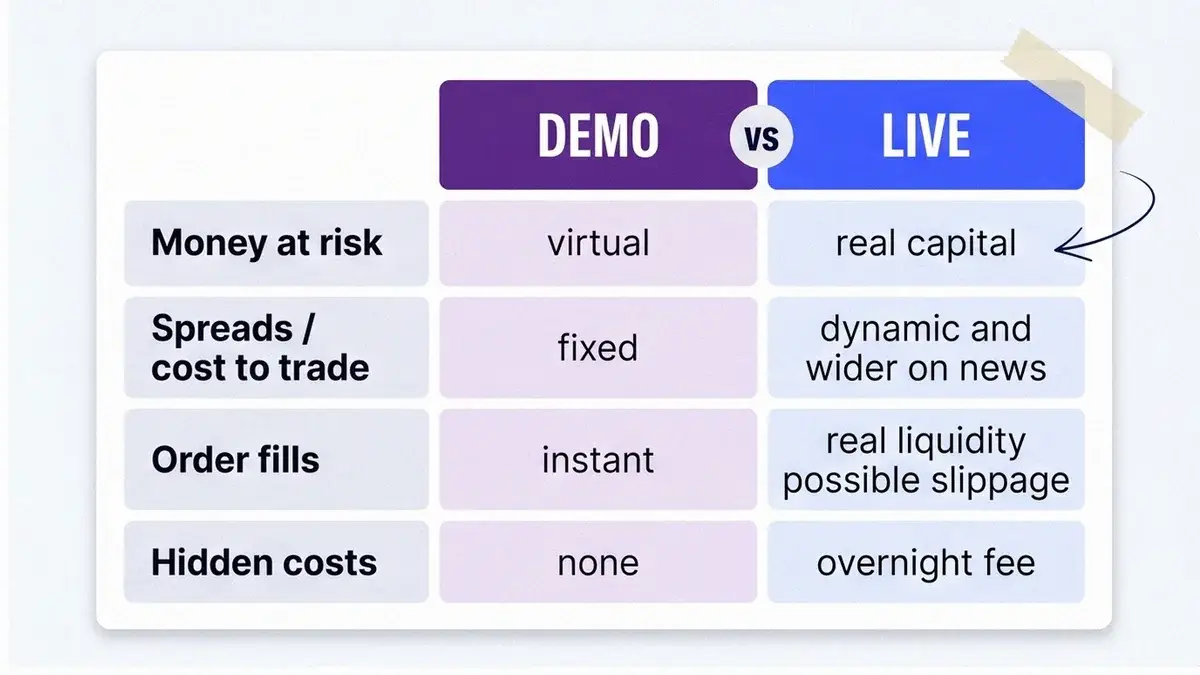
A demo account is a practice account: it runs on real, live prices but uses pretend money, so you learn the platform without risking a cent. A live account uses your real money; the strategy is identical. Three things change: emotion, spreads (the gap between buy and sell price – the cost to trade – is fixed and tiny on demo but turns dynamic and widens on news when live), and execution (“slippage,” a worse fill when fast markets meet real liquidity).
| What changes | Demo account | Live account |
|---|---|---|
| Money at risk | Virtual – zero real loss | Your real capital, and real emotion |
| Spreads (cost to trade) | Often shown fixed and idealised | Dynamic; on Volity, Standard from 0.6 pip, wider when volatile |
| Order fills | Instant, at the displayed price | Real liquidity; possible slippage in fast markets |
| Hidden costs | May ignore overnight fees | Overnight/rollover fee can apply past 22:00 GMT |
Do this: open a free demo and place a few trades today for a baseline. Do not treat a flawless demo week as proof; one good week is luck.
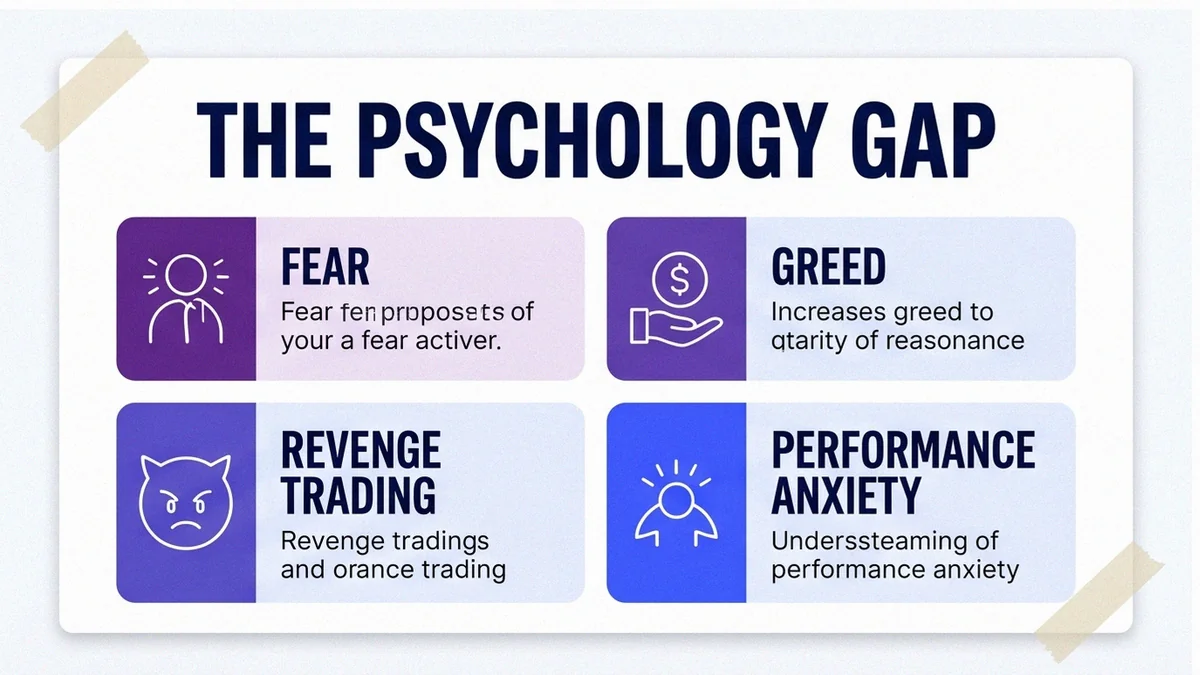
2. Understand the psychology gap (normal, not a flaw)
Every trader who has gone live has felt this, so treat it as a stage to pass through, not a personal failing or a broker problem. The four usual suspects are fear (closing a winner too early), greed (oversizing after a couple of wins), revenge trading (forcing a trade after a loss to win it back), and performance anxiety (freezing on a setup you would take instantly on demo). Name the feeling and you can stop and follow your rule.
Do this: before going live, write down how you reacted to your worst demo drawdown (“drawdown” means a stretch where your account drops from its peak) – that is your emotional baseline. Do not assume you will be calmer with real money than fake money; almost nobody is. Copy trading and signals are available on Volity as a lower-pressure way to stay engaged.
3. Score yourself against seven signs you are ready
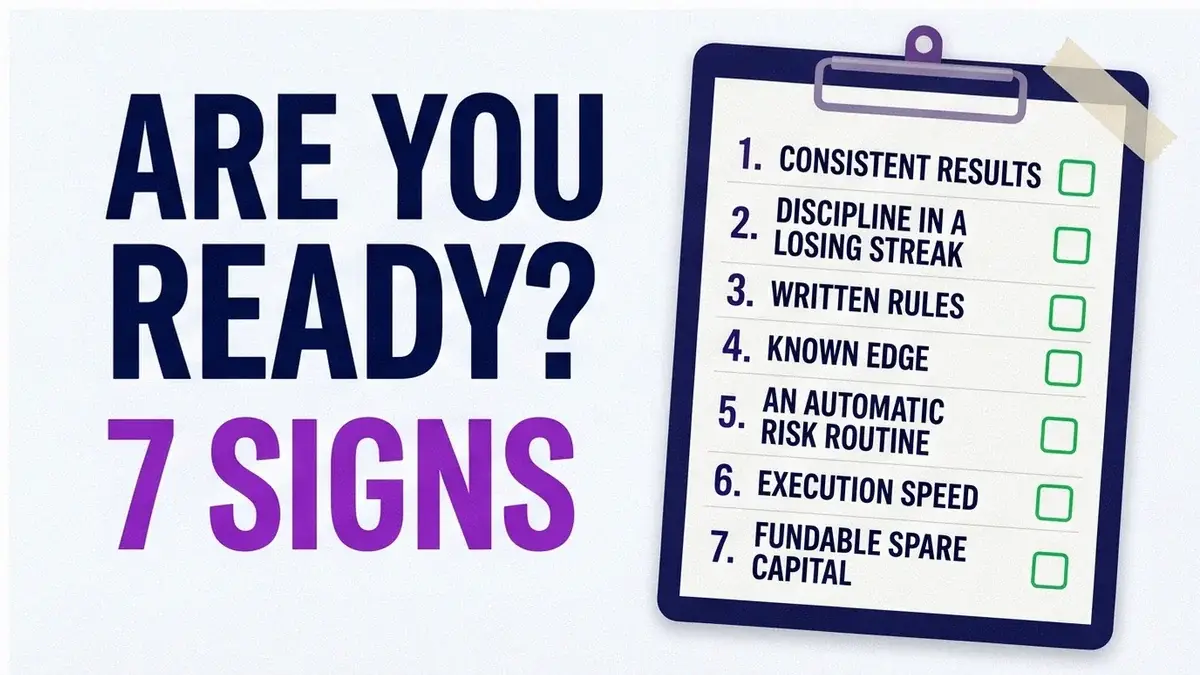
Readiness is not a feeling; it is a set of things you can check. The seven objective signs cover your results, discipline under a losing streak, written rules, known edge, risk routine, execution speed, and fundable spare capital – the exact box version is step 7.
Do this: score yourself honestly against all seven; the Volity trader education hub covers journaling, win rate and risk routines. Do not go live if you cannot claim every one – stay on the free demo and re-test next month.
4. Set your go-live trigger by consistency, not the calendar
“How long should I practise on a demo?” is the most-asked question, and the honest answer frustrates people: there is no fixed date. Rules of thumb (a few months, a set number of trades) are hints, not laws. The real trigger is documented consistency over a meaningful sample, including a losing streak you handled by the book; anyone looks disciplined while winning.
Do this: keep a trade journal and set your trigger as “consistent across a meaningful run including a losing streak,” not a number of weeks. Do not go live just because a date arrived.
5. Size your first live deposit so a total loss would not hurt
The first deposit is a psychology decision before a money decision. Pick a number you would be calm losing in full – the brain only believes risk is real once the money is – and start smaller than feels exciting. Watch leverage too: it multiplies gains and losses alike. Volity offers up to 1:500 on PRO and VIP and 1:50 on crypto, but “available” is not “use it all,” and the sizing math lives in the trader hub.
Verdict: For a first live step, the Volity Markets account opens from a $1 minimum and is commission-free, so you can go live with a small, controlled amount at the smallest size. If you mainly trade currencies, the Volity forex hub covers spreads and pips before you size up.
Do this: fund the Markets account from its $1 minimum, trade at the smallest size, and confirm every cost on the SEE FEES AND ACCOUNT TYPES page. Do not deposit money you need for rent, debt or savings.
6. Match your demo and live settings so nothing surprises you
The cleanest way to shrink the demo-to-live gap is to change one variable only: the money. Volity runs the same Volity MT platform for demo and live, so mirroring your setup is easy. Match these six:
- Same instrument – the pair, share or asset you practised, not a new “hot” market.
- Same position size – the lot or unit size you used on demo, not a bigger one now it is “real.”
- Same stop and take-profit rules – identical exit logic; do not widen stops to avoid being stopped out.
- Same session and time – your usual hours have their own volatility.
- Same leverage assumption – so your risk per trade stays as modelled.
- Account for hidden costs – the overnight/rollover fee past 22:00 GMT, unless on an Islamic swap-free account.
Do this: copy your demo setup onto live and change nothing except that the money is real. Do not “upgrade” your strategy as you go live; new settings plus new emotions blow up good demo traders.
7. Tick the 7-box go-live checklist before your first real trade
The spine of the guide: seven yes/no boxes. Every “yes” means you are ready; one “no” is your homework on the demo.
- I am consistent and profitable across a meaningful run of demo trades, documented in a journal – not a lucky week.
- I have lived through a demo drawdown and followed my rules instead of revenge trading.
- I trade from written entry, exit, stop and sizing rules, and follow them without deviation.
- I know my approximate win rate and whether my strategy has a positive edge.
- My risk routine is automatic: a stop on every trade and a known max loss before I enter.
- I expect live results below demo, and I am prepared for that.
- I can fund with money I can afford to lose entirely, at the smallest size.
Do this: when all seven boxes are ticked, OPEN A VOLITY ACCOUNT, fund the smallest sensible amount, mirror your demo settings, and place one trade by your rules. Do not place a second trade to “make up” for a bad one.
What to do next
- TRY A FREE DEMO, place baseline trades, and journal each one until you are consistent across a run that includes a losing streak.
- Score yourself against the seven signs, mirror your demo settings, then place one trade.
The free demo and live trading share one Volity login, so the only thing that changes on the big day is that the result is real. When you are ready, OPEN A VOLITY ACCOUNT and run both from one account that also holds shares and crypto.
Reviewed by: A. Bennett, Volity editorial desk.
Data integrity: all product figures (free demo on every tier, Markets $1 minimum, commission-free, Standard spreads from 0.6 pip, leverage up to 1:500 / crypto 1:50) are verified against the Volity fee schedule, current as of June 2026. No practice-duration, demo-to-live degradation or loss statistics are stated, as those are not part of Volity’s verified data.
Related coverage on Volity
- Market Order vs Limit Order: Which to Use and When
- How to Read a Forex Spread: Bid, Ask, Pips and Cost
- How to Avoid Common Stock Trading Mistakes
- How to Start Stock Trading: A 2026 Beginner Guide
- Forex Risk Management: A Position-Sizing Framework for Pairs
Frequently asked questions
How long should I use a demo account before going live?
There is no fixed number of weeks. Stay on the free demo until you are consistently profitable across a meaningful run of trades that includes a losing streak you handled by your rules – judge readiness by documented consistency, not by a date.
Why is live trading harder than demo?
Real money adds emotion – fear, greed and the urge to chase losses – that a practice account never triggers. It also carries real costs a demo can hide: dynamic spreads that widen on news, possible slippage, and overnight fees. Expect live results below demo, and plan for that.
How much money should I start live trading with?
An amount you would be calm losing in full, and smaller than feels exciting. The Volity Markets account opens from a $1 minimum and is commission-free, so you can go live with a small, real amount – never money you need for rent, debt or savings.
Does Volity have a free demo account?
Yes. A free demo account is available on every Volity account tier – Markets, PRO and VIP – on the same Volity MT platform you will trade live. You practise risk-free, then switch to live from the same login, with only the money changed.
Can I switch from demo to live without changing platforms?
On Volity, yes. The free demo and the live account use the same Volity MT platform and the same login, so you do not relearn anything. Mirror your demo settings – instrument, size, stops, session and leverage – and the only difference is real money.
Sources
This guide draws on the following public sources.
- Bank for International Settlements – BIS working paper on retail trading behaviour
- ESMA – ESMA warning on speculative retail trading risk
- CFA Institute – CFA Institute Research Foundation on investor behaviour
- Bank of England – Bank of England explainers on markets and risk
- IOSCO – IOSCO report on retail market conduct and online marketing
- Nobel Prize – Thaler's Nobel work on behavioural economics
- Bank of England – Bank of England explainer on interest rates and risk
- IOSCO – IOSCO on retail distribution and digital engagement practices
- Nobel Prize – Kahneman's Nobel work on judgement under uncertainty