Investing in financial products involves risk. Losses may exceed the value of your original investment.
Quick answer
To start stock trading: open an account with a regulated broker (CySEC, FCA, FINRA), submit KYC, fund with $100 to $500 minimum, and start with broad index ETFs (SPY, QQQ) before picking individual names, and see our worked example on how to buy Nike stock. Define risk per trade at 1% of equity, study quarterly earnings of any company you hold, and track total return (price + dividends) not just price gains.
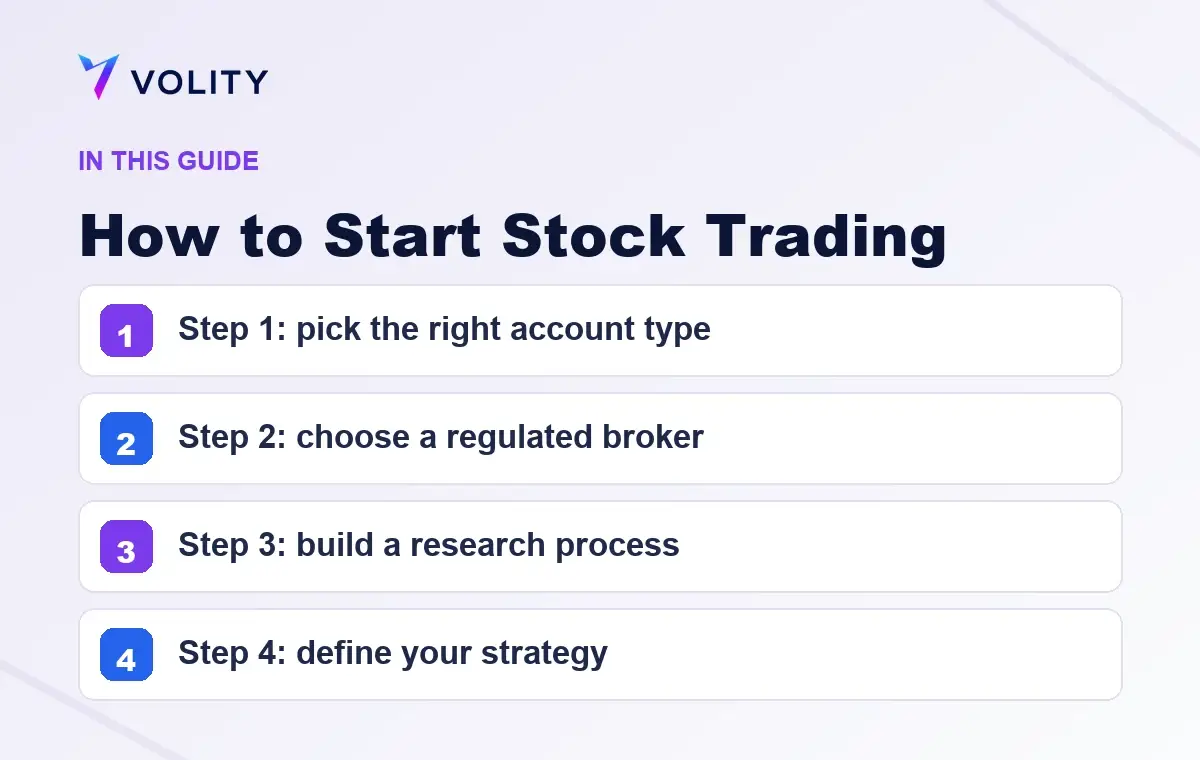
Stock trading in 2026 is more accessible than ever and more crowded than ever. Zero-commission brokers, fractional shares, and 24/5 access have stripped the friction; the same forces have turned the retail flow into measurable order-flow data that institutional desks now front-run. The good news: the structural retail edges (long horizon, no career risk, ability to hold through drawdown) still work. The bad news: the day-trading edge has compressed. Here is the honest beginner guide.
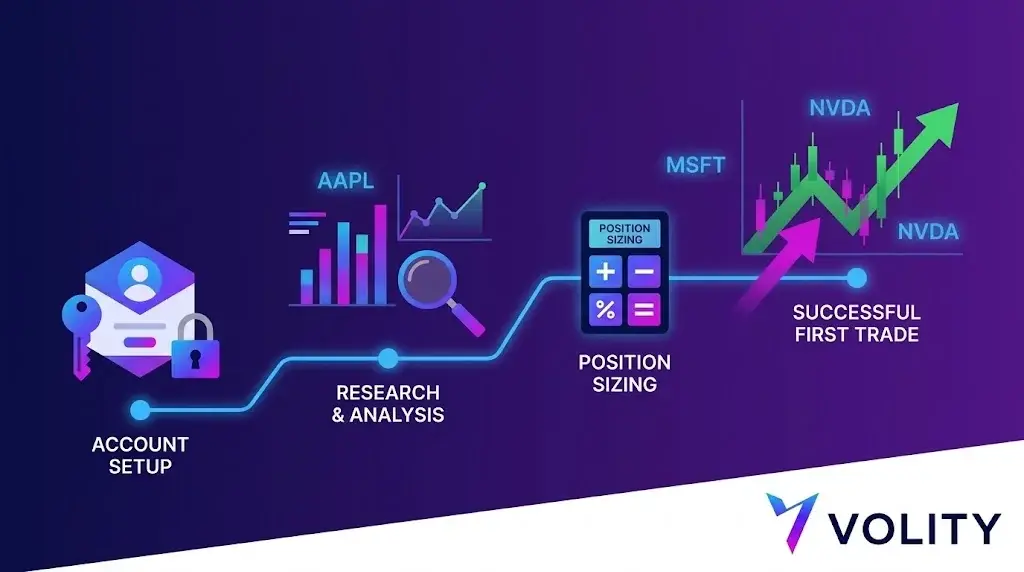
Step 1: pick the right account type
Three primary access paths for European retail in 2026:
- Cash equity account: you own the shares outright, with full voting rights and dividend access. Best for long-horizon investing.
- CFD on equity: you trade the price difference, no ownership of the underlying share. Best for short-horizon trading, short-side flexibility, and capital efficiency.
- ETF / mutual fund: pooled exposure. Not stock trading per se, but the right starting point for most beginners with a 5+ year horizon.
For active stock trading specifically, CFD-on-equity is structurally efficient: one account, leverage capped at 1:5 retail under ESMA, short-side and long-side with the same workflow, no share-borrow friction. For a single-stock walkthrough, see how to buy Rolls-Royce shares.
Step 2: choose a regulated broker
Three minimum criteria:
- EU regulator with public register: CySEC, BaFin, AMF, AFM. Volity’s trading is by UBK Markets Ltd, CySEC 186/12.
- Investor compensation: Cyprus ICF up to EUR 20,000 per client per firm in the event of broker insolvency.
- Negative balance protection: ESMA-mandated for retail clients.
Step 3: build a research process
The single biggest mistake new traders make is trading without a research process. Three sources should anchor your work:
- SEC filings (US): 10-K (annual), 10-Q (quarterly), 8-K (material events). Free on EDGAR. The 10-K is the single most valuable document on any US listed company; budget 90 minutes to read one for a stock you intend to trade.
- Earnings calls and transcripts: management’s framing of the quarter. The Q&A section often reveals more than the prepared remarks. Free transcripts on Seeking Alpha, Bamsec, Tikr.
- Macro context: Federal Reserve rate decisions, earnings season calendar, sector rotation. The Fed’s H.15 release and FOMC statements move equity indices.
Skip the social media hot takes for the first six months. The signal-to-noise ratio is brutal.
Step 4: define your strategy
Pick one approach for the first 100 trades. Not three. One. Three valid retail starting points:
- Buy-and-hold of broad-market ETFs (S&P 500, MSCI World): the strategy with the strongest 100-year track record. Not exciting; pays.
- Earnings-momentum swing trading: take positions on stocks beating or missing on earnings, hold 3-15 days. Setup is well-documented; works when news is well-priced.
- Sector-rotation swing: rotate between sector ETFs (XLK, XLE, XLF, XLV) based on macro regime. Slower but cleaner setups.
Avoid intraday scalping for the first year. The data on retail intraday equity scalping is grim.
Step 5: position sizing
The rule that separates surviving accounts from blown ones: risk no more than 1% of account equity per trade.
Calculation: account $10,000, 1% risk = $100. AAPL entry $190, stop $185 (5-point risk). Position size = $100 / $5 = 20 shares. Notional $3,800. At 1:5 retail equity leverage that is $760 of margin. Plenty of room for the next trade.
This rule does the hard work for you: it removes emotional sizing and caps the damage from any single trade.
Step 6: paper-trade for two weeks
Open a demo account on the platform you will trade live. Run 20-30 paper trades over 2-3 weeks. Track each: setup, entry, stop, target, position size, R-multiple at exit. By trade 30, you will have a clear read on whether your strategy fits the current market regime.
Step 7: go live at quarter size
First live capital is 25% of your intended account, 0.5% risk per trade. The first 20 live trades are about verifying execution and managing the emotional load. The setups you took on demo will feel different live; that is expected.
Step 8: review and scale
Sunday evening journal review, weekly. After 50 live trades with positive expectancy, scale to full size and 1% risk. If expectancy is flat or negative, stay at quarter size while you isolate the issue.
The macro context every beginner should track
- Federal Reserve calendar: 8 FOMC decisions per year. Equity indices typically compress 2-3 days before, expand 30-90 minutes after.
- Earnings season: 4 quarters, roughly January, April, July, October. Single-stock setups dominate during earnings.
- US CPI: monthly, biggest macro mover for equities since 2022.
- Sector index performance: which sectors are leading, which are lagging. The relative-strength view sets up most directional swings.
What to avoid in the first year
- Penny stocks and microcaps: information asymmetry is brutal. Wait until you can read a balance sheet without help.
- Options as your first instrument: option pricing has more moving parts than equity pricing; learn the underlying first.
- Maximum leverage: ESMA caps retail equity CFDs at 1:5. Use 30-50% of the cap, not 100%.
- Holding through earnings without a plan: gap risk is real. Either close before the print or size for the gap.
Stock trading at Volity
Volity offers CFD exposure to global equities including S&P 500, NASDAQ, FTSE, DAX components, and major individual stocks, on Volity MT. Retail leverage on individual equities is capped at 1:5 under ESMA, 1:20 on major indices. Negative balance protection applies. Trading is executed by UBK Markets Ltd (CySEC 186/12).
Common questions
How much money do I need to start stock trading?
$1 opens a Volity Markets account, enough to size on index CFDs without material risk. A working live account that can express single-name views with proper sizing wants $1,000 to $2,500. Spot share ownership through a traditional broker has different minimums; some platforms offer fractional shares from $1 but typical workable balances start at $500.
Can I trade US stocks from Europe?
Yes. Volity offers CFDs on US, EU, and APAC blue-chips through a single regulated account. If you are weighing a specific blue-chip, our guide on how to buy Visa stock walks through the shares-versus-CFD choice. Trading hours follow the underlying exchange (US cash equity runs 14:30 to 21:00 UTC during summer time). Index CFDs trade longer than the underlying cash market thanks to the futures wrap. EU MiFID II rules govern your reporting and tax obligations.
What is the difference between stock trading and stock investing?
Investing typically holds for years to capture earnings growth and dividends; trading takes shorter horizons to capture price moves around catalysts. Both are legitimate; both require different skill sets and time commitments. The Volity CFD platform is built for active trading; for buy-and-hold ownership use a spot broker with custodial accounts. For a worked example on one company, see our guide on how to buy Tesla stock, or how to buy Alibaba stock for a Chinese ADR example. For a UK pharmaceutical blue-chip, see how to buy AstraZeneca shares.
Volity operates a trading platform and also publishes educational and analytical content about trading. The content on this page is for educational purposes only and should not be considered financial advice. Volity may benefit commercially when readers open trading accounts through links on this site.
Our content is produced and reviewed under documented editorial standards; see our comparison and review methodology.