You have probably heard the phrase without anyone explaining it. So, what is a brokerage account? In plain terms, it is the account that lets you buy and sell investments like shares, funds and crypto, then hold them until you sell. This guide covers what it is, how money flows through it, how your assets are kept safe, and how to open one.
TL;DR / Quick insight: A brokerage account is an investment account you fund with cash, then use to buy and hold assets like shares, fractional shares, crypto and funds. Money moves in by deposit, sits in a wallet until you trade, and moves out when you withdraw. The broker holds the assets for you, usually under regulation and with client money kept separate from the firm’s own. With Volity, one account holds real shares, fractional shares, crypto and CFDs, plus a $0 multi-currency wallet.
Nothing here is personal advice – investing carries risk, and prices can fall as well as rise.
A brokerage account in one sentence
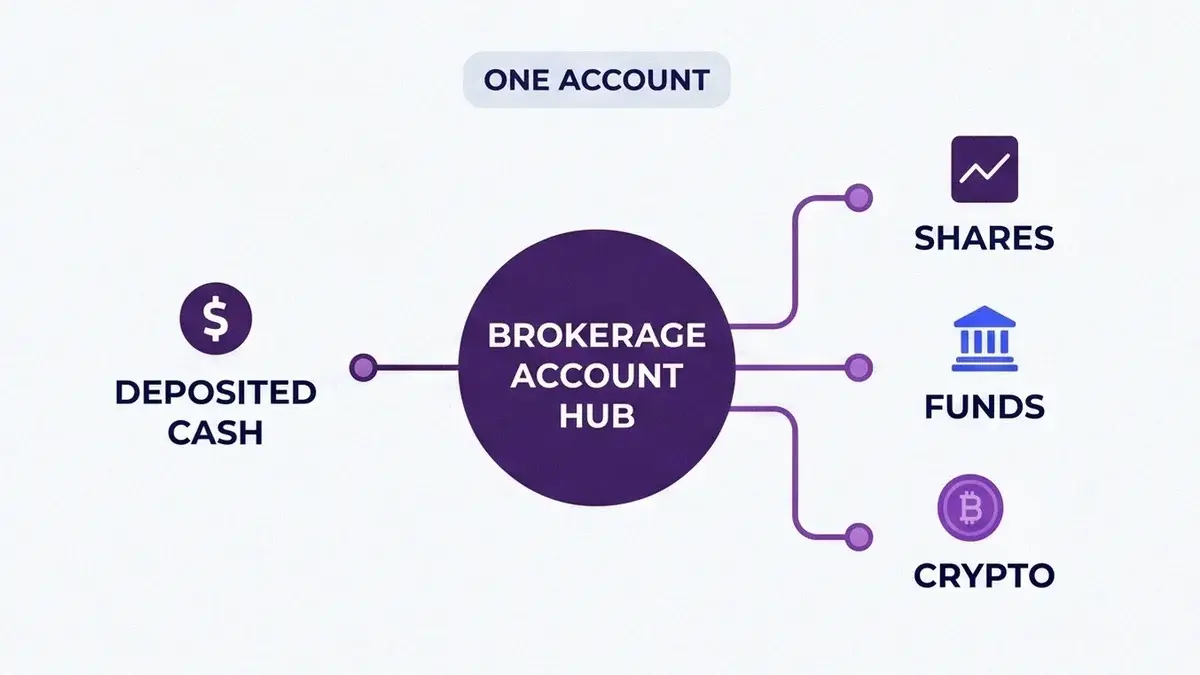
A brokerage account lets you buy investments, then holds them in one place. That is the whole idea.
Unlike a savings account, where money mostly sits and earns interest, a brokerage account is built for action. You put cash in, turn it into assets when you choose, and the account keeps a record of what you own. The broker is the firm that runs the account and routes your orders to the market.
On Volity that account is multi-asset, so real shares, fractional shares, crypto and CFDs all live under one login. A CFD, or contract for difference, tracks a price without you owning the underlying asset.
What it lets you hold and trade
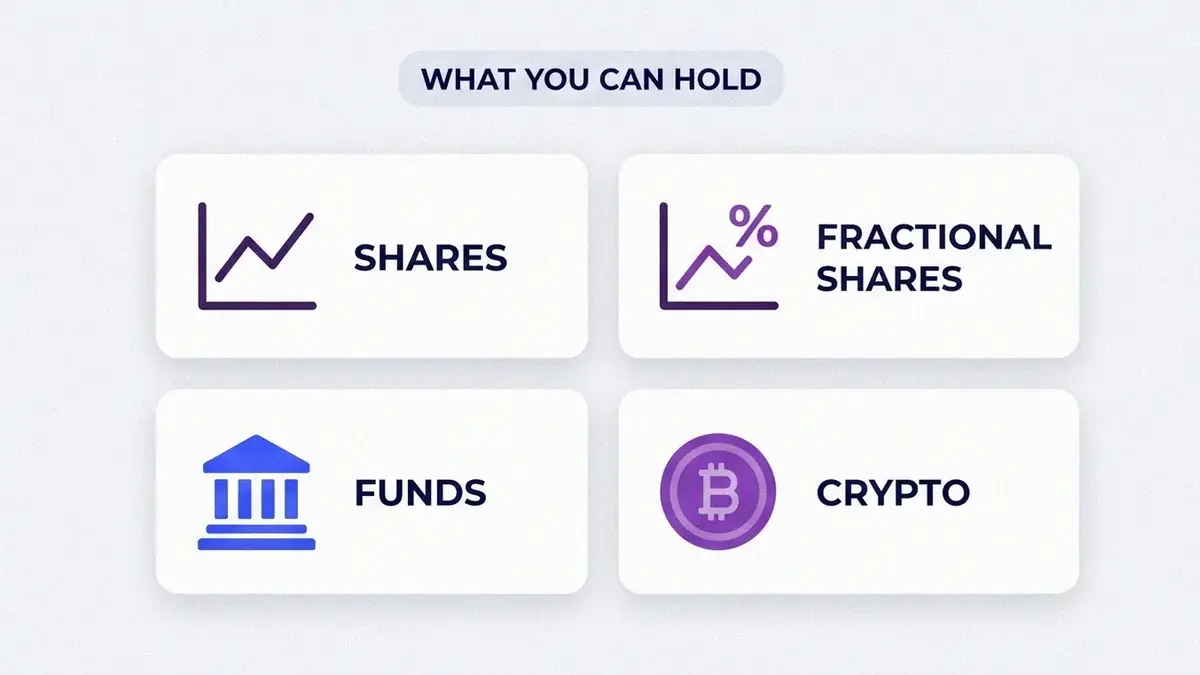
The point of the account is choice. Once funded, you decide what to hold, and a good account gives a wide menu in one login.
Most brokerage accounts let you buy whole shares, or fractional shares when a single share costs more than you want to commit. You can hold funds that spread your money across many companies at once, or take a position in crypto. On Volity you can also trade CFDs.
The Volity MT platform has TradingView charts built in, so you research, place orders and track positions in one window. The $0 multi-currency wallet sits alongside, holding cash in several currencies with yield, FX and IBAN features. For the full menu by market, the trading platforms hub lays it out.
Decide what you want to hold first, then check the account covers it.
How money moves in and out
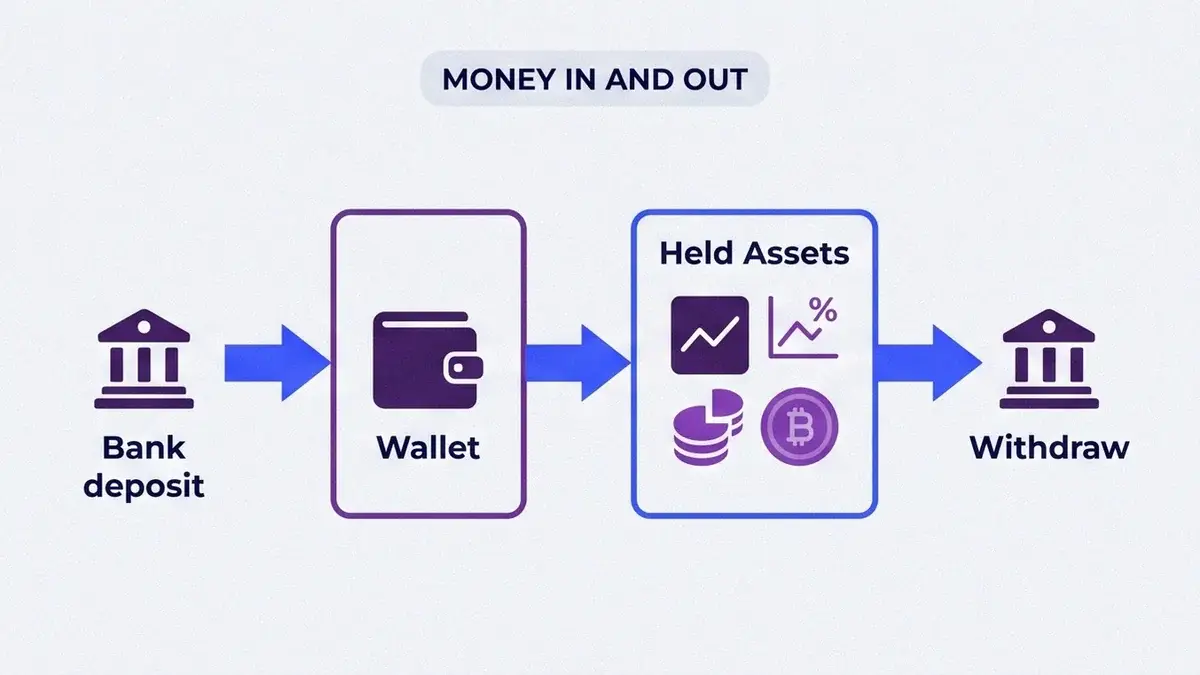
Money in a brokerage account moves through three simple stages. First you deposit, sending cash from your bank or card into the account’s wallet, where it waits. Then you trade, turning some of that cash into assets when you place an order. Finally you withdraw, selling assets back to cash and sending it to your bank. The wallet is the holding bay between your bank and your investments.
| Stage | What happens | On Volity |
|---|---|---|
| Deposit | Cash enters the wallet, ready to invest. | Minimum EUR 10, available 24/7; free and instant via BTC, ETH, USDT, VISA or Mastercard. |
| Trade | Cash becomes assets when you place an order. | Markets trading is commission-free; one account for shares, crypto and CFDs. |
| Withdraw | Assets are sold back to cash and sent out. | Minimum EUR 10; withdrawals generally process within 4 hours. |
Costs matter at the edges. Volity keeps FX, custody, account opening, closure, statements and KYC free, so friction usually sits in the spread on a trade rather than in moving your money.
How your assets are held and protected
This is the part people worry about most. When the broker holds your assets, what keeps them safe?
Two general principles do most of the work across the regulated industry. The first is regulation: a licensed broker operates under rules set by a financial authority that govern how it handles client money and assets. The second is segregation, where client funds are kept separate from the firm’s own operating money. These are industry concepts, not a guarantee against investment loss, and the specifics vary by firm and jurisdiction.
Volity operates under public regulation that includes CySEC licence 186/12, held via UBK Markets, alongside entities in Saint Lucia and Cyprus. Regulation covers how the firm operates; it does not stop a holding from falling in value. Your shares can still drop and your crypto can still swing. The framework addresses the safety of the structure around your assets, not how the assets themselves perform.
Read a broker’s terms for the exact custody and protection arrangements, because they differ between firms. Treat any vague promise of “guaranteed” returns as a warning sign.
What to check before you open one
Not every account suits every person, so a short check before you sign up saves regret.
- Assets covered. Confirm it holds what you want, whether shares, fractional shares, funds, crypto or CFDs.
- Costs. Look at commissions, spreads, FX charges and custody fees. On Volity, Markets trading is commission-free, with FX and custody free.
- Minimums. Volity sets both the minimum deposit and minimum withdrawal at EUR 10, which keeps the entry low.
- Deposit and withdrawal routes. Volity deposits run 24/7 and withdrawals generally clear within 4 hours.
- Regulation. Confirm the firm is licensed and states its regulatory footprint plainly.
- A demo. Practising with no money at risk tells you a lot, and every Volity tier includes a free demo.
Score the account against your own priorities. A low minimum and a free demo matter most when starting out.
How to open an account on Volity
Opening an account is more paperwork than puzzle. Here is the Volity version, step by step.
- Start the sign-up. Pick a tier that matches your plan; the Markets tier has a low entry and commission-free trading.
- Verify your identity. You must be at least 18, and KYC requires ID, proof of address and a source of funds. Volity does not charge for it.
- Explore the demo. Rehearse on the free demo until placing orders feels routine.
- Fund the wallet. Deposit from EUR 10, free and instant via BTC, ETH, USDT, VISA or Mastercard, into your $0 multi-currency wallet.
- Place your first trade. Turn some wallet cash into the asset you chose, then watch the position appear.
- Plan your exit. Withdrawals run from EUR 10 and generally process within 4 hours.
Verification is mandatory, so have your documents ready.
Ready to open a brokerage account?
Run this list before you commit. Treat it as a standing pre-flight check.
- Do I know what a brokerage account is and why I want one?
- Have I decided which assets I plan to hold first?
- Have I compared costs, including commissions, spreads, FX and custody?
- Do the minimum deposit and withdrawal suit my budget?
- Is my preferred deposit and withdrawal method supported and quick?
- Is the broker clearly regulated, with its footprint stated plainly?
- Am I 18 or over, with ID, proof of address and source of funds ready?
- Have I rehearsed on a free demo before risking real money?
If any line gets a “no”, settle it first.
What to do next
Decide what you want to hold, rehearse on the free demo, then verify your identity and fund your wallet from EUR 10 to place your first trade – all in one account for shares, fractional shares, crypto and CFDs. OPEN A VOLITY ACCOUNT to get started commission-free, or browse the trading platforms hub. Want the numbers first? SEE FEES AND ACCOUNT TYPES.
Reviewed by: A. Bennett, Volity editorial desk.
Data integrity: every product figure here (EUR 10 minimum deposit and withdrawal, 24/7 deposits, withdrawals within 4 hours, free FX, custody and KYC, commission-free Markets trading, $0 wallet, one account for shares, fractional shares, crypto and CFDs, CySEC licence 186/12 via UBK Markets) is verified against Volity’s published account and fee docs.
Related Volity guides
- How to choose a trading platform
- How to deposit and withdraw from a trading account
- How much money do you need to start trading?
Related coverage on Volity
- How to Choose a Trading Platform: A 10-Point Checklist
- Demo vs Live Trading Account: A 7-Step Checklist Before You Go Live
- How to Deposit and Withdraw From a Trading Account
- Fractional Shares Explained: How to Start Investing With
- How Much Money Do You Need to Start Trading? A Realistic Guide
Frequently asked questions
Is a brokerage account safe?
A regulated brokerage account rests on two safeguards: oversight by a financial authority, and segregation, where client money is kept separate from the firm’s own funds. That protects the structure around your assets, not their price. Volity operates under public regulation including CySEC licence 186/12 via UBK Markets. Your holdings can still rise or fall.
How much do you need to open one?
Less than most people expect. Many brokers set a low entry so beginners can start small. On Volity both the minimum deposit and minimum withdrawal are EUR 10. You can also open a free demo and practise with no money at all before funding a live account.
Can you lose money in a brokerage account?
Yes. A brokerage account holds investments, and investments can fall in value, so you can get back less than you put in. Regulation and segregation protect the account structure, not the performance of your holdings. CFDs and leverage add risk. Practise on a free demo and only commit money you can afford to put at risk.
What is the difference between a brokerage and a bank account?
A bank account, such as a current or savings account, mainly holds cash and handles payments. A brokerage account is built to buy and hold investments like shares, funds and crypto, which can change in value. Volity adds a $0 multi-currency wallet with IBAN features, so cash management and investing sit side by side.
How do you open a brokerage account?
Pick a tier, then verify your identity. You must be 18 or over, and KYC requires ID, proof of address and a source of funds, which Volity provides free. After verification you fund the wallet from EUR 10 and place your first trade. Rehearsing on the free demo first makes the process feel routine.
Sources
The guidance above draws on the following public sources.
- Nasdaq – how to open a brokerage account
- Nasdaq – what you can hold in the account
- Financial Conduct Authority – client money must be kept separate
- Financial Conduct Authority – check before you invest
- Financial Services Compensation Scheme – investment compensation limits
- Financial Services Compensation Scheme – what protection actually covers
- Cyprus Securities and Exchange Commission – Investor Compensation Fund explained
- European Securities and Markets Authority – CFD rules for retail clients
- European Securities and Markets Authority – retail investor protection basics
- Investor.gov – assets held in a brokerage account