Investing in financial products involves risk. Losses may exceed the value of your original investment.
Nvidia amd ai is a core topic for traders in 2026. The complete guide follows.
Ai chip kings charge ahead as 2026 bets crowd the tape
Semiconductors have seized the market’s microphone as late 2025 results fade into early 2026 positioning. Meanwhile, traders have rotated back into risk, and the bid has followed one theme: AI spend that refuses to cool. The two names that still set the tone, Nvidia and AMD, now trade less like “chip stocks” and more like macro proxies for capital expenditure.
Nvidia’s latest quarter landed like a drumbeat. Revenue rose 62.5% year on year to $57 billion, while earnings climbed 60.5% to $1.30 a share.
However, the stock has not been a straight line. It sits about 15.5% below its October high, yet it remains up 36.8% year to date.
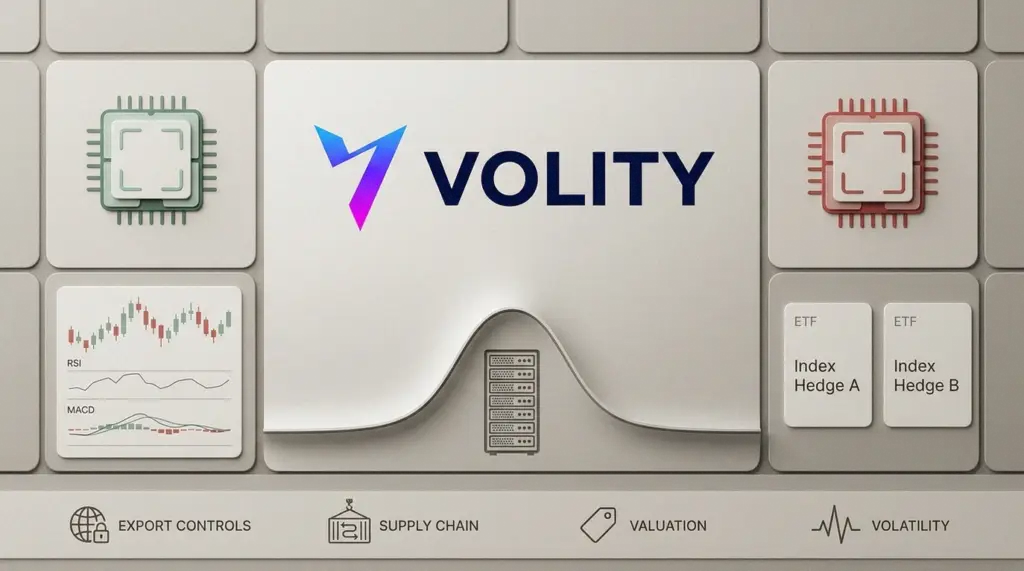
Technicians will note the simpler point: momentum has not broken. The MACD signal still reads constructive, and the RSI has cooled to about 52, which often tempts buyers back in.
Price targets have turned into their own side show. Consensus sits near $256, implying roughly 39% upside from recent levels.
However, the moat story invites bigger numbers. Wedbush flags $275, while Evercore ISI sketches out $352, a near double from here.
D.A. Davidson stays at Buy with a $250 target, and it frames 2026 as an “inflection year” for the next buildout cycle.
The argument is not just that Nvidia is winning, but that the addressable market is still expanding.
AMD, meanwhile, has done the most important thing for a challenger: it has turned promise into data centre dollars. Fourth quarter revenue reached $10.3 billion, up 34% year on year, and it beat forecasts. More importantly, data centre revenue hit a record $5.4 billion, up 39%, driven by EPYC CPUs and Instinct GPUs. CEO Lisa Su has called 2025 “defining”, and she has pushed the idea that 2026 could bring faster momentum, with a 35% plus revenue CAGR and data centre growth above 60%.
Guidance kept the pedal down. AMD pointed to about $9.8 billion for Q1, which implies 32% year on year growth.
The market has treated the name less like a cyclical and more like a second AI platform. Wall Street’s grid reflects that shift.
About 34 analysts rate it a Buy, the average target sits near $289, and the high end reaches $380. Shares trade near $216 after a volatile run, and they have roughly doubled in two years.
Broader semis have ridden the wake. Broadcom stays tied to the same AI capex narrative, while Intel still tries to convince investors it can reclaim relevance at scale.
However, the marginal buyer has cared more about revision trends than turnarounds. Nvidia’s 2026 EPS expectations have moved up toward $4.66, and its momentum scoring has remained supportive.
The rally has felt less like hope, and more like spreadsheets being rewritten in real time.
Outside chips, the risk-on tone has also lifted odd bedfellows. Airlines and travel names have seen bursts of volume as traders pair cyclical exposure with tech breadth. Meanwhile, broad index vehicles like SPY and QQQ have acted as the grease, letting investors express “AI plus growth” without picking every winner. Financial results from BLK and GS have also helped the mood, because strong fee lines and trading desks signal healthy market plumbing.
By the numbers
- NVDA revenue: $57 billion, up 62.5% year on year.
- NVDA EPS: $1.30, up 60.5% year on year.
- NVDA position: down 15.5% from October highs, up 36.8% year to date.
- AMD Q4 revenue: $10.3 billion, up 34% year on year.
- AMD data centre: $5.4 billion, up 39% year on year.
Valuation and policy remain the two tripwires. Nvidia trades around 41 times forward earnings, which looks gentler than its own history but still demands flawless execution.
However, geopolitics can still hit the group through export rules and supply chains. AMD also has softer spots in consoles, even if AI offsets them.
The cleanest read is behavioural: both stocks now sell off on “cycle” fears, then rebound on “demand” evidence.
Key takeaways
- Buy-the-dip setups: NVDA and AMD have become liquidity magnets on pullbacks, especially with RSI cooling and revisions rising.
- Watch guidance more than beats: the next leg depends on 2026 visibility, not last quarter’s fireworks.
- Track data centre mix: AMD’s credibility rides on sustained server and accelerator growth, not PC noise.
- Use index hedges: SPY or QQQ can damp single-name shocks when the sector trades as one risk factor.
- Respect headline risk: export controls and supply constraints can move these names faster than fundamentals for a day or two.
For more on this topic see our deep-dives on QQQ Momentum and Tech: How Gold and Bitcoin Shape Risk Sentiment, Sector Rotation Trades: Reading Tech vs Energy Moves Like a Pro, and AI Stocks Rally as Oil Surges: Where Traders Are Looking Now.
What our analysts watch: Three readings frame any AI chip view from the Volity desk. Forward EPS revision velocity (the rolling four-week change in 2026 consensus) tells us whether the buy-side is upgrading faster or slower than price.
Hyperscaler capex guidance from Microsoft, Meta, Alphabet, and Amazon together sets the addressable market. AMD data-centre revenue mix as a share of total (above 50 percent confirms the platform-credibility upgrade is sticking) shows whether the second-source thesis is monetising.
When all three rotate the same way, the chip pair trades as a single risk factor rather than two stocks.
Frequently asked questions
What is the cleanest leading indicator for the next NVDA leg?
Hyperscaler capex revisions, not Nvidia’s own quarterly print. Nvidia’s revenue follows the combined budgets of fewer than ten buyers, so a one to two percent change in their planned capex can move Nvidia ten to twenty percent. The SEC EDGAR filings database hosts the quarterly capex disclosures from the major buyers.
How does AMD avoid being treated as just a Nvidia substitute?
By delivering on the data-centre revenue mix narrative quarter after quarter. As long as data-centre revenue grows above 35 percent year on year and Instinct GPU shipments scale, the market treats AMD as a second AI platform. A miss on either dimension reverts the stock to the cyclical-chip multiple. The Investopedia data-centre reference covers the broader unit economics.
Are export controls a real risk for both names?
Yes, in different ways. Nvidia faces direct revenue exposure in China-bound data-centre GPUs, where each export-control update changes the addressable market. AMD has thinner China data-centre exposure today, but is more exposed to consumer console weakness, a separate cyclical risk. The BIS publishes research on semiconductor cycles and trade-policy transmission.
How should investors hedge a single-stock AI chip position?
The simplest hedge is a partial offset using SPY or QQQ index puts sized to the position beta, which dampens single-name shocks without wholly giving up the upside. Pair trades (long AMD, short a weaker semi) work for sophisticated traders but require active management. The CBOE publishes options education and volatility data useful for hedge sizing.
Related guides
- Best AI stocks to invest in
- Stocks investing for beginners
- Best stock trading platforms in Europe
- Best trading platforms
- Risk management
Volity operates a trading platform and also publishes educational and analytical content about trading. The content on this page is for educational purposes only and should not be considered financial advice. Volity may benefit commercially when readers open trading accounts through links on this site.
Our content is produced and reviewed under documented editorial standards; see our comparison and review methodology.