Investing in financial products involves risk. Losses may exceed the value of your original investment.
Oil shock trading is a core topic for traders in 2026. The complete guide follows.
Oil back at three digits as Hormuz risk returns to the screen
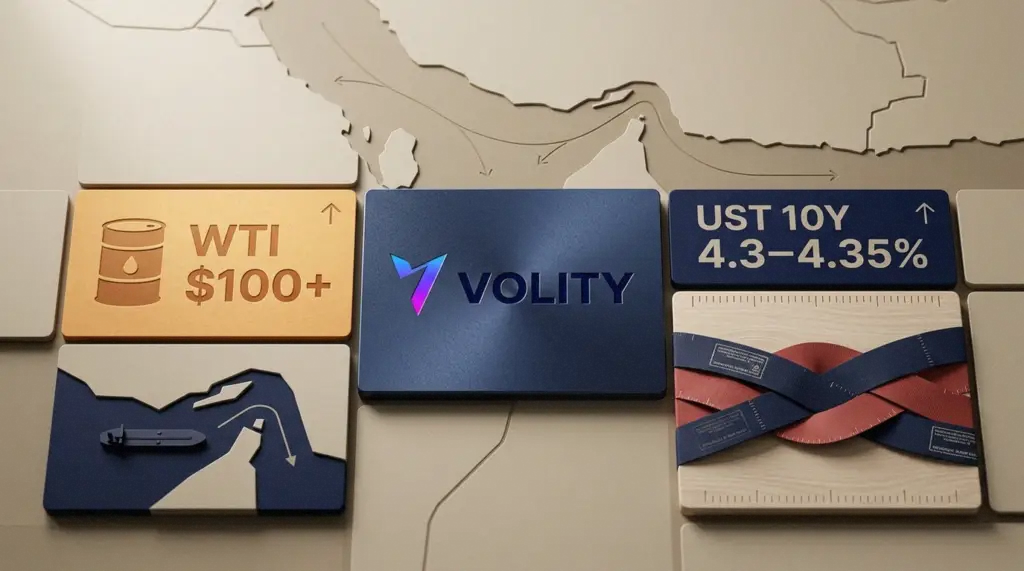
Oil traders woke up to a number they had hoped stayed in 2023. WTI punched through $100 a barrel on Monday, printing $104.41, up 8.11% on the day. Meanwhile, the move leaves crude 11.66% higher over the past month and nearly 70% above year ago levels.
The catalyst is not complicated. Military action in the Middle East has cast fresh doubt over shipments through the Strait of Hormuz, the narrow choke point that turns a regional crisis into a global energy problem. The market has started paying for delay, rerouting and outright disruption again, not in theory but in price.
Brent has kept pace. It averaged about $103 a barrel in March, and traders now talk easily about $110 to $115 this quarter if flows stay impaired.
However, the rally has also shown how jumpy the tape is. Comments from Iran’s president about being ready to end the war under certain conditions knocked crude off intraday highs near $107.
Yet the pullback looked more like profit taking than relief.
Across benchmarks, the pressure looks broad rather than quirky. WTI Midland sat around $100.56, suggesting inland US barrels have tightened too. Meanwhile, the OPEC basket traded near $107.29, a reminder that the premium is not confined to one grade.
Bond yields climb, and equities feel the squeeze
As oil reprices, rates traders have followed with their own blunt maths. The US 10-year Treasury yield has hovered around 4.29% to 4.35% this week, close to the highest levels since mid 2025. Anything priced off long duration cash flows has looked a bit more fragile.
Some forecasters now point to 4.44% by quarter end, which would keep financial conditions tight even if the Federal Reserve sits still. Meanwhile, the higher yield backdrop makes the “safety bid” in bonds look crowded rather than comforting, because inflation risk sits inside the hedge.
Equities do not need a recession scare to wobble when both oil and yields jump. Growth stocks tend to suffer first, and consumers tend to follow. The market has started to reprice second order effects, from airline fuel bills to delivery fleets to household confidence.
Tesla, which fell 5.5% on April 7 after weak deliveries, sits in that awkward cross current. Higher petrol prices can help the EV story at the margin. However, higher funding costs and shakier discretionary spending usually do not.
Trading desks shift focus from forecasts to flows
The new question is less “where is fair value” and more “where is the forced buying”. Energy producers and oil service names tend to attract momentum money in this setup. Meanwhile, airlines, chemicals and consumer cyclicals often become the funding leg.
Options markets are likely to stay bid. Traders who lived through 2022 will recognise the pattern. Volatility rises because headlines arrive at odd hours, and because liquidity thins when everyone wants the same hedge. Position sizing matters more than conviction.
By the numbers
- WTI: $104.41 a barrel, +8.11% on the day
- WTI 1-month: +11.66%
- WTI year on year: +69.68%
- WTI Midland: about $100.56
- US 10-year yield: roughly 4.29% to 4.35%
What could break the move
Relief still has a clear route. If shipping lanes normalise and tanker queues clear, the war premium can evaporate quickly. Traders are watching not just statements but observable logistics, including AIS signals, insurance rates and gulf loading schedules.
However, the risk cuts the other way too. If outages persist, $100 oil becomes a floor rather than a spike, and central banks regain a problem they did not want in 2026. Meanwhile, equities could struggle to hold rallies when margins get squeezed from both sides.
Key takeaways
- Oil has reintroduced a geopolitical premium that can widen and vanish fast, so avoid oversized directional bets.
- Higher yields plus higher energy prices usually punish long duration equities first, then cyclicals.
- Watch physical signals, not just rhetoric, because pipelines and tankers move prices more than speeches.
- Options hedges may stay expensive, yet they can still beat stop losses in gap risk conditions.
- Sector rotation often becomes the cleaner trade than index direction when macro shocks overlap.
For more on this topic see our deep-dives on UEC Stock Outlook: Debt-Free Uranium Play vs Pricey TEM Peers, BATL, DXYZ and SpaceX Buzz: Trading Thin Floats and Oil Volatility, and Dell AI Orders and Backlog: How Hardware Drives the AI Trade.
What our analysts watch: Three readings filter signal from headline risk. Brent-WTI spread tells us whether the move is genuine supply shock (Brent leads, spread widens) or speculative position-driven (WTI leads).
Tanker freight rates (VLCC and Aframax day rates) reveal whether routing constraints are binding now or only being priced. Energy sector earnings revisions show how fast sell-side models are catching up.
When all three confirm a structural shift, longs in upstream energy and tanker equities historically extend rather than reverse, while broad indices recover only after the inflation reading rolls over.
Frequently asked questions
Why does the Strait of Hormuz matter for oil prices?
Approximately 20% of global oil supply transits the Strait of Hormuz, including the bulk of Saudi, UAE, Kuwaiti, and Qatari exports. Any credible threat to transit forces shipowners to reroute or pause, which compresses available tanker capacity and pushes spot prices higher even before a single barrel is actually disrupted. The U.S. Energy Information Administration (EIA) publishes the canonical transit data that desks reference during crises.
Which equities benefit most from an oil spike?
Three categories tend to lead. Upstream pure-play producers see direct earnings leverage.
Integrated supermajors capture trading and refining margin alongside upstream profit. Tanker equities (Frontline, Euronav, DHT) re-rate as freight day rates climb.
The duration of the trade depends on how long the spread stays elevated. Investopedia covers the sector mechanics in depth.
How does an oil shock affect rates and equities broadly?
Higher oil feeds headline inflation, which delays expected rate cuts and lifts real yields. Rate-sensitive growth equities (long-duration tech, consumer discretionary) typically de-rate first.
Defensives, energy, and certain commodity-linked currencies (CAD, NOK) outperform. The U.S.Federal Reserve publishes the rate-path framework that drives the discount-rate side of this equation.
How should retail traders manage cross-asset oil exposure?
Use a CySEC-regulated venue with transparent execution to access oil futures CFDs alongside energy equities and FX, position-size each leg independently rather than treating the basket as a single trade, and avoid leveraged ETPs that decay during volatile periods. Volity research desks build cross-asset baskets for clients.
Related guides
- Foreign exchange market explained
- Indices trading platforms
- Best forex trading strategies
- Risk management
- Best trading platforms
Volity operates a trading platform and also publishes educational and analytical content about trading. The content on this page is for educational purposes only and should not be considered financial advice. Volity may benefit commercially when readers open trading accounts through links on this site.
Our content is produced and reviewed under documented editorial standards; see our comparison and review methodology.