Investing in financial products involves risk. Losses may exceed the value of your original investment.
Bitcoin price drop is a core topic for traders in 2026. The complete guide follows.
Crypto tumble shakes traders as bitcoin slips $3,000 from the peak
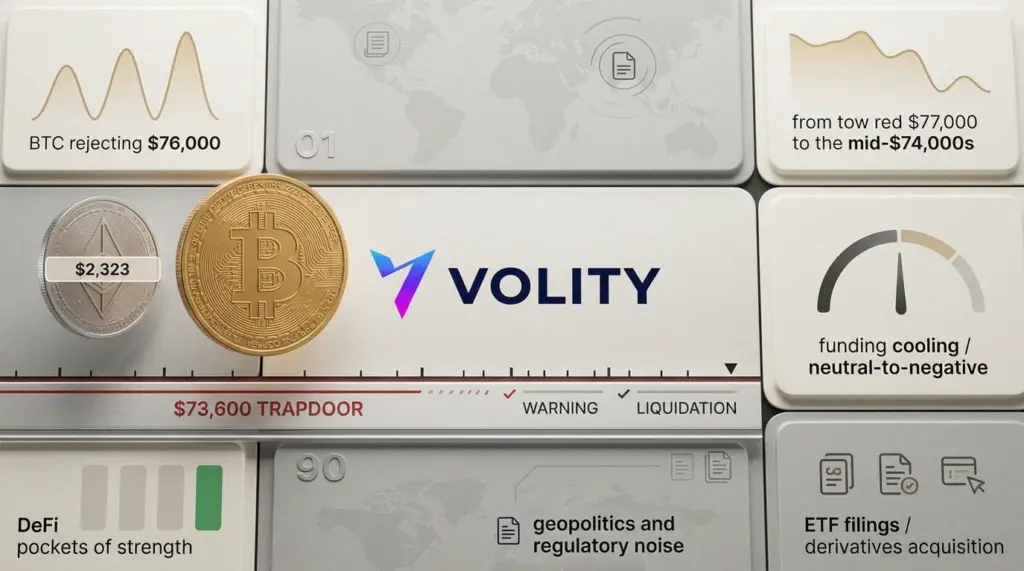
Bitcoin’s weekend wobble arrived the usual way, with a hard shove lower after leverage got too comfortable. BTC briefly pierced $77,000 late Friday, then slid back through the mid $74,000s on Sunday as perpetual funding eased and long liquidations crept up. Meanwhile, liquidation heatmaps cluster around $73,600, a level traders now describe as the trapdoor. If that floor goes, forced selling can do the rest.
Sunday’s price action also carried a familiar tell. Bitcoin failed again to hold above $76,000, its third rejection in roughly two months. However, unlike some prior pullbacks, funding rates in some venues stayed soft to negative, which bulls read as less froth. The market ended up split between “healthy reset” and “start of something uglier”.
Market snapshot: red across the board
Risk faded across large caps as BTC drifted lower. Ethereum sat in a more fragile spot because the next meaningful liquidation pocket sits near $2,323, where roughly $1.04 billion of long exposure is at risk on common estimates. Meanwhile, several large alts nursed deeper percentage losses, even as single names still popped on idiosyncratic news.
- BTC retreated about $3,000 from Friday’s peak, with $73,600 now the level to watch.
- ETH faced a key liquidation zone near $2,323, with long exposure concentrated below.
- Morpho jumped about 12% in a DeFi-led bounce, even as other new tokens saw sharp reversals.
- Polymarket pricing implied slightly better-than-even odds of a lower close versus yesterday’s noon ET level.
Geopolitics also stayed in the background as a volatility excuse. Traders pointed to changing headlines around Hormuz and oil flows, then used them to justify de-risking. However, the tape looked more like positioning than panic. The tell was the way bids appeared on dips, then stepped away the moment BTC tried to reclaim $76,000.
Strategy and deal chatter return to the surface
As bitcoin cooled, the usual second-order trade came back into focus. MicroStrategy, which markets itself as Strategy, again drew criticism for its playbook of funding bitcoin exposure through capital markets. Peter Schiff called the approach reckless, while dip buyers argued that the structure only matters when volatility spikes. Meanwhile, the stock’s recent surge, tied to BTC’s move through the 100-day moving average, left it vulnerable to a fast giveback if bitcoin breaks down.
Elsewhere, deal talk added colour. Alcoa’s New York smelter site reportedly moved closer to a sale to NYDIG, the crypto firm with a taste for infrastructure. If it closes, it will read as a small but telling sign of how mining and data-centre demand keep colliding with old industrial footprints.
Regulatory thaw and Wall Street’s next product rush
Washington’s tone remains fluid. Lower visible SEC enforcement fed a fresh spat between Senator Elizabeth Warren and chairman Paul Atkins, while the agency’s own messaging hinted at a softer stance under the current leadership group. However, traders care less about speeches and more about what gets approved, what gets delayed, and what gets sued.
Attention shifted to the product pipeline. Goldman Sachs filed for a Bitcoin Premium Income ETF, another attempt to bottle yield and sell it with a ticker. Meanwhile, Payward, the parent of Kraken, agreed to buy Bitnomial for $550 million, a move aimed at US-regulated crypto derivatives. If the plumbing gets friendlier, volume follows, and spreads tighten.
Prediction markets also kept creeping into the mainstream conversation. Citadel and Charles Schwab have shown interest in expansion, while Polymarket’s steady drip of volume gives brokers a reason to ask if they should offer similar rails. However, the risk is obvious. These markets can turn into leverage in a trench coat, especially when retail piles into simple up-or-down bets.
Security scares and “tech” headlines that still move prices
Security remained the market’s recurring tax. A reported Kelp exploit, estimated at $293 million, rippled through DeFi venues and reminded traders that smart contract risk is not theoretical. Meanwhile, World ID pushed another identity upgrade, selling “proof of human” as the next layer for online services. Quantum fear also resurfaced, although Adam Back dismissed the idea of a near-term threat to bitcoin’s cryptography.
Finally, the regulator’s own resilience became part of the story. The CFTC chair said AI tools are filling roughly a quarter of staff cuts, which sounds efficient until the next market dislocation tests whether automation can replace human judgement.
Key takeaways
- Watch $73,600 in BTC. A clean hold supports dip bids, while a break risks liquidation-driven momentum.
- ETH traders should map exposure around $2,323, because forced selling accelerates fastest near clustered leverage.
- Product headlines matter again. ETF filings and US-derivatives deals can change flows even on quiet weekends.
- DeFi remains headline-sensitive. Exploit risk can overwhelm fundamentals in a single session.
For now, the market is not pricing a grand collapse. It is pricing a reminder. Bitcoin rallies hardest when leverage stays disciplined, then it punishes traders when it doesn’t. Bulls can still talk about $125,000, but first they need to keep the trapdoor shut.
For more on this topic see our deep-dives on Bitcoin, Solana and Meme Coins: Reading Crypto Rotation, Bitcoin, the Yen Carry Trade and Tariffs: How Macro Shocks Move BTC, and Bitcoin Price Crashes Explained: BTC Volatility and What Traders Watch.
What our analysts watch, by Volity Editorial: Three reads define this kind of drawdown. Funding rates show whether longs are still leaning or have already paid for the move.
Liquidation cluster maps tell us where forced selling can compound, with $73,600 the obvious shelf today. And spot ETF flows over the next two sessions reveal whether passive allocators are buying the dip or stepping back.
The combination either rebuilds the floor or removes it.
Frequently asked questions
What is a trapdoor level in Bitcoin trading?
A trapdoor is a price shelf where stop-loss and liquidation orders cluster densely enough that a clean break triggers cascading forced selling. $73,600 here qualifies because long exposure built up between $74,000 and $77,000. Once the floor goes, the next material bid can sit several percent lower. The CoinDesk derivatives coverage tracks open interest and funding to flag these setups in advance.
How do funding rates predict Bitcoin moves?
Perpetual funding is the periodic payment between long and short holders that keeps perp prices anchored to spot. Persistently positive funding means longs are paying, which signals crowded bullish positioning and increases squeeze risk. Soft to negative funding during a drawdown can mean shorts are paying enough to fund a contrarian bounce. The Bank for International Settlements has published research on crypto derivatives leverage cycles.
Should I buy Bitcoin dips like this one?
Dip-buying works only with rules. Define the invalidation level (here, a daily close below $73,600), size the entry to survive a further leg lower, and avoid averaging down without a fresh signal. Spot allocations behave differently from leveraged positions, where margin maths can force exits at the worst moment. The Investopedia guide on dollar-cost averaging covers the long-only version for portfolio accounts.
What does the MicroStrategy criticism mean for BTC holders?
MicroStrategy (now branded Strategy) funds Bitcoin purchases through capital markets, which amplifies both upside and downside. Critics like Peter Schiff highlight the structural fragility if BTC drops sharply; defenders point to the firm holding through prior 70% drawdowns. For most BTC holders, the takeaway is that Strategy is a leveraged proxy, not a Bitcoin equivalent. At Volity, regulated by CySEC under licence 186/12 via UBK Markets, we treat such proxies as separate exposure with their own risk budget.
Related guides
Volity operates a trading platform and also publishes educational and analytical content about trading. The content on this page is for educational purposes only and should not be considered financial advice. Volity may benefit commercially when readers open trading accounts through links on this site.
Our content is produced and reviewed under documented editorial standards; see our comparison and review methodology.